Rhodonite: Healing What Love Broke
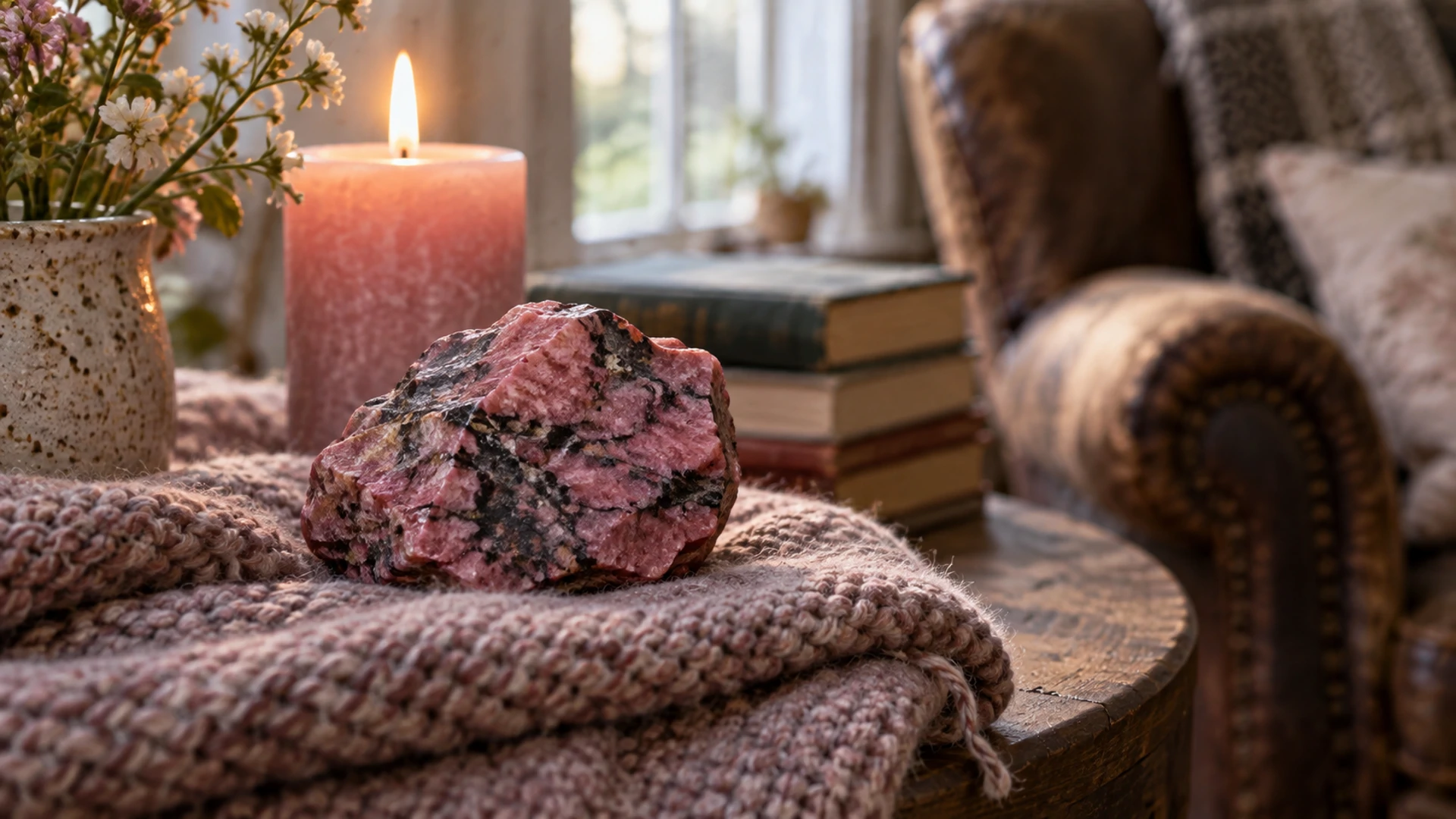
Rhodonite is a manganese silicate mineral from the pink-to-red family, distinguished by its signature black manganese-oxide veining — and in metaphysical practice, it belongs to the Love & Relationships category not because it attracts love, but because it does the repair work that makes love possible again after it's gone wrong.
Healing What Love Broke: Why Rhodonite Belongs in Love & Relationships
The question worth answering first is why Rhodonite sits in Love & Relationships at all, since it doesn't do what most people expect a love stone to do. It doesn't draw in a new relationship. It doesn't soften the heart toward someone new. What it does is address the thing that blocks all of that: the unprocessed wound from the relationship that ended badly, the person who hurt you, the grief you haven't fully moved through, the resentment that's hardened into something else entirely.
Rhodonite's mechanism is healing and forgiveness after relational wounds. That's a specific job, and it's genuinely distinct from what the other stones in this category do. Rose quartz works with universal, unconditional love — it's the foundational stone for every form of love, not aimed at one particular injury. Chrysoprase is for joyful new beginnings after heartbreak — optimism and heart-reopening, the readiness to step into something new. Rhodonite comes before Chrysoprase. It's the work you do before you're ready for a fresh start. You don't rebuild well on top of unaddressed grief, and Rhodonite knows that.
Its primary chakra is the heart — which you'd expect. But Rhodonite also has a real connection to the root chakra, and that secondary grounding anchor is part of what makes it useful rather than just meaningful. Grief and betrayal are destabilizing. They can pull someone into a loop of revisiting the wound without ever processing it, or into emotional overwhelm that doesn't move anywhere. The root chakra connection keeps the emotional work from becoming untethered. You feel what needs to be felt, but you stay functional while you do it. That's a specific kind of support, and it's part of why the stone shows up so consistently in forgiveness work rather than in more expansive, visionary heart practices.
The visual symbolism is genuinely useful to understand here, because it's not incidental. Rhodonite's pink-to-red body carries compassion and tenderness — the love that still exists even in the aftermath of a wound, because most relational pain comes precisely from having cared. The black manganese-oxide veining through that pink is the strength and grounded honesty required to actually face the wound rather than smooth over it. Those two things together are the stone's whole point. The black isn't a flaw in an otherwise pretty pink stone. It's the other half of the mechanism. Mars governs this stone in some traditions — a planet associated with direct, sometimes uncomfortable honesty and decisive action — and that fits. Forgiveness isn't passive. It takes a specific kind of will.
Rhodonite's zodiac and planetary correspondence is genuinely unsettled across sources. One tradition assigns it to Taurus, tying the stone to Venus and the earth element, in keeping with Taurus's themes of recognizing real value and enduring what release requires. A separate tradition assigns it to Scorpio instead, with Mars as ruling planet and water as its element, reflecting Scorpio's territory of depth work and transformation through buried emotional material. Some sources go further and say there's no firmly settled zodiac assignment for Rhodonite at all. Taurus/Venus/earth and Scorpio/Mars/water are two distinct, internally consistent pairings rather than a single mixed correspondence.
Not Rhodochrosite: Choosing Rhodonite
The most common confusion in purchasing Rhodonite is mistaking it for Rhodochrosite, and it's worth being specific about the difference because the two are genuinely not interchangeable. Both are pink manganese minerals. Both appear in the emotional-healing and love-stone space. But they're physically different and they're worked with for different things.
Rhodochrosite sits at Mohs 3.5 to 4 on the hardness scale — considerably softer. It typically shows a brighter, more saturated pink, often in visible concentric or parallel banding, and it doesn't carry the black veining that makes Rhodonite visually distinctive. Rhodonite is harder, generally running from Mohs 5.5 to 6.5, and its color tends toward a deeper, more grounded pink or rose-red with the characteristic black manganese-oxide veins running through it. If you're looking at a piece and it has bright banding but no dark veins, it's most likely Rhodochrosite. If it has dark veins cutting through a deeper pink body, it's Rhodonite.
Their practical applications also diverge. Rhodochrosite tends to be worked with for self-love and inner-child themes — reaching back toward younger, more tender parts of the self that need care. Rhodonite leans specifically toward forgiveness and grounded healing of relational wounds in the present or recent past. They're related in spirit but doing genuinely different jobs, and using one when you mean the other can leave you feeling like the work isn't landing. Knowing which stone you have matters.
When selecting a piece for active practice, the black veining isn't something to avoid — it's something to look for. A piece with prominent veining alongside a good depth of pink color is giving you both aspects of the stone's nature in one place. Tumbled pieces work well for carrying in a pocket or holding during meditation. Raw or rough pieces can be placed on an altar or in a grid. Cabochon-cut pieces set in jewelry are a practical option if you want to wear it through a difficult period.
On care: Rhodonite is reasonably durable at its hardness range, but it doesn't love prolonged water exposure or salt water, both of which can dull its polish over time. Salt baths and extended soaking aren't the right cleansing methods for this stone. A soft dry cloth is the safest routine care. For energetic cleansing, sound (a singing bowl, a bell) or moonlight work well without any physical contact with water at all. Keep it away from hard impact too — at Mohs 5.5 to 6.5, it's not fragile, but a hard knock can still chip a polished piece.
Three Practices for What Needs Forgiving
The Named Wound
This practice is for when a relational hurt has settled into something vague and chronic — present enough to affect how you feel, but never quite examined directly enough to move through.
Sit with your Rhodonite held in both hands or placed over your heart. Light a pink candle if you have one — pink for the heart register, the tenderness alongside the difficulty. Speak the wound aloud in one plain sentence: not the story around it, not all the context, just the specific thing that hurt. "You left without explanation." "I was betrayed by someone I trusted completely." "I lost the version of this relationship I thought I had." Let it be that simple. Holding the stone while you name the thing gives the hurt somewhere to land outside of your body — not to disappear, but to be seen, which is always the first step before it can move. Sit with whatever arises for a few minutes, then set the stone down deliberately and breathe. The naming itself is the work here, not what comes after.
The Forgiveness Given
This practice is for extending forgiveness toward another person — not as a statement that what happened was acceptable, and not as a reopening of contact or relationship, but as a release of what you've been carrying on their behalf.
Write the person's name on a small piece of paper and place it face-down under your Rhodonite. If you work with candles in harmony or release work, a blue or white candle nearby reinforces the intention without pulling toward heat or urgency. Hold both hands over the stone without picking it up. Say plainly — again, aloud, since speaking it matters — "I release what I've been holding for you. This is not mine to carry anymore." You don't need to feel the forgiveness in the moment you say it. The practice creates the container; the feeling tends to follow over time rather than all at once. Leave the paper under the stone until it feels complete — a day, a week, however long — then fold it away or burn it if fire feels like the right close.
The Self Forgiven
This practice addresses one of the harder pieces of relational healing: forgiving your own role in how something broke, which is distinct from forgiving someone else and often takes longer.
Hold the Rhodonite over your heart chakra while lying down. Rose as an herb or incense works well alongside this practice — it keeps the register compassionate rather than punishing. Take a few slow breaths and, without going into the full story, name the one specific thing you're holding against yourself: a choice, a silence, a word, an action. Then say this, again aloud: "I did what I knew how to do then. I know more now. I forgive myself for the gap between those two." The Rhodonite in your hands is there to make the words feel less abstract — the stone's weight and texture give your body something to focus on while your mind does the harder work. If this brings up grief, let it. That's the root chakra's role here: it keeps you steady enough to feel what's real without losing the ground beneath you.
Discovered in the Urals, Kept by Czars
Rhodonite's documented history has one strong, specific anchor worth knowing: it was first discovered in the Ural Mountains of Russia in the 1790s, and it quickly became a significant material in Russian decorative arts and aristocratic culture. Russian czars valued it highly, and it was traditionally given as a wedding present among Russian royalty — a piece of genuine history that connects the stone to partnership, commitment, and the formal marking of a relationship's beginning, even if the working was more symbolic than metaphysical in its original context.
Russian craftsmen used Rhodonite extensively in ornamental objects, large decorative vases, columns, and inlaid work — the kind of scale that reflected both the material's visual impact and the value placed on it. The stone's combination of deep pink color and bold black veining made it particularly suited to decorative carving. Some of the finest historic specimens remain in Russian museum collections. The Ural Mountains continue to be one of the most significant sources of quality Rhodonite today, alongside Sweden, Australia, and the United States — and Rhodonite holds the status of Russia's national gemstone, which is a direct continuation of that centuries-old association.
The modern nickname "rescue stone" is a separate matter entirely. It comes from consistent practitioner observation over recent decades — the pattern of Rhodonite appearing useful in exactly the situations where emotional healing from relational damage is needed most. It's not derived from the Russian discovery or the czarist tradition, and the two shouldn't be folded into a single continuous story. One is material and decorative history; the other is contemporary metaphysical shorthand. Both are real descriptions of the stone, but they come from different times and different frameworks.
Love, Repaired Before It's Rebuilt
Rhodonite's place in the Love & Relationships category isn't about being the most romantic stone in the group. It's about being the most necessary one for a specific moment: the one where the heart is still holding something that needs to be processed before anything new can actually land. Repair work isn't a lesser version of love work. It's often the harder version — and it's what makes the rebuilding real rather than just hopeful.
If you want to see how Rhodonite fits alongside the other Love & Relationships stones and the six other stone paths — protection, cleansing, healing, empowerment, abundance, and intuition — The Crystal Compendium: Seven Paths to Stone Magic is the place to start.