Purple Candle Magic: The Color of Earned Authority
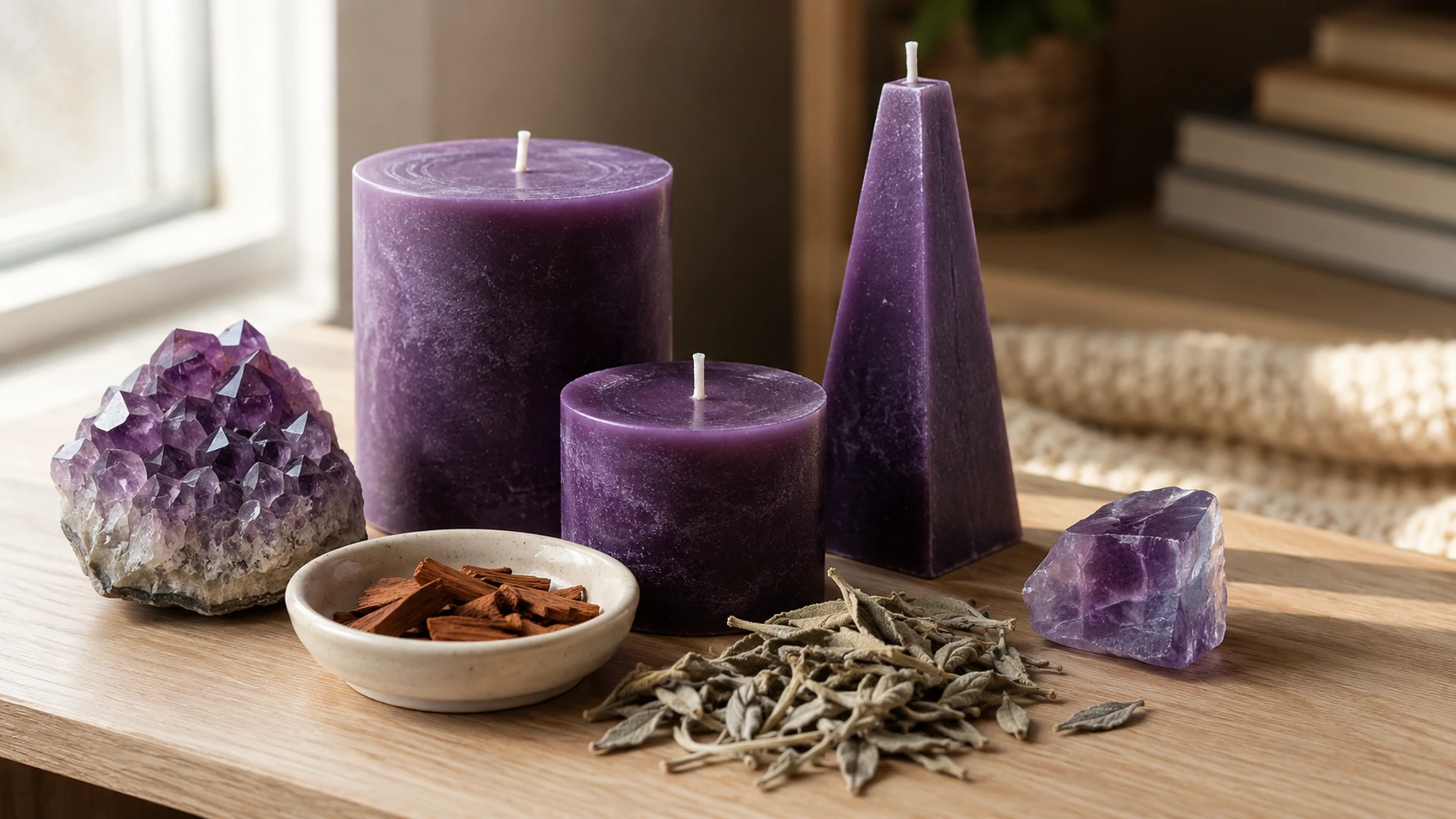
Purple has always signaled access. In the ancient world it marked who could walk into the room where real decisions were made — emperors, high priests, those the divine had singled out. In candle magic, that signal hasn't changed. A purple candle sits at the threshold between ordinary awareness and something deeper: psychic sight, wisdom that accumulates over time, and the kind of spiritual standing that comes from actual inner work rather than a title or a claim. This is the color for practitioners who are building something real in their practice, and it will meet you wherever you are in that process.
Access, Not Just Color
A Dye Worth More Than Gold
The specific purple used in ancient Phoenicia — Tyrian purple, extracted from the murex sea snail — required thousands of crushed shells to produce a single ounce of dye. The process was labor-intensive, foul-smelling, and wildly expensive. Roman emperors reserved it for themselves by law. Byzantine rulers were called porphyrogennetos, "born in the purple," because the imperial birthing chamber was lined with porphyry stone. The color didn't just indicate wealth; it indicated a category of person who had access to power and divine favor that most people never touched.
This matters for the magic because the symbolism was never arbitrary. Purple in ritual contexts carried the same weight it carried in the throne room: you were operating in a register most people couldn't reach. When you light a purple candle, you're working in that same energetic language — not claiming royalty, but claiming access to realms of perception and knowledge that require effort and intention to enter.
The Third Eye and Psychic Perception
The Third Eye chakra, called Ajna in Sanskrit, sits between and just above the eyebrows and governs inner vision — the faculty of perceiving what isn't visible to the physical eye. Purple is its color, and lighting a purple candle is essentially an act of tuning. You're shifting your attention toward a different mode of reception: intuitive knowing, pattern recognition that bypasses linear reasoning, the kind of clarity that shows up in divination, meditation, and deep spiritual inquiry.
This isn't mystical decoration. Directing attention matters in any focused working, and purple's correspondence to the Third Eye gives you a reliable, historically consistent way to signal to yourself — and to whatever currents you're working with — that you're operating in psychic rather than mundane mode.
Spiritual Authority as Mastery of Self
Purple's authority isn't about power over other people. It has nothing to do with hierarchy, dominance, or impressing anyone. The authority purple carries is the kind that develops when you've done consistent inner work: deepening your practice, expanding your magical skill, learning to trust your own perception. That's earned standing, not claimed status.
This distinction is worth being explicit about because it shapes how you use the color. Purple workings are most potent when they're oriented inward — toward your own development, your own capacity, your own relationship with spirit. The more you bring that focus, the more the color delivers.
Purple Across Ritual Traditions
Catholic bishops wear purple during Advent and Lent, periods of preparation and penitence that sit at the edge of sacred time. Tibetan Buddhist ceremonial robes use deep purple for monks holding specific teaching offices. In Umbanda, purple marks altars dedicated to Exú Rei and certain Orixá workings that involve spiritual authority and crossroads between worlds. These traditions have nothing to do with each other historically, yet they all landed on the same color for the same conceptual purpose: purple marks the threshold between the human and the divine, the ordinary and the sacred. That convergence doesn't happen by accident.
Purple's Correspondence Profile
Purple's correspondences are rooted in Jupiter's expansive spiritual authority, the fifth element of pure Spirit, and the psychic perception of the Third Eye. Here's the full correspondence profile at a glance:
- Planet: Jupiter
- Element: Spirit (Ether/Akasha)
- Gender: Masculine
- Deities: Hecate, Jupiter, Odin, Iris, Hermes Trismegistus
- Magical properties: Psychic development, spiritual authority, wisdom and higher knowledge, divination, ancestral connection, personal power
- Associated crystals: Amethyst, labradorite, lapis lazuli, purple fluorite
- Chakra: Third Eye (Ajna)
Jupiter as Ruling Planet
Jupiter governs expansion, higher learning, and the kind of authority that comes from genuine wisdom. This isn't Mercury's quick-moving information transfer or Mars's driven, forceful energy. Jupiter's growth is slow, cumulative, and deep — the prosperity of someone who has mastered their field rather than someone who has hustled their way to a quick win.
Purple is Jupiter pursued directly and alone, without the softening lunar current that blue candle magic carries alongside it. Blue holds Jupiter's wisdom in one hand and the Moon's intuitive, feeling quality in the other. Purple drops the emotional softness and goes straight for the commanding register of Jovian authority — higher knowledge, spiritual mastery, the capacity to perceive and operate at levels most practitioners are still developing toward. Thursday is Jupiter's traditional day, and timing purple workings during a Jupiter hour amplifies the current considerably.
Spirit (Ether/Akasha) as the Element
The fifth element — called Aether, Akasha, or Spirit depending on the tradition — sits above and within the four physical elements of Earth, Water, Fire, and Air. It's pure consciousness, the animating force behind everything that exists. Working with purple means working at that level: the magic of mind and soul rather than the material and tangible.
In practice, this means purple workings tend to be more effective when your intent is clearly focused inward — on perception, understanding, or spiritual development — rather than on producing a specific external result. The color operates in the realm of awareness. Give it work that matches that.
The Third Eye Chakra
Purple's Ajna correspondence anchors the whole profile. Everything this color does — psychic development, higher knowledge, divination, spiritual authority — flows through the faculty of inner vision. That's the mechanism, and it's why purple works as well for meditation and scrying as it does for ancestor contact and deep study. The common thread is perception beyond the ordinary senses. Indigo does the work of receiving that perception from below; purple takes what indigo brings up and carries it into commanding, articulated authority.
The Deities
Each deity in purple's profile represents a specific facet of earned spiritual authority, and each one shows up here for reasons distinct from how they appear in other colors' profiles.
Hecate carries the deep magical knowing that comes from having walked every path: her knowledge is encyclopedic, accumulated through total mastery of the craft rather than through any single gift or shortcut. Jupiter the god brings the king-of-the-gods register — expansive, commanding authority rooted in cosmic order, not personal ambition. Odin here is specifically the wisdom-seeker who hung on Yggdrasil for nine days and sacrificed an eye to drink from Mimir's well: his runic knowledge was earned through genuine sacrifice, and that's what he represents in purple's current — structured spiritual authority made real through cost and discipline. Iris is the messenger who physically bridges the divine and human realms, carrying word between worlds — here she represents the access that purple embodies, the capacity to move between levels of reality. Hermes Trismegistus is the archetype of the sacred teacher, the one who holds the keys to hidden knowledge and transmits it to those who have prepared themselves to receive it. He's distinct from Hermes as straightforward messenger; Hermes Trismegistus is about the transmission of wisdom itself.
The Crystals
Each of purple's four associated crystals does something specific and different.
Amethyst is the most direct ally for purple candle work: it combines psychic protection with intuitive development, creating a field where inner vision can open without picking up interference. Place it at the base of a purple candle during any divination or meditation working and notice the quality of the clarity it supports. Labradorite is particularly useful here for its aura-shielding quality — during deep spiritual work where you're genuinely opening your perception, labradorite maintains the integrity of your energy field so what comes in is signal rather than static. Lapis lazuli shows up in mystery school traditions across Egypt, Mesopotamia, and medieval Europe; the specific wisdom it carries is ancestral and lineage-based, drawn from the accumulated practice of everyone who has done this kind of work before you. In purple workings, lapis connects you to that inherited tradition. Purple fluorite is the mental clarity stone — it sharpens the mind's ability to absorb and organize spiritual information, making it particularly useful when you're studying, learning a new system, or trying to integrate something complex from a recent divination or dream.
Working With Purple
Simple Lighting With Focused Intention
You don't need any tools to get real results from a purple candle. The only requirement is a clear intention held firmly in mind as you light it. Decide before you reach for the match: are you opening psychic perception, deepening your practice, strengthening your connection to inner authority? State that clearly to yourself — out loud or internally — then light the candle and let the act carry it.
Simple lighting works because the color itself already holds the correspondence. Your focused intention at the moment of lighting is what directs it. Purple responds particularly well to this kind of clean, unadorned approach when the intent is strong and the mind is quiet.
Dressing and Inscribing
When you want to layer more intentional energy into a working, dressing and inscribing are the natural next steps. For purple specifically, the oils with the strongest correspondence are frankincense (elevation and protection, used in sacred spaces across traditions for millennia), cedarwood (ancestral connection and the kind of deep, slow wisdom that comes from old lineages), and clary sage (psychic clarity, specifically useful for sharpening the intuitive faculties before divination or meditation). Apply from base to tip for drawing energy in, tip to base for releasing or sending outward. The full technique is covered in the candle dressing guide.
For inscribing, purple's natural symbols include the Jupiter glyph (the planet's ruling sigil), the Eye of Horus or a simple eye symbol for psychic sight, or a short intention phrase carved directly into the wax — "clear sight," "deep knowing," or "inner authority" all work well. The Jupiter glyph in particular connects the working directly to the planet's expansive, wisdom-focused current. The full technique is in the candle inscribing guide.
Anchoring a Divination Session
One of purple's clearest applications is as an anchor for tarot, oracle, scrying, or pendulum work. Light a purple candle at the start of any divination session and leave it burning throughout. The flame signals a shift in mode — you're moving from ordinary waking attention into the receptive, perceptive state where divination actually functions.
This works especially well if you make it consistent. When purple becomes your habitual divination candle, the act of lighting it begins to carry its own signal — a trained cue that shifts your attention into the right register before you've even touched your cards or your mirror. For detailed preparation specific to this kind of spiritual growth work, see the guide on preparing candles for spiritual growth magic.
Charging for Ongoing Spiritual Development
Purple's most powerful application might be the cumulative one. Choose a candle large enough to burn across multiple sessions — a pillar candle or a seven-day candle both work well here. Charge it once with the overarching intention of deepening your practice and expanding your spiritual perception. Then light it every time you study, meditate, journal about your practice, or engage in any deliberate spiritual work.
The repetition is the point. Each time you light that candle, you're adding another layer of intention to the same working. Over weeks or months, the candle becomes a genuine container for the momentum of your practice. The candle charging guide covers how to set this up properly so the working holds its integrity across multiple sessions.
Ancestral and Spiritual Altar Work
Purple's correspondence to ancestral connection and spirit communication makes it a natural fit for ancestor altar work. Place a purple candle on a dedicated ancestor altar on significant dates — solstices, equinoxes, Samhain, family anniversaries — or during regular weekly practice if ancestor work is part of your ongoing path. The color's resonance with lineage wisdom and spirit communication deepens the line of connection, drawing on the accumulated knowledge of those who practiced before you.
You can pair this with lapis lazuli on the altar, since its mystery school associations tie it directly to inherited tradition, and with frankincense as an offering smoke. This combination — purple candle, lapis lazuli, frankincense — covers all three of purple's core ancestral registers: color, stone, and scent.
Multi-Candle Pairings
Purple combines cleanly with several other colors when a working calls for more than one thread of intention.
- Purple + White — spiritual clarity and protection; the white purifies and holds space while the purple opens deeper perception. This is a strong pairing for any working where you want clarity without interference.
- Purple + Gold or Yellow — wisdom and knowledge made manifest. Gold candle magic carries visible, radiant, material success — the kind of achievement the world recognizes. Purple carries the quiet, internal authority that underlies it. Together, they cover both the seen and unseen dimensions of wisdom: the inner knowing and the outward credibility it eventually produces.
- Purple + Black — deep shadow work or ancestral contact. Black handles banishing, absorption of what needs to be cleared, and the confrontation with shadow material, while purple holds the container of spiritual authority and insight needed to do that work without getting lost in it.
Purple is the color for the work that doesn't show up in results right away — the slow accumulation of spiritual skill, the gradual sharpening of inner vision, the long process of becoming someone whose perception you can trust. That's what earned authority actually looks like: not an event, but a direction. If you want to go deeper across all the colors in your practice, the complete candle color guide maps out the full spectrum and how each color fits into the larger picture.