Palo Santo (Bursera graveolens) in Magic: Correspondences, Uses & Safety

Palo Santo — Spanish for "holy wood" — is one of those botanicals that earns its reputation. Whether you've seen it bundled at a metaphysical shop, smelled it burning at a ceremony, or scrolled past it a hundred times on a witchy Instagram feed, there's a reason it keeps showing up. Bursera graveolens is a resinous wood native to South America with a long, living history in spiritual practice, and when you understand the actual energetic logic behind it, it becomes one of the most useful tools in your kit. This article covers everything you need to work with Palo Santo confidently — its spiritual meaning, its correspondences, how to use it in real magical workings, where it comes from, and what to be careful about.

The Spiritual Meaning of Palo Santo

Palo Santo carries one of the most distinctive energetic signatures of any botanical used in modern magical practice. Its scent — warm, woody, faintly citrusy, with an undertow of resin — isn't just pleasant. It's been described across traditions as a scent that naturally invites clarity. Working with it tends to feel like the mental equivalent of opening a window in a closed room. That quality, the sense of air moving again, is central to what Palo Santo does energetically.


At its spiritual core, Palo Santo is a wood of purification and uplift. It doesn't strip a space bare the way some cleansing herbs do — it clears what needs to go and replaces it with something warm and luminous. Think of it less as an energetic eraser and more as an energetic reset. That distinction matters when you're choosing the right cleansing tool for the work in front of you. If you need something sharp and aggressive to cut through heavy, entrenched energy, you might reach for something more aggressive like black tourmaline or banishing incense. But if you want to clear a space, shift your own mood, and make room for new energy to settle — Palo Santo is exactly right.


There's also a strong solar quality to this wood. Its warmth, its brightness, and its historic association with light-bringing and protection all point toward solar and fire energy. Many practitioners describe working with Palo Santo as feeling simultaneously grounding and elevating — it anchors you in your body while lifting the emotional heaviness that keeps you stuck. That dual quality makes it especially powerful in rituals involving intention-setting, meditation, and spiritual communication, where you want to be both present and open.


Perhaps the most important spiritual concept to understand about Palo Santo is the idea of sacred space. In many traditions, before any meaningful magical work happens, the space — physical and energetic — needs to be prepared. Palo Santo is one of the finest tools available for that preparation. When you burn it deliberately, with clear intention, you're not just making your space smell good. You're training your own mind to shift states, signaling to your consciousness that something intentional is about to happen. That mental and energetic preparation is where a huge portion of magical power actually lives.

Palo Santo Correspondences and How to Use Them

Correspondences are the symbolic and energetic relationships between a plant and other forces — planets, elements, deities, crystals — that define how it behaves in magical work. When you understand Palo Santo's correspondence profile, you stop guessing about when and how to use it and start working with it deliberately. Every choice you make in a ritual, from which herbs you burn to which candle color you choose, is more powerful when it's intentionally aligned. Here's how Palo Santo lines up.


Here's the full correspondence profile at a glance:

  • Planet: Sun
  • Element: Fire
  • Gender: Masculine
  • Deities: Apollo, Ra, Inti, Pachamama
  • Magical properties: Purification, protection, spiritual elevation, creativity, luck, healing
  • Associated crystals: Clear quartz, black tourmaline, citrine, selenite
  • Chakra: Crown chakra

The Sun correspondence is the most important one to internalize. Solar energy is about vitality, clarity, confidence, and the outward expression of will. When you bring Palo Santo into a working, you're amplifying those qualities. It's particularly well-suited for rituals performed on Sundays, during waxing or full moon phases when you want to draw energy toward you, or any time you're working with goals that require confidence, visibility, or renewed motivation.


Its Fire element correspondence reinforces that active, forward-moving quality. Fire in magical practice is the element of transformation, will, and action. Pairing Palo Santo with other fire-aligned tools — red or orange candles, cinnamon, carnelian — creates a concentrated burst of transformative, action-oriented energy. This makes it excellent for breaking stagnation, beginning new projects, and any working where you need to shake things loose and move forward.


The crown chakra association connects Palo Santo directly to higher consciousness, spiritual awareness, and openness to guidance. The crown chakra — located at the top of the head — governs your sense of connection to something larger than yourself, your capacity for spiritual perception, and your receptivity during meditation or divination. Burning Palo Santo before a tarot reading, a meditation session, or any kind of spiritual communication work is more than atmospheric ritual — it's a targeted, correspondence-driven act that opens the right channel in your own energetic system.


The crystal pairings are worth paying attention to too. Clear quartz amplifies intention and clarity — pair it with Palo Santo when you want to sharpen the focus of a working. Black tourmaline adds a layer of energetic shielding, making the combination especially effective for cleansing and protecting a space simultaneously. Citrine resonates with Palo Santo's solar, joyful energy and boosts workings around abundance and creativity. Selenite pairs beautifully for high-vibration spiritual work, especially communication, meditation, and dream magic.

Ways to Use Palo Santo in Magical Practice

One of the best things about Palo Santo is that it comes in multiple usable forms, and each one suits a slightly different kind of work. You're not locked into one method. Understanding what each form does best lets you choose the right tool for whatever working you're actually doing.


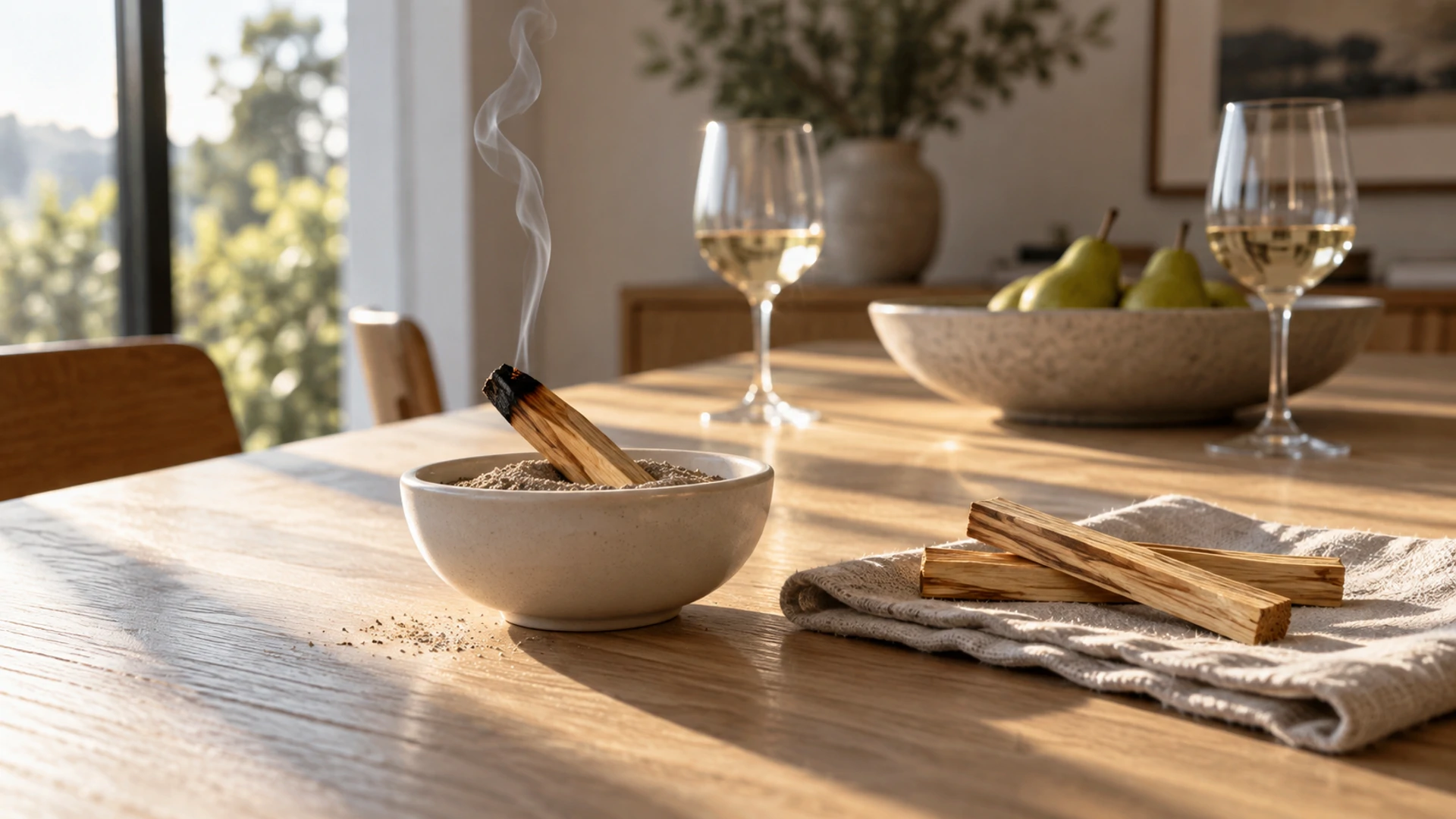
Burning the wood is the most common and most powerful method. Palo Santo sticks are lit, allowed to catch for about 30 seconds, then gently blown out so they smolder and release smoke. That smoke is the active vehicle — it carries the cleansing, protective, and elevating energy through your space or over your body and tools. Use it to cleanse a room before ritual, clear your altar between workings, or purify a new set of tarot cards or crystals. Move the smoldering stick in deliberate patterns — clockwise for attraction and blessing, counterclockwise for banishment and removal — and speak your intention aloud as you work.


Palo Santo essential oil is extracted from the wood and resin and carries much of the same energetic profile in a concentrated, versatile form. Use it to anoint candles for solar magic, protection workings, or healing rituals. A single drop on your wrists or the soles of your feet before meditation works as an intentional signal to your nervous system and your energetic body that you're shifting into a focused, receptive state. You can also add a few drops to a diffuser to fill your space with Palo Santo energy without open flame — useful for sustained, longer-duration workings.


Palo Santo incense — cones or sticks made from the wood powder and resin — offers a longer, more consistent burn than raw wood. This makes it ideal for rituals that need sustained atmospheric support: long meditation sessions, group ceremonies, or any working where you want the energy to build and hold over time. Choose incense made with genuine Palo Santo rather than synthetic fragrance oil for the real correspondence alignment.


Sachets and bundles are an underused but excellent way to work with Palo Santo for ongoing protection and attraction. Combine small chips of Palo Santo wood with other aligned herbs — frankincense resin for spiritual elevation, rosemary for protection, calendula for solar energy — in a small cloth pouch. Charge the sachet with your intention and place it in your home, under your pillow, in your bag, or on your altar. The wood holds its scent for a surprisingly long time, which means the magical charge stays active.


Candle dressing with Palo Santo oil or ground wood powder is one of the cleanest ways to integrate this botanical into spellwork. For a protection candle, anoint it with Palo Santo oil while focusing on your intention, then roll it lightly in ground wood powder before lighting. The combination of fire, solar correspondence, and intentional touch creates a focused, aligned working that engages your will on every level — visual, tactile, olfactory, and intentional.


Space clearing rituals deserve their own mention because they're often where new practitioners start with Palo Santo — and rightly so. Before any significant magical working, especially in a space that's been energetically busy, clearing the air matters. Start at the front door, move clockwise through each room, let the smoke reach corners and thresholds, and speak your intention clearly: you are clearing what no longer belongs and opening the space to aligned energy. End where you started. This is a simple but genuinely effective ritual, and Palo Santo's combination of purifying and uplifting energy makes it ideal for the job.

Palo Santo Across Cultures: A Brief History

Palo Santo's use in spiritual practice is not a modern invention or a New Age trend. It has deep, documented roots in the indigenous cultures of South America, and understanding that history helps you work with it with appropriate awareness and respect.


The Andean peoples — including communities in Peru, Ecuador, and Bolivia — have used Palo Santo in ceremonial practice for centuries. Shamans and healers burned it to clear negative energy, invite good spirits, and prepare ritual space before healing ceremonies. The wood was considered sacred, and its proper harvesting was governed by cultural protocols — only naturally fallen trees and branches were gathered, never living trees. That relationship between the plant's sacredness and its sustainable use is not incidental. It reflects a worldview in which the wood's power is inseparable from how it's treated.


The Inca incorporated Palo Santo into religious ceremony as an offering to Inti, the sun god, and as a tool for communicating with spiritual forces. Its solar and purifying qualities made it a natural fit for ceremonies that sought to honor the sun and draw its protective, life-giving energy into the ritual space. The wood's connection to solar deities in this tradition aligns closely with its Fire and Sun correspondences in modern Western magical practice — another example of independent cultures arriving at similar energetic conclusions through lived experience.


In contemporary curanderismo — the Latin American healing tradition that blends indigenous, Catholic, and folk magical practices — Palo Santo remains a working tool, not a relic. Curanderos (healers) use it for limpias, which are ritual cleansings of the body and aura, believed to remove susto (spiritual fright), mal de ojo (the evil eye), and lingering negative energy from illness or trauma. This living tradition demonstrates that Palo Santo's applications in modern magical practice aren't invented from scratch — they're continuous with a long line of practical, intentional use.

Safety, Ethics, and What to Watch For

Working with Palo Santo responsibly means paying attention to two categories of concern: practical safety and ethical sourcing. Neither one is complicated, but both matter.


On the practical side, Palo Santo smoke is generally mild and well-tolerated, but no smoke is completely neutral in an enclosed space. If you have asthma, respiratory sensitivity, or are pregnant, exercise caution with any form of smoke-based cleansing and consider switching to essential oil diffusion instead. Always burn Palo Santo in a well-ventilated space, keep a fireproof dish or abalone shell underneath the smoldering stick to catch ash and embers, and never leave burning wood unattended. The stick will often self-extinguish — that's normal — but always confirm it's fully out before leaving the area.


Palo Santo essential oil should always be diluted in a carrier oil before skin contact. Undiluted essential oils can cause skin irritation or sensitization, especially with repeated use. A standard dilution of 2 to 3 percent — roughly 12 drops of essential oil per ounce of carrier oil — is appropriate for most topical applications. Avoid contact with eyes and mucous membranes, and do not ingest essential oil.


The ethical sourcing question is the most important one to get right. Genuine, sustainably harvested Palo Santo comes only from naturally fallen trees — trees that have died and been left to rest on the forest floor for a minimum of several years. During that resting period, the resin that gives the wood its distinctive scent and magical properties fully develops. Living trees that are cut down do not produce the same quality of wood, energetically or practically, and their harvest contributes to deforestation. Look for suppliers who clearly state that their Palo Santo is harvested from naturally fallen wood, ideally from Peru or Ecuador, with transparent sourcing. When in doubt, ask. A reputable supplier will have a clear answer.

Continue Building Your Herbal Practice

Every herb you work with belongs to a broader category — cleansing, protection, attraction, or banishment — and knowing where a plant sits in that framework is what turns a shelf of dried botanicals into a real practice. If you're ready to see how Palo Santo fits alongside the other foundational herbs, read Herbs in Magic: A Beginner's Guide to Magical Herbalism. It maps out the four core categories of herbal magic and walks you through the key plants in each one.

Start where you are, follow what calls to you, and trust that your practice will deepen with every plant you come to know.


FAQ - Palo Santo in Magic for Beginners

What does Palo Santo do spiritually?

Palo Santo clears stagnant or negative energy from a space, person, or object and replaces it with warm, uplifting energy. It's most commonly used to purify ritual space before magical work, to elevate mood and mental clarity, and to open receptivity during meditation or divination.

How do I burn Palo Santo correctly?

Hold the stick at a 45-degree angle and light the tip. Let it catch for about 30 seconds, then gently blow it out so it smolders and releases smoke. Hold it over a fireproof dish to catch ash and move it through your space with clear intention. The stick will often self-extinguish — confirm it's fully out before leaving it unattended.

Can I use Palo Santo for protection magic?

Yes. Palo Santo has strong protective correspondences alongside its cleansing ones. Pair it with black tourmaline or use the essential oil to anoint a protection candle for a focused working. Burning it at thresholds — doorways and windows — is a traditional way to create a protective barrier around your home.

What's the difference between Palo Santo and sage for cleansing?

Both are effective cleansing tools, but they work differently. Sage — particularly white sage — tends to be more aggressive, stripping energy comprehensively. Palo Santo clears what needs to go and brings in warm, positive energy in its place. Many practitioners use sage first for a deep clear and then Palo Santo to reset the atmosphere.

Which planet rules Palo Santo?

Palo Santo is ruled by the Sun. This makes it particularly well-suited for workings on Sundays, solar rituals, confidence and clarity magic, and any working where you want to bring in warmth, vitality, and positive forward momentum.

Is Palo Santo safe to use around pets?

Use caution. Essential oils and smoke can be harmful to birds, cats, and some small animals. Birds have highly sensitive respiratory systems and should never be in a room where any smoke or diffused oil is present. With cats and dogs, ensure good ventilation and allow them to leave the space freely. When in doubt, opt for brief burning sessions in well-ventilated areas and remove pets beforehand.

How do I know if my Palo Santo is ethically sourced?

Genuinely sustainable Palo Santo is harvested only from naturally fallen trees, not living ones. Look for suppliers who clearly state this and ideally identify their source region — Peru and Ecuador are the most established. If a supplier cannot tell you how the wood was harvested, that's a red flag. Ethically sourced Palo Santo typically costs a little more, but the quality and energetic integrity are worth it.

Can I use Palo Santo essential oil instead of burning the wood?

Absolutely. Palo Santo essential oil carries the same correspondence profile as the wood and is a great alternative when you need to avoid smoke — for respiratory reasons, in apartments with smoke detectors, or during sustained longer rituals. Use it in a diffuser to cleanse your space, or diluted in a carrier oil to anoint candles, crystals, or your own body before magical work.
May 21, 2026

About the Author — Claire

Claire is a New York-based magical practitioner and folklore researcher with years of study spanning mythology, astrology, tarot, herbalism, and grimoire traditions. She approaches magic as a disciplined practice rooted in will and intention — and writes about it with the same depth, honesty, and enthusiasm she brings to her own craft. Whether you're just starting out or deep in your practice, her articles give you real knowledge you can actually use.

More about the author →