Rainbow Candle Magic: Every Color's Voice Heard at Once
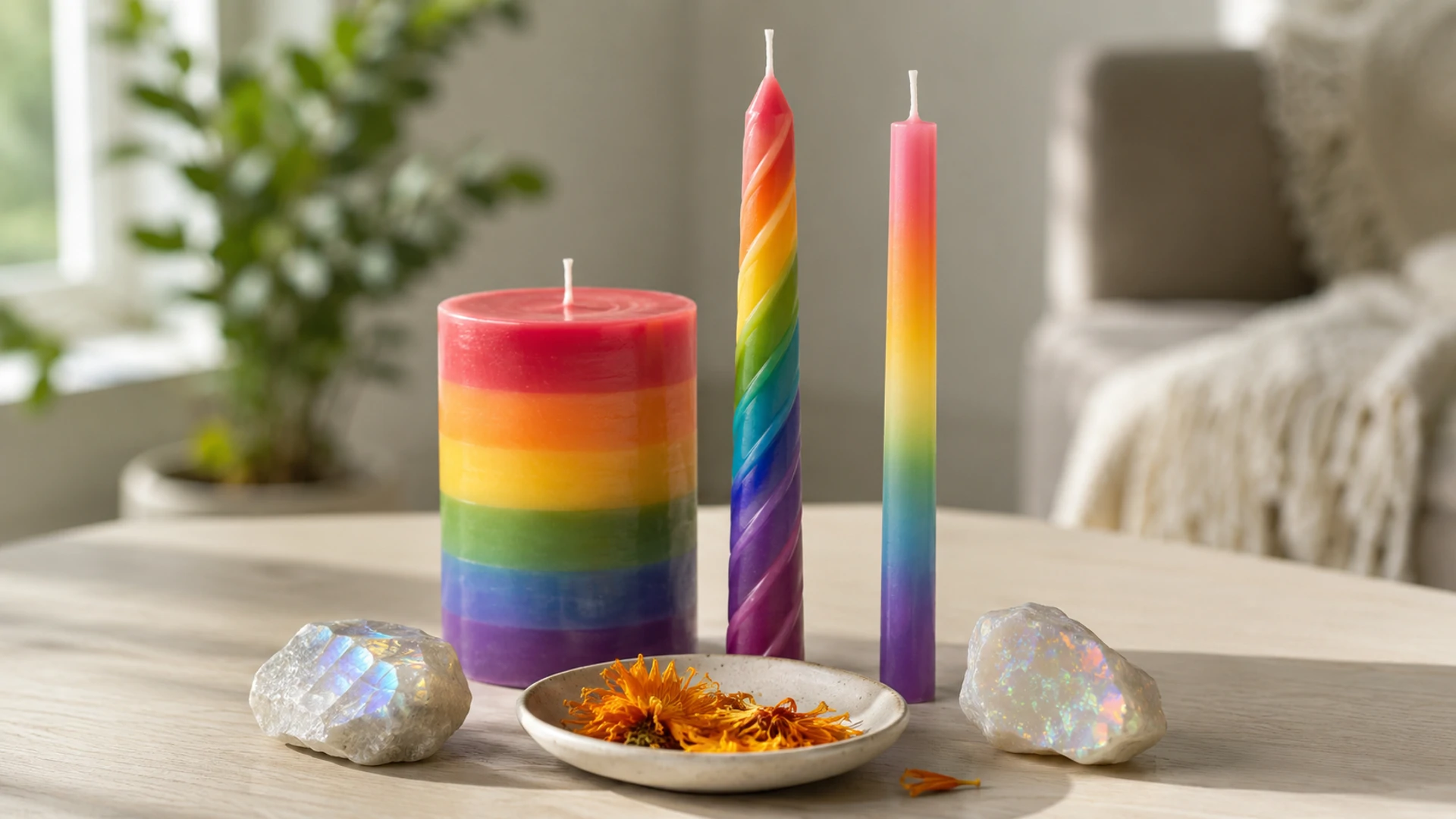
Most candle magic works like a spotlight — one color, one current, one focused intention. A rainbow candle works differently. It holds red and violet and every frequency between them at the same time, not blending them into a neutral average, but keeping each one distinct and present. Lighting a rainbow candle isn't choosing a single intention. It's sounding a full chord and letting every note carry. That's what makes rainbow candle magic genuinely different from any other color in the practice — and why it calls for its own approach rather than a modified version of single-color technique.
The Bridge Where Everything Meets
A Symbol That Spans Every Culture
The rainbow holds a remarkably consistent symbolic role across cultures that had no contact with one another, which is worth paying attention to. In Norse cosmology, the Bifrost is a burning rainbow bridge connecting Midgard, the human world, to Asgard, the realm of the gods — a literal crossing point between two orders of reality, guarded by Heimdall. In Greek tradition, Iris is not merely a deity who delivers messages along the rainbow's path. She is the rainbow, her body the arc of color spanning sky to earth, made into a messenger because the rainbow itself is the thing that bridges the divine and the mortal. In the Hebrew Bible, the rainbow appears after the flood as a covenant sign, a visible declaration from the divine written across the sky for humans to read.
The pattern continues across Mesoamerican traditions, where rainbow deities govern rain, fertility, and cosmic order — Ixchel in Maya cosmology is the goddess of the moon, medicine, and weaving, and is closely associated with the rainbow's ability to end storms. In West African Dahomean tradition, the serpent deity Ayida-Weddo is the rainbow itself, a celestial arch embodying completeness, prosperity, and the holding of the sky. In Hinduism, Indra's bow — Indradhanush — is the rainbow, formed from his celestial weapon and associated with storms, the release of waters, and divine power over the natural world. Japanese tradition preserves the rainbow as Niji, a bridge between the human world and the heavens, structurally identical in meaning to the Norse Bifrost.
What All of These Share
Strip away the specific names and the rainbow carries one consistent meaning underneath all of them: it is where opposites meet. Sky and earth. Human and divine. Separation and reunion. Storm and calm. The rainbow doesn't belong entirely to one realm — it spans the gap. That spanning quality is the energetic intention you're invoking when you light a rainbow candle. Not a vague feeling of optimism, but a specific act of synthesis. You're calling on the force that holds opposites together without flattening either side.
Three Distinct Spiritual Meanings
Rainbow candle magic builds toward three clear intentions, each genuinely distinct.
The first is wholeness. Not a fixed, static completeness, but the full range of possibility held in one place — every color present, every frequency available. This is meaningfully different from white candle magic, which also carries associations with totality and spiritual light. White holds every color in undifferentiated potential, the way light before it hits a prism contains everything but shows nothing. Rainbow is that same light already split into its full visible range, each color differentiated and displayed. White is potential. Rainbow is potential made manifest and held in its entirety.
The second is unity and reconciliation. Because rainbow doesn't favor one energy over another — it contains all of them equally — it's a genuinely neutral harmonizing force. It doesn't tip the scales toward one party or one outcome. It works toward integration, the bringing together of things that have become separated or opposed.
The third is optimism and divine favor. This one is active, not passive. It's not wishful thinking — it's the deliberate orientation toward possibility after a period of difficulty or uncertainty. The rainbow appears after the storm. Lighting one is a conscious declaration that you're turning to face what's ahead.
Rainbow's Correspondence Profile
Every working is strengthened when you understand what you're actually working with. Here's the full correspondence profile at a glance:
- Planet: Jupiter
- Element: Spirit (Aether)
- Gender: Androgynous
- Deities: Iris, Oshun, Indra, Heimdall
- Magical properties: Unity/wholeness, divine protection, joy and optimism, spiritual alignment, manifestation of full potential across all areas at once
- Associated crystals: Labradorite, rainbow moonstone, tourmaline, opal
- Chakra: All, with emphasis on the Crown
Jupiter: The Great Benefic
Jupiter's rulership shapes what rainbow candles are especially good at. Jupiter is the great benefic in classical planetary magic — the planet associated with expansion, abundance, good fortune, and the broad view over the narrow one. It governs growth that extends outward in all directions rather than in one targeted line. That's a natural fit for rainbow's multi-spectrum character. A rainbow candle working under Jupiter's influence isn't pushing toward one specific windfall. It's opening the field of possibility across all of your efforts at once.
It's useful to contrast this with gold candle magic, which is often paired with rainbow for abundance work. Gold is Sun-ruled, and the Sun's light arrives as undivided white-gold radiance — concentrated, singular, direct. Rainbow is that same solar light already refracted through a prism into every visible frequency. They're related through the physics and symbolism of light itself, not through a shared planetary ruler. Gold concentrates. Rainbow spreads. Both are powerful, but they do different work. For timing your rainbow candle workings, Thursday is the natural choice as Jupiter's day, though the Jupiter hour can be used on any day for greater precision.
Spirit as Element
The classical four elements — Fire, Water, Air, Earth — each govern a domain of material and energetic reality. Spirit, or Aether, is the fifth. It doesn't sit alongside the other four so much as it stands above and through them, the field within which the others operate. In ceremonial magic, Spirit is the element of the quintessence, the divine principle that animates and unifies the rest. Assigning Spirit as rainbow's elemental correspondence makes sense: a rainbow candle isn't working within one elemental current. It holds the space where all of them meet.
Androgynous Gender Correspondence
Most candle colors carry a gender correspondence that affects how they interact with polarity in a working. Masculine or projective colors push energy outward. Feminine or receptive colors draw energy in. Rainbow is androgynous — it holds both poles without committing to either. In practical terms, this means rainbow candles don't require you to manage polarity when you place them. A rainbow candle integrates into any configuration naturally, alongside projective or receptive colors, without creating an imbalance you then have to account for.
The Deities, Each Doing Something Distinct
Iris is the rainbow in Greek tradition — not a deity who uses the rainbow as a road, but the rainbow itself in divine form. She is color made into a messenger, the visible proof that the divine can reach the human world across the gap between them. Working with Iris through a rainbow candle invokes that bridging quality directly.
Oshun is the Yoruba orisha of rivers, love, and abundance. Her energy through a rainbow candle is joyful and generous — she governs the sweetness of life, the abundance that comes through divine favor rather than struggle. Her rainbow association brings warmth and emotional richness to any working.
Indra, the Vedic storm deity whose bow is the rainbow, governs the release of waters, the breaking of drought, and celestial power over natural forces. Through a rainbow candle, Indra's energy carries the sense of a blockage breaking open — the storm that clears the air and makes way for growth.
Heimdall guards the Bifrost, which means he governs who and what crosses between worlds. His presence in this correspondence gives rainbow candles a protective quality in ceremonial contexts, particularly when you're working at a threshold — opening or closing a working, or setting up elemental space.
The Crystals, Each Doing Distinct Work
Labradorite looks plain and grey at first glance. Then the light hits it at the right angle and it flashes the full visible spectrum — blues, greens, golds, violet — from within a stone that seemed to contain none of them. That's the most literal crystal parallel to what rainbow itself does, and it's why labradorite is the primary crystal companion for rainbow candle work. It holds a hidden spectrum and displays it only when the conditions are right.
Rainbow moonstone adds a lunar layer to that same spectral quality. Where labradorite flashes color from within opacity, rainbow moonstone carries an adularescent glow alongside its spectral flash — a softer light, emotionally attuned, connected to intuition and the receptive side of magic. Paired with a rainbow candle, it brings emotional intelligence to workings that might otherwise stay purely in the realm of broad intention.
Tourmaline here means specifically rainbow or watermelon tourmaline — varieties that carry multiple colors within a single crystal, embodying multi-spectrum energy in physical form. Tourmaline in these varieties also carries strong protective properties, which makes it especially useful in rainbow workings that are about holding a lot of energy at once without losing coherence.
Opal is the prismatic spectrum in mineral form, and it's associated with creativity and spiritual vision in a way none of the other three crystals quite match. An opal placed beside a rainbow candle specifically strengthens workings around artistic output, visionary insight, and the capacity to perceive what isn't yet visible.
Working With Rainbow
Plain Burning for Spiritual Alignment
The simplest and often most powerful way to use a rainbow candle is to light it without any additional preparation and let it do what it does. During daily practice, meditation, or journaling, a rainbow candle burns as a full-spectrum presence rather than a directional one. You're not pulling one energy toward a specific target. You're attuning to the whole range at once, letting the flame hold space for whatever needs attention.
This is especially valuable during periods of uncertainty or major transition, when you don't have a single clear target to direct a working toward. When everything is shifting at once and you can't identify which thread to pull first, a rainbow candle gives you a point of alignment rather than a point of focus. It says: all of this is held, all of it matters, all of it is in motion.
Dressing and Inscribing
When you're ready to prepare a rainbow candle for a specific working, the two primary tools are dressing and inscribing.
For dressing, frankincense oil is the strongest choice for workings centered on spiritual connection and alignment — it's one of the oldest consecration oils in recorded ritual practice. For joy and abundance, sweet orange or bergamot oil work well, both carrying solar brightness into the working. Apply the oil from center outward to send energy out, center inward to draw energy in, based on your intention.
A particularly effective rainbow-specific variant after oiling: roll the dressed candle in a blend of dried herbs. Calendula for joy and solar warmth, lavender for peace and emotional ease, and cinnamon for prosperity and magnetism. The three together mirror the triple meaning of rainbow itself — joy, harmony, and abundance — pressed physically into the wax.
For inscribing, a name and specific intention scratched into the wax works for personal workings. A personal sigil or a planetary symbol — Jupiter's glyph for expansion and fortune, for instance — are both appropriate where you want to anchor the working to a specific current without narrowing the full-spectrum quality that makes rainbow worth using.
Unity and Reconciliation Rituals
Because rainbow carries no inherent bias toward any one party or energy, it's one of the most effective candle colors for reconciliation work — between people, between aspects of yourself, or between competing priorities in your life that have gotten stuck in opposition.
Write the names of the parties involved on separate pieces of paper, or create small representations of each. Place them beneath or around the candle before lighting it. As you light the flame, speak your intention for unity clearly — not what you want one party to do, but what you want the relationship to become. You can add rose quartz for love and emotional healing, or labradorite for transformation. Let the candle burn completely in a single session if possible, or return to it across multiple sessions with the same spoken intention each time. For more detailed technique on structuring this kind of working, the guide to preparing candles for harmony magic covers the full approach.
Chakra Alignment and Energy Clearing
One of rainbow's most practical uses is as a single-candle substitute for a full seven-chakra setup. The standard approach — placing seven candles of different colors along the body from root to crown — requires sourcing, preparing, and managing seven separate candles. A single rainbow candle, lit with the clear intention of bringing each energy center into balance from root to crown, does the same work in a more concentrated form.
Hold the intention through breathwork or visualization as the candle burns. Breathe in slowly and imagine each color of the rainbow moving from the base of your spine upward, one by one, each one settling and steadying its corresponding center before moving to the next. The crown receives all colors at once. This practice is especially useful at the start of a new season, after a period of illness or emotional depletion, or as a regular maintenance working for energetic coherence. The full method for this kind of working is in the guide to preparing candles for spiritual growth magic.
Ceremonial and Altar Work
In elemental quarter setups, rainbow candles serve as the center point representing Spirit, the fifth element that stands above and synthesizes the classical four. At the four quarters, you place candles corresponding to each element: red or yellow for Fire, blue or green for Water, brown or green for Earth, white or yellow for Air. The rainbow candle at center holds the entire arrangement together. It's not just a decorative anchor — it's doing active work as the Spirit current that the other four flow into and out of.
Rainbow candles are also well-suited to workings that come at the end of heavy protective or banishing work. After a black candle has done its clearing — releasing what needed to go, cutting what needed to be cut — lighting a rainbow candle seals the working with a forward-facing intention. Black clears the space. Rainbow fills it with the full range of what's now possible. This is different from following a black candle with magenta, which asserts a fast, specific new direction with commanding force. Rainbow after black is gentler. It doesn't name what comes next — it opens the field and holds it with hope.
When a rainbow candle is used in this closing role, you don't need to prepare it elaborately. Light it with a simple, spoken intention: that what was released is truly gone, and that what comes next carries the full possibility of who you are. Let it burn as long as feels right. The working is complete when the flame feels settled rather than restless.
Rainbow candles work well in any container format for sustained ceremonial work. A pillar candle can carry a multi-day alignment working, returned to each morning or evening. A chime candle lets you complete the working in one sitting. Choose the format based on the scope of what you're holding, not convention.
Rainbow candle magic is for when a working needs every part of the picture present at once — not one color dialed up while the others wait. It carries wholeness, reconciliation, optimism, and the full field of your own potential, all lit at the same time. To see how rainbow fits into the complete color practice, the candle color magic complete guide lays out every color's role and how they relate to one another.