Peridot, the August Birthstone: Burning Off What Obscures the Fire
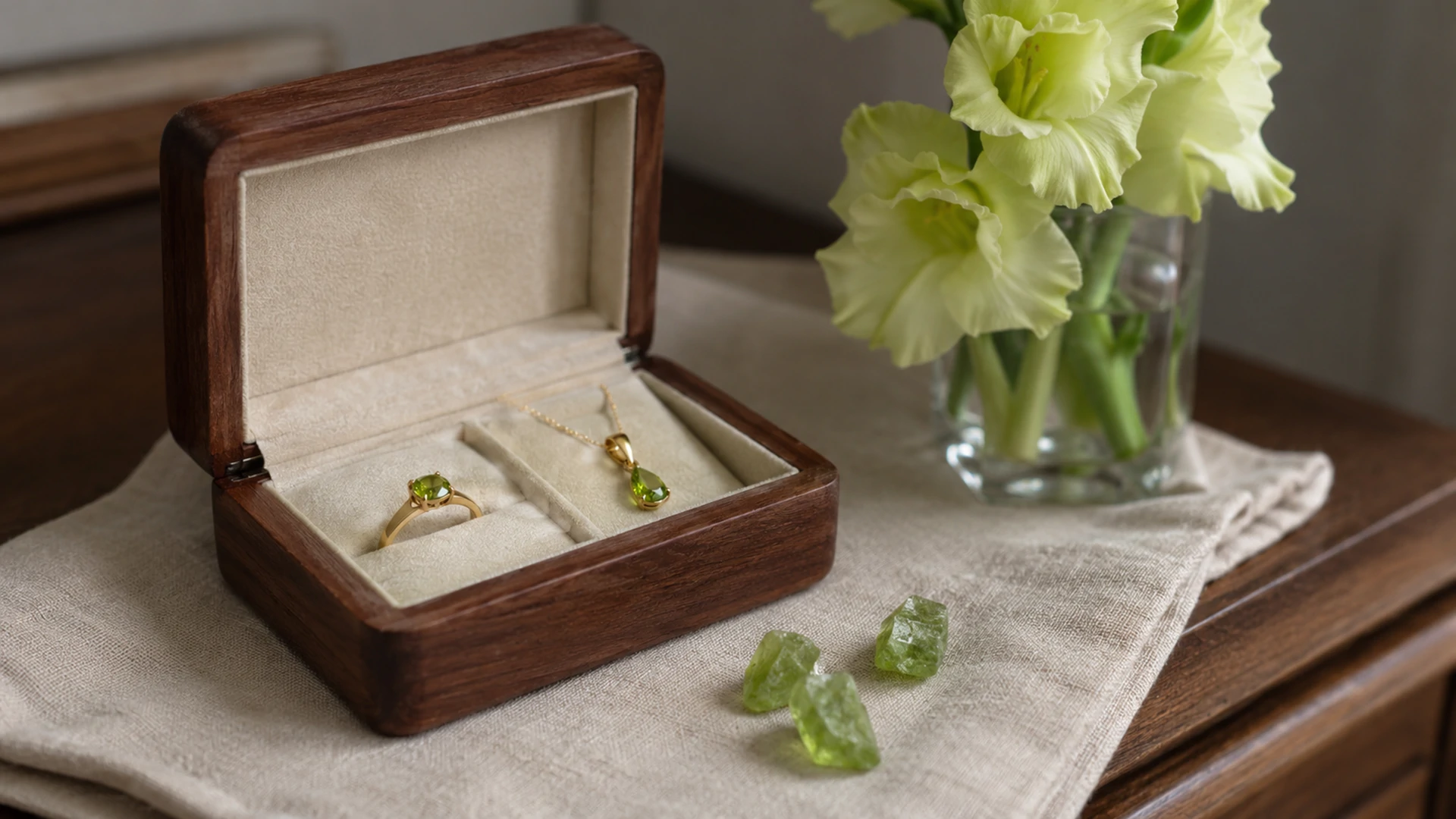
Peridot is one of those stones that earns its place. As August's leading birthstone, it carries a meaning that goes far deeper than a calendar assignment — it speaks directly to what August actually demands of the people born in it. This article is specifically about Peridot birthstone meaning: why it was chosen for this month, what it does for the signs that live here, and how to use it in your practice and your daily life. If you want a full breakdown of the stone's general correspondences and care, the complete Peridot magic guide has you covered — but what follows is about the stone as yours.
What Peridot Means as the August Birthstone
August sits at a fascinating crossroads in the year. In the northern hemisphere it's the peak of summer — the sun is at its most assertive, heat is relentless, and the energy of the natural world is at full crescendo before it begins its long exhale into autumn. It's a month of maximum output, and the people born under it tend to carry that same charge. August spans two zodiac signs: Leo (July 23 – August 22) and Virgo (August 23 – September 22). Both signs are ambitious, capable, and driven — but they express it through very different internal tensions, and Peridot speaks to both of them in precise ways.
The historical record of Peridot as an August stone is one of the oldest in gemology. Ancient Egyptians called it the "gem of the sun" and mined it from the island of Zabargad (also known as St. John's Island) in the Red Sea for over three thousand years. Roman soldiers called it "evening emerald" because its green luminosity didn't fade under artificial light — it kept glowing. The modern standardization of birthstone lists happened in 1912 through the American National Retail Jewelers Association, and Peridot's assignment to August was confirmed without serious dispute because the cultural and historical record was already so strongly established. This stone and this month have a relationship older than most written traditions. August also has two alternative birthstones worth knowing — Sardonyx, the ancient August stone that predates the 1912 standardization, and Spinel, added to the official list in 2016 — but Peridot is the one with the deepest solar roots and the most direct correspondence to what August asks of its people.
For Leo, the core tension is between the genuine warmth and creative generosity they're known for and the ego fragility that can undermine it. Leos lead, inspire, and give — but they also need recognition, and when it doesn't come, bitterness and self-doubt can quietly corrode their confidence. Peridot, with its solar correspondence and its traditional association with clearing jealousy, resentment, and the need for external validation, targets that specific wound. It doesn't dampen Leo's fire. It burns off what's obscuring it.
For Virgo, the tension is different but equally real. Virgo is analytical, service-oriented, and genuinely excellent at improving things — but that same precision can slide into perfectionism, harsh self-criticism, and a grinding sense that nothing is ever good enough. Peridot's correspondence with heart-centered renewal and releasing internal negativity is a direct remedy. It helps Virgo redirect their relentless discernment inward in a kinder direction, giving them the clarity they love without the self-punishment they don't need.
Working with Peridot as a general tool and working with it as your birthstone are two different things. With any crystal, you're drawing on its established energetic signature — its planetary ruler, its elemental nature, its historical function. With a birthstone, the relationship is more direct than that. Peridot is a Sun-governed stone, and the Sun rules the vitality of the individual self — your core identity, the creative force that animates you. Because August is the Sun's season at full strength, and Peridot has been a solar stone for over three thousand years, working with it when you were born under that same solar peak means the attunement runs through your own energetic constitution. You're not reaching for something external. You're working with what's already woven into you.
Peridot's Hardness, Care & Origins
Peridot sits at 6.5 to 7 on the Mohs hardness scale. That makes it moderately durable — fine for everyday wear with reasonable care — but genuinely sensitive to heat, chemicals, and prolonged exposure to harsh conditions. Hot water, ammonia, acidic cleaners, salt water, and sustained high heat can all dull the surface or damage the stone's internal structure. Clean it with lukewarm water and a soft cloth. Skip the ultrasonic cleaner and skip leaving it in a hot car.
On the question of sunlight: Peridot's solar correspondence is real and thematically strong, and a brief morning sun exposure is a perfectly good cleansing method. What you want to avoid is leaving the stone out in peak summer heat for hours at a stretch. Prolonged high-heat exposure is exactly the kind of thing that can gradually degrade the surface. A short, intentional window of morning light — treat it as a ritual moment rather than a passive all-day charge — serves both the stone's care needs and the working's intent.
Peridot's ancient home was Zabargad, the Egyptian island in the Red Sea that supplied the world's gem-quality peridot for millennia. That island is no longer a commercial source. Today, the major producers are Myanmar, Pakistan, and China, along with the San Carlos Apache Reservation in Arizona — one of the largest current commercial sources in the world, producing the small, richly colored stones you'll find in a lot of modern peridot jewelry. Peridot also occurs, extraordinarily rarely, in pallasite meteorites: gem-quality crystals formed in the mantle of ancient asteroids, delivered to Earth by impact. Most peridot you'll work with comes from the earth, but the stone has a literal cosmic lineage that no other common gemstone can claim.
How to Use Peridot as Your Birthstone in Magic Rituals
Charging and Carrying Your Peridot
The most foundational birthstone practice is also the most powerful one: charge your Peridot with specific personal intention and carry it on your body. Start by cleansing the stone — a brief morning sun exposure works well given Peridot's solar correspondence, letting it sit in gentle early light for fifteen to twenty minutes rather than baking in midday heat. Once cleansed, hold it in your dominant hand and let yourself settle. Think about what you actually want from this stone — not a vague wish for "good things" but a specific quality: more patience with yourself, the courage to finish something creative, or the ability to release a specific grudge. Speak it out loud, or press it into the stone through focused visualization. Feel the warmth the stone picks up from your palm as a two-way exchange. Carry the charged stone in a pocket close to your body, or tuck it into a pouch worn near the heart. Recharge it monthly at minimum — ideally when the sun enters Leo each year, which is your anchor point.
Peridot and Green Candle Intention Ritual
Peridot pairs naturally with green candle magic because both carry the correspondence of growth, prosperity, and heart-centered renewal. For this working, choose a green taper or pillar candle and dress it with a solar or abundance oil — sunflower oil works well given Peridot's ancient solar connection, or use a citrus-based oil for its cleansing and brightening qualities. Place your Peridot at the base of the candle so the stone and flame share the same working space. Write your intention on a small piece of paper — keep it to one clear sentence — and tuck it beneath the stone. Light the candle and spend a few minutes in open-eyed meditation, watching the flame while mentally rehearsing the outcome you've stated. Don't strain. Let the image come naturally, hold it warmly, then release it into the candle's light. Allow the candle to burn completely if safe to do so. The Peridot remains on your altar or in your carry rotation after the working, now linked to that intention.
Leo Season Threshold Ritual
August birthstone magic is most potent when it's anchored to the actual solar calendar. The sun's ingress into Leo (around July 23) marks the threshold of your birthstone's season — an energetically charged moment to set your intentions for the year ahead. On or just after that date, sit somewhere you can be undisturbed and hold your Peridot in both hands. Reflect on the previous twelve months: what did you accomplish, what did you let drag you down, what are you ready to release before the sun moves on? Name these things honestly. Then pivot forward. Speak three intentions aloud — specific, actionable, grounded. These are your solar-year intentions, not wishes. Place the stone on a surface you consider sacred for the duration of Leo season, and revisit it on the Virgo ingress (around August 23) to refine or recommit to those intentions as they move from the Leo phase of bold beginning into Virgo's phase of careful follow-through.
Heart Chakra Opening Practice
Peridot carries a well-documented correspondence with the heart chakra — the energetic center associated with love, self-worth, compassion, and the ability to give and receive without conditions. This correspondence is particularly relevant for August-born people because both Leo and Virgo tend to have complicated relationships with self-worth: Leo ties it to achievement and recognition, Virgo ties it to usefulness and correctness. Peridot can interrupt both patterns. Lie flat on your back in a quiet space and place your Peridot directly on the center of your chest. Close your eyes and breathe slowly, letting your awareness settle into the weight of the stone on your sternum. With each inhale, imagine a warm green light expanding outward from the stone through your chest. With each exhale, release whatever specific story you're currently telling yourself about not being enough. Stay with this for at least ten minutes. The practice doesn't have to be dramatic to be effective — it works through sustained contact and intention, not intensity.
Resentment Release Working
One of Peridot's oldest and most specific correspondences is its traditional use against jealousy, bitterness, and the slow poison of held grudges. This is not a gentle general "cleansing" — this is targeted. For this working, write down whatever you're carrying: a specific resentment, an old wound, a jealousy you're ashamed of, a bitterness you've been rationalizing. Be brutally honest on paper — no one is reading this. Hold your Peridot over the written words and speak directly to what you've named: acknowledge it fully, don't minimize it, and then state plainly that you are choosing to release its hold on you. Not because the other person deserves your forgiveness, but because you deserve to stop carrying it. Burn or bury the paper afterward. Keep the Peridot close for the following week, touching it when the old feeling resurfaces as a physical reminder that you've already made the choice.
Altar Placement for Ongoing Solar Alignment
If you work with a regular altar space, Peridot belongs in the southern quadrant — the direction traditionally associated with the element of fire and solar energy in many Western magical traditions. Place your stone there alongside other sun-aligned tools: a piece of citrine, a gold or yellow candle, sunflower petals if you have them, or a small piece of paper inscribed with your solar-year intention from the threshold ritual above. This placement turns your altar into an ongoing energetic anchor for Peridot's qualities — abundance, renewal, clarity, and the clearing of internal resistance. Refresh the altar monthly by cleansing the Peridot in sunlight and re-stating your intention aloud in front of it. The stone's function here is not decoration; it's an active focal point for your will.
Wearing & Carrying Peridot for Daily Protection
Jewelry
Peridot set in gold is the classical prescription — gold amplifies the stone's solar correspondence and was the metal preferred for it in ancient Egyptian and medieval European traditions. If gold isn't accessible, sterling silver works well and adds a gentle lunar quality that can soften Peridot's assertive energy rather than competing with it. Wearing Peridot as a pendant near the heart directly supports its heart chakra correspondence, while a ring on the right hand keeps it active in your outward-facing, action-taking energy. Both are valid choices depending on what you want the stone doing for you on a given day.
In the Home
Peridot placed on a windowsill where it catches morning sunlight does double duty: it charges in the early light while anchoring the room's energy to Peridot's qualities of renewal and clarity. The entryway or a south-facing window is ideal. For evening ritual work, Peridot is a particularly good altar stone — its Roman nickname "evening emerald" came from a real optical property, that its green glow holds its depth under candlelight rather than fading. Most green stones go flat in low light. Peridot doesn't. If your practice happens at night and you want a stone that's visually and energetically present in firelight, this is the one built for it.
In the Workspace
If you work from home and struggle with the Virgo tendency toward anxious perfectionism, keeping a small piece of Peridot near whatever tools you use most subtly supports clearer, less self-critical mental energy through the day. A tumbled piece the size of your thumbnail is enough for ambient placement. For any working centered on visibility — performance, public speaking, creative output, putting your work in front of people — pairing Peridot with a candle in your workspace leans directly into the Leo correspondence and the stone's ancient association with solar confidence. And if you work in protection, talisman-making, or funerary rites, it's worth knowing that ancient Egyptian amulet-makers placed peridot with the dead specifically to guard them in the afterlife. That's a protective virtue with three thousand years behind it, well beyond generic "good energy" framing.
One last use worth naming on its own: Peridot is one of the only gemstones found in pallasite meteorites — ancient asteroids that cooled slowly enough to grow gem-quality crystals in their iron-nickel cores. The stone you're holding almost certainly came from the earth, but the mineral itself has been found falling from space. For workings that deal with cosmic timing, ancestral connection across vast spans of time, or the sense of something larger than a single human life, Peridot carries that resonance in a way that isn't symbolic or assigned — it's simply what the stone is.
Peridot Crystal Combinations: What Pairs Well
Peridot and Citrine — Both stones carry solar energy and an abundance correspondence, but they operate in complementary registers. Citrine is energizing and activating — it pushes things into motion. Peridot is clearing and sustaining — it removes the internal resistance that stops abundance from landing. Together, they cover both ends of a prosperity working: Citrine generates the momentum, Peridot clears the self-worth blocks that would otherwise undermine it.
Peridot and Black Tourmaline — Peridot's protective quality is solar and clearing — it works by raising your energetic frequency so that lower-vibration influences have less to grip. Black Tourmaline provides the harder, boundary-setting layer of protection: it actively deflects and grounds. Together they create a layered protective field — one that raises and one that deflects — making this an excellent pairing for anyone who works in high-traffic or emotionally demanding environments.
Peridot and Rose Quartz — Peridot clears the negative internal material — the resentment, the self-criticism, the jealousy — while Rose Quartz fills in what's left behind with self-compassion and receptive heart energy. This is not a redundant pairing; clearing and filling are distinct actions. For Virgo placements especially, Peridot does the surgical work of removing harsh self-judgment and Rose Quartz provides the warmth needed to actually believe in the cleared space. Wear them together or place both on the chest in the heart chakra practice.
Peridot and Labradorite — Peridot is grounded in solar clarity and material renewal; Labradorite operates in the liminal, strengthening intuition, psychic awareness, and the ability to perceive what's hidden. The pairing works because Peridot prevents Labradorite's expansive quality from becoming ungrounded or destabilizing. For August-born practitioners who do any form of divination, dream work, or intuitive practice, keeping both stones in rotation means the insights that surface have somewhere solid to land.
Peridot and Sunstone — Both stones carry a strong solar correspondence, but Sunstone is specifically associated with personal will, optimism, and the courage to be visible — which speaks directly to Leo's creative and expressive drives. When Leo placements are playing small or suppressing their natural self-expression, Sunstone amplifies the will to show up fully while Peridot clears the ego vulnerability that makes that feel risky. This is a Leo-forward pairing in the best possible way.
August's Other Birthstones
August is one of the few months with three recognized birthstones, and the other two aren't interchangeable with Peridot — they serve different energetic needs. Sardonyx is August's oldest-attested gem, worn by Roman soldiers and recorded as an August stone long before the 1912 standardization existed. Its energy is grounding and disciplined where Peridot's is solar and clearing — if you're drawn to August's more structured, endurance-focused qualities rather than its radiant peak-summer charge, Sardonyx is the stone that speaks to that side of the month. It's also a Mohs 7, slightly harder than Peridot, and significantly more affordable.
Spinel is August's newest addition, joining the official list in 2016. It comes in a wide color range — red, pink, blue, violet, black — and sits at Mohs 8, making it the most durable of the three by a clear margin. Energetically, Spinel is associated with revitalization and releasing what's worn out, which has its own resonance with late-summer themes of approaching completion. If you want something rarer and harder than either Peridot or Sardonyx, and you're drawn to color options beyond green and banded brown-red, Spinel is worth looking at seriously as an August working stone.
August Is Yours — Let Peridot Prove It
Peridot didn't end up as August's leading birthstone by accident. It earned its place through three thousand years of solar symbolism, a documented history as a protective and renewing stone, and a precise energetic fit with the two signs that share this month. For Leo, it addresses the ego fragility hidden behind the confidence. For Virgo, it interrupts the cycle of relentless self-criticism. And for both, it functions as a heart-centered clearing agent — not a feel-good platitude but a specific energetic tool aimed at the specific internal resistance that tends to accumulate in August-born people.
What makes birthstone work different from general crystal magic is that personal resonance. Peridot isn't just associated with August — it's associated with you, at a frequency level that's already compatible with how your energy is structured. Every ritual in this article, every daily placement, every pairing is built on that foundation. You don't have to work hard to connect with this stone. You just have to show up and let it do what it already knows how to do for you.
If you want to see how Peridot sits within the full birthstone calendar, the complete guide to every month's stone is the place to go next. And if you're drawn to Peridot beyond its birthstone role, its full magical profile goes much deeper than August alone.