Labradorite: The Shield That Opens the Door
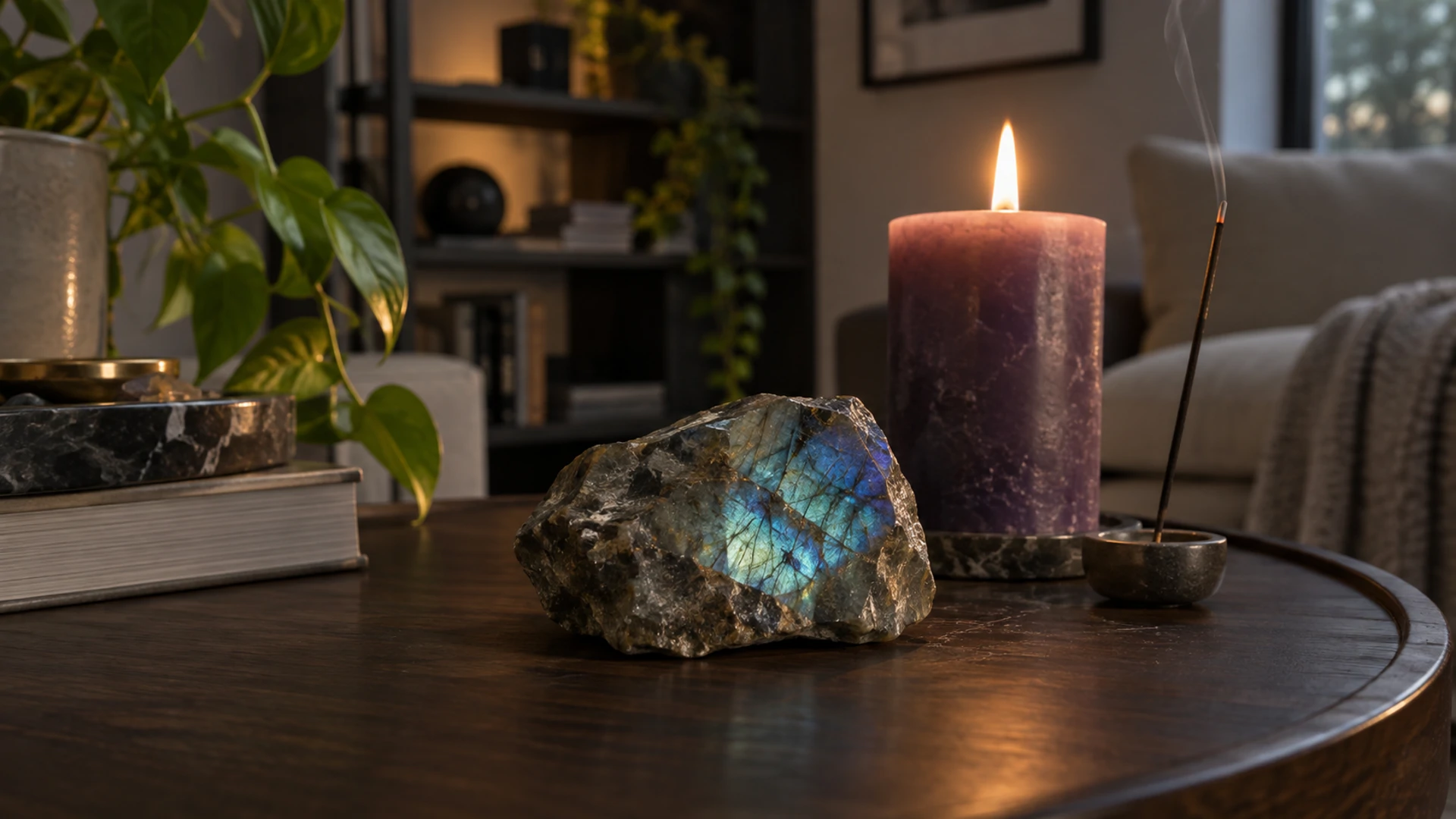
Labradorite awakens dormant psychic ability while shielding the aura during that opening — protection and activation at the same time, from the same stone.
The Shield That Opens the Door: Why Labradorite Belongs in Intuition & Psychic Development
Most intuition stones do one thing. They quiet the mind so you can receive — or they activate, pushing your perception outward into less familiar territory. Labradorite does both in the same gesture, and that double action is what sets it apart from every other stone in the Intuition & Psychic Development category. It is specifically the stone for active development: for someone in the process of opening, not someone who has already arrived at a settled, receptive state.
Compare it to amethyst, which works by quieting mental noise into clear, sober perception — psychic reception through calm rather than active awakening. Amethyst is for the person who is ready to receive and needs the static cleared. Or compare it to celestite, which offers gentle, receptive contact with angelic and higher realms — the softest and most passive stone in this category, reaching up rather than reaching out. Labradorite is for neither of those moments. It is for the moment when ability is stirring but the door isn't fully open yet, and you need to be able to open it without leaving yourself exposed in the process.
The stone's physical appearance is inseparable from this mechanism. Labradorite is a feldspar mineral — specifically a plagioclase feldspar — with a base color that reads as gray or dark green when held in flat, uniform light. Then you shift the angle, and something ignites from inside: flashes of deep blue, electric teal, gold, occasionally violet. This is labradorescence, and it happens because light enters the stone and refracts between its internally layered feldspar structure, scattering at wavelengths determined by the thickness of those layers. The color isn't on the surface. It isn't in the light hitting it. It comes from within the stone's own architecture. Practitioners have worked with this quality for centuries as a description of what the stone does: it doesn't add anything new to you. It reveals what was already there, hidden at a particular angle.
The correspondences extend this quality across three chakras, which is an unusually broad reach for one stone. The third eye is the primary activation — the seat of inner vision, pattern recognition, and psychic perception. The throat chakra is cited as a secondary activation in many traditions, connecting what is perceived inwardly to honest outward expression. The crown appears in some traditions as well, extending the stone's reach toward higher-self connection and universal consciousness. Whether all three activate simultaneously or sequentially in a given working depends on the practitioner's focus, but the three-chakra reach is consistent enough across independent sources to be worth noting as part of labradorite's specific character rather than an outlier claim.
Its water and Uranus and Moon correspondences are generally consistent across sources. Its planetary associations give it a quality of sudden revelation — Uranus governs the unexpected, the awakening, the flash of insight that arrives before the rational mind catches up — alongside the Moon's more cyclical, intuitive current. Zodiac associations are less settled. Leo, Scorpio, and Sagittarius appear in some traditions; Cancer appears in others. Treat those as starting points for personal exploration rather than fixed assignments, and don't let any single zodiac correspondence become a reason to dismiss the stone if your chart looks different.
Flash From Within: Choosing Labradorite
The single most important test for a genuine labradorite specimen is directional. Real labradorescence appears from inside the stone at specific angles and disappears completely as the stone rotates away from that angle. If you're holding a piece and the color shows up from every direction at once, it isn't true labradorescence — it's either painted glass, foil-backed material, or dyed agate showing surface color rather than internal refraction. The flash should arrive and vanish depending on where the light hits and how you're holding the piece. That behavior is structural, not cosmetic, and no treatment can convincingly replicate it at close inspection.
One point of real confusion is worth naming directly: Rainbow Moonstone. It is technically a variety of labradorite — a white labradorite rather than a separate species — but it behaves differently in ways that matter for both identification and practice. Rainbow moonstone shows a vivid, prismatic, multicolor flash that spreads across its surface with more breadth than classic labradorite's directional color play. It also has a milky base rather than labradorite's characteristic gray-green. Classic moonstone, by contrast, has a softer, more contained inner glow — adularescence rather than labradorescence — and comes from an orthoclase feldspar rather than a plagioclase. The three stones are related but distinct, and it's worth not assuming they work identically simply because they share optical family resemblance or a mineralogical classification.
On care: labradorite sits at Mohs 6 to 6.5, which means it will scratch against harder stones stored in the same bag or tray. Keep it separate from quartz varieties and anything above a 7. Its internally layered feldspar structure is the same feature that produces its color — and that layering can develop fractures with prolonged water exposure. Brief rinsing is fine for general cleansing purposes, but soaking is not a good idea. Skip salt baths entirely, as salt is abrasive on softer feldspar surfaces. For energetic cleansing, moonlight, sound (a singing bowl or a few minutes of soft tone), and smoke all work cleanly without any water contact required.
Three Practices for Opening Under Cover
The Opened Eye
This practice is for someone actively developing psychic sensitivity for the first time — not someone with an established intuitive practice, but someone at the beginning of that opening, when perception is starting to shift and there isn't yet a felt sense of how to work with it.
Hold a piece of labradorite between both palms and sit comfortably in low, warm light. Close your eyes and spend the first two or three minutes simply breathing slowly, without trying to perceive anything. Then bring the stone to your third eye — the center of the forehead just above the eyebrow line — and hold it there with one hand. Let your awareness settle behind that point without forcing it. If images, impressions, or sensations arrive, observe them without analyzing. After ten to fifteen minutes, lower the stone and sit quietly for another two or three minutes before opening your eyes. Lighting a purple candle nearby or burning a small amount of frankincense before you begin helps set the perceptual register without overriding what the stone is doing. Keep a journal close enough to write in immediately after, while the impressions are still fresh.
The Traveler's Shield
This practice is for entering psychically demanding situations — reading for others, moving through a crowded or energetically noisy space, or any context where you need your perception open but your boundaries intact.
Before leaving for the situation, hold the labradorite in your dominant hand and state your intention plainly — something like: "I am open, and I am protected while I am open." Visualize the stone's labradorescence as a field sitting just outside your skin, catching and refracting dissonant energy the same way the stone refracts light — not blocking it, but transforming its direction so it doesn't land. Then place the stone in a left breast pocket, a bag worn close to the body, or a piece of jewelry that sits against the skin. If the situation allows, choosing to work during a Moon hour adds an additional current of receptive lunar intuition to what the stone is already holding. When you return, set the labradorite down deliberately somewhere it can air overnight — a windowsill works well — and give yourself five minutes of deliberate stillness to separate what you picked up from what was yours.
The Threshold Crossed
This practice is for working through a major life transition where both protection and new perception are needed at once — a move, a career shift, the end of a relationship, or any moment that requires you to release a previous version of yourself while remaining grounded enough to function.
Set a labradorite piece on your altar or a flat surface where it can stay undisturbed for the duration of the transition period — days or weeks rather than a single session. Light a silver candle nearby each time you check in with the stone. Each morning or evening, hold the piece for just two minutes and ask it one question: "What do I need to see today that I couldn't see yesterday?" Don't force an answer. Set the stone back down and go about your day. Over time, the practice builds a habit of directed, protected perception — not asking the stone to carry the transition for you, but using it to keep your intuition engaged and your aura stable while the change moves through. Pairing it with a grounding stone kept in the opposite pocket — black tourmaline or smoky quartz — balances the opening the labradorite initiates with an anchoring current that keeps you in your body throughout.
Discovered on a Coast Named for Its Colors
In 1770, a Moravian missionary documented labradorite on the Isle of Paul, a small island near Nain on the coast of Labrador, Canada. The discovery was specific and well-corroborated — this is not the vague "known since ancient times" framing that gets attached to many stones without much evidence behind it. The Labrador coast had been named by earlier European explorers for a Portuguese navigator, João Fernandes Lavrador, and the stone that came out of it took that name with it when specimens made their way to Europe.
The comparison that traveled with those specimens was the Northern Lights. Inuit oral tradition — older than the 1770 documentation — held that labradorite had fallen from the frozen fire of the Aurora Borealis, that the lights of the aurora were somehow captured inside the stone and could be glimpsed when it caught the light at the right angle. Whether or not that's taken literally, the comparison shaped how the stone was received in Europe, where its color play was unlike anything in the existing gemstone vocabulary. A gray rock that ignited blue and gold from within didn't fit the familiar framework of colored gemstones. It was described, almost universally, as a stone that hid something inside itself — and that description has stayed remarkably consistent across the two and a half centuries since it was first named.
Its metaphysical reputation developed largely in parallel with its growing availability. The primary sources that built its modern associations — the Inuit lore, the protective-and-awakening reputation, the connection to the third eye and the Aurora — are documented from the late 18th century onward. It doesn't carry the 4,000-year trail of a lapis lazuli or an emerald, but its reputation has been consistent enough since its Western discovery that it stands on something real rather than on 20th-century marketing.
Protected Enough to Open
Labradorite's mechanism — awakening dormant psychic ability while shielding the aura during that opening — is what makes it the most versatile stone in the Intuition & Psychic Development category for anyone in an active period of development. It doesn't ask you to choose between being open and being safe. It handles both at once, which is exactly the combination that practitioners in early development tend to need most and find hardest to build on their own.
If you want to see where labradorite sits alongside the other stones in this category — and how those nine other stones approach intuition from genuinely different angles — the full Crystal Compendium: Seven Paths to Stone Magic maps all seven categories together, including the full Intuition & Psychic Development cluster. That's the place to go next.