Chrysoprase, the May Birthstone: A Stone of Emotional Forward Motion
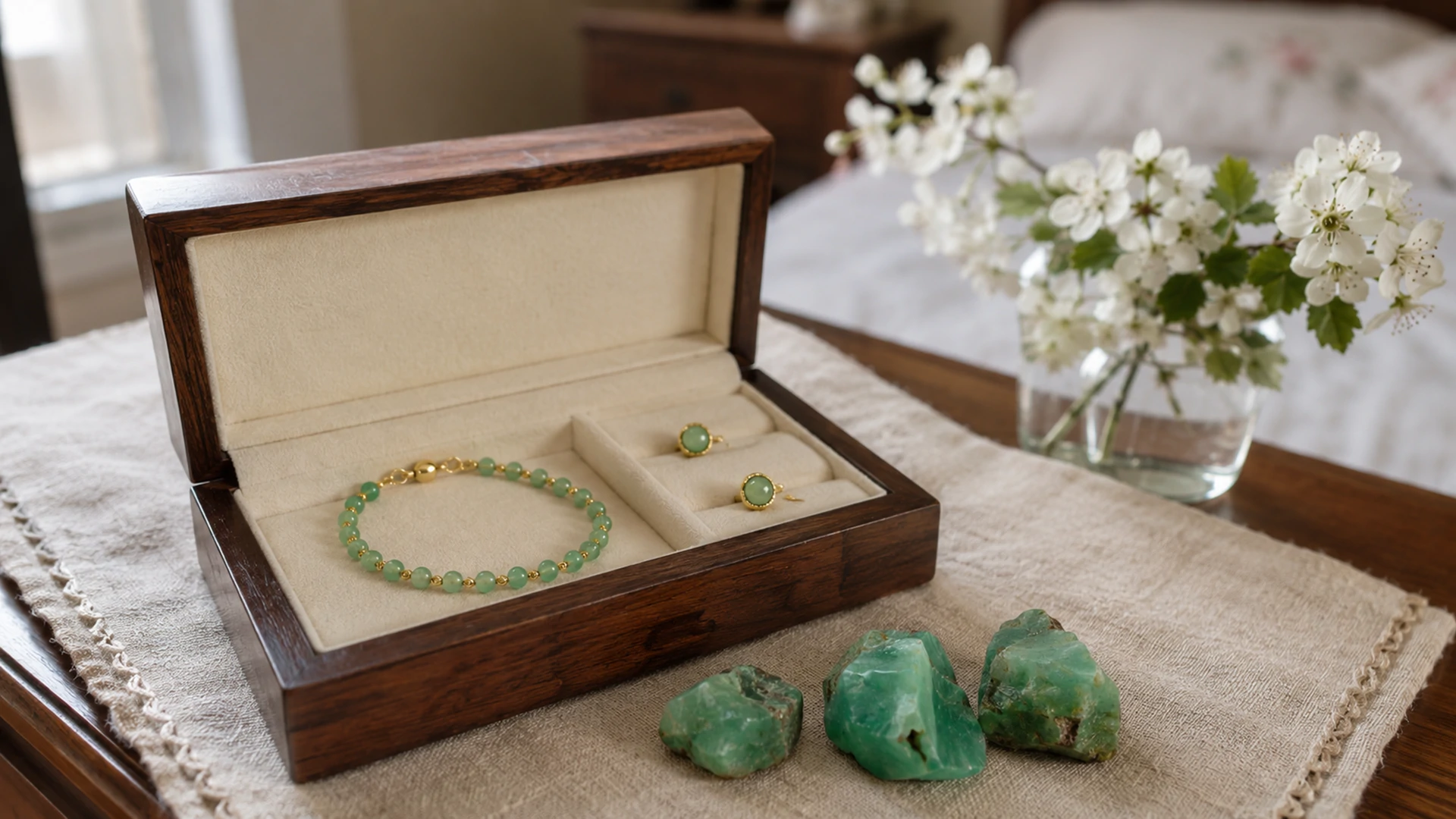
Chrysoprase is May's modern birthstone, and if you've been drawn to its apple-green glow without quite knowing why, there's a good reason for that. This stone carries the exact energetic quality that May itself embodies — the point in the year when the earth has fully committed to spring, growth is no longer tentative, and the heart opens whether you plan for it to or not. As a May birthstone, Chrysoprase isn't about decoration. It's about alignment: between who you are, what you're building, and the emotional courage it takes to keep going. If you were born in May, this stone speaks your frequency. This guide breaks down exactly what that means in practice — spiritually, ritually, and every day.
What Chrysoprase Means as the May Birthstone
Chrysoprase is a green-hued chalcedony — a microcrystalline form of quartz — whose color comes from traces of nickel. That vivid, almost luminous green places it immediately in the conversation around heart energy, growth, and the natural world in full expression. May actually has three birthstones to choose from: Emerald holds the Traditional primary position with ancient roots reaching back to classical antiquity, Green Tourmaline offers a third option with its own distinct magical character, and Chrysoprase carries the Modern designation — formalized when Britain's National Association of Goldsmiths established its standardized birthstone list in 1937, a list reaffirmed in a 2013 update. That's a genuine, traceable, national-trade-body tradition, not a casual assignment. Ancient Greeks and Romans used it as a gemstone of Venus, associating it with beauty, love, and personal joy. Medieval lapidaries referenced it for its capacity to lift the spirits and restore a sense of hope. The 1937 codification gave Chrysoprase its official standing, but the stone's relationship with May's seasonal character runs considerably deeper.
May sits squarely at the apex of spring — it's the month when the year's momentum becomes undeniable. Astrologically, May spans two signs: Taurus (until the 20th) and Gemini (from the 21st onward). Taurus is a fixed earth sign ruled by Venus, and its central tension is between deep desire and inertia — Taurus knows what it wants but can get stuck in comfort, resistance to change, or fear of disruption. Gemini is a mutable air sign ruled by Mercury, and its tension is between curiosity and follow-through — Gemini opens a hundred doors and sometimes walks through none of them. Chrysoprase addresses both. Its heart-opening quality breaks Taurus's tendency to wall off emotionally, and its grounding green frequency gives Gemini's restless mental energy something to anchor to. It's a stone of emotional forward motion — not reckless, but genuine and sustained.
Working with Chrysoprase as your birthstone is different from working with it as a general magical tool, and the difference is rooted in what the stone actually is. Chrysoprase's color comes from nickel inclusions — that saturated, almost luminous apple-green isn't incidental, it's the signature of a specific mineral condition that places the stone firmly in the register of heart energy, optimism, and outward growth. When that frequency matches the month you were born into, you're not borrowing something foreign. You're working with a material that already shares your seasonal and elemental baseline. That's why birthstone practice tends to feel more immediate than general crystal work. The stone isn't introducing a quality you're missing. It's amplifying what's already yours.
Chrysoprase's Hardness, Care & Origins
Chrysoprase sits at 6.5 to 7 on the Mohs scale, which makes it durable enough for everyday wear in rings, pendants, and bracelets without much fuss. For cleaning, mild soap and lukewarm water is all you need — just avoid prolonged soaking, which can affect some stones in this family. One thing worth knowing before you buy: chrysoprase is occasionally dyed or waxed to deepen or even out its color. Reputable sellers disclose this, and treated stones are perfectly usable in practice, but if you're investing in a piece for serious ritual work, it's worth asking. Natural-color chrysoprase has a slightly uneven, organic green that's honestly more beautiful for knowing it came that way.
The name comes from the Greek chrysos (gold) and prason (leek) — a description of its golden-green tone that tells you exactly how the ancient world saw it. The most historically significant deposits are in the Szklary region of Poland, where chrysoprase has been mined since the Bronze Age and where the stone supplied much of Europe's supply through the medieval period and beyond. Today, the dominant source of fine chrysoprase is Marlborough in Queensland, Australia, which produces the vivid, consistent apple-green material that most modern practitioners work with. The stone's long geographic reach — from ancient Poland to contemporary Australia — is part of what gives it such a layered history across cultures and traditions.
How to Use Chrysoprase as Your Birthstone in Magic Rituals
These six rituals are built specifically for May-born practitioners working with Chrysoprase as a personal stone. Each one draws on a distinct practice type so you're not repeating the same energetic gesture six times. Start with whichever one speaks to your current situation — you don't need to do them all at once.
The Birthday Charging Practice
This is the foundational birthstone ritual and the one most worth doing at least once a year. In the week of your birthday, hold your Chrysoprase in both hands and sit somewhere quiet outside, or near a window with natural light. May's light is specific — it's full and warm but not yet harsh, and that quality matters here. Let the stone rest in your palms and breathe slowly until you feel settled. Then speak — out loud if possible — three things you are genuinely releasing from the previous year and three things you are genuinely calling in for the year ahead. Be specific. Not "I want more abundance" but "I'm releasing the fear that kept me from pursuing the work I actually care about." Your will focused through clear language is what charges the stone, not the light or the gesture alone. After you've spoken, close your hands around the stone and hold it for several minutes. Carry it on your body for the following week to let the intention settle in.
Green Candle and Chrysoprase Heart-Opening Ritual
Chrysoprase's Venus rulership and heart-center association make it a natural partner for green candle magic, which carries correspondences of growth, love, healing, and abundance — the same territory Chrysoprase governs. For this ritual, choose a green taper or pillar candle and dress it with a light oil such as rose, bergamot, or plain olive oil, working from the base upward to draw energy toward you. Set your Chrysoprase directly in front of the candle so the flame's light falls across the stone. Sit comfortably and focus on the specific emotional block you want to dissolve — the place in your chest where you've been holding back, playing small, or protecting yourself past the point of usefulness. As the candle burns, let yourself feel what it would be like to move through that block completely. Don't visualize it as solved — feel the sensation of moving through it. Chrysoprase in the candlelight acts as a focal anchor, keeping your attention in the heart rather than in the analytical mind. Let the candle burn down completely if safe to do so, or snuff it and repeat the practice over three nights.
Beltane Threshold Ritual
May 1st is Beltane in the wheel of the year — one of the most energetically potent threshold moments in the calendar, marking the full arrival of summer's force. Even if you don't follow a specifically Pagan practice, this date carries real seasonal weight: the earth is at a peak of outward creative energy, and that makes it an unusually powerful time for intention-setting around growth, desire, and new commitments. On the evening of April 30th or the morning of May 1st, take your Chrysoprase outside and hold it at a threshold — a doorway, a gate, the edge of a garden, any boundary between one space and another. A threshold is a liminal space in magical terms: a place between what was and what will be, which makes it ideal for setting intentions that require genuine change. Stand there and state what you are crossing into. Not what you want to attract, but what version of yourself and your life you are stepping into as a present reality. Hold the stone against your chest as you speak, then step forward through the threshold. Keep the stone with you for the rest of May.
Heart Chakra Activation Practice
The chakra system, originating in Hindu Tantric and Yogic traditions, maps energy centers along the body — and the heart chakra (Anahata in Sanskrit) governs love, compassion, grief, connection, and the capacity for emotional openness. Chrysoprase is one of the most consistently cited heart chakra stones across modern crystal practice, and its green color aligns directly with that center's vibrational frequency. For this practice, lie down comfortably and place your Chrysoprase at the center of your chest. Breathe slowly and deeply, focusing your attention on the physical sensation of the stone's weight on your sternum. With each inhale, imagine green light expanding outward from the stone; with each exhale, let go of any tightness, constriction, or defensive holding in the chest. This isn't a meditation that requires visualization skill — it just requires attention and breath. Stay here for ten to fifteen minutes. If emotion surfaces, let it move rather than managing it. That's the practice working. Do this on a regular basis when you feel emotionally shut down, guarded, or disconnected from what you care about.
Dream Clarity and Emotional Processing Practice
Chrysoprase has a long association with dream work in lapidary tradition — medieval sources specifically noted its ability to bring clarity and optimism to the dreaming mind. In the framework of emotional processing, the dream state is where the heart works through material the waking mind resists. This makes Chrysoprase particularly useful for May-born practitioners who tend to intellectualize emotion or stay in their heads as a default coping strategy (a common pattern for both Taurus and Gemini). Place your Chrysoprase under your pillow or on your nightstand before sleep. Before closing your eyes, spend two or three minutes consciously reviewing one emotional situation from your waking life that you haven't fully processed — something you've been circling rather than resolving. You don't need to solve it. Just hold it in awareness as you drift off. Keep a journal nearby and write down whatever you remember when you wake, even fragments. Over time, this practice builds a real bridge between your emotional body and your conscious understanding of what you're actually feeling and why.
Protective Altar Placement for May
Chrysoprase carries a protective function that is often overlooked in favor of its heart-opening qualities, but historically the stone was used specifically to shield against envy, manipulation, and the kind of psychic noise that comes from other people's emotional projections. For May-born practitioners, this is especially relevant because the heart-open quality Chrysoprase cultivates can also make you more sensitive to other people's energy. Set up a small dedicated space on your altar or windowsill during May — your birthday month — with your Chrysoprase as the centerpiece. Surround it with fresh greenery, a small dish of salt, and any other protective allies you work with. This isn't a ritual with spoken steps — it's a sustained energetic container. The point is to create a physical focal point that reminds you, every time you see it, that being open doesn't mean being unprotected. Openness and boundaries are not opposites. Chrysoprase holds that knowledge; the altar placement makes it visible in your daily environment.
Wearing & Carrying Chrysoprase for Daily Protection
Jewelry. Because Chrysoprase is a form of chalcedony, it's durable enough for everyday wear — a Mohs hardness of around 6.5 to 7 means it holds up well in rings, pendants, and bracelets without constant babying. Skin contact is ideal for this stone. Its heart-center correspondence means the closer it is to your chest, the more directly it works — a pendant on a chain that rests near the sternum is the most aligned placement. If you prefer wrist jewelry, the left wrist is traditionally the receptive side, drawing energy inward, which suits Chrysoprase's role as a stone you're absorbing rather than projecting.
In the Home. Chrysoprase works well in any space where emotional quality matters — the bedroom, a reading nook, a creative workspace. Its Venus and heart-center correspondence means it supports the spaces where you rest, connect, and create. Placing it near a window brings in natural light, which enhances the stone's already luminous green quality and keeps it feeling vibrant rather than stagnant.
In the Workspace. If you work in an environment with high interpersonal tension or emotional demand — a busy office, a healthcare setting, anywhere you're absorbing a lot of other people's emotional states — a piece of Chrysoprase on your desk or in your bag helps maintain the boundary between your emotional field and everyone else's. Its historical use as a shield against envy is directly relevant here: the stone has been employed for centuries specifically in social environments where other people's projections and agendas were a real concern.
For Travel. Chrysoprase earned the informal title "Stone of Joy" across a long stretch of European tradition, and Frederick the Great of Prussia valued it so highly he had it worked into the decor at Sanssouci palace — an unusually specific historical endorsement of the stone's capacity to sustain optimism and wellbeing in daily life. Carrying a tumbled piece when traveling keeps that quality active. Beyond protection against envy and energetic static in crowded environments, the stone is worth reaching for when travel itself is grinding you down — delays, difficult company, the particular flatness of being far from your own space. For May-born travelers the added resonance is real: the stone's frequency is already calibrated to yours, so its presence in an unfamiliar environment is naturally steadying.
Chrysoprase Crystal Combinations: What Pairs Well
Chrysoprase and Rose Quartz — Both stones operate in the heart-center register, but they approach it differently. Rose Quartz works on self-love, compassion, and the soft dissolution of emotional walls, while Chrysoprase adds optimism, forward motion, and a slightly more activating energy. Together they create a full-spectrum heart-healing combination: Rose Quartz softens and opens, Chrysoprase energizes and moves. This pairing is particularly useful when grief or heartbreak has left you stuck rather than just sad.
Chrysoprase and Malachite — Both are green stones with Venus and earth correspondences, but Malachite is an amplifier and transformer — it accelerates the surfacing of emotional material, sometimes uncomfortably so. Chrysoprase provides the optimistic stability that keeps that process from becoming destabilizing. If you're doing deep emotional work or shadow work and Malachite feels too intense on its own, Chrysoprase is the balancing companion that keeps you grounded in forward motion rather than overwhelmed by what surfaces.
Chrysoprase and Black Tourmaline — This is a classic heart-and-boundary pairing. Chrysoprase opens and sustains emotional availability; Black Tourmaline provides a hard protective perimeter that keeps external energies from flooding in through that openness. If you find that working with Chrysoprase makes you feel more sensitive or permeable than you're comfortable with, adding Black Tourmaline creates a contained field: open inside, protected at the boundary. Wear them together or place them at opposite ends of your workspace.
Chrysoprase and Citrine — Chrysoprase works in the heart register; Citrine works in the solar plexus — the center of personal will, confidence, and the capacity to act on desire. The combination bridges feeling and doing. If you know what you want emotionally but keep failing to act on it, this pairing addresses the gap between the heart's knowledge and the will's execution. It's a strong combination for May's Taurus energy in particular, which can feel deeply but hesitate to move.
Chrysoprase and Moss Agate — Both stones carry strong nature and growth correspondences, and both resonate with May's seasonal character. Moss Agate is a stone of slow, organic development — patience with long-term growth cycles, connection to the earth, and persistence without force. Where Chrysoprase supplies optimism and emotional openness, Moss Agate supplies staying power and rootedness. Together they create the full energy of a May garden: blooming and grounded simultaneously.
May's Other Birthstones: How Chrysoprase Compares
Emerald is May's Traditional stone, and it brings a very different energy to the table. Where Chrysoprase is opaque and chalcedony-based — accessible, durable, and deeply personal in its frequency — Emerald is a transparent beryl with ancient pedigree going back to Egyptian, Roman, and Incan traditions. It carries the weight of that history. Emerald is richer in tone, higher in value, and associated with fidelity, vision, and the deep wisdom of fully committed love rather than Chrysoprase's more optimistic, forward-moving warmth. If you want the stone with the longest ceremonial lineage, or if you're drawn to transparency and depth over opacity and glow, Emerald is the Traditional choice — and it has earned that designation across thousands of years of use.
Green Tourmaline occupies an interesting position compared to Chrysoprase specifically. It's transparent, harder (Mohs 7 to 7.5), and visually closer to Emerald — deep, rich green with a gem-quality clarity that makes it a compelling Emerald alternative on appearance alone. But Green Tourmaline holds no official birthstone-list standing. It's not on the National Association of Goldsmiths list, not on the American Gem Society's list, and its association with May is a modern practitioner convention rather than a codified tradition. Chrysoprase, by contrast, has that 1937 British-list designation — it's actually the listed Modern stone. If you're choosing between the two as an Emerald alternative, Green Tourmaline wins on transparency and visual similarity to Emerald; Chrysoprase wins on legitimate birthstone status, historical depth, and that specific apple-green optimism that maps so cleanly onto May's energetic character.
May Is Yours — Let Chrysoprase Help You Own It
You've now seen exactly why Chrysoprase belongs to May — not as an arbitrary assignment but as a genuine correspondence. The stone's heart-opening, Venus-ruled, growth-forward energy maps directly onto the month's seasonal apex and onto the specific emotional tensions that Taurus and Gemini navigate: the fear of disruption and the restlessness that resists follow-through. Chrysoprase doesn't soothe those tensions by removing them. It gives you the emotional courage and optimistic momentum to move through them with your heart open instead of your walls up.
What makes birthstone work different from general crystal practice is the personal resonance — and that's the takeaway worth holding onto. Chrysoprase as a May birthstone isn't generic heart-healing energy you're borrowing. It's a frequency that already matches yours, refined and made portable. Every ritual, every time you carry it, every combination you build with it deepens that connection. The more you work with it intentionally, the more precisely it responds to you specifically.
If you want to explore how Chrysoprase fits into the larger birthstone tradition — including the history of how stones were assigned to months and why that history matters for your practice — the complete guide to every month's birthstone is the place to go next. May is yours. This stone is yours. Now you know what to do with it.