Peridot: Abundance After the Weight Lifts
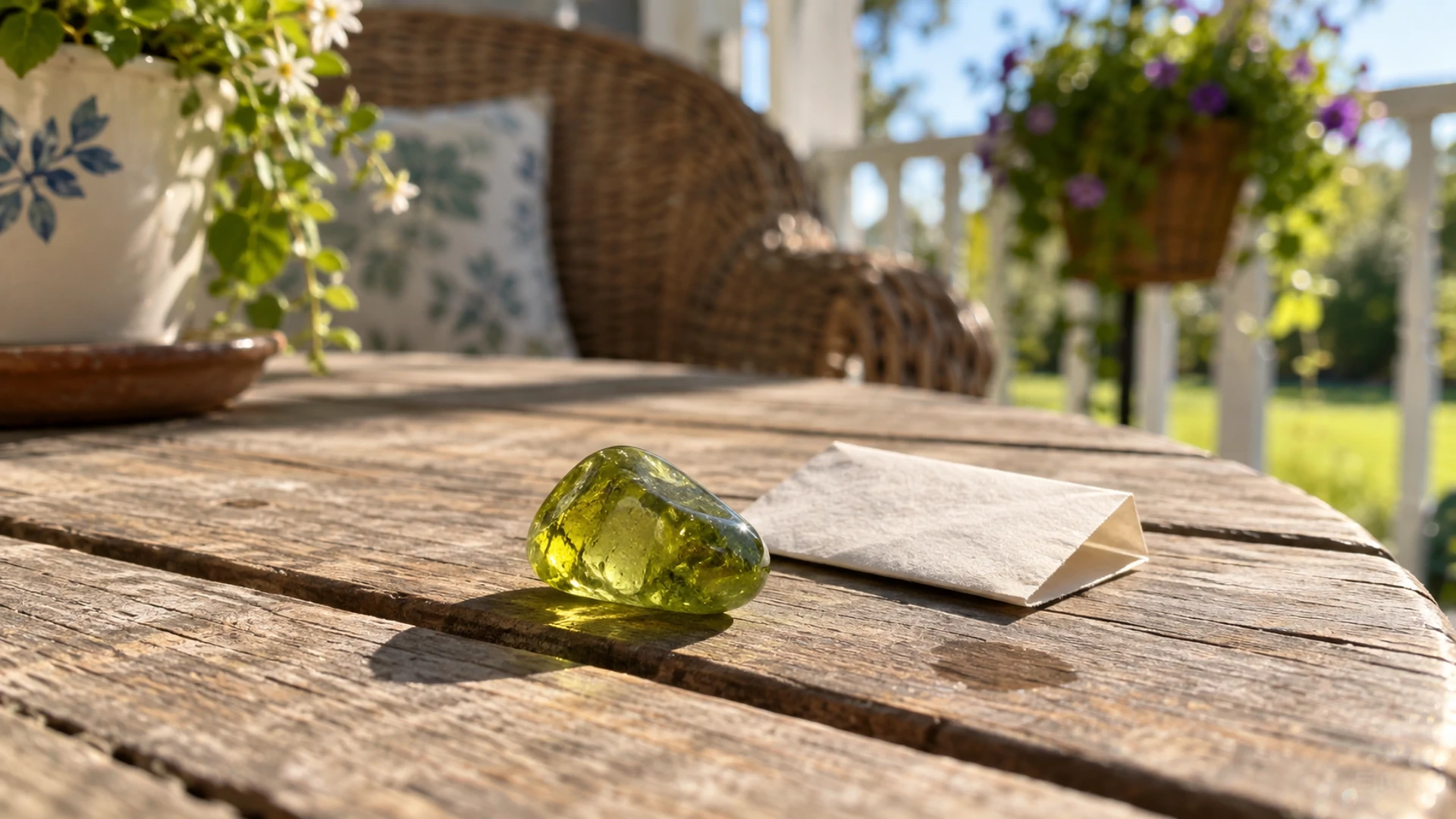
Peridot doesn't generate wealth the way some stones do. It clears the weight that's been keeping prosperity out.
Abundance After the Weight Lifts: Why Peridot Belongs in Abundance
Peridot is gem-quality olivine, a magnesium iron silicate that forms deep in the Earth's mantle rather than in the crust like most gems. What makes it unusual is that its green color isn't a trace impurity layered onto an otherwise colorless structure — the iron that colors it is part of the mineral's own chemical makeup. That's why peridot is one of the rare gems that comes in essentially a single color family, ranging from yellowish green to a deep olive, and nothing else. The color is intrinsic. It's built in.
It reaches the surface through volcanic activity, carried up in basaltic lava and in xenoliths — chunks of mantle rock that hitch a ride to the surface during eruptions. On rare occasions, peridot has also been recovered from pallasite meteorites, a class of stony-iron meteorites that contain beautiful olivine crystals suspended in a metallic matrix, and from comet dust sampled by NASA's Stardust mission. The stone isn't just ancient in a human sense. Its origins are, in some cases, extraterrestrial.
In magical practice, peridot falls into the Abundance category — but its mechanism is specific, and it matters. Peridot works through emotional clearing. It targets jealousy, resentment, guilt, and the residue of past financial hardship: the feelings that quietly block prosperity from returning even when external circumstances have shifted. Its work is to release what's in the way. That's different from citrine's spontaneous manifestation — citrine actively generates new wealth and opportunity through confidence and joy. It's also different from yellow sapphire's wealth through wisdom, which expands prosperity through ethics and right conduct guided by Jupiterian discernment. Peridot doesn't push outward. It lifts something off so that what you've been working toward can finally land.
Its ruling body is the Sun, which connects it to warmth, vitality, and the return of light after darkness — not the aggressive heat of something like carnelian, but something closer to the quality of a late-summer afternoon when the day has finally cooled. That solar connection is part of why peridot's protective register is so distinct within the Abundance cluster: it guards against the emotional states — envy, bitterness, old wounds around money — that erode prosperity from the inside. Leo is its associated zodiac sign, adding the solar thread of self-expression and the movement from contraction back into radiance. The heart chakra is its primary energetic center, which makes sense: the clearing this stone does is emotional, not mental. The work happens in the chest before it shows up in the bank account.
One Color, One Direction: Choosing Peridot
Peridot has one cleavage plane, which means it can chip or split if struck at precisely the wrong angle despite a Mohs hardness of 6.5 to 7. That hardness is respectable — harder than glass, harder than steel — but it doesn't protect against directional impact. If you're wearing peridot in a ring or bracelet, treat it with a bit more care than you would a sapphire or diamond. Skip ultrasonic cleaners entirely, which can cause fractures along that cleavage plane, and be cautious with steam cleaning too. A soft cloth and brief water contact for cleansing is all you need.
Choosing a genuine specimen is relatively straightforward compared to stones with complicated imitation markets. Because peridot occurs in essentially one color family — yellowish green to olive — anything sold as peridot in a dramatically different hue deserves a second look. The green should feel alive and slightly warm, tending toward yellow rather than blue. Genuine peridot also has a slightly oily or greasy luster that distinguishes it from glass imitations, which tend to look flatter. In faceted gems, look for the characteristic doubling of the back facets visible through the top — a result of peridot's birefringence, a physical property worth knowing because few fakes replicate it.
For raw or tumbled pieces used in energy work, the same color principle applies. A strongly bluish-green piece may be something else entirely. The stones that work best for abundance practice tend to be those with clear, clean color — not necessarily large, not necessarily flawless, but with that characteristic warm yellow-green that makes peridot immediately recognizable. Brief water contact is safe for cleansing. Sunlight is fine in moderation. Avoid harsh chemicals, and avoid leaving it sitting in prolonged direct sun for extended periods since the color, while stable, can be affected by extreme heat over time.
Three Practices for Letting Prosperity Back In
The Release
Use this when you recognize a scarcity pattern — a reflex of fear, resentment, or lack — that predates your current circumstances and needs to go before anything new can arrive.
Hold your peridot in both hands, close your eyes, and spend a few minutes identifying the specific feeling or belief you're releasing — not vaguely, but precisely. Name it internally: "I'm releasing the belief that money always leaves," or "I'm releasing the resentment I still carry about [specific situation]." When you have it clearly in mind, breathe out slowly and deliberately three times, imagining the feeling moving out of your chest and into the stone. Then set the stone down on your altar or a windowsill in direct sunlight and leave it for the remainder of the day. The sun does the work of transmutation. A gold candle nearby amplifies the solar current of this working and signals completion — light it while you set the stone down and let it burn for at least an hour. This practice works best done once, deliberately, rather than repeated daily: the point is a clean cut, not a ritual you return to indefinitely.
The Sunlit Return
Use this after a genuinely hard period — a financial loss, a long stretch of struggle, a recovery — when things have shifted but prosperity hasn't fully returned yet.
Choose a morning when the sun is visible. Place your peridot in a spot where sunlight will fall directly on it for at least an hour, and sit beside it. Write out, by hand, three specific things that are now available to you that weren't during the hard period — not wishes or goals, but things that genuinely exist now. The writing is important: it anchors the statement in the physical world rather than leaving it as a feeling. Read what you've written aloud once, then hold the stone while you read it a second time. Timing this to the Sun's planetary hour on a Sunday deepens the working's alignment with Leo's solar current. Carry the peridot on your body for the remainder of that day. The practice isn't about manufacturing optimism — it's about making the shift legible to yourself, so your energy can reorganize around what's actually true now rather than what was true before.
The Guarded Gate
Use this when you're open to prosperity but concerned about jealousy, bad faith, or draining financial influences from people in your orbit.
Place your peridot at the entrance point of your home — a windowsill near the front door, or on a surface just inside the threshold. Surround it with a small ring of dried basil, which carries a long-standing Mars-driven reputation for both financial protection and warding. Light a green candle nearby — not directly on top of the basil — and state your intention clearly before you light it: you are marking this threshold as permeable to genuine abundance and closed to envious or draining influence. Let the candle burn fully in a single session if it's small, or mark this as a working you revisit weekly if using a larger candle. The peridot stays at the threshold, working passively between sessions. Replace the basil every two weeks and cleanse the stone briefly with water each time you do.
Named for an Island It May Never Have Come From
The ancient Egyptians mined peridot on Zabargad Island in the Red Sea — an island the Greeks and Romans called Topazios — for more than three thousand years. They called peridot the "gem of the sun," and it was considered so sacred that mining was permitted only at night, when the sun wouldn't dim the stones' visibility. By daylight, the legend went, peridot was difficult to find; by torchlight, its yellowish-green glimmer gave it away. Whether or not that practice was literally observed, the name tells you something real: this was a stone associated with the sun's own warmth, not with moonlit or nocturnal work.
Here's where the history takes a genuinely strange turn. The island where Egyptians mined peridot was called Topazios by Greek and Roman writers, and that name became the root of our modern word "topaz." The complication is that what the ancients called "topaz" — the stone associated with this island — almost certainly was not the mineral we call topaz today. It was almost certainly peridot. The two stones were mixed up across languages and trade routes for centuries, and the naming confusion is now well-documented. The word "topaz" in the modern mineralogical sense came to be attached to an entirely different stone, while the original Topazios gem — peridot — kept its own name from other traditions. It's one of the most enduring cases of mistaken identity in gem history. A related theory, widely repeated though not definitively settled, holds that the famed emeralds attributed to Cleopatra may have also been peridot from these same Egyptian mines rather than true emerald. The theory is plausible given the mining geography, but it remains a theory, not a confirmed fact.
One final detail that earns peridot a kind of historical status no amount of ancient mining can match: the olivine crystals recovered from pallasite meteorites, and detected in comet dust by space missions, are chemically identical to the peridot mined on Zabargad. The stone the Egyptians called the gem of the sun has since been found arriving from beyond it.
Abundance With the Weight Gone
Most abundance work is focused on attraction — pulling something in, generating something new, positioning yourself for a lucky break. Peridot does something different. It asks what's been sitting in the way, and removes it. That's a quieter mechanism than citrine's active radiance or the disciplined accumulation of other stones in the category, but it's not a lesser one. Sometimes the most useful thing isn't adding a new force to the situation. It's clearing the emotional residue — old resentment, old fear, old grief about money — that's been quietly blocking the door.
If you want to see where peridot sits alongside the other Abundance stones and the six other crystal categories, the full Crystal Compendium: Seven Paths to Stone Magic is the place to start.