The First Pentacle of Jupiter: Calling Parasiel, Lord and Master of Treasures
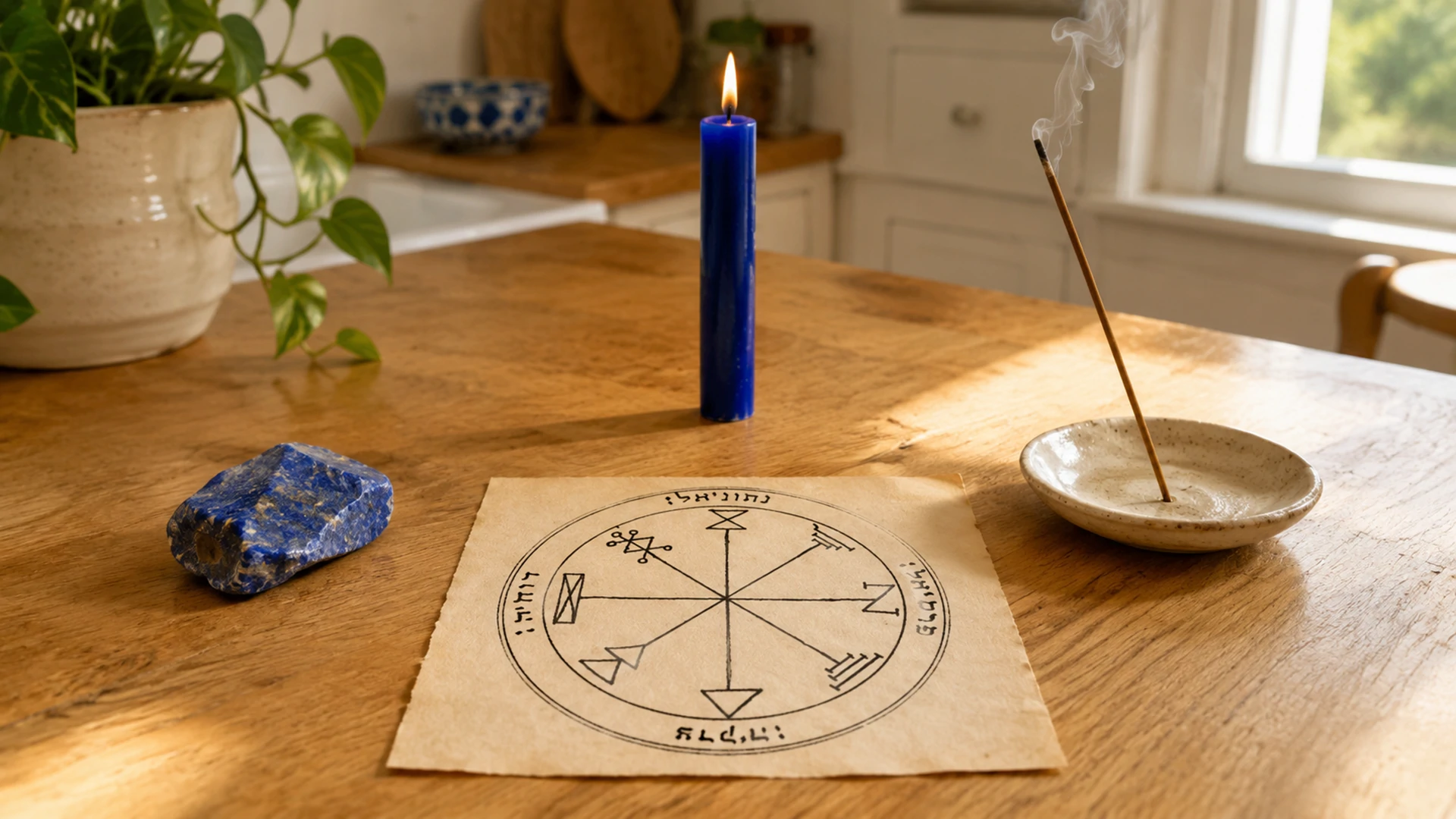
The First Pentacle of Jupiter is specifically designed to invoke the spirits of Jupiter, and above all Parasiel, the angel named Lord and Master of Treasures. That is its documented office, and it is a precise one. This Pentacle of Solomon is not a general prosperity charm — it is a tool for making direct contact with the Jovian current and the spirits who govern material abundance at its source.
Jupiter's domain in traditional planetary magic covers wealth, honor, expansion, and sovereign authority. The planet governs the kind of increase that comes with legitimacy — not luck scraped together, but prosperity earned through proper alignment with natural law.
If you want a complete overview of all seven Jupiter pentacles and how they relate to one another, the full guide to the 44 Pentacles of Solomon covers every planet and office in one place.
Construction and Symbolism of the First Pentacle of Jupiter
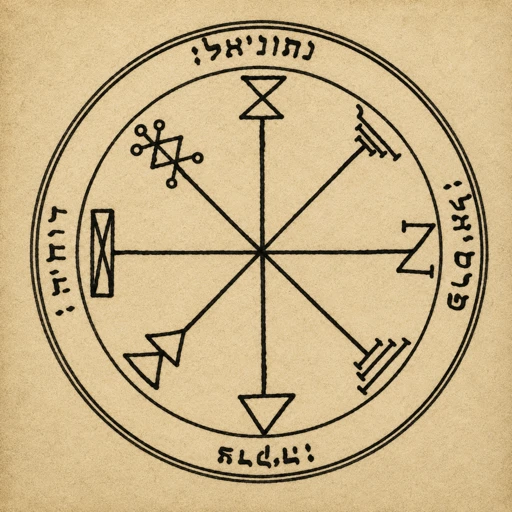
The First Pentacle of Jupiter carries four angelic names arranged on the figure: Netoniel, Devachiah, Tzedeqiah, and Parasiel. Parasiel is identified in the source text not just as an angel but specifically as Lord and Master of Treasures — and the source goes further, noting that he teaches the operator how to become possessor of the places wherein treasures lie. That is a meaningful distinction. His office is not simply to locate what is hidden; it extends to instructing you in how to take possession of what he reveals. Each of the seven Jupiter pentacles works with Jovian spirits, but this one names the presiding intelligence over treasure — the entity at the top of that particular hierarchy — directly on the seal.
The other three angels — Netoniel, Devachiah, and Tzedeqiah — function as attendants within this office. Netoniel's name derives from the Hebrew root for "gift of God." Tzedeqiah shares its root with tzedek, the Hebrew word for Jupiter itself, meaning righteousness or justice. These are not decorative names. Their presence on the seal reflects the tradition that a pentacle's power comes partly from the specific intelligences whose names are inscribed on it, each name acting as an address that orients the working toward a precise spiritual office.
The figure is composed of the Mystical Characters of Jupiter — abstract, non-alphabetic sigil-forms specific to the planet, the same class of construction found on several of the Saturn pentacles — with the four angel names written in Hebrew around the figure. These characters are not letters or words in any spoken language. They are the planet's own symbolic vocabulary, used in the Key of Solomon tradition to anchor a working directly within Jupiter's current. The four names written around that field do exactly what names always do in Solomonic construction: they address specific intelligences and draw them into the working the characters define.
No specific verse is assigned to the First Pentacle of Jupiter in the source material, which is worth noting. Several of its siblings — the Second, Fourth, Fifth, Sixth, and Seventh Jupiter pentacles — each carry a quoted Biblical verse that anchors the pentacle's office in scripture. The First Pentacle stands on the authority of the angelic names themselves, letting the identities of Parasiel and his attendants carry the weight that elsewhere falls to a Psalm or passage. This is not a gap in the record — it reflects a deliberate construction choice in the Key of Solomon tradition, where the naming of a spirit directly on the seal is considered sufficient establishment of that spirit's office and authority.
The Spiritual Office of the First Pentacle of Jupiter
The documented office of this pentacle is invocation: it calls forth the spirits of Jupiter, with particular emphasis on Parasiel, Lord and Master of Treasures. That description is narrower than it might first appear. This is not a pentacle for protection, for commanding spirits to obey against their will, or for general wealth increase. It is specifically oriented toward making contact with Jovian intelligences and, through Parasiel's presence, toward the domain of treasures — their location, their revelation, and their rightful passage to the operator.
The difference between the First and Seventh Pentacles is one of approach. The Seventh uses the Mystical Characters of Jupiter — abstract sigil-forms — and addresses poverty and treasure revelation from a devotional angle. The First names the hierarchy directly and sets up the conditions for invocation itself. If the Seventh is the key that opens a door, the First Pentacle is the act of calling out to the one who holds the room beyond it. Parasiel is not invoked incidentally in the First Pentacle — he is the point of the working.
Jupiter Correspondences for This Working
Jupiter's metal is tin, and its color is blue. In candle magic, blue candles carry Jupiter's signature of expansion, authority, and lawful abundance. The planetary day is Thursday, and all Jupiter workings gain traction when performed on that day, ideally within a Jupiter planetary hour for maximum alignment. You can track the exact timing using this planetary hour almanac.
The crystals traditionally associated with Jupiter include lapis lazuli, sapphire, amethyst, sodalite, and blue topaz. Of these, lapis lazuli is the strongest match for this pentacle's invocatory office. Its deep blue carries Jupiter's color signature, and its historical association with divine favor, royal power, and communication with angelic forces maps directly onto the work of calling Parasiel and his attendants. Lapis is the stone you reach for when the intent is to address a spiritual hierarchy with authority.
The herbs of Jupiter include cedar, sage, nutmeg, hyssop, dandelion, borage, and lemon balm. For this specific working, cedar is the right choice for incense or smoke cleansing. Cedar carries Jupiter's expansive, sovereign quality and has a long history of use in sacred contexts where divine presences are invited into a space. It prepares the environment by establishing the gravity appropriate for angelic contact. The element associated with Jupiter is Fire, though some traditions assign it to Air — the working benefits from both, through the candle flame and the rising incense smoke.
Who Should Work With the First Pentacle of Jupiter
This pentacle is the right choice when you want to open a channel to Jupiter's spiritual current directly — specifically through the agency of Parasiel and the three attending angels. If you are building a Jovian practice from the ground up, beginning with this pentacle makes sense, because it establishes contact with the hierarchy before any specific material request is made. Think of it the way you would think about an introduction. You don't ask for something from someone you haven't yet met.
It is also the correct pentacle when your work involves discovering or accessing resources that feel blocked or hidden. Parasiel's title — Lord and Master of Treasures — refers not only to physical wealth but to things of value that are guarded or concealed. If you feel that opportunities, resources, or material support exist but aren't reaching you, and you want to call in the intelligence that governs their release, this is the working to do.
Where this pentacle is not the best fit: if you want general abundance and a tranquil mind around money, the Second Pentacle of Jupiter addresses exactly that. If you need protection while doing Jovian work, the Third Pentacle is built for that purpose. If you want a talisman specifically for honor and wealth in professional life, the Fourth Pentacle — traditionally engraved on silver in Jupiter's hour — is the more targeted choice. And if poverty is the specific condition you're working against, the Seventh Pentacle names that office directly. The First Pentacle is for invocation and initial contact, not for any one downstream material outcome.
A Modern Ritual for the First Pentacle of Jupiter
This ritual is built entirely around the First Pentacle's documented office: invoking Parasiel and the spirits of Jupiter to open the Jovian current and begin establishing a working relationship with this hierarchy.
Timing
Perform this ritual on a Thursday, within a Jupiter planetary hour. The first Jupiter hour after sunrise on Thursday morning is particularly strong for invocatory work — you are beginning at the moment Jupiter's current is freshest in the day. Use a reliable Jupiter hour-finder to identify the exact window for your location.
Materials
- Blue candle — Jupiter's color correspondence anchors the working in the planet's frequency; a single taper or chime candle in deep royal blue is ideal for this invocatory intention.
- Lapis lazuli — placed beside the pentacle to reinforce the angelic contact the working seeks, specifically Parasiel's office as keeper of treasures.
- Cedar — burned as incense before and during the working to prepare the space for dignified spiritual contact; cedar's sovereign quality signals that this is formal invocatory work, not a casual petition.
- The First Pentacle of Jupiter — drawn or printed on paper or parchment, placed at the center of your working space; this is the focal point through which Parasiel and his attending spirits are addressed.
Setup
Clear your space and set out the pentacle at the center of your altar or working surface. Place the blue candle directly above the pentacle so the flame will cast light across the figure when lit. Set the lapis lazuli to the left of the pentacle. Light the cedar incense before anything else and let the smoke move through the space for a few minutes. You are not banishing — you are opening the atmosphere to receive what you are calling in.
Sit or stand in front of the setup and take a few slow breaths. Look at the four names on the pentacle: Netoniel, Devachiah, Tzedeqiah, Parasiel. Read each one aloud once, slowly, before you begin. This is not yet the working — it is an orientation. You are familiarizing yourself with who you are about to address.
The Working
Light the blue candle. Hold your attention on the pentacle's center seal and speak the following intention aloud:
Netoniel, Devachiah, Tzedeqiah, and Parasiel, Lord and Master of Treasures — I call upon you in the hour of Jupiter. I open this channel with will and with reverence. Let the current of Jupiter flow through this seal and into my life. Make your presence known. Let the hidden be revealed and the way to abundance be opened. I receive what is under your governance.
Hold the lapis lazuli in your non-dominant hand as you speak. After finishing the intention, sit quietly with the burning candle and open pentacle for at least five minutes. You are not waiting for a dramatic sign — you are letting the working settle. Notice what thoughts, images, or impulses arise. These belong to the working.
Closing
When you are ready to close, thank the four angels by name in reverse order: Parasiel, Tzedeqiah, Devachiah, Netoniel. Extinguish the candle intentionally — do not blow it out. You can return to it on subsequent Thursdays to reinforce the working. Keep the pentacle and lapis lazuli on your altar between sessions. The cedar incense can burn out on its own.
How to Work With the First Pentacle of Jupiter Today
The four angels named on this pentacle — Netoniel, Devachiah, Tzedeqiah, and Parasiel — are the construction detail that makes this pentacle what it is, and they are what distinguishes a modern working with it from improvised Jupiter magic. You can work with Jupiter's energy in dozens of ways. What this pentacle gives you is a named hierarchy and a named presiding intelligence. That specificity is the point. When you work with this seal, you are not calling Jupiter in the abstract — you are addressing Parasiel by title and his three attendants by name, which in the Solomonic framework is what actually makes contact rather than simply aligning with a planetary current.
In traditional practice, this pentacle's construction would ideally have been carried out in a specifically consecrated ritual context, in the day and hour of Jupiter. The original tradition specifies tin as Jupiter's metal, but engraving on tin is well outside most modern practitioners' reach. What's consistently preserved across modern Solomonic practice is the accuracy of the design and the intentional timing of the working — the figure itself, drawn correctly with the four names in their proper arrangement, is considered functional whether the medium is tin, parchment, or good paper. What you lose with paper versus metal is durability and the ritual weight of the engraving process. What you keep is access to the office.
Precise planetary timing, while optional, genuinely sharpens this working. The First Pentacle is invocatory in nature — it's asking for contact with a hierarchy, not pulling on a passive talisman. Working in a Jupiter hour on a Thursday puts your intention in alignment with the current you are trying to access. That alignment isn't magic by itself, but it focuses your will in the same way good timing focuses any intentional act.
One thing to be clear about: this pentacle's office is not coercive or baneful. It doesn't compel Parasiel against his nature — it calls him through the authority of his own names, in keeping with the angelic logic of the Key of Solomon tradition. That makes it among the more accessible of the 44 pentacles for newer practitioners, because the relationship being established is one of respectful invocation rather than coercive command. You are asking to be received into the Jovian hierarchy's attention. Approach the working with that frame — clarity of intention, dignity in address, and genuine openness to what the working returns — and this pentacle will give you something real to build on.