The Third Pentacle of Jupiter: Command and Protection Over Jovian Spirits
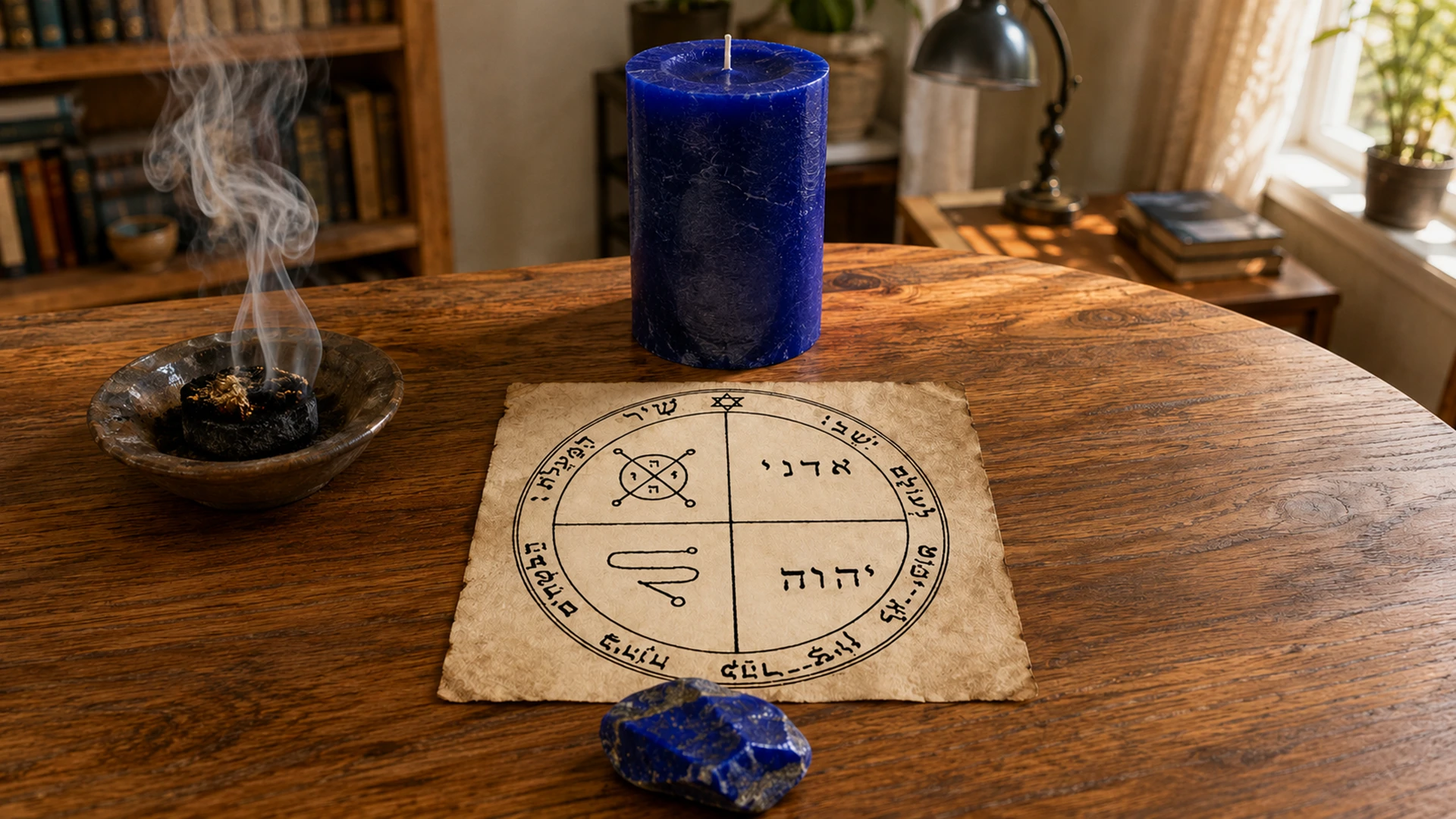
The Third Pentacle of Jupiter is documented as a pentacle of protection and command: those who carry it are defended, and the spirits of Jupiter are compelled to obey immediately upon beholding it. That dual function — shielding the operator while establishing authority over Jovian spirits — is what makes this Pentacle of Solomon distinct from its siblings under the same planet. Jupiter governs expansion, abundance, authority, and divine favour, and this pentacle channels those energies specifically into the practitioner's own protection and command over spiritual forces.
If you're new to Solomonic talisman work and want a broader view of how the full set is organized by planet and office, the complete guide to all 44 pentacles is a good place to ground yourself before going deeper here.
Construction and Symbolism of the Third Pentacle of Jupiter
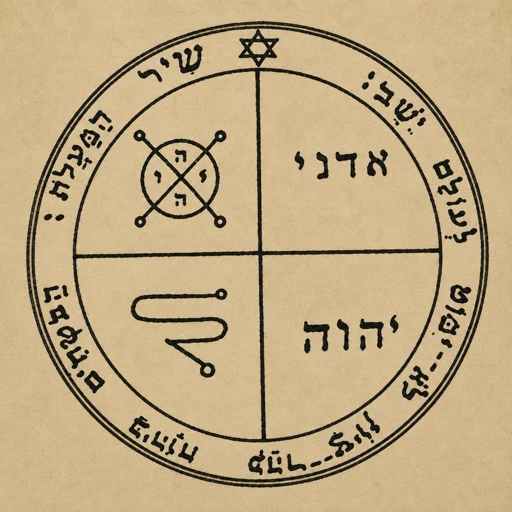
The figure bears three distinct layers of sacred inscription, each doing specific work. The first is the Magical Seal of Jupiter — the geometric talisman associated with the planet itself, carrying the concentrated current of Jovian authority. This seal is not merely decorative; in the tradition of the Key of Solomon, each planetary seal functions as a kind of signature or key that identifies the working to the spirits being called upon.
Within and around that seal sit two of the most foundational divine names in Solomonic and Kabbalistic practice: IHVH (the Tetragrammaton, the four-letter name of God) and Adonai (Hebrew for "Lord," used as a spoken substitute for IHVH in religious practice and as a name of direct invocatory power in magical contexts). Together, these two names carry a specific weight in the tradition — IHVH as the transcendent source of all divine authority, Adonai as the name by which that authority makes contact with the created world. Their pairing on this pentacle is not incidental; it frames the working as one backed by the full range of divine power, from the highest to the operative.
The third named element is the Seal of the Intelligence of Jupiter. In the planetary magic of this tradition, each planet has both a spirit (a raw, unconditioned force) and an intelligence (a ruling mind that governs how that force is directed). The Intelligence of Jupiter, called Iophiel in related texts, represents the ordered, wise, beneficent aspect of Jovian energy. Including its seal on this pentacle is a deliberate choice: it signals that the working calls on Jupiter's intelligence rather than its brute expansion, which is exactly right for a pentacle whose office is defence and orderly command rather than raw acquisition.
The verse anchoring this pentacle is Psalm 125:1: "They that trust in the LORD shall be as mount Zion, which cannot be removed, but abideth for ever." The selection of this verse is precise. It doesn't speak of victory in battle or the accumulation of blessings — it speaks of immovability and permanence. Mount Zion, in the Psalm's imagery, is the thing that simply cannot be dislodged regardless of what acts against it. That image maps directly onto this pentacle's office: the operator is not promised aggressive power, but something arguably more useful — a stability that the spirits cannot override and that adversity cannot shake. The verse functions as both a scriptural seal on the intention and a statement of what the operator claims by carrying this pentacle.
The Spiritual Office of the Third Pentacle of Jupiter
The documented office is protection of the invoker and immediate compliance from Jovian spirits. When the pentacle is shown to those spirits during a working, they obey at once. This is not a passive talisman — it's an instrument of active spiritual authority, and that authority is grounded specifically in the act of invoking. You're not just carrying something that keeps harm away; you're carrying something that makes the spirits of Jupiter answerable to you the moment they see it.
The protection it offers is specific to the context of invocation. The tradition describes it as defending the person who is in the act of calling upon Jupiter's spirits — not as a general ward against all harm in daily life. This distinction matters practically. You are not wearing it as an all-purpose amulet. You are holding or displaying it as an instrument of command and shelter during a ritual working, and within that context it carries real weight.
Jupiter Correspondences for This Working
Jupiter's planetary day is Thursday. Its metal is tin, its traditional color is blue, and its element is fire in its expansive, ordering aspect. Blue candles are the standard choice for Jovian workings, covering the full range from royal blue to deep indigo depending on whether you want to emphasize authority and command or wisdom and spiritual expansion. For this pentacle specifically, a deep royal blue aligns best with the commanding, protective nature of the office.
Crystals traditionally associated with Jupiter include lapis lazuli, sapphire, amethyst, yellow sapphire, and yellow topaz. For the Third Pentacle's specific office, lapis lazuli is the strongest choice. It has been associated with divine truth and royal authority for millennia, and its deep blue surface patterned with gold resonates directly with the pentacle's pairing of Jovian command and scriptural permanence. It grounds the working in both protective energy and the kind of clear, authoritative spiritual presence the Third Pentacle demands.
Jupiter's herbal correspondences include sage, dandelion, cedar, agrimony, and hyssop. For incense in this working, cedar is the right call. Cedar has a long tradition as a wood associated with endurance, sacred space, and divine authority — qualities that mirror the Mount Zion imagery of Psalm 125:1. Burning cedar during a Third Pentacle working reinforces the intention of permanence and unshakeable protection that the verse itself names.
Who Should Work With the Third Pentacle of Jupiter
The clearest use case is any practitioner who is actively working with Jovian spirits and wants both protection during that work and the assurance that those spirits will comply with their direction. If you're calling upon Jupiter's intelligences for expansion, opportunity, or authority in your life and you want those calls to land with force rather than trailing off into uncertainty, this pentacle gives you a stable foundation to work from.
It's also a strong choice for someone who has been doing Jovian work and feels like the results are inconsistent or that the current isn't fully responding. The Third Pentacle's command function is specifically about making the spirits answer — immediately and without evasion. If your workings under Jupiter feel like they're not quite reaching, this pentacle addresses that gap directly.
Where people sometimes misread this pentacle is in comparing it to the Sixth, which offers protection against earthly dangers through daily devotional practice. The Sixth is a general-purpose daily carry; the Third is a ritual instrument. If what you need is ongoing ambient protection in your day-to-day life, the Sixth is the better fit. The Third is for the moment you step into active spirit work and want both a shield and a writ of command. Similarly, if your primary intent is gaining wealth, honour, or material expansion, the Second or Fourth pentacles answer those needs more directly. The Third is not about what you gain from Jupiter — it's about what you're able to do within Jupiter's domain.
A Modern Ritual for the Third Pentacle of Jupiter
Timing
Perform this working on a Thursday during a Jupiter hour. You can find your Jupiter hour for any day using the planetary hour almanac at Modern Magic Grimoire. The first Jupiter hour after sunrise on Thursday is the strongest, as it aligns both the planetary day and the planetary hour. If that's not practical, any Jupiter hour on Thursday will hold the working well.
Materials
- Royal blue candle — Blue is Jupiter's color, and the depth of a royal blue specifically mirrors the commanding, protective quality of this pentacle's office rather than the softer abundance energy of lighter shades.
- Lapis lazuli — Placed near the pentacle to anchor the divine authority named in IHVH and Adonai; its historical association with sacred kingship and truth-telling makes it the crystal most aligned with this pentacle's command function.
- Cedar incense — Burned throughout the working to reinforce the Psalm 125:1 imagery of permanence and sacred endurance; cedar smoke signals to the spirits that the space is consecrated and the operator's authority is firm.
- The Third Pentacle of Jupiter (drawn or printed) — The central instrument of the working; held, displayed, or placed on the altar as the focus through which the working's intention and command are directed.
Setup
Arrange your altar simply: pentacle at center, blue candle behind it, lapis lazuli resting at the pentacle's base. Light the cedar incense first and let the smoke settle around the space before you light the candle. Take a moment to read Psalm 125:1 aloud — not as performance, but as an orienting statement that tells your mind what quality of space you're entering. The words "cannot be removed, but abideth for ever" are your frame. You are establishing the terms of the working before calling anything into it.
The Working
Hold the pentacle in both hands and feel its weight. Breathe evenly. The names on the figure — IHVH, Adonai, the Seal of the Intelligence of Jupiter — are not decoration; they are the authority behind the working. State your intention clearly, either aloud or in a held inner voice, naming both what you are calling on Jupiter for and the protection you claim for yourself in doing so. Then speak the following intention:
By IHVH and Adonai, by the Intelligence of Jupiter whose seal I hold, I stand as one who cannot be moved. The spirits of Jupiter are shown this sign and are bound to answer. I am defended in this working. My intention is firm and my will is clear. Let what I call forward come, and let nothing act against me in this hour.
Rest the pentacle on the altar, face up, with the lapis lazuli touching its edge. Allow the candle to burn for at least one full Jupiter hour. During this time you can hold silence, repeat the Psalm quietly, or simply stay present with your stated intention. The working is done through sustained focus, not through action.
Closing
When you are ready to close, extinguish the candle intentionally — not by blowing it out, but by snuffing it. Thank the Jovian current by name. You can carry the pentacle with you for the duration of whatever working you've opened, or store it wrapped in blue cloth on your altar until needed again. The lapis lazuli can remain on your altar or be carried as an ongoing anchor to the working's intention.
How to Work With the Third Pentacle of Jupiter Today
The distinctive feature of this pentacle's construction — the pairing of the Magical Seal of Jupiter with the Intelligence's own seal alongside both IHVH and Adonai — means that the figure itself carries a layered claim of authority that goes beyond simple planetary correspondence. You're not just invoking Jupiter generally; you're invoking the ordered, intelligent, directed aspect of Jupiter's force under the highest divine names. That layering is why careful reproduction of the figure matters: the three elements work together, and omitting any one of them changes what the figure is saying.
The tradition called for engraving this pentacle in tin — Jupiter's metal — at a Jupiter hour, with all the precision that implies. Most modern practitioners skip the metal engraving entirely and work with hand-drawn or printed versions on paper or parchment. This is a reasonable adaptation. What you're preserving is the figure itself, the names in their correct arrangement, and the verse as a seal on the intention. The metal and the engraving timing were ways of locking the planetary current into a permanent physical object. A carefully drawn paper version does a different kind of work — it's more temporary, more personal, more directly tied to your own hand — but it's fully usable and practitioners working this way consistently report clear results.
The office of this pentacle is not coercive in any ethically complicated sense — it doesn't curse, bind a person, or force an outcome against someone's will. Its command is directed at spirits, and the protection it offers is for the operator. You don't need to wrestle with whether it's appropriate to use; it's one of the more straightforwardly beneficial workings in the Jupiter set. What you do need to bring to it is clear intention about what you're invoking Jupiter for, because the pentacle creates a condition of authority and protection but doesn't specify the goal. That part is yours.
If you're early in your work with planetary timing, don't let the precision of Thursday and Jupiter hour feel like a barrier. The timing sharpens the working — Jupiter hour on a Thursday is genuinely the strongest window — but a working done with clear intention and proper focus on a slightly off timing will still carry force. The figure, the names, and the directed will are the core. Everything else is refinement.