Lapis Lazuli: Wisdom That Wants to Be Spoken
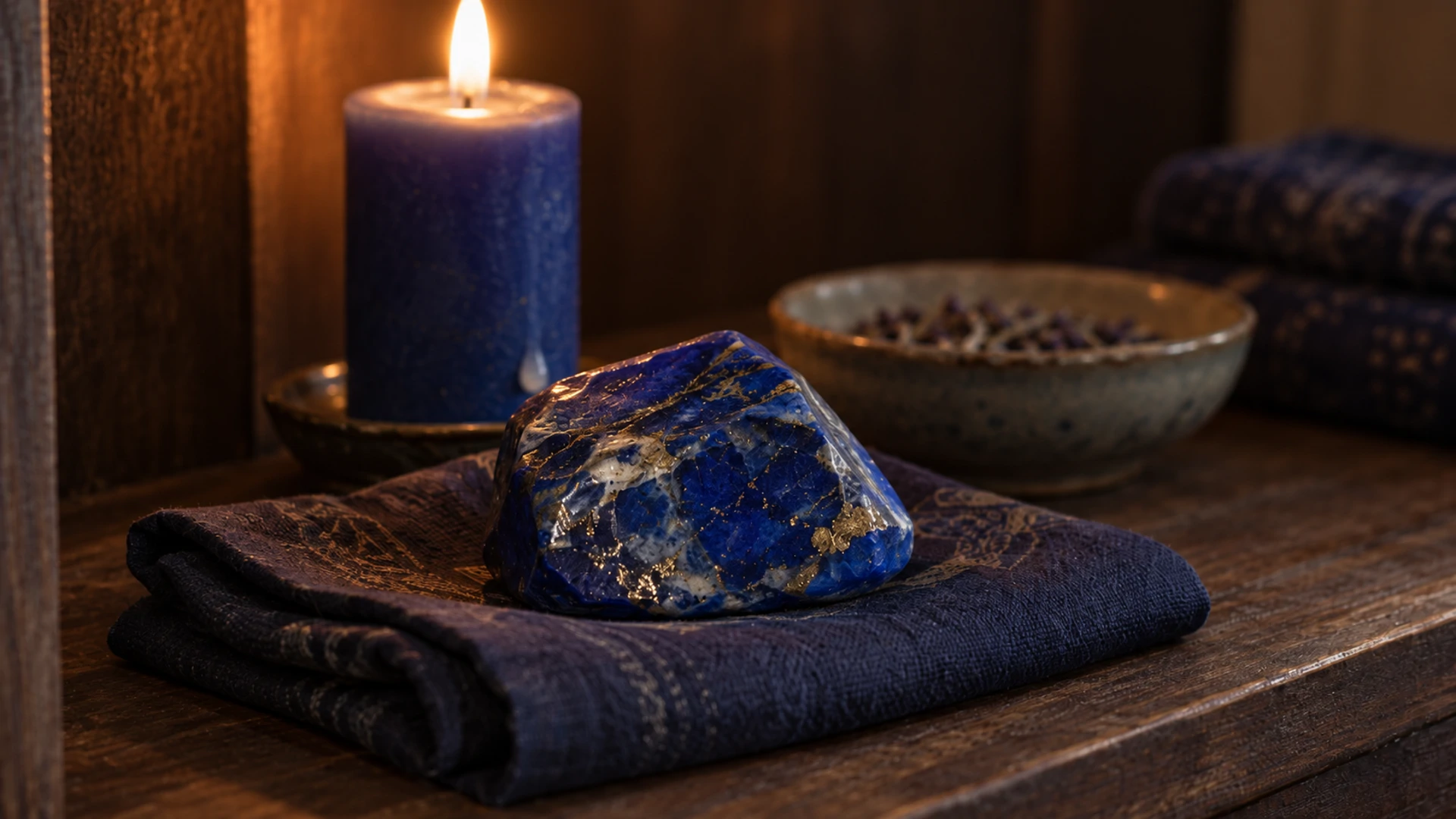
Lapis lazuli is the stone of ancient wisdom turned into honest speech — it bridges the third eye and the throat so that what you perceive doesn't stay locked inside, but comes out as the true thing you actually need to say.
Wisdom That Wants to Be Spoken: Why Lapis Lazuli Belongs in Intuition & Psychic Development
Most stones in the intuition category work on perception. They help you receive more clearly, or move through confusion, or still the mind enough to hear something you'd been missing. Lapis lazuli does something distinct: it asks you to speak what you know. Its mechanism is ancient wisdom turned into honest speech, and the anatomical map of that is written right into the stone's two chakra correspondences — the third eye and the throat. Not one or the other. Both, together, as one working.
That pairing puts it in a different functional position than its closest companions in this category. Amethyst works by quieting mental noise into clear, sober perception — psychic reception through calm rather than active awakening. That's a receiving posture. Lapis lazuli has a different orientation: perception that wants to move, to become language, to be said aloud or written down or offered to someone who needs to hear it. And blue kyanite does work the throat chakra — it provides instant, self-maintaining chakra alignment, and cuts through confusion via its blade-like structure to open honest communication. But kyanite's throat-chakra action is structural and mechanical. It clears the channel. Lapis lazuli's throat-chakra action is rooted in something older — a specific weight of history and tradition that makes the speech it supports feel less like clearing a blockage and more like drawing on a lineage.
Sagittarius is the zodiac sign most commonly paired with lapis lazuli across traditional and contemporary sources, which makes a certain kind of sense. Sagittarius is the sign of philosophy, long-range vision, and the impulse to teach — to take what you've understood and hand it outward to others. That's the same orientation as the stone itself. Not private illumination. Shared illumination.
Jupiter and Venus both appear in planetary correspondences across serious sources, with no strong consensus on which rules it. Some traditions emphasize Jupiter for its association with wisdom, truth, and expansion — the planet of philosophy and higher knowledge. Others emphasize Venus for beauty, artistry, and harmony, reflecting lapis's long history as a pigment and ornamental material. Both have genuine cases. If you're drawn toward timing your practice, a Jupiter hour carries the wisdom and truth-seeking quality that aligns most naturally with lapis lazuli's specific mechanism.
At 5 to 5.5 on the Mohs scale, lapis lazuli is softer than most stones in this category — a fact worth noting, since it's technically a rock rather than a single mineral, composed mainly of lazurite with flecks of pyrite and calcite. That composite nature is part of what makes it feel so layered. The golden pyrite flecks aren't a flaw or an impurity. They're part of what the stone is, visually and energetically — starlight in midnight blue, the kind of image that lands differently when you know those flecks are actual iron sulfide that crystallized inside the matrix over millions of years.
Afghan Blue, Not Chilean Pale: Choosing Lapis Lazuli
The single most important thing to understand before buying lapis lazuli is that not all of it is the same product. There's a wide quality range, and the top and bottom of that range are genuinely different stones in terms of appearance, durability, and market value. Fine Afghan-grade lapis shows a deep, saturated, uniform blue with minimal white calcite veining and visible golden pyrite flecks scattered through the matrix. That's what you're looking for. Chilean material — which makes up a large share of the affordable market — tends to be pale, heavily calcite-streaked, and lacking the density of color that makes Afghan lapis so visually striking. It isn't a lesser version of the same thing. It's a different-looking product at a different price point, and knowing that going in saves you from disappointment or from overpaying for something that doesn't match what you expected.
Chilean lapis is frequently dyed to compensate for its pale tone — a common and widespread practice that isn't always disclosed at point of sale. One way to check: look at any white calcite areas on the surface. On dyed material, those areas often show blue staining around the edges where the dye has bled into the lighter matrix. Genuine, undyed lapis will have clean white calcite patches that haven't absorbed color from their surroundings.
The other substitution worth knowing about is sodalite, which is sometimes sold as lapis, either deliberately or because less-experienced sellers genuinely can't tell them apart. Sodalite is also a deep blue stone with a similar visual weight, but it lacks the golden pyrite flecks that are one of genuine lapis's most reliable identifying features. If you hold a piece of "lapis" up to good light and see no trace of gold anywhere in the matrix — no metallic shimmer, no pinpoint flecks — look more carefully at whether you're holding sodalite instead. Sodalite is a beautiful stone in its own right, with its own correspondences and uses, but it isn't lapis, and the distinction matters when you're sourcing intentionally.
On care: because lapis is a composite rock rather than a single mineral, and because much of the commercial material has been dyed, your cleaning approach matters more here than with harder, single-mineral stones. Brief water contact is fine — a quick rinse is generally tolerated with no problem. What you want to avoid is prolonged soaking, which can affect the calcite within the matrix, and any acidic or chemical cleaners, which can strip color from dyed pieces and damage the surface of natural material. Skip the vinegar-based cleaning solutions entirely. A soft dry cloth is the safest regular maintenance. Store lapis separately from harder stones that could scratch its surface — at 5 to 5.5 Mohs, it will lose that fight against quartz, topaz, or corundum.
Three Practices for Speaking What You Know
The Honest Word
Use this when you know something true that you haven't said yet — not because you don't know how, but because the speaking of it feels like a risk.
Sit somewhere quiet with your lapis lazuli in your non-dominant hand. Light a blue candle — blue for the throat, for honest communication, for the channel you're opening. Close your eyes and place the stone at the base of your throat for a few breaths, feeling its weight there. Don't try to formulate what you're going to say yet. Just notice the sensation of the stone resting on that spot, and let yourself become aware of what you've been holding back. When it surfaces clearly, open your eyes. Speak it aloud to the candle — to the flame, to the room, to yourself. Not polished. Not prepared. Just the true thing, in your own words, said out loud in actual air. That's the practice. The speaking is the spell.
The Royal Seat
Use this when you've been doubting your own inner knowledge — deferring to others, dismissing your own perceptions, treating your own knowing as less credible than it actually is.
Lapis lazuli has been worn by royalty, clergy, and those who claimed formal authority over wisdom traditions for thousands of years. This practice borrows that lineage deliberately. Hold the stone in both hands and sit with your spine straight — the posture matters here, because the posture is part of the signal you're sending your own nervous system. Consider lighting a purple candle for authority and earned mastery. Breathe slowly and bring your attention first to your third eye — the center of your forehead — and hold it there until you feel some quality of presence or stillness there. Then move your attention down to your throat. Say, aloud: "I trust what I know." Not as an affirmation to be repeated until believed, but as a declaration made from that upright posture, with that old stone in your hands. Sit for as long as you need. Let the weight of the stone remind you that the knowing you carry isn't new — it's old, and it's yours.
The Star-Flecked Night
Use this when you're not trying to speak anything yet — when you need to receive first, in stillness, before you'll know what to say.
This is a contemplative practice built around the stone's own surface rather than any particular intention or declaration. Hold your lapis lazuli so a source of low light — candlelight works better than overhead light for this, silver or white — catches the pyrite flecks in the matrix. Let your gaze soften on those gold points of light the same way you'd soften your gaze looking at actual stars: not fixing on any single one, just letting the whole field exist. Breathe slowly. Don't ask a question and don't try to formulate an intention. Let the image — deep blue, gold flecks, candlelight moving — be the whole of the practice for ten minutes or more. What surfaces during that time, if anything, is what the practice gives you. If you work with a moon hour for your intuition work, this practice lands particularly well timed there — the receptive, inward quality of that hour matches exactly what this contemplation asks of you.
Mined From the Same Mountains for Seven Thousand Years
The Sar-e-Sang mines in the Badakhshan region of northeastern Afghanistan have been worked continuously for over 7,000 years, making them among the longest continuously operated gem mines in all of human history. That's not a figure of speech or a rough approximation — it's a well-documented archaeological fact, traceable through physical evidence found at sites across the ancient world. Lapis lazuli from those specific mountains traveled extraordinary distances in the ancient world, showing up in archaeological contexts far beyond any reasonable overland trading range for the period. The stone moved because people wanted it badly enough to move it.
One of the most recognizable uses of lapis lazuli in the ancient world is inlaid into Tutankhamun's burial mask — the deep blue sections of that iconic gold-and-blue face come from this stone. That single fact gives you a useful anchor for thinking about what lapis lazuli has meant across time: it was considered worthy of accompanying a pharaoh into death, of framing the face that would be remembered. That's not incidental decoration. That's a stone chosen for a specific purpose by people who took the correspondence of materials seriously.
The Sar-e-Sang mines are still operating today, which means the Afghan lapis lazuli you can source now comes from the same geographic deposit that supplied those ancient burial objects and royal adornments. The mountains haven't moved. The mineral hasn't changed. When you hold a piece of fine Afghan lapis, you're holding material from a source that has been considered significant by human beings for longer than most of the world's oldest cities have existed. That continuity is part of what gives the stone its particular weight — not as mystification, but as plain fact.
The Insight That Doesn't Stay Silent
Every stone in the Intuition & Psychic Development category offers a different way into this kind of work — some reach upward, some still the mind, some align, some transmute. Lapis lazuli's specific contribution is the bridge between inner knowing and outer expression. It's the stone you reach for when the insight already exists and the work is in the speaking of it.
If you want to see how lapis fits within the full range — all seven categories, all the stones in this one, the distinctions between them — the Crystal Compendium lays it out clearly. Go there next if you're building a practice and want to understand how these stones work in relation to each other rather than in isolation.