Sapphire: The Name That Changed Stones
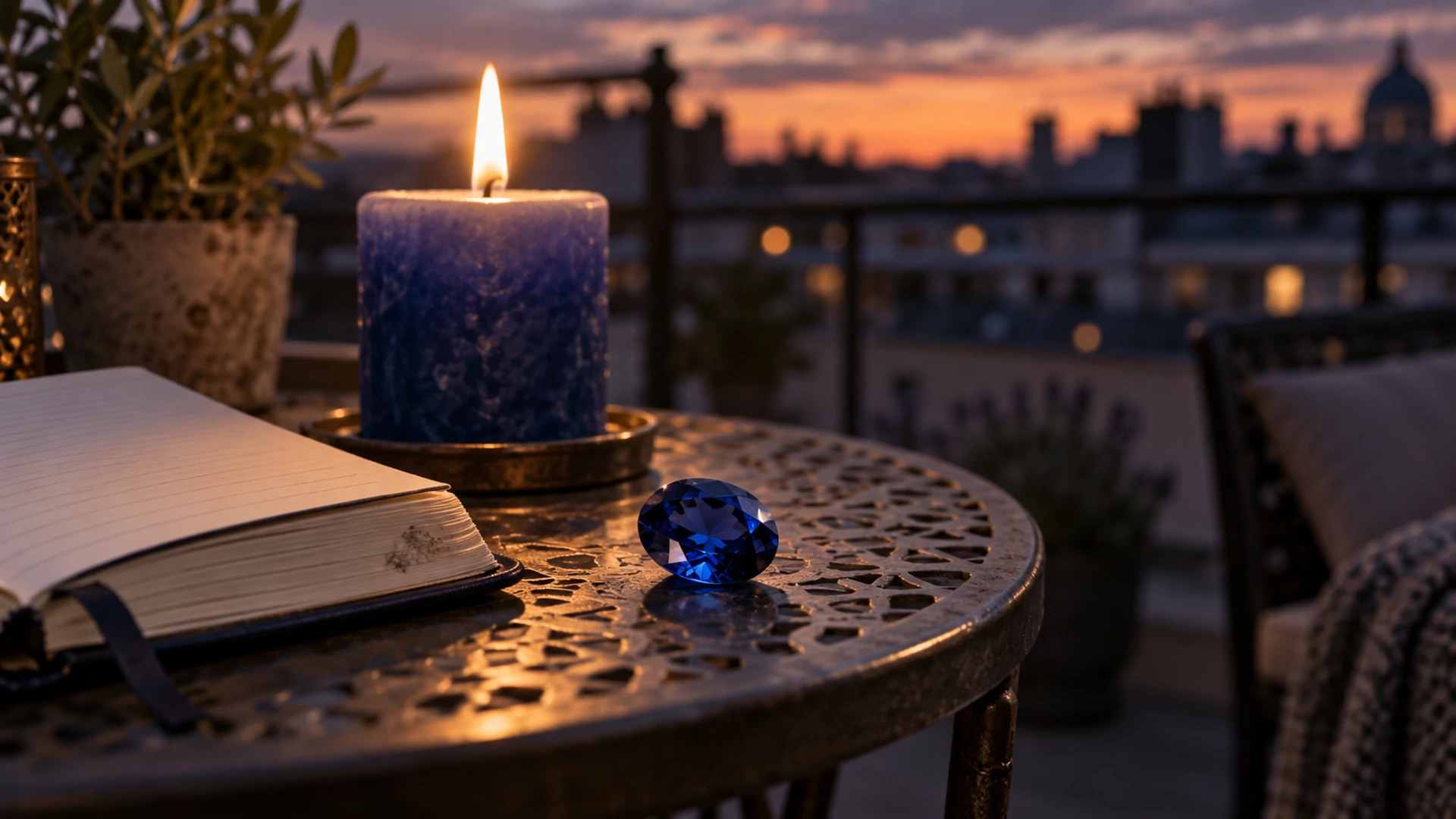
Sapphire is a stone whose identity has been quietly borrowed and returned across centuries. What it does in practice — sharpen the mind, steady judgment, hold you to honest conduct — is real and specific. Getting to that requires clearing away what belongs to a different stone entirely.
The Name That Changed Stones: Why Sapphire Belongs in Intuition & Psychic Development
Sapphire is the blue variety of corundum, an aluminum oxide mineral that forms in metamorphic and igneous rock. The blue comes from trace amounts of iron and titanium in the crystal lattice. Its sister stone ruby is the red variety of that same mineral — the only difference is what trace elements are present. At Mohs 9, it is one of the hardest natural materials that exists.
Its place in the Intuition & Psychic Development category rests on a specific mechanism: disciplined mental clarity and truth-seeking. That framing needs to be stated plainly upfront, because sapphire shares category space with stones that work very differently. Amethyst works by quieting mental noise into clear, sober perception — psychic reception through calm rather than active awakening. Sapphire is not that. Its clarity is not passive or soothing. It is focused and conduct-oriented, the kind of mental sharpness that asks whether you are actually living by what you say you believe.
The comparison with lapis lazuli needs to be made directly, because these two stones share something deeper than a category: they share a name. The ancient Greek word sappheiros and the Latin sapphirus almost certainly referred to lapis lazuli — the opaque blue stone flecked with gold — not to the transparent blue corundum gem known today as sapphire. Ancient sources describing sapphire tablets, sapphire oracle stones, sacred sapphire rings, and the sapphire stone of the biblical breastplate were in all likelihood describing lapis lazuli's history, not sapphire's. The two stones were simply not reliably distinguished in the early gem trade. At some point in the medieval period, as gem merchants developed better identification practices, the name migrated to the transparent blue corundum it now denotes, and it has stayed there since.
This matters for practitioners because the registers these two stones work in are genuinely different. Lapis lazuli's mechanism is ancient wisdom turned into honest speech — it pairs third-eye insight with the throat chakra, oriented toward speaking the true thing rather than only perceiving it, and it carries a genuinely ancient lineage. Sapphire's mechanism, by contrast, is newer in its own right and distinct in its quality: it is about disciplined thinking, honest self-assessment, and clarity that holds even under pressure. Both are wisdom stones. They are not interchangeable.
Sapphire's correspondences fall at the throat and third-eye chakras — a pairing that reflects both its cognitive clarity and its association with honest, precise speech. Its element is water. Its planetary ruler in most Western sources is Saturn, which fits: Saturn governs discipline, structure, and the slow accumulation of real understanding over time. Across traditions it is connected to Virgo and Libra, signs oriented toward discernment and balance. The September birthstone association is strong and consistent. Its color runs from pale cornflower through deep velvety blue depending on origin, and color saturation affects both its market value and, in magical practice, its felt intensity.
Kashmir Blue and the Synthetic Shelf: Choosing Sapphire
The most important buying reality for sapphire is that synthetic material is extremely common. Synthetic sapphire is chemically and physically identical to natural sapphire — same mineral, same hardness, same color — produced in a laboratory rather than the earth. It is sold legally, and at prices that make natural material look implausible by comparison. If the authenticity of origin matters to your practice, ask directly. A trustworthy seller will tell you whether a stone is natural, lab-created, or treated. There is no shame in working with synthetic material if you choose it knowingly, but it is worth choosing it knowingly.
Among natural sapphires, heat treatment is the norm rather than the exception. The vast majority of sapphire on the market — including fine, expensive material from reputable dealers — has been heated to improve color saturation and clarity. This is a widely accepted and generally disclosed trade practice, comparable to how ruby is routinely treated. Unheated natural sapphire exists and commands a premium, but it is not more magically potent by virtue of being untreated — what matters more is that you know what you are working with.
Kashmir sapphire is the benchmark that the entire trade has used for well over a century. The Kashmir deposits, found in what is now northern India, produced a deeply saturated, velvety blue material that has never been matched for quality. Those deposits are largely exhausted, which is why genuine antique Kashmir sapphire reaches extraordinary prices. For practical purposes, fine natural material from Sri Lanka — historically called Ceylon sapphire — is the most widely available high-quality alternative, with a typically lighter, more brilliant blue. Madagascar, Myanmar, and Australia are also significant modern sources.
On care: sapphire requires almost none. Mohs 9 means it resists scratching from virtually everything except diamond. It is water-safe, chemically stable, and carries no toxicity concerns. You can rinse it, wear it daily, submerge it briefly without worry. Store it separately from softer stones it might scratch — not to protect sapphire, but to protect everything else. The main thing to avoid is direct impact against another Mohs 9 or 10 material, since even an extremely hard stone can chip or cleave along the right angle. For practical daily use, sapphire is one of the lowest-maintenance stones you will own.
Three Practices for Disciplined Clarity
The Honest Ledger
Use this before a significant decision — not to figure out what to do, but to check whether you have been living in a way that is consistent with the values driving the choice.
Hold the sapphire in your non-dominant hand and set a blue candle at arm's length. Write at the top of a page the value or principle the decision is supposed to honor — fairness, loyalty, honesty, growth, whatever is actually at stake. Then list, plainly and without softening language, three to five actions you have taken in the past month that either support or contradict that principle. The goal is not self-flagellation. The goal is to make sure your stated values and your actual behavior are aligned before you commit to a direction. When the list is complete, read it once with the stone pressed to your sternum, just below the throat. Burn the list if it contains anything you would not want someone else to read — and let the burning be intentional, not just disposal.
The Steady Verdict
Use this when a judgment call is being demanded faster than your clarity has arrived — when someone needs an answer and the pressure of the moment is threatening to override your actual thinking.
Keep the sapphire in your dominant hand during the conversation or the moment of pressure, held firmly enough that you can feel its weight. Before you respond, press your tongue briefly to the roof of your mouth — a small physical action that interrupts the reflex to speak before thinking. Then ask yourself one question only: What do I actually know, as distinct from what I am afraid of? Answer that question to yourself before you answer anyone else. If you have time and the situation permits, work this practice during a Saturn hour, which sharpens the stone's correspondence with structured discernment. The practice is not about slowing down indefinitely — it is about making sure urgency does not become a substitute for clarity.
The Kept Word
Use this when you have already committed to saying or doing something and the moment of follow-through has arrived, whether or not it is still comfortable.
Place the sapphire on a piece of paper on which you have written the specific commitment — not the aspiration behind it, the actual words you said or wrote. Light a single indigo candle and read the commitment aloud once, in full, as it was originally stated. Then sit for five minutes in silence with one hand on the stone and one hand flat on the paper. The silence is the practice: it is the space where you allow what you committed to to be real, without revising it in your head. When the five minutes are done, speak the commitment aloud a second time, and then go do the thing. Use bay laurel as an optional addition — a single leaf placed beneath the paper, for the connection between speech, honor, and the weight of a word that has been spoken.
A Name Borrowed From Another Stone
The word that gave sapphire its name almost certainly referred to something else entirely. Greek sappheiros and Latin sapphirus described a vivid blue stone flecked with gold — a description that matches lapis lazuli precisely, with its deep blue body and characteristic pyrite flecks. The transparent blue corundum now known as sapphire does not match that description at all. Ancient and classical writers were almost certainly writing about lapis lazuli when they described sapphire tablets, sapphire on sacred rings, sapphire among the gemstones held in reverence for their clarity and divine connection.
At some point during the medieval gem trade — once merchants had better tools and broader access to stones from different sources — the name migrated. Transparent blue corundum became sapphire in the European trade, and it has held that name ever since. Once it had its own clear identity, sapphire built a genuine tradition. Medieval clergy wore sapphire rings as symbols of heaven and divine wisdom, connecting the stone's deep blue to the celestial vault and to the idea that a religious leader's judgment should be clear, elevated, and untainted by earthly self-interest. This is a different register from the ancient lapis tradition, but it is distinctly sapphire's own — and it maps cleanly onto the stone's actual mechanism, which is wisdom that holds itself to a standard of conduct rather than wisdom that simply arrives.
The amethyst bishop's ring has its own long history in the same tradition — amethyst was worn by medieval clergy for its connection to sober, clear perception — and sapphire's role in that world ran alongside it. Two different blue stones, two different registers, both ultimately about clarity in service of integrity.
Wisdom That Answers to Conduct
What makes sapphire distinct in the Intuition & Psychic Development category is that its clarity is not passive and it is not given freely. It is earned through honest self-examination and sustained by consistent behavior. That is a different register from almost every other stone in this group, and it is genuinely different from the ancient mystical wisdom associated with lapis lazuli, even though the two stones share a name across centuries of confusion. Sapphire's insight has conditions: it asks what you have actually done, not just what you intend.
If you want to see where this stone sits alongside the full range — across protection, cleansing, healing, empowerment, abundance, love, and intuition — The Crystal Compendium: Seven Paths to Stone Magic is the place to start.