Blue Topaz: Composure Under Every Eye
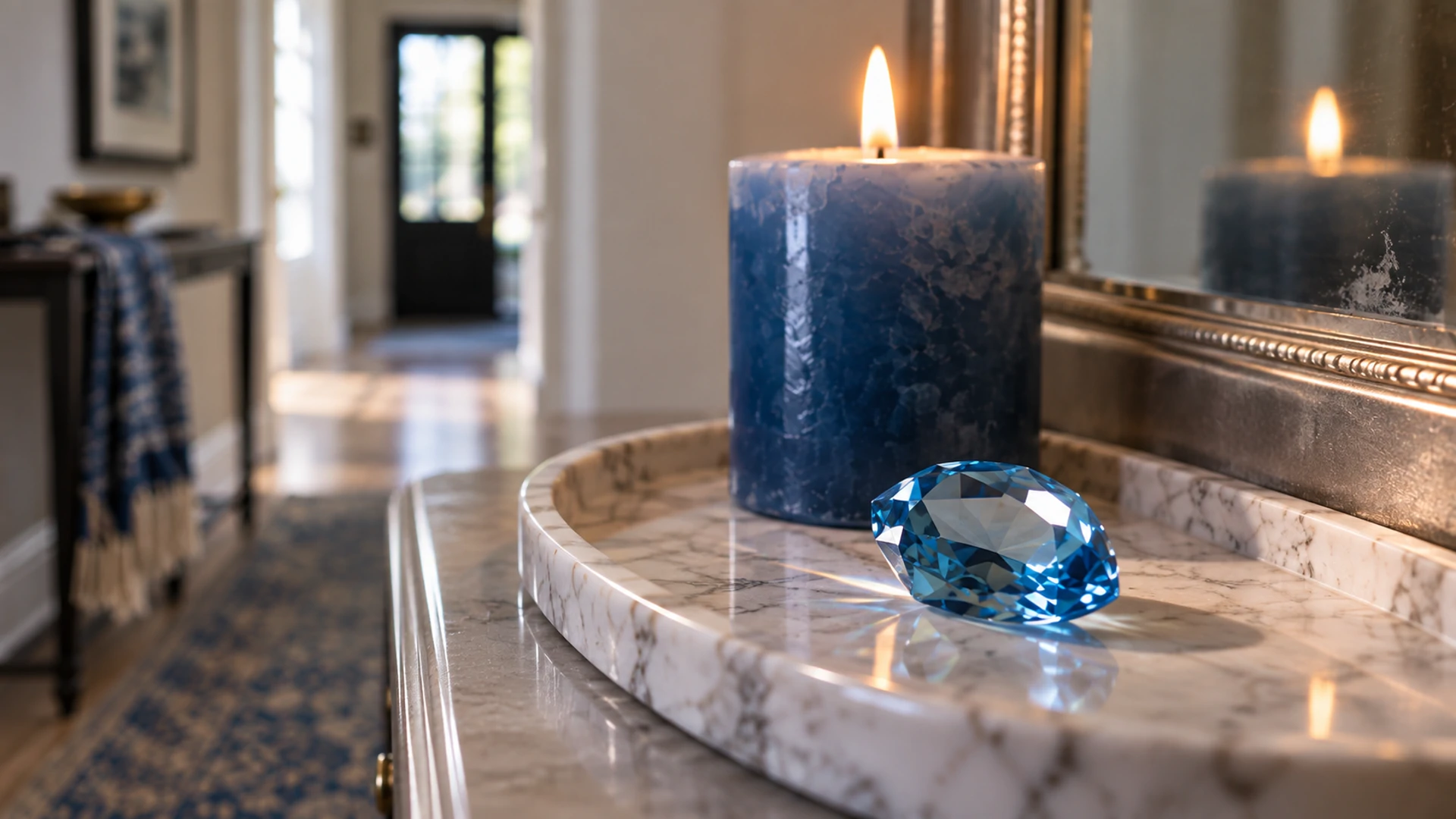
Blue topaz works on a specific kind of anxiety: the kind that surfaces when eyes are on you. That alone sets it apart from the other healing stones in this category.
Composure Under Every Eye: Why Blue Topaz Belongs in Healing
The anxiety blue topaz addresses isn't vague or general. It's the tightening in your chest before you walk into a room where people are waiting to evaluate you — an interview, a stage, a camera, a presentation. It's the self-consciousness of being watched and knowing it. That's the stone's specific register, and it's why it belongs in the Healing category rather than the Empowerment category, even though the two often get conflated when people talk about performance nerves.
It helps to compare it directly with its closest neighbor in this category. Aquamarine calms communication under real external pressure — public speaking, travel, danger — and carries centuries of use as a talisman for steadying courage in situations of genuine risk. Its register is pressure and stakes. Blue topaz operates in a related but genuinely different territory: visibility and being watched. The difference is subtle but real. If you're terrified your ship will go down in a storm, aquamarine is the stone sailors reached for. If you're terrified people will see you stumble and judge you for it, that's blue topaz's domain. Both touch on communication and both ease nerves, but one is about surviving pressure, and the other is about being seen clearly — by others and, eventually, by yourself.
The throat chakra is blue topaz's primary center, which makes sense given how much of that visibility anxiety lives in the voice. A quavering tone, a mind that goes blank mid-sentence, words that come out wrong under scrutiny — these are the experiences this stone is most consistently associated with supporting. Its connection to honest self-expression and the calming of anxious speech has made it a natural fit for anyone whose work requires them to be articulate in high-stakes moments.
The third eye is a genuine secondary center for this stone, and it's worth being honest about that. Blue topaz carries a real secondary thread toward Intuition and Psychic Development, not just healing. That third-eye pull shows up in how the stone is used: not only for calming anxiety before you speak, but for gaining clarity on what you actually think and perceive before you're asked to share it. The two purposes connect logically. Anxiety around visibility often traces to uncertainty about your own perspective — you're not sure what you really think, so being asked to express it publicly feels exposing. The third-eye association addresses the root of that uncertainty rather than just its surface symptoms.
In terms of planetary and elemental correspondences, blue topaz sits at a junction that reflects its dual focus. Mercury and Venus are both cited across sources, with Mercury governing clarity of thought and communication, and Venus contributing the relational warmth that makes honest expression feel safe rather than threatening. The water element appears consistently, which fits both the stone's color and its emotional register — water governs feeling, perception, and the kind of intelligence that operates beneath rational analysis. These correspondences aren't arbitrary decorations. They tell you something about when to reach for this stone and what kind of working it genuinely supports.
Sky, Swiss, or London: Choosing Blue Topaz
The single most important thing to know before buying blue topaz is that the vivid blue color almost certainly isn't natural. Natural blue topaz does exist, but it's rare and typically appears in very faint, pale tones — not the saturated blues you see in most jewelry. The vast majority of blue topaz on the market today is colorless topaz that has been irradiated and then heat-treated to develop a stable, permanent blue color. This is a fully disclosed, widely accepted industry process, not a deception. The color doesn't fade, doesn't require special handling to maintain, and is considered completely safe. But it's worth knowing what you're working with.
Within that treated category, there are three recognized grades. Sky Blue is the lightest treatment, producing a soft, pale blue reminiscent of a clear winter sky. It's the most affordable and the most widely available. Swiss Blue is treated more intensively to produce a vivid, medium blue — bright and saturated without reaching into darker territory. London Blue is the deepest of the three, a dark, cool blue with slightly greenish or grayish undertones depending on the specimen. It's the most valuable of the treated grades and also the rarest. For magical practice, the grade you choose is less about any inherent difference in energy and more about which color resonates with your intention. Lighter tones feel airier and suit the mental-clarity work; the deeper London Blue carries a more grounded, composed quality.
People sometimes confuse blue topaz with aquamarine because both are pale blue gemstones associated with the throat chakra and calm communication. But they're entirely different minerals. Aquamarine is a beryl, a family that also includes emerald. Blue topaz is an aluminum fluorosilicate. The difference in structure matters practically: topaz has perfect cleavage in one direction, meaning it can split cleanly along that plane if struck at the wrong angle. Its Mohs hardness is 8, which is genuinely durable for everyday wear — but hardness measures scratch resistance, not resistance to impact. A ring stone that takes a sharp knock at the right angle can chip or cleave even at Mohs 8. Pendants and earrings carry less risk than rings in this regard.
For care, brief water contact is fine. You can rinse the stone without concern. What to avoid is prolonged soaking, ultrasonic cleaners (which can work along that cleavage plane), and harsh chemical exposure from perfumes or cleaning products if the stone is set in jewelry. Store it separately from harder stones like diamond or sapphire that could scratch a polished surface, and from softer stones it might scratch in return. For energetic cleansing, moonlight, sound, and smoke all work well without any risk to the stone.
Three Practices for Being Seen Clearly
The Composed Word
Use this practice in the minutes immediately before any moment of being evaluated or watched — an interview, a presentation, an audition, a difficult meeting where you know all eyes will be on you.
Hold the blue topaz in your non-dominant hand and press it gently to your throat for a few breaths. The point isn't to perform calm — it's to locate it. Feel the stone's weight as a physical anchor for your attention. As you breathe, bring your awareness specifically to your throat: soften any held tension there, and let your exhale be slow enough that you can feel it travel through your chest. If you have a few minutes, light a blue candle and set the stone at its base. State your intention aloud in one clear sentence — not a wish, but a statement of what you're bringing into the room with you. Carry the stone in your pocket or hold it until the moment begins.
The Clear Insight
Use this practice when you need to know what you actually think before you're asked to speak it publicly — before writing something that will be read, before a conversation where your opinion will matter, or before any situation where you've been feeling uncertain or foggy about your own perspective.
Sit somewhere quiet and place the blue topaz on your third eye — the point between and slightly above your eyebrows — while lying down, or simply hold it there with one hand if sitting. Breathe without forcing anything. The goal in this practice isn't to generate ideas but to clear the static that's been muffling your actual perception. Stay with it for five to ten minutes. If a Mercury hour is available, working within it sharpens the stone's communication and clarity current. When you feel a thought settle into focus — even a partial one — open your eyes and write it down before examining it. The act of writing anchors what the stone helped surface.
The Steady Reflection
Use this practice after a moment of visibility has passed — not before — when the residual self-consciousness or self-criticism from being seen is still running through your mind and you need to set it down.
Fill a small bowl with cool water and rest the blue topaz beside it (not submerged — this is symbolic, not a water elixir). Sit with the bowl and the stone and let yourself replay whatever happened without trying to change the memory. Then, deliberately redirect your attention to your breath and the physical temperature of the stone in your hand. Lavender burned nearby — as incense or a dried bundle — helps draw down excess nervous energy and signal to your body that the moment of performance is genuinely over. The stone's role here is less about activation and more about landing: it gives the residual anxiety somewhere to go other than into more rumination. Hold it until you feel the loop of self-review begin to quiet.
A Modern Color for an Ancient Stone
Topaz as a mineral has a long history — ancient Egyptian tradition associated the golden and yellow varieties with solar protection, and the stone appears in classical Greek and Roman sources under various names. But that history belongs to the yellow and orange members of the family. Blue topaz as it's commonly understood today — the vivid, commercial blue that fills jewelry cases worldwide — is essentially a twentieth-century phenomenon. The irradiation and heat-treatment process that produces stable blue color in colorless topaz is a modern industrial development, not a technique available to ancient lapidaries. The blue variety most people encounter carries no ancient lineage of its own.
This matters because honesty about a stone's actual history is part of working with it clearly. You can absolutely work with a stone whose primary cultural meaning was built in the last several decades — blue lace agate is another example of a stone whose metaphysical reputation developed largely in the modern era rather than ancient practice. The resonance is real regardless of when it was first articulated. But borrowing golden topaz's ancient solar associations and applying them to the blue variety as if they shared a continuous tradition is a distortion. Blue topaz's history is brief. Its clarity, its throat-and-third-eye correspondences, and its specific mechanism around visibility and being seen — those are what it actually brings. That's enough.
Steady in Front of an Audience
Blue topaz's specific gift is narrow in the best sense. It doesn't try to heal everything. It addresses one particular kind of fear — the fear of being watched, evaluated, and found wanting — and it does that with a clarity that most broad-spectrum healing stones can't match because they're not designed for it. That specificity is exactly what makes it worth understanding rather than just collecting.
If you want to see where blue topaz sits in relation to every other healing stone in this category — and how those seven categories map onto each other as a whole — the place to go is The Crystal Compendium: Seven Paths to Stone Magic. It's the fuller picture this stone belongs to.