Moss Agate: The Stone for What You Just Planted
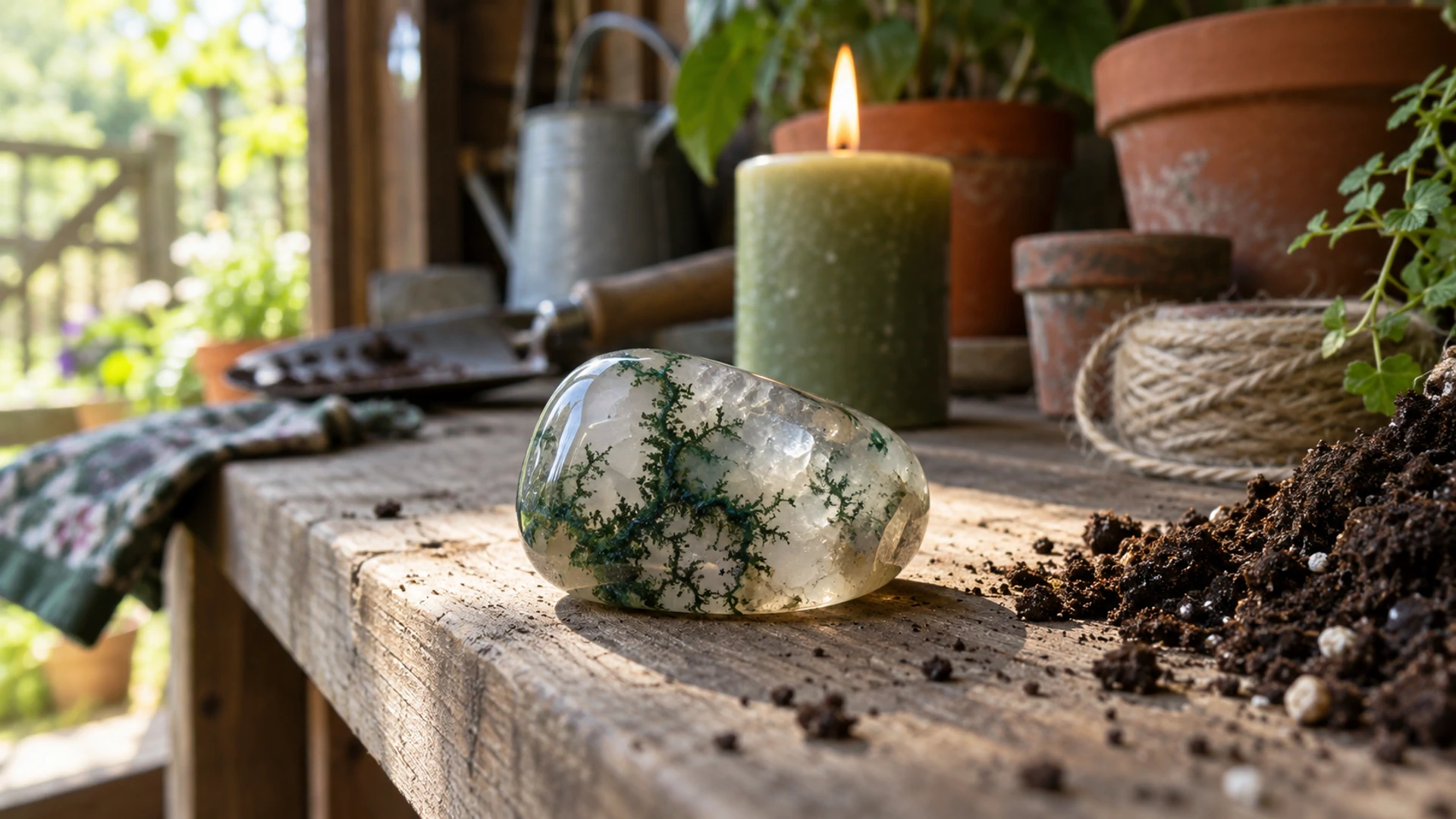
Moss agate is the abundance stone for the stage before abundance has arrived — the planting, not the harvest. If you have just started something and need the patience and steadiness to tend it until it takes root, this is the stone for that.
The Stone for What You Just Planted: Why Moss Agate Belongs in Abundance
Moss agate's place in the abundance category is not about wealth already flowing or opportunity arriving by luck. Its mechanism is growth from a new planting — patient tending of a venture, habit, or income stream at its earliest stage, before it has borne any fruit. That specificity matters, because it draws a clear line between what moss agate does and what neighboring stones do. Green jade works through steady accumulated prosperity — wealth that builds over time through harmony and right conduct. Moss agate works earlier than that. It belongs in the ground before the seed has even germinated, not after the tree is already producing.
Before getting into what moss agate is spiritually, it helps to know what it is physically — and what it isn't. Despite its name, moss agate is not a true agate. True agates are defined by concentric banding, the layered ring structure formed as silica-rich fluids fill a rock cavity in stages. Moss agate has no such banding. What it has instead are dendritic inclusions — branching, tree-like formations of manganese or iron oxide that grew through the stone's chalcedony base during formation, producing patterns that look remarkably like moss, ferns, or the trailing roots of a plant. Technically it is a dendritic chalcedony, and calling it an agate is a trade-name convention, not a mineralogical description. This is not a quality concern — it's simply an accurate one, and knowing it helps you understand why moss agate looks the way it does.
The inclusions that give moss agate its name typically appear in shades of green, though red, brown, and occasionally blue formations occur depending on the specific mineral content. The base stone ranges from translucent to milky white chalcedony. Sources include India, the USA, and Brazil, and the stone forms in rock cavities where mineral-laden fluid deposits its branching patterns over time. That geological process — slow, patient, incremental growth from a dissolved source into solid form — is the physical reality that its spiritual reputation mirrors.
In terms of correspondences, Earth is moss agate's element, which fits immediately given its visual and mechanical connection to growth and the land. Some traditions associate it with the heart, reflecting its use in emotional grounding and care for living things, though this is not a universal assignment. Virgo is the zodiac sign most consistently cited for this stone — precise, attentive, service-oriented, the sign that shows up and does the work even when no one is watching. Venus governs it as a planetary influence, connecting its nurturing quality to something receptive and relational rather than driven or aggressive. These correspondences don't need to be memorized as a checklist. Together they describe a stone built for patience, care, and slow-but-real development — everything the early stage of a serious effort demands.
Reading the Inclusions: Choosing Moss Agate
Genuine moss agate has depth. The inclusions sit inside the stone — suspended within the chalcedony matrix in a way that gives them a three-dimensional quality. When you tilt the piece in light, you can see the branching formations at different layers within the stone, not just on its surface. Imitation material, which sometimes appears in the lower price ranges, tends to show patterns that look too regular, too symmetrical, or that sit flatly on the stone's surface rather than living inside it. The real thing looks more like something discovered than something designed.
There is one trade fact worth knowing before you buy: heating moss agate oxidizes its iron content, and this oxidation shifts the green inclusions toward reddish, orange, or mocha tones. This is where the nickname "mocha stone" originates — it refers specifically to heat-treated moss agate rather than a different mineral. Some sellers offer mocha stone as a distinct product, which it effectively is in terms of appearance, but it begins as moss agate. Neither form is fraudulent, but if you want the classic green-included material specifically, look for sellers who disclose whether the stone has been treated.
On durability: moss agate sits at Mohs 6.5 to 7, which puts it comfortably in the range of daily-wear jewelry. It holds up to routine handling, is water-safe, and carries no toxicity concerns for regular use. The one caveat, as with most chalcedony pieces, is to keep it away from harsh chemical cleaners. A soft damp cloth is all it needs. For energetic cleansing, moonlight or sound work well — this is a stone tied to earth and growth rather than fire, so smoke cleansing with a grounding herb fits naturally if you prefer that method.
Three Practices for the Earliest Stage
The First Planting
Use this practice on the day you formally begin something — the day you register a business name, write the first entry in a new project journal, or take the first concrete step toward an income stream you have only existed in your head until now.
Hold your moss agate in both hands for a moment before anything else happens. State your intention plainly — not as a wish, but as a description of what you are beginning. Then set the stone somewhere it will stay: on your desk beside the project, in a small dish near your workspace, or literally in soil if your venture is an actual garden. If you want to add weight to the working, light a green candle beside the stone and let it burn while you do the first real task of the new effort — not while you sit with the candle, but while you work. The candle marks the start. The work is the magic.
The Patient Tending
Use this as a recurring check-in — monthly works well — for something that is already growing but has not yet matured enough to show results you can measure.
Pick the same day of the month each time, ideally a day that falls during a waxing moon phase to support continued growth. Sit with your moss agate and ask yourself three things honestly: What has actually moved since last month, even if slightly? What needs attention that I have been avoiding? What am I expecting too soon? You don't need to write the answers down, though some people find that useful. The point is to make contact with where the thing actually is, not where you wish it were. Hold the stone during this review and let its weight remind you that real growth moves at its own pace. If you want to add an herbal element, basil dried and placed near the stone works well for ongoing prosperity work — it's a practical Mars-driven herb, which pairs productively with moss agate's patient Venus energy.
The Rooted Ground
Use this practice when your financial goal feels abstract or disconnected from real life — when you are thinking about money without feeling grounded in the actual earth you are trying to grow something from.
Take your moss agate outside if you can, or to a potted plant if you cannot. Press the stone briefly into real soil — a garden bed, a planter, a patch of ground you can reach. Hold your intention in mind while the stone makes contact with the earth. If you have a specific financial goal attached to the venture you are tending, name it plainly while doing this — not as a demand, but as a statement of direction. Leave the stone in contact with the soil for a few minutes, then retrieve it. Some practitioners bury it temporarily, overnight or for a few days, before working with it directly. If you want to time this working for maximum support, Venus hour on a Friday is the natural fit given the stone's planetary correspondence. The practice works regardless of timing — but if you have the option, it adds coherence.
The Gardener's Stone
Moss agate's folk reputation is specifically agricultural. The tradition that placed this stone near seeds or buried it in fields for a bountiful harvest is not an invented romantic connection — it reflects the stone's actual historical use as a working talisman for people whose livelihood depended on what grew. The stone looked like what they needed: roots, moss, living green things branching through a clear medium, full of growth already caught mid-motion. That visual correspondence made it a natural choice for anyone beginning a growing season and hoping for a good one.
In Britain specifically, a good-luck association with moss agate is documented as far back as the late eighteenth century. This is not a deep ancient civilizational lineage — moss agate does not carry the millennia of continuous sacred use that some other stones in this category do, and there is no honest reason to claim otherwise. What it has instead is a genuine, regionally documented folk tradition tied directly to the earth and to the hope that what you plant will grow. That is a narrower but more accurate history, and for a stone whose entire mechanism is about doing the real early work of something rather than reaching for inflated significance, a focused and honest history fits.
Abundance at the Seed Stage
Not every abundance stone targets the same moment. Moss agate is built for the stage before things work — before you have income, traction, proof, or results. It asks for the kind of faith that is not passive waiting but active tending: showing up, checking in, keeping conditions favorable for something that is growing beneath the surface even when you cannot see it yet. That is a specific and genuinely difficult form of abundance work, and this stone is well suited to it.
If you want to see where moss agate fits alongside the rest of the stones in this category — and how the Abundance path sits within the full range of crystal work — The Crystal Compendium: Seven Paths to Stone Magic maps all seven categories together in one place.