Malachite: The Stone That Won't Let You Look Away
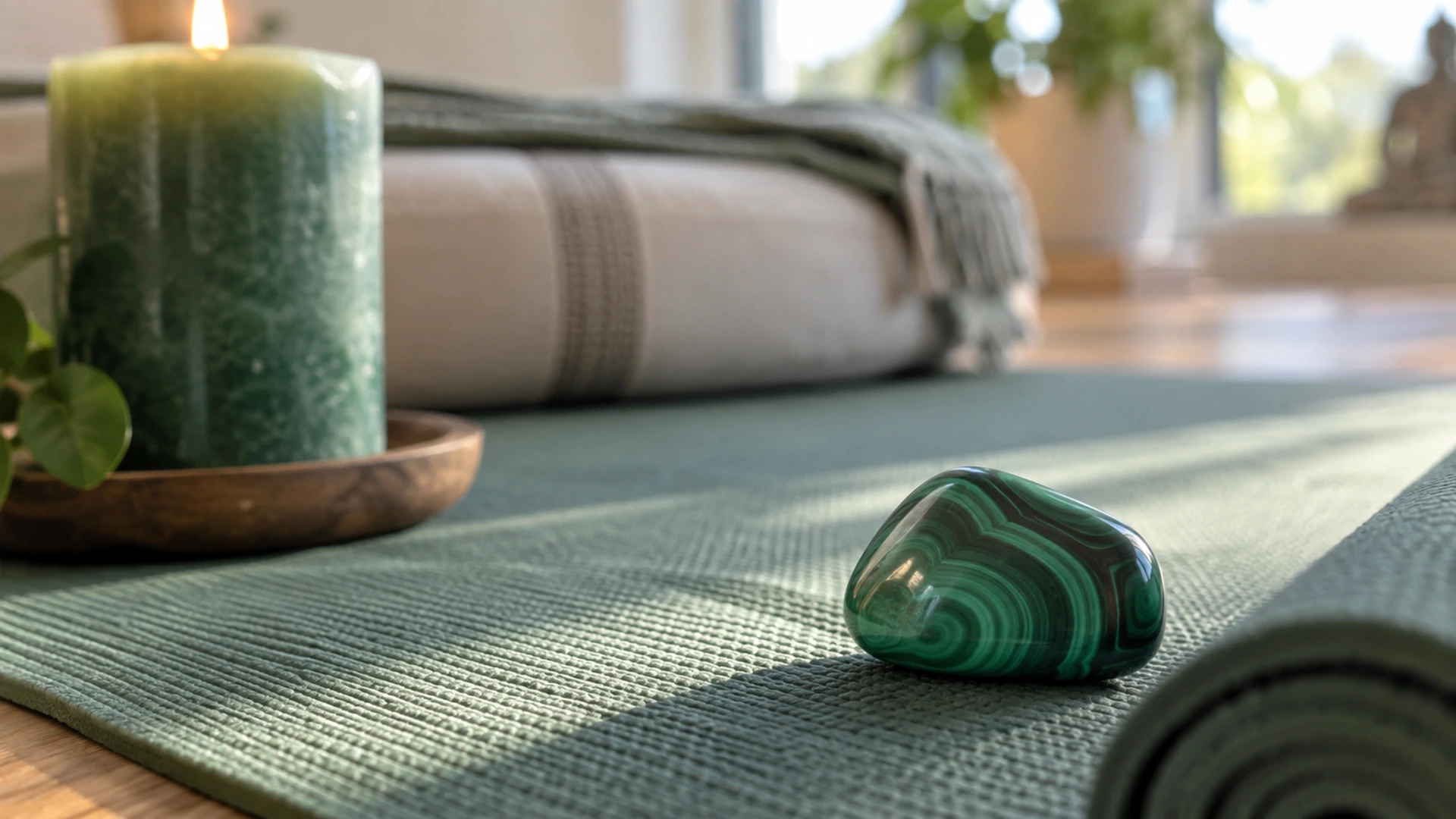
Malachite is a copper carbonate mineral with a vivid banded green pattern, a Mohs hardness of 3.5 to 4, and a reputation in healing work for surfacing what's buried rather than smoothing over it.
The Stone That Won't Let You Look Away: Why Malachite Belongs in Healing
Most stones in the Healing category work quietly. Blue Lace Agate soothes anxiety in self-expression, especially for relearning to speak after being silenced or dismissed. Mangano Calcite offers gentle, unconditional-feeling tenderness for shame and self-worth, with no confrontation required. Malachite is different. It doesn't soften first and heal quietly in the background. It brings buried material to the surface, sometimes uncomfortably, and that confrontational quality is the mechanism rather than a side effect. This is not a stone that lets you avoid what needs healing.
That specificity is exactly what puts malachite in the Healing category rather than anywhere else. Healing isn't only about comfort — sometimes it's about making what's been buried visible enough to actually work with. Malachite does that. Emotional patterns that have settled deep, old wounds that have calcified beneath layers of ordinary functioning, grief or resentment that never quite got processed — malachite tends to pull on those threads. It creates the conditions for genuine emotional work rather than the conditions for rest.
This same intensity is also why malachite carries a real secondary quality in Protection. The same force that surfaces buried patterns also tends to hold a kind of boundary around the person doing that difficult work. These aren't separate functions running in parallel — they come from the same place in this stone. Doing deep emotional excavation requires a protected space to do it in, and malachite, in practice, seems to provide both the excavation and the containment.
Its correspondences reinforce this picture. Malachite resonates with the heart chakra and the solar plexus chakra together — the heart for the emotional material being surfaced, the solar plexus for the personal will required to face it. Its element is Earth, grounding that otherwise destabilizing process of bringing buried things up into contact with everyday life. Its primary planetary ruler is Venus, which governs the heart's domain: love, value, what we hold close. But Pluto is also cited alongside Venus for malachite, and the association makes sense — Pluto governs transformation through confrontation with what's been hidden, exactly the mechanism this stone works through. Its signs are Scorpio and Capricorn: Scorpio for the willingness to go into the depths, Capricorn for the discipline to stay steady while doing it.
Beautiful and Toxic: Choosing and Handling Malachite Safely
The single most important thing to know before working with malachite is this: raw malachite dust should never be inhaled or ingested under any circumstances. Cutting, sanding, grinding, or a piece that breaks apart all release copper carbonate particles that are genuinely harmful. This is not a fringe concern or an overcautious disclaimer — it's the reason malachite should only ever be handled in its polished, sealed form, and why anyone who works with raw malachite in lapidary or craft settings must use appropriate respiratory protection. Polished malachite is safe for normal handling, wearing as jewelry, and placing on the body during meditation. Raw, unsealed material is not in the same category.
The second non-negotiable: malachite should never be used to make gem elixirs or infused water, regardless of whether the stone is polished. The copper content leaches even through a sealed surface over time when submerged. There is no safe version of drinking malachite-infused water. If you work with crystal elixirs regularly, malachite is one of the stones that simply doesn't belong in that practice.
Choosing a Good Specimen
Once the safety picture is clear, choosing malachite becomes a genuinely pleasurable exercise. The stone's banded, ring-like green patterns — concentrically layered, varying from pale mint to deep forest green — are part of its natural structure, formed as copper-rich groundwater deposits in layers inside rock cavities. No two pieces are identical. When choosing a tumbled stone or carved piece for healing work, look for good definition in the banding and a fully sealed, smooth surface. Rough or partially finished pieces are best avoided for hands-on work.
Its softness is worth taking seriously as a practical matter. At Mohs 3.5 to 4, malachite scratches easily and should be stored separately from harder stones rather than in a general crystal dish. Quartz, tourmaline, and most other stones in a typical collection will scratch malachite on contact over time. A separate pouch or a lined compartment keeps the surface intact. Brief water contact for rinsing is generally tolerated, but prolonged soaking isn't recommended — keep it dry as a general rule, and clean with a soft cloth rather than anything abrasive.
Three Practices for Surfacing What's Buried
The Surfacing
This practice is for deliberately bringing a buried or long-avoided emotional pattern into conscious awareness — and it should only be undertaken when there is real space and readiness to feel what comes up, not in a rushed moment between obligations.
Sit somewhere you won't be interrupted, with a polished malachite piece resting on the surface in front of you rather than held. Light a green candle if it suits your practice — green is malachite's own color and sits in the same Venus-governed, heart-centered territory as the stone itself. Spend a few minutes with slow, deliberate breathing before you do anything else. Then bring to mind the pattern, the avoided feeling, the old wound you've been circling without fully entering. Don't force narration or analysis. Let the presence of the malachite hold the space while you stay with whatever surfaces. When the session feels complete — not when it gets uncomfortable, but when you've genuinely arrived at a natural stopping point — ground yourself before standing: feet on the floor, a glass of water, something physical and ordinary. Take notes if that's part of your practice.
The Dreamwork Hold
This practice uses malachite's pattern-surfacing quality through dreams rather than waking confrontation, which suits those who process more readily in sleep than in conscious sitting work.
Place a small polished malachite on your bedside surface rather than under your pillow or worn against the skin for the full night — proximity is enough, and extended skin contact overnight isn't necessary for this practice. Before sleep, hold the stone briefly in both hands and set a clear intention: name, at least internally, the emotional territory you'd like to bring into clearer view. You don't need to know what you're looking for. Just indicating the general area — an old relationship, a grief, a recurring pattern — is sufficient direction. Keep a journal within reach for the morning. Amethyst or labradorite can be placed alongside malachite on the nightstand if you want support for dream recall alongside the surfacing — both strengthen intuitive access without competing with what malachite is doing.
The Guarded Threshold
This practice uses malachite's secondary Protection quality deliberately, pairing it with its healing intensity to hold a space safe during a period of sustained, deep emotional work.
Choose the threshold of the room where your primary emotional work takes place — a bedroom, a meditation space, a home office used for journaling. Place a polished malachite piece at the threshold, either just inside or just outside the doorway depending on what feels right. The intention here is specific: you are not asking the stone to keep things out in a general warding sense, but to hold the energetic boundary of the space so that what's happening inside it stays contained and protected while you're in the middle of something raw. This works well during periods of extended healing work — a week of shadow journaling, a course of therapy sessions being processed at home, a moon cycle of intentional grief work. Black tourmaline can be paired at the same threshold if the emotional intensity runs high enough that you want additional grounding anchored alongside malachite's containment. Work during a Saturn hour when setting this up, if timing matters to your practice — Saturn governs held boundaries and serious work, which maps directly to what this ritual is holding.
A Room Built Entirely From One Stone
The most extraordinary single use of malachite in history isn't a piece of jewelry or a carved amulet. It's a room. The Malachite Room of the Winter Palace in St. Petersburg, designed by the architect Alexander Bryullov in the late 1830s for Empress Alexandra Feodorovna, used several tons of malachite from the Demidov mines in the Urals to face its columns, pilasters, fireplaces, and decorative surfaces. The stone was applied using a technique called Russian mosaic — thin matched slabs of malachite, selected and oriented so the banding aligned across them, glued to a stone base so the finished column appeared to be carved from a single continuous mass. It wasn't. Malachite doesn't occur in pieces large enough to be solid columns. The illusion was built from hundreds of carefully matched fragments.
The room's historical weight goes beyond its craftsmanship. In October 1917, the Provisional Government of Russia held its final meeting there, in the hours before the Bolsheviks broke through. That a stone so associated with surfacing what's buried and transformation through confrontation should have witnessed that particular historical moment has a certain resonance, even if the history is stranger than any symbolic framing could capture. The room survived, and it can still be visited today as part of the Hermitage Museum collection — one of the most concentrated deployments of a single mineral in any interior space on Earth.
That's the dominant anchor of malachite's material history, but not the only one. Ancient Egyptians ground malachite into pigment and used it in eye cosmetics — the green kohl seen in Egyptian paintings and artifacts was often malachite-derived. Pharaohs lined headdresses with it. The same vivid copper-green that drew a 19th-century Russian empress to tile an entire state room with it was working on Egyptian royalty three thousand years earlier, for different reasons and in a very different scale.
Healing That Doesn't Let You Avoid It
Most healing stones offer the easier side of the category — comfort, calm, a softening of what's raw. Malachite offers the harder side, and in doing so it covers territory nothing else in the Healing group quite touches. If the emotional material is buried too deep for gentle work to reach it, malachite is the stone that goes after it. That makes it genuinely useful, and genuinely demanding. It asks that you be ready to actually feel what comes up rather than arrive at a sense of having done something healing without the discomfort that usually goes with it.
If you want to see how malachite sits alongside the rest of the Healing stones — and how Healing sits alongside the six other paths in crystal work — The Crystal Compendium: Seven Paths to Stone Magic is the place to go.