Imperial Topaz, the November Birthstone: Solar Fire for a Sunless Season
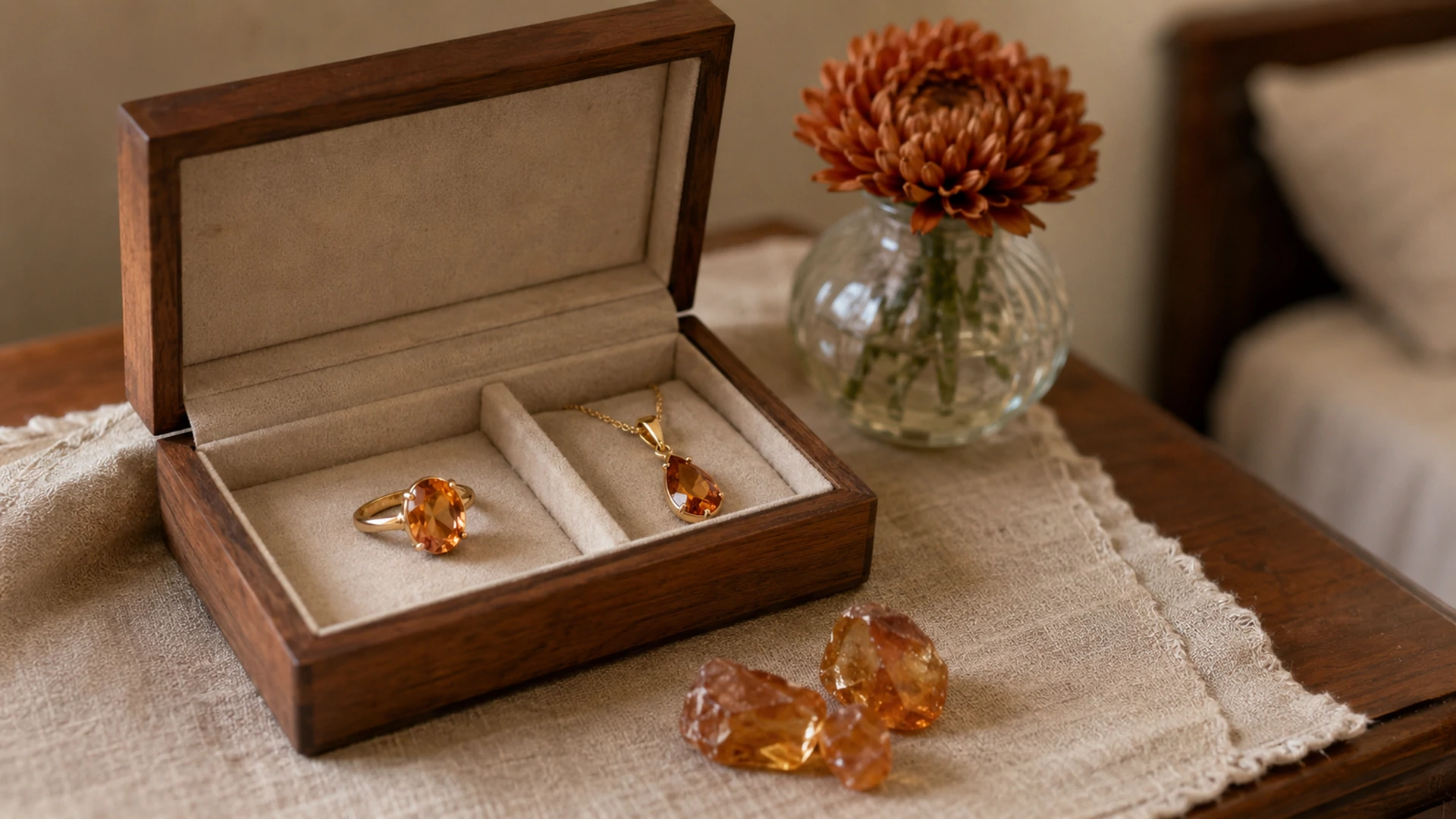
Imperial Topaz is one of the most striking birthstones in the calendar — a deep golden-amber stone that carries genuine solar warmth into the darkest month of the year. As the traditional November birthstone, Imperial Topaz isn't just a pretty gem associated with the season. It holds a specific energetic role: bridging the emotional intensity of late Scorpio with the forward-reaching ambition of early Sagittarius, and offering its wearer a stable, sun-charged anchor right when the year begins to close. If you were born in November, this stone was assigned to your month for reasons that go deeper than calendar convention — and working with it as your birthstone is one of the more powerful personal practices you can build.
What Imperial Topaz Means as the November Birthstone
November sits at a threshold. The veil between seasons has fully dropped, daylight is shrinking, and the natural world is completing its withdrawal. In magical terms, this is a month of consolidation — endings being processed, resources being gathered, intentions being clarified before the stillness of winter. Imperial Topaz, with its saturated golden-orange fire, acts as a counter-current to that descent. It brings solar virtue (the quality of light, vitality, and active will traditionally attributed to the Sun in planetary magic) directly into a month that is defined by its absence.
November spans two zodiac signs. Scorpio governs the first three weeks, and Sagittarius takes over around the 22nd. These signs don't share much on the surface — Scorpio is fixed water, inward, investigative, and prone to emotional intensity that can tip into obsession or stagnation. Sagittarius is mutable fire, outward, philosophically restless, and prone to overreach when it hasn't done the internal work first. Imperial Topaz addresses both tensions simultaneously. Its solar correspondence stabilizes Scorpio's tendency to spiral, while its energy of abundance and confident expansion gives Sagittarius a grounded platform to launch from rather than just leap blindly. For November-born practitioners, this is the stone's core gift: it steadies what is deep and fires what is ready to move.
Historically, topaz held a place in gemstone lore long before the modern birthstone list was codified. Ancient Greeks associated topaz with the sun god and believed it could increase strength and grant invisibility in emergencies. In medieval European lapidaries — the gem-magic reference texts of the period — topaz was listed under the governance of the Sun and prescribed for those who needed courage, clarity of mind, and protection against melancholy. When the modern standardized birthstone list was established in 1912 by the American National Retail Jewelers Association, topaz was confirmed for November, a designation that reflected centuries of accumulated association between the stone and autumn's solar qualities. Imperial Topaz specifically — the orange-to-golden-orange variety originally sourced from the Ural Mountains of Russia and prized by the Russian Imperial family, which gave it its name — became the prestige form of that assignment. November does have a second birthstone, Citrine, which shares some of the same solar and abundance qualities but operates on a lighter frequency. For a deeper look at Imperial Topaz's full magical correspondences outside the birthstone context, the Imperial Topaz magic correspondences article covers the complete picture.
There's a meaningful difference between working with Imperial Topaz as your birthstone and working with it as a general magical tool. When you use any stone generally, you draw on its inherent correspondences — its planetary rulership, element, and traditional virtues. When you work with your birthstone, the dynamic shifts. Imperial Topaz carries the solar fire of the Russian Imperial court, the weight of a stone so prized it was reserved for royalty, and a golden-orange current that has been associated with authority and abundant will across centuries of documented use. That history isn't decorative — it's baked into what the stone does. For November-born practitioners, working with it as your birthstone means claiming that specific solar identity as your own, rather than borrowing it as a general tool. The stone is already calibrated to the season you arrived in. Working with it as such is simply using what's already yours. If you're new to birthstone magic and want to understand the history and logic behind these designations, Birthstones: History, Magic, and How to Use Yours lays out the full foundation.
Imperial Topaz's Hardness, Care & Origins
Imperial Topaz sits at Mohs 8, which puts it solidly in the durable category — harder than most crystals you'll work with regularly. That hardness is real, but it comes with a caveat worth knowing before you start carrying it daily: topaz has perfect cleavage. That means despite its surface hardness, the stone can chip or split cleanly along an internal plane if struck at the wrong angle. Hardness and toughness are not the same thing, and topaz is a good example of why. A knock against a hard edge — a countertop, the inside of a bag with metal objects — can crack a piece that would otherwise survive years of wear. A bezel or protective setting is worth the investment for a ring, and a padded pouch is worth having for loose tumbles.
The name Imperial Topaz traces directly to 19th-century Russia, where orange and golden-orange topaz from the Ural Mountains was so highly regarded that the Russian Imperial family effectively claimed it as their own. That exclusivity is where the name comes from. Today, the dominant source of fine Imperial Topaz is Brazil — specifically the Ouro Preto and Capão mines in Minas Gerais — and the material coming out of those mines is what most practitioners are working with now. It's worth knowing that Imperial Topaz is typically untreated and naturally colored, which is part of what makes it genuinely rarer and more valuable than other topaz varieties. A lot of the blue topaz you'll see on the market — December's birthstone, not November's — is colorless topaz that has been irradiated and heat-treated to achieve that blue. There's nothing wrong with treated stones for general use, but if you're sourcing Imperial Topaz specifically, natural color is part of what you're paying for and worth verifying with your supplier.
One historical footnote that's stayed with me: the Braganza Diamond, a massive 1,680-carat stone set into the Portuguese Crown Jewels and long celebrated as the largest diamond in the world, was eventually identified as colorless topaz. The stone had been mistaken for something it wasn't for generations. There's something genuinely useful in that story for magical work — topaz as a stone that reveals true worth rather than accepting the label others assign. If you're drawn to working with Imperial Topaz for clarity around your own value, that particular lineage gives the intention real historical texture.
How to Use Imperial Topaz as Your Birthstone in Magic Rituals
The rituals below are ordered from foundational daily practice through seasonal and depth work. Start with the first two if you're new to birthstone magic, then layer in the others as your practice develops.
Charging and Carrying Your Stone
This is the foundational birthstone practice and the one worth doing before anything else. Hold your Imperial Topaz in both hands and take several slow breaths, letting your awareness settle. Speak your name aloud — your full name, the one that belongs to you — and state that this stone is yours, charged to carry your intention for the month ahead. Name one specific thing you are building, claiming, or strengthening right now. It doesn't need to be elaborate. Clarity matters more than poetry. Then carry the stone on your body for the rest of the day — in a pocket, tucked into a bra, or in a small pouch against your skin. Recharge it in direct sunlight for at least 20 minutes on a clear day once a week, and repeat the intention-setting each time you recharge. The cumulative effect of repeated, consistent charging is what builds the real force behind a birthstone practice.
Gold Candle Solar Abundance Working
Imperial Topaz is governed by the Sun, and gold candle magic operates on the same solar current — wealth, authority, confidence, and the ability to attract rather than chase. For this working, set a gold or deep orange candle on your altar and place your Imperial Topaz directly in front of it. If you want to dress the candle first, a light application of frankincense or cinnamon oil drawn upward from base to wick focuses the working on drawing abundance toward you. Before lighting the candle, hold the stone and name what you are calling in — be specific about whether it's financial, creative, relational, or professional. Light the candle, set the stone down in its glow, and sit with the flame for at least five minutes, holding the image of what you named as clearly as you can. Let the candle burn down in one session if possible. This working is most effective on Sundays, which carry solar correspondence, or on the new moon in Scorpio or Sagittarius if you're timing to the November sky.
November Threshold Intention Ritual
November is one of the year's genuine thresholds — the final push before the stillness of December, the last month where the year still has momentum. This ritual uses that threshold quality deliberately. On the first day of November, or the first Sunday of the month, sit somewhere quiet with your Imperial Topaz and a piece of paper. Write down three things you are completing before the year ends, and three things you are choosing to release. Read both lists aloud, holding the stone as you speak. Then fold the paper and place the stone on top of it, leaving them together on your altar for the duration of the month. The stone acts as a seal and a witness — its solar energy keeps the intention alive and actively supported through the dark-light tension of November rather than letting the month's withdrawing quality pull the focus under.
Solar Plexus Chakra Activation
Imperial Topaz has a documented correspondence with the solar plexus chakra — the energy center located just above the navel that governs personal will, self-confidence, and the ability to act on your own authority rather than waiting for permission. This is a particularly relevant correspondence for November-born practitioners, since both Scorpio's self-doubt and Sagittarius's impulsive overreach are expressions of an unsteady solar plexus. Lie down and place your Imperial Topaz directly on the solar plexus. Breathe slowly and deeply, drawing each inhale toward the stone's position. Visualize the stone's golden-amber color expanding outward from that point with each exhale, filling your torso with warm, steady light. Stay with this for 10 to 15 minutes. You're not forcing anything — you're giving your own center permission to be strong. Do this practice in the morning if you're preparing for something that requires confident, self-directed action.
Dream Clarity Working
Scorpio season carries a natural amplification of the subconscious — dreams become more vivid, old patterns surface, and the unconscious is more willing to communicate than usual. Imperial Topaz's solar clarity can be used to give that underworld information a usable shape. Place your charged stone under your pillow or on your nightstand before sleep, and keep a journal within reach. Before closing your eyes, hold the stone and ask a single, honest question — something you genuinely want clarity on, not something you want confirmed. Keep the question simple. In the morning, write down whatever you remember from the night, even fragments, without editing. Do this for seven consecutive nights during Scorpio season (before the 22nd of November). By the end of the week, patterns usually emerge. The stone isn't producing the dreams — it's sharpening your ability to bring what's already moving in you into conscious view. Mugwort is a traditional companion herb for this kind of dream work and pairs well with the stone's clarity-sharpening function if you want to add an herbal layer to the practice.
Altar Placement for Year-End Focus
Imperial Topaz placed in the southern position on your altar calls on its solar correspondence to sustain active, outward-facing intentions through the closing months of the year. The south is traditionally the position of fire, will, and the Sun — the direction of heat and agency. Set your stone there and surround it with objects that represent what you are actively working toward right now, not what you're protecting or releasing, but what you're building. A coin for financial intention, a written goal sealed with wax, a symbol of something you want to complete before the year turns. Leave the arrangement in place from the start of November through the winter solstice. This isn't a spell with a single activation — it's a sustained altar working that keeps your attention and will pointed at what matters, using the stone as a constant solar anchor in a month that can otherwise pull focus inward and downward.
Wearing & Carrying Imperial Topaz for Daily Protection
Jewelry
The most direct way to work with Imperial Topaz as your birthstone in daily life is skin contact. Wearing it as a ring, pendant, or bracelet keeps the stone's solar current in continuous contact with your personal energy field. For protection specifically, a ring on the dominant hand means the stone is active in the direction you're extending yourself toward the world — a good placement for days involving negotiation, performance, or any situation where you need to hold your authority without strain. A pendant that rests near the solar plexus extends the chakra correspondence covered in the ritual section into ordinary waking life, quietly supporting the confidence and self-trust that November energy can challenge. Because of topaz's perfect cleavage, a bezel setting offers better protection than a prong setting for a ring worn daily — worth keeping in mind when you're choosing how to mount it.
Imperial Topaz also holds a specific role as the traditional 23rd wedding anniversary gemstone — distinct from Blue Topaz, which marks the 4th anniversary and is often confused with it since both carry the topaz name. If you're working with Imperial Topaz in the context of long-term commitment, partnership deepening, or any magic around sustained devotion, that anniversary designation gives the stone's solar authority a relational dimension worth drawing on.
In the Home
Place Imperial Topaz in the area where you do your most important work — a desk, a studio, a kitchen if that's your creative space. Its solar correspondence pulls vitality and productive focus into the space, and its abundance current is well-suited to spaces where real effort happens. Keep it away from darker, more yin areas of the home (bathrooms, closets, under the bed) — it's an active stone and its energy stagnates when placed in spaces that don't have regular light or movement.
When traveling, Imperial Topaz is a reliable road stone. Its historical association with protection against melancholy and its solar energy both translate into practical support for the particular fatigue that travel creates — the disorientation of being between places, the low-grade anxiety of unfamiliar environments. The Braganza stone's story is relevant here too: a gem that spent generations misidentified, its true nature eventually coming to light. Carry Imperial Topaz when you need to be seen accurately — in interviews, negotiations, or any situation where your actual worth needs to cut through how others have framed you. Tuck a small tumbled piece into your bag or coat pocket. It doesn't need to be touching skin to function in this capacity; just having it in your immediate energy field is sufficient. The stone's protective correspondence traces back directly to its planetary rulership: the Sun governs vitality, clarity, and safe passage, and Imperial Topaz carries all three.
Imperial Topaz vs. Citrine: November's Two Birthstones
November is one of the few months with two recognized birthstones, and the difference between them is worth understanding practically. Citrine sits at Mohs 7, which makes it slightly softer than Imperial Topaz's Mohs 8, though both are durable enough for regular wear. The bigger difference is rarity and sourcing. Most commercial Citrine on the market is heat-treated amethyst — purple quartz that has been fired until it shifts to golden yellow. Naturally golden Citrine does exist but is far less common than what's typically sold. Imperial Topaz, by contrast, is naturally colored; its orange-to-golden-orange hue comes without treatment, which is part of what makes it rarer and more expensive.
Energetically, they occupy similar territory — both carry solar and abundance correspondences — but the frequency is different. Citrine is lighter and more diffuse, good for brightening mood, opening receptivity, and keeping energy moving without directed force. Imperial Topaz is denser and more concentrated; it's a stone for claiming something specific, not just creating favorable conditions. If your budget makes Citrine the more accessible choice, it's a legitimate November stone with real solar virtue. But if you can source genuine Imperial Topaz, you're working with a materially rarer stone that has held the November designation longer and carries more of that solar authority in its natural color alone.
Imperial Topaz Crystal Combinations: What Pairs Well
Imperial Topaz and Citrine — Both stones share solar and abundance correspondences, but they operate on different frequencies of that current. Citrine's energy is lighter and more diffuse — it brightens mood and opens receptivity. Imperial Topaz is denser and more directional — it concentrates will and pushes toward a specific outcome. Together, they create a complete abundance working: Citrine softens resistance and opens the field, while Imperial Topaz drives the stated intention forward. Use this pairing when you want both an inviting atmosphere and active momentum, rather than just one or the other.
Imperial Topaz and Carnelian — Carnelian is a fire stone governing courage, creative drive, and physical vitality. Imperial Topaz adds solar authority and the confidence to claim what the Carnelian is generating. Where Carnelian provides the spark and the creative impulse, Imperial Topaz provides the self-belief required to act on it without second-guessing. This pairing is particularly well-suited to Scorpio placements, who often have enormous internal drive but struggle to bring it outward without interference from self-doubt.
Imperial Topaz and Smoky Quartz — This is a grounding pairing for shadow work. Smoky Quartz absorbs and transmutes negative or stagnant energy, which makes it ideal for the underworld-facing quality of Scorpio season. Imperial Topaz provides the solar clarity and willpower needed to look at what's surfacing without being pulled under by it. The two stones work as a functional pair: Smoky Quartz clears the field, Imperial Topaz holds the light steady so you can see and work with what's been cleared. For November-born practitioners engaged in any kind of depth or healing work, this combination is worth having on hand.
Imperial Topaz and Pyrite — Pyrite is the stone of earned material success — it corresponds to disciplined effort, strategic thinking, and the confidence to claim prosperity without apology. Imperial Topaz adds the solar current that makes confidence magnetic rather than just assertive. Where Pyrite builds the foundation of material focus, Imperial Topaz makes the practitioner genuinely compelling in the spaces where that focus needs to be expressed: career situations, financial negotiations, public-facing work. Together they form one of the stronger abundance pairings in the crystal toolkit, particularly for Sagittarius risings and sun placements who are ready to move from aspiration into material reality.
Imperial Topaz and Labradorite — This pairing works through contrast rather than reinforcement. Labradorite governs transformation, intuition, and the magic that moves between visible and invisible layers of reality — qualities that are amplified by Scorpio season. Imperial Topaz is unambiguously solar and present-tense. Together, the two stones create a working that is simultaneously aware of depth and anchored in action. For November practitioners who are doing transformative work but need to stay functional in everyday life, Labradorite opens the inner door while Imperial Topaz keeps the outer structure intact.
You Were Born for This Stone — Let It Work for You
Imperial Topaz became November's traditional birthstone because it holds exactly what November lacks and needs: solar fire, confident will, and the ability to hold abundance-focused attention through a month that wants to turn everything inward. The historical designation wasn't arbitrary — it emerged from centuries of practical observation about what this stone does and when that virtue is most needed. November practitioners, split between Scorpio's depth and Sagittarius's reach, benefit more from this stone than almost anyone else using it generally.
What you've seen here — through the rituals, the daily practices, and the pairings — is a complete picture of how that plays out in real magical work. The charging practice builds a personal current with the stone. The candle working activates its solar abundance function at full intensity. The threshold ritual and altar placement use November's seasonal quality rather than fighting it. The solar plexus practice brings its most personal correspondence directly into the body. The pairings extend its reach into whatever area of your practice needs it most.
Your birthstone is not a symbol of when you were born. It's a tool shaped by the same energetic conditions that shaped you. Working with Imperial Topaz as a November-born practitioner means working with something that already resonates with your frequency — and that's a real advantage worth using. To see how every month's stone fits into the full picture, the complete birthstone guide covers the entire calendar with the same depth applied here.