Lemon Balm Tea Ceremony for Healing: A Return to Yourself, in Its Own Time
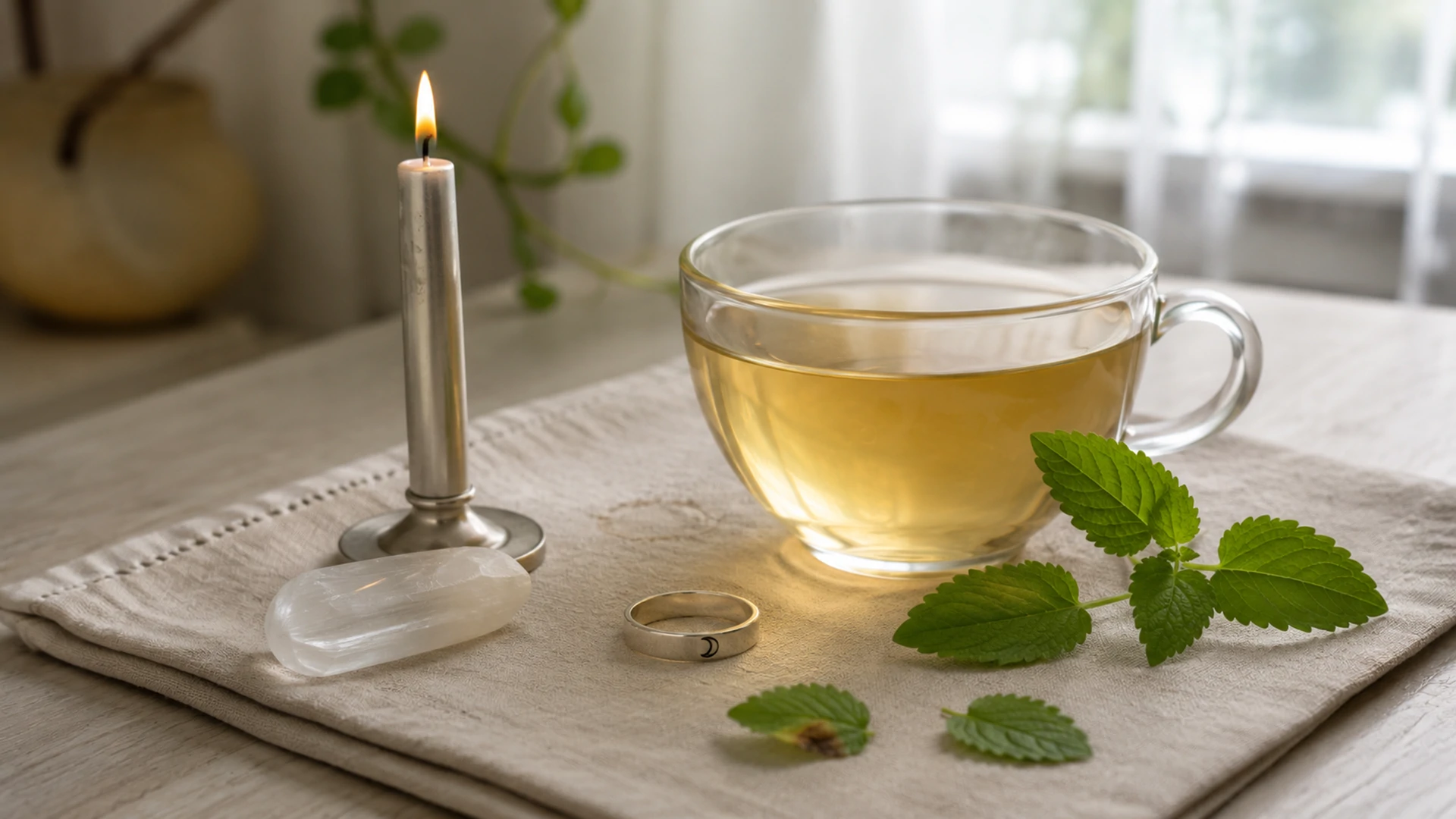
If you're looking for a lemon balm tea ceremony for healing, you've already picked the right herb. Lemon balm (Melissa officinalis) has one of the most well-documented relationships with healing in both folk herbalism and the Western magical tradition — not because it's a trendy wellness ingredient, but because its planetary and elemental correspondences, its long history as a medicine, and its very sensory character all point directly toward restoration and recovery. This guide walks you through a complete spiritual tea ceremony using lemon balm as your primary working tool, from the moment you set up your space to the final act of closing the ritual. You'll understand not just what to do, but why every step works the way it does.
Why Lemon Balm Is Suited to a Healing Tea Ceremony
Lemon balm sits firmly under the rulership of the Moon in the Western magical and astrological tradition. The Moon governs cycles, the body's rhythms, emotional tides, and the process of recovery — all of which are central to what healing actually means, whether you're working on physical recuperation, emotional restoration, or the slow mending of something that's been broken over time. Moon-ruled herbs are classically associated with the body's inner landscape and its capacity to return to wholeness, and lemon balm fits that archetype almost perfectly. Its element is Water, which adds depth to this correspondence: Water energy in magic is fluid, receptive, and cleansing, concerned with flow rather than force. Healing under Water influence isn't about pushing through — it's about creating the conditions for restoration and allowing the body and spirit to move back toward balance.
Historically, lemon balm's healing use is extraordinarily well-documented. Medieval European herbalists, including Paracelsus, considered it a primary herb for restoring the body's vitality. The 16th-century physician John Gerard wrote about its power to "driveth away all troublesome cares" — a phrase that maps onto both emotional and physical healing with remarkable precision. Arab physicians of the medieval period used it specifically for heart complaints and nervous exhaustion, recognizing its capacity to calm and restore simultaneously. In folk magic across Europe, lemon balm was grown near homes to invite gentle, sustaining energy — the kind of energy that holds space for recovery rather than demanding action. You can explore its full magical correspondences and traditional uses in depth, but the short version is this: lemon balm has been chosen for healing work across centuries and cultures because its nature genuinely supports it.
There's also a sensory dimension worth taking seriously. The scent of fresh lemon balm is bright, lemony, and gently sweet — not medicinal or harsh. That quality isn't cosmetic. In magical practice, an herb's sensory character is part of its correspondence because scent and taste directly engage the nervous system and shift the practitioner's state of consciousness. Lemon balm's aroma is immediately calming and clarifying at the same time, which is exactly what a healing working needs: the ability to simultaneously settle the body and focus the will.
Now, why tea specifically? You could burn lemon balm as incense, carry it in a sachet, or use it in a charm. All of those are legitimate approaches. But drinking it as a tea is a meaningfully different form of working with this herb, and it's particularly suited to healing magic for one key reason: ingestion is the most intimate form of contact you can have with a plant. When you drink lemon balm tea in a ceremonial context, you're not just directing energy toward a healing intent from the outside — you're bringing the herb's correspondence physically into your body. You're creating a direct, internal relationship between your will, the plant's nature, and the specific outcome you're working toward. For healing in particular, which is inherently about the interior — your body, your mind, your emotional landscape — this embodied approach carries a resonance that no external method quite matches.
Preparing for Your Lemon Balm Tea Ceremony
Space
Before you brew anything, spend a few minutes preparing your space. Healing ceremonies work best in an environment that already communicates care and calm to your nervous system. This isn't just aesthetic — your surroundings are part of the working. Choose a quiet space where you won't be interrupted. Clear your surface, whether that's a table, a windowsill, or a corner of your floor. You want the space to feel intentional, not casual. If you can open a window to let in fresh air, do it — air movement supports the Water element's quality of flow and keeps energy from becoming stagnant.
Timing
Timing matters for healing work. The optimal time to hold this ceremony is during a waxing or full Moon, particularly if your healing intent is oriented toward restoration, recovery, or building vitality back up. Monday, the Moon's day, is lemon balm's own day of the week — you can find the Moon's hour for your location and date using our Moon's hour finder to align your ceremony even more precisely. The waxing Moon supports increase and growth, which maps well onto recuperation. If you're working on releasing something — releasing pain, releasing illness, releasing the emotional weight of something difficult — a waning Moon can also be appropriate. Morning is a strong time for this ceremony because it aligns with the beginning of cycles and with the body's natural openness at the start of the day. That said, if you're holding this ceremony specifically because you're exhausted or need rest, evening is perfectly valid — lemon balm's gentle sedative quality means it will support you well in that context too.
Auxiliary Tools
Two supporting tools that will deepen this ceremony significantly:
- A silver candle: Silver candle magic is directly tied to the Moon's current — the same current that gives lemon balm its restorative character. Lighting one before you begin creates a visible, ongoing point of focus that keeps your working anchored to that lunar quality throughout. As the flame burns while your tea steeps and while you drink, it reinforces the ceremonial container in a way that a candle of any other color simply doesn't replicate here. If you want to dress it before the ceremony to sharpen its intent further, a complete guide to preparing candles for healing magic will walk you through the process.
- Selenite: Selenite is an ideal companion for this ceremony. Its name comes from Selene, the Greek goddess of the Moon, and its correspondence with lunar energy runs deep — it carries a quality of clarity and cleansing that pairs precisely with what lemon balm is doing on the inside. Where many healing stones are broadly restorative, selenite specifically works to clear stagnant or blocked energy, which makes it particularly useful when illness or exhaustion has settled in and won't shift. Hold it in your non-dominant hand while the herb steeps, or rest it beside your cup. Its presence during the ceremony adds a second, distinct point of focus: while lemon balm draws restoration inward, selenite keeps the energetic field around you clear enough to receive it.
Safety Note
A brief and important note before you brew: lemon balm is generally considered safe for most adults at typical tea-strength quantities. However, if you are pregnant, breastfeeding, taking thyroid medication, or taking sedatives, you should check with a doctor or herbalist before consuming it. Treat this as useful information rather than a reason to avoid the ceremony. You're always the most important element in your own practice.
Brewing Lemon Balm With Intention
The brewing itself, in a healing tea ceremony, is not separate from the ritual — it is the ritual. Every physical action from this point forward is a deliberate act of will directed toward your healing intent. Hold that awareness from the moment you begin.
Gathering Materials and Setting Intention
Start by gathering your materials: one to two teaspoons of dried lemon balm (or a small handful of fresh leaves if you have them), a ceramic or glass cup, a kettle or small pot, and a strainer or infuser. If you're using fresh leaves, gently crush them between your palms before placing them in the cup. Do this slowly and consciously. Feel the texture of the leaves, notice the scent that rises as you bruise them, and as you do, set your intention clearly in your mind. Say it inwardly, or say it aloud: name what you are healing. Be specific. "I am restoring my energy." "I am releasing the weight of this grief." "I am supporting my body's return to strength." The specificity of intention is what separates a ritual from a routine.
Heating the Water
Heat your water to just below boiling — around 90 to 95°C (195 to 200°F). Boiling water can damage delicate volatile compounds in lemon balm, and practically speaking, it can make the tea slightly bitter. But the ceremonial reason to be attentive here is just as important: you are paying attention. You are not rushing. Watching the water heat is itself an act of presence and intention. As the water comes to temperature, focus on the image of warmth entering your body — warmth as healing, as comfort, as the gentle restoration of something that has gone cold or dim inside you.
Pouring and Steeping
Pour the water over your herb slowly and deliberately. Watch the color begin to shift in the cup — fresh lemon balm will give you a faint golden-green; dried leaves will turn the water a deeper amber-gold. As the herb steeps, hold your hands over the cup (not touching it — the steam is hot) and direct your will downward into the tea. If you feel moved to speak, do so. You might say something like: "As this herb opens in this water, so does my capacity for healing open within me. I draw into myself restoration, calm, and the strength to recover." This is not a formula — it's a prompt. Say what is true for you.
Steep for seven to ten minutes for a full-strength infusion. The longer steep time is intentional — it gives you more time to hold focus and allows the herb to fully release its properties into the water. Cover your cup while it steeps if you can, to keep the volatile oils from escaping with the steam. While you wait, sit quietly. Hold your selenite if you have it. Watch the candle flame. Let your mind stay with your healing intent rather than wandering. This is the moment where many practitioners discover how short their attention span is — and that's fine. Every time your mind drifts, gently return it to your intention. That returning is itself an act of will, and will is the engine of this practice.
Drinking and Closing the Ceremony
When your tea has finished steeping, remove the herb and hold the cup in both hands for a moment before you drink. Feel its warmth against your palms. Let that warmth register as something intentional — not just hot liquid, but the beginning of what you asked for, already meeting your skin. Take one slow breath in through the nose and notice the scent: that characteristic lemon-bright, slightly herbal, gently sweet quality of melissa. Let it fully register before you take your first sip.
Keep your attention where the tea is — in the cup, in your hands, moving through you. Each sip is a deliberate act of receiving. As you drink, maintain a quiet, gentle focus on your healing intent. You don't need to concentrate intensely — healing magic has a soft quality that benefits from receptivity rather than force. Think of it less as pushing your intention outward and more as opening yourself to receive what you've asked for. Feel the warmth of the tea move through you. Visualize that warmth as restoration — moving through tired muscles, through clenched nerves, through whatever in you needs to soften and recover. Let the ceremony feel nourishing, because it is.
When you finish the tea, sit with the empty cup for a moment. This pause is part of the closing — it marks the transition from active ceremony to returning to ordinary time. Thank the herb, if that feels right to you. You don't need elaborate language: a simple, genuine acknowledgment of what you've received is more powerful than a formal invocation spoken without feeling.
Ground yourself before you stand up. Grounding — the practice of consciously reconnecting your energy with the physical, material world after ritual work — is an important step that many practitioners skip, especially in gentler ceremonies where it doesn't seem necessary. But even in a soft, restorative ceremony like this one, you've been holding focused intention for an extended period, and a brief grounding helps you integrate that experience rather than carrying a kind of scattered, half-in-half-out feeling for the rest of the day. Press your feet flat on the floor. Take three slow breaths. Feel the chair or cushion beneath you. That's it.
Dispose of the spent herb in a way that honors the intent. For a healing ceremony, returning the used herb to the earth is ideal — scatter it in your garden, a potted plant, or a patch of soil outdoors. This act of returning the herb completes a cycle: the plant gave something to you, and you return it to the ground that grew it. If that's not possible, composting is a perfectly acceptable alternative. Journal briefly if you're able — even two or three sentences noting how you feel, what you focused on, and what came up during the ceremony. Over time, these notes become one of the most valuable tools in your practice.
Let Lemon Balm Be Your Return to Yourself
What you've built here is not a one-time exercise — it's a repeatable practice you can return to every time healing is what you need. And it's worth naming clearly what makes lemon balm genuinely suited to this work: it's not a general-purpose herb dressed up in healing language. Its Moon rulership directly connects it to the body's cycles and its capacity for restoration. Its Water element aligns it with the receptive, flowing quality that healing requires. Its documented history across European, Arab, and folk herbal traditions confirms what its sensory character suggests at first encounter: this is an herb that has always been associated with calming what is agitated, restoring what is depleted, and supporting the body and spirit through difficult passages.
When you drink lemon balm with intention, you are doing something qualitatively different from drinking it casually. You are directing your will through a plant whose nature is aligned with your purpose, using the most intimate possible form of contact — ingestion — to make that alignment internal and embodied. The ceremony framework is not decoration on top of that intention. It's what keeps your will focused long enough and clearly enough to matter.
Come back to this ceremony whenever you feel depleted, when recovery feels slow, when grief or illness or exhaustion has settled into your body and won't lift easily. The practice doesn't change, but you will — and each time you return, you'll bring a more practiced will, a clearer intention, and a deeper relationship with this herb and what it can help you do. If you want to explore more healing ceremonies using different herbs, the chamomile tea ceremony for healing works beautifully alongside lemon balm for days when you need a deeper layer of calm, and the calendula tea ceremony for healing is worth exploring when your intent centers on repair and resilience rather than rest. For the full range of ceremonies organized by intent and herb, the Spiritual Tea Ceremonies: A Complete Guide by Intent is a strong next step.