Garden Sage: The Herb of a Long and Wise Life
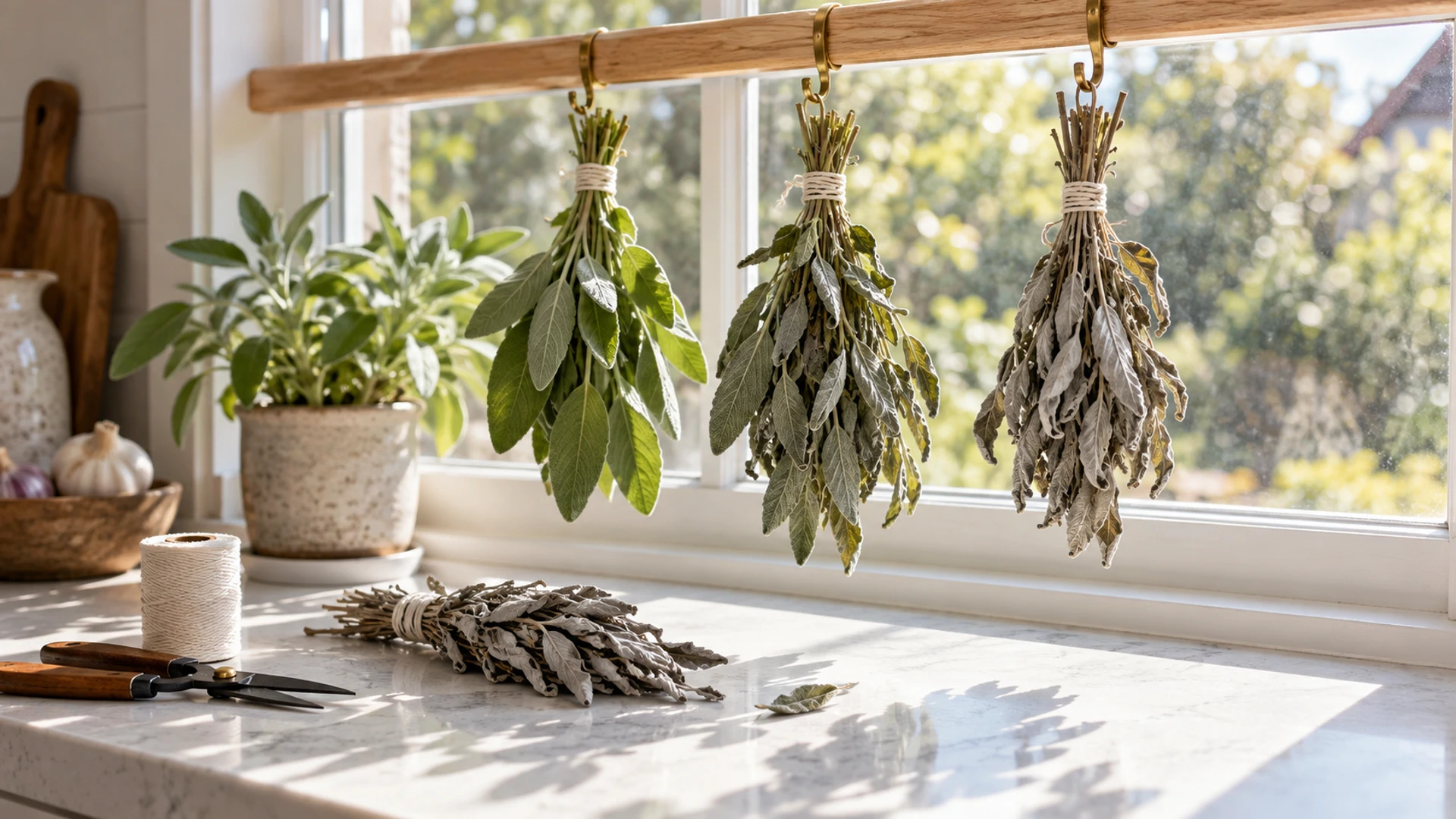
Garden sage (Salvia officinalis) — the grey-leaved kitchen sage grown by the door and dried for wisdom sachets and wish workings — is the longevity, wisdom, and a cleansing smoke you can grow yourself.
Longevity and Wisdom: Garden Sage's Place in Healing
Garden sage belongs to the Healing & Peace category, but its angle is distinct from most of what sits there. Think of chamomile as soothing to sleep — a gentle, sunlit calm that settles a person for rest. Think of comfrey as mending — knitting together what has broken, with safe travel as its second face. Garden sage works on neither of those. Its concern is the long arc: longevity, wisdom, and the well-being of a life lived well over time. This is an herb for sustained health and accumulated knowing, not for an acute moment of rest or repair.
Scott Cunningham lists garden sage's virtues as immortality, longevity, wisdom, protection, and wishes. Culpeper places it under Jupiter, and Cunningham agrees, adding air as its elemental correspondence. Thursday is the day that carries Jupiter's current, which is why any working that calls on garden sage's full range sits most naturally on a Thursday or opened during a Jupiter hour. The herb's secondary category is Cleansing & Purification — it can serve as a clearing smoke just as readily as it serves wisdom and longevity work, and it does so as a plant you can grow yourself.
Garden sage is one of three sages that appear in magical herbalism, and it helps to be clear about which is which. Garden sage (Salvia officinalis) is the longevity, wisdom, and healing herb. White sage (Salvia apiana) is the strong clearing smoke. Clary sage (Salvia sclarea) is the clear-sight and dream herb, whose name comes from the Latin clarus and whose heady oil opens the door to vivid dreaming. All three are Salvia, but they are not interchangeable in practice or in correspondence.
Salvere: To Be Well
The genus name Salvia comes directly from the Latin salvere, meaning to be well. The plant was named for what people believed it did. Medieval European herbalists made this explicit: a well-known verse from the School of Salerno poses the question of why any person should ever die while sage is growing in their garden. The sentiment is rhetorical rather than medical, but it captures the herb's reputation precisely — sage was understood as the guardian of life, the plant that kept death waiting at a respectful distance. That idea is built into everything garden sage does in magical practice.
Common sage and kitchen sage are the two names you'll encounter most often alongside the botanical Salvia officinalis, and they reflect how thoroughly this plant has been woven into everyday domestic life. It is not an exotic or ceremonial import. It grows in temperate gardens across Europe and North America, sits in kitchen spice racks, and flavors roast dinners. That ordinariness is not a limitation — it is part of what makes garden sage such a grounded and accessible working herb. The magic here is close to hand, not locked behind a specialty supplier.
A Smoke From Your Own Garden
Garden sage and rosemary are the garden-grown, non-threatened cleansing smokes — and that distinction matters practically. A bundle of garden sage can be grown from seed or a cutting, harvested from your own plant, dried at home, and bundled without involving a supply chain at all. If you have a sunny windowsill or a patch of garden soil, you have access to a cleansing smoke that you produced yourself from start to finish. That full chain of custody — seed to smoke — is its own form of intentional practice, and it makes garden sage one of the most self-sufficient cleansing herbs available to any practitioner.
Leaves for the Kitchen and the Censer
The leaves are the working part of garden sage in every form of practice. Dried leaves go into smoke bundles for room clearing, loose into wisdom or wish sachets, steeped into a ritual tea, or scattered into a bath. Culinary use is entirely safe — this is kitchen sage, and it has been eaten by people for centuries. The oil contains thujone, which can trigger seizures, and medicinal doses are avoided in pregnancy, epilepsy, and while breastfeeding, since sage reduces milk supply. For ritual purposes, working with the dried leaf or a modest tea keeps you well within the safe and traditional range.
Three Garden Sage Workings for a Long Life
A Sage Plant by the Door
Use this working when you want an ongoing, living presence in your household that holds the intention of longevity and well-being for everyone who lives there.
Plant a garden sage in a pot by your front door or on a kitchen windowsill where it will get strong light. Choose the spot deliberately — this is not decorative planting, it is a working. As you place the plant, call to mind the Salerno verse: why should anyone in this house fall into decline while sage is growing here? Tend the plant as you would any working you care about. Water it, pinch back the flowers when they come so the leaves stay full, and harvest from it when you need sage for any purpose — tea, cooking, smoke. The tending is the working. Every time you attend to the plant you are reinforcing the intention it holds.
A Garden Sage Smoke Bundle
Use this working when a space needs clearing — after conflict, after illness has passed through a household, or at the start of a new season or chapter.
Cut several stems of fresh garden sage, each six to eight inches long, and gather them into a tight bundle. Bind the bundle firmly with cotton thread, wrapping from the base up to the tip and back down, pulling snugly at each turn. Hang the bundle upside down in a warm, dry place with good air circulation and leave it for two to three weeks, or until the leaves are fully dry and crackle slightly when pressed. To use it, light the tip and let it catch, then blow it out so it smolders. Move through the space you are clearing — along walls, into corners, near doorways — holding the intention that what has accumulated here is released and the air is renewed. Let the bundle go out on its own in a fireproof dish when you are finished.
A Wisdom Sachet
Use this working when a decision is coming that requires clarity and sound judgment rather than speed.
Write your question or wish on a small piece of paper — one sentence, stated plainly. Fold the paper and place it with a pinch of dried garden sage leaves inside a small cloth sachet. Tie it closed. Make this on a Thursday or during a Jupiter hour to align with the herb's correspondence. Carry the sachet with you during the period when the decision is forming. When you have reached your answer, open the sachet and burn the paper as a release.
Sage in the Garden
Garden sage belongs to a category of herbs concerned with healing and peace in the broadest sense — not one acute moment of need, but the whole quality of a life over time. Longevity and wisdom are the long-game virtues, and this herb embodies both. It sits comfortably in a kitchen garden and equally comfortably on an altar, because it has never needed to be rare or difficult to do its work.
If you want to see how garden sage sits alongside the other Healing & Peace herbs — and how all of plant magic organizes across seven distinct paths — the Witch's Herbarium guide is where to go next.