Clary Sage: The Clear-Eye Herb of Vivid Dreams
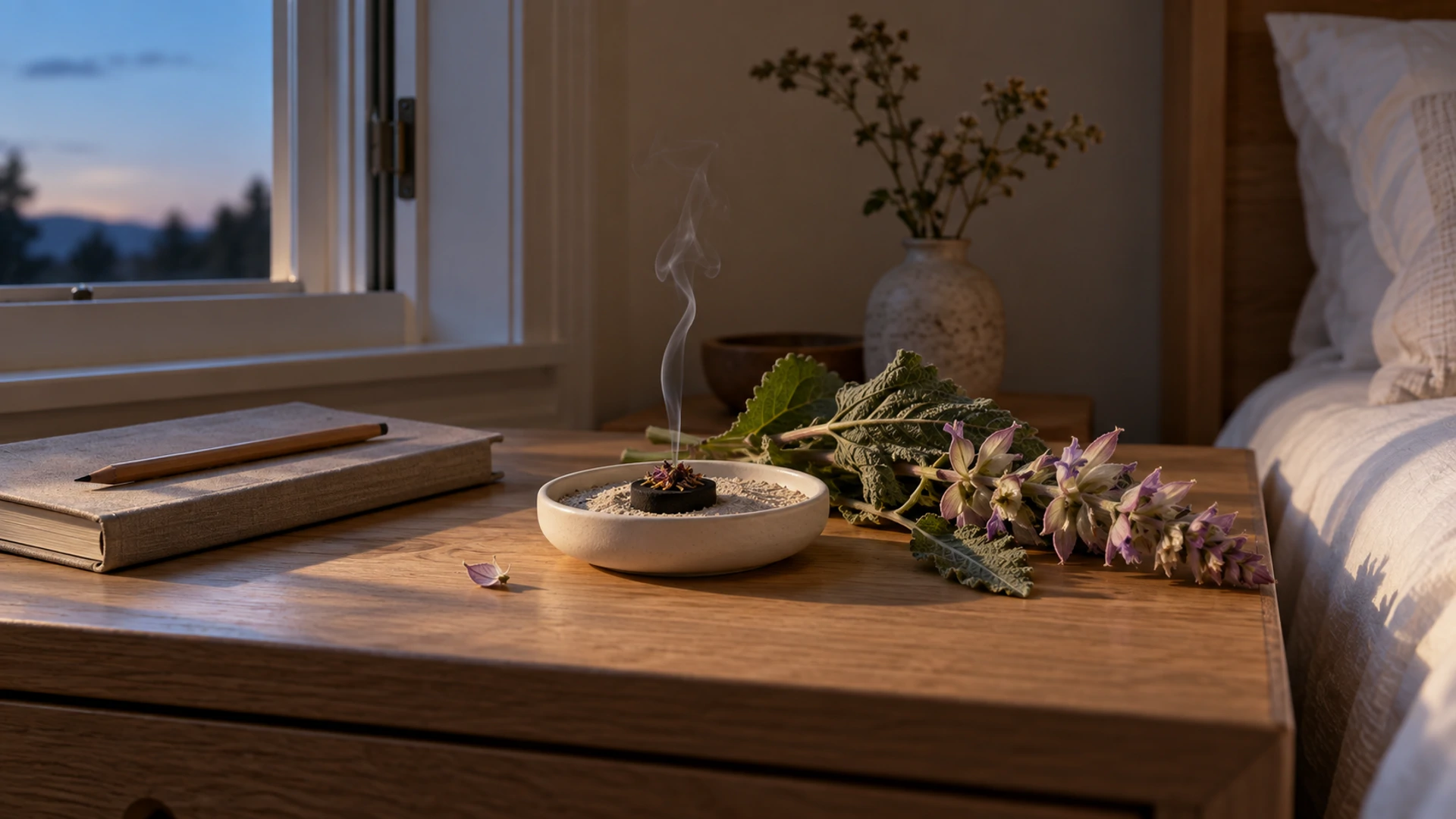
Clary sage (Salvia sclarea) is a tall, flowering Salvia whose essential oil and dried flowers are used to support scrying and dreamwork, opening vivid, heady states in the practitioner. Its secondary face is Healing & Peace, making it useful on evenings that need settling as much as on nights set aside for intentional dreaming.
Vivid Dreaming: Clary Sage's Place in Divination
Among the twelve herbs that belong to Divination & Spirit Work, clary sage occupies a specific and unusual place. Its angle is vivid dreaming: the quality of bringing dreams that are sharp, heady, and memorable rather than simply more frequent. That specificity matters because the other dreaming herbs do different things. Mugwort opens the door to dreaming and seeing — the gentler Artemisia, coaxing dreams and inner sight toward you. Eyebright works differently still, clarifying perception — sharpening the reader's sight before a waking reading rather than deepening what happens in sleep. Clary sage is the one you reach for when you want the dream itself to be vivid and heady: not just a feeling of having dreamed, but something you can recall and work with.
Its planetary ruler, according to Culpeper, is the Moon — a correspondence that makes sense when you look at what the herb actually does. The Moon governs intuition, cyclical rhythms, and the interior life that only becomes audible when the waking mind quiets. Monday is its day. Clary sage belongs to that lunar current: inward, receptive, working in the dark.
It helps to know where clary sage sits among the three sages, because the names invite confusion. Clary sage (Salvia sclarea) is the clear-sight and vivid-dream herb. White sage (Salvia apiana) is the strong clearing smoke of Native Californian ceremonial tradition, used for purification. Garden sage (Salvia officinalis) is the longevity, wisdom, and healing herb — the one in your kitchen. They share a genus but not a magical role. Using one in place of another is not a correspondence; it is a substitution that changes what you are actually doing.
Clear-Eye: Seeds That Lifted Grit
The name clary comes from the Latin clarus, meaning clear. Culpeper called it "clear-eye," and the practice behind that name is specific: the seeds of the plant, when wet, turn mucilaginous — they become sticky and gelatinous — and were placed in the eye to collect and lift out a piece of grit. It was a practical herb named for a practical use. That etymology ties it, in theme, to eyebright, which carries its own clear-sight name and its own eye-herb history. Both herbs have names that promise sharpened perception, though they arrive at it differently: eyebright through waking clarity, clary sage through dreams.
Muscatel Wine and Heady Beer
The dreamwork reputation clary sage carries today did not arise from nowhere. In 16th-century Germany, it was added to Rhine wine to imitate the taste of muscatel, and it was also used in place of hops in some beers. Both uses gave it a reputation for producing a particularly heady, disorienting intoxication — stronger than the alcohol alone would account for. That reputation followed it into magical practice. When clary sage is described as producing vivid dreams or heady states, that history is the root.
Oil, Flowers, and Smoke
The two main forms in practice are the essential oil and the dried flowers. The oil is diffused before scrying or dreamwork, or used diluted for anointing — a drop on the wrists or brow as part of a ritual opening. The dried flowers go into dream pillows, where they work slowly over the course of a night, and into incense burned before sleep or before a reading. The oil is avoided in pregnancy. It is sedating in quantity, so a little goes further than you might expect. It is not taken internally.
Three Clary Sage Workings for Sight and Dreams
Anointing the Brow Before Scrying
Use this when you are opening a formal scrying session and want your inner sight to be as clear and receptive as possible before you begin.
Dilute one drop of clary sage essential oil in a small amount of a neutral carrier oil — a teaspoon of jojoba or almond oil is enough. Settle into your space, close your eyes, and spend a moment setting your intention: you are here to see clearly, and you are opening to what the working brings. Touch the tip of one finger to the diluted oil and apply a small amount to the center of your brow. Breathe the scent in slowly. If you are working with a Moon hour or on a Monday, let that timing reinforce the opening rather than rush it. Then proceed to your scrying tool — mirror, bowl, flame, or whatever form your practice takes — carrying the clarity of that anointing into the work.
Clary Sage Smoke Before Sleep
Use this when you are setting an intention to remember and work with your dreams, particularly before a night when you want to receive something rather than simply sleep.
About an hour before you plan to sleep, burn a small amount of dried clary sage flowers as incense — on a charcoal disk, in a fireproof dish, or blended into a loose incense you already use for dreamwork. Let the smoke fill the room gently. State your intention clearly, even just in your own mind: you want to dream vividly and to remember what comes. Then open the window for a few minutes to let the smoke clear before you actually lie down — you are working with the scent and the ritual of the smoke, not sleeping in it. Keep a notebook or journal beside the bed so that when you wake, you can write down whatever is still present before it recedes.
A Diffuser on a Heavy Evening
Use this on an evening that feels weighted or stuck, when you need the Healing & Peace side of clary sage rather than its dreamwork face.
Add two or three drops of clary sage oil to a diffuser and let it run for thirty minutes to an hour while you do something quiet — reading, journaling, sitting still. The oil's sedating quality is what you are using here: a gentle loosening of whatever has been holding tight all day. This is not a working aimed at visions. It is the herb doing its simpler, quieter work.
Dreams in Sharp Focus
Clary sage's vivid-dreaming angle gives it a particular usefulness within Divination & Spirit Work. It does not call spirits, it does not carry prayers, and it does not open the kind of sight you use at a table with cards in front of you. What it does is sharpen the dreaming mind into a state where what arrives in sleep is worth paying attention to. That is its contribution to the broader category: dreams as a source of real information, made vivid enough to be legible.
If you want to see how clary sage sits alongside the other eleven divination and spirit-work herbs — and across all six other magical categories — the witch's herbarium of plant magic is where to go next.