Chamomile (Matricaria chamomilla) in Magic: Correspondences, Uses & Safety
Chamomile is one of those herbs that earns its place on every practitioner's shelf early — and stays there for good reason. Whether you know it as the gentle tea that helps you unwind before bed or as a golden-flowered plant growing wild along roadsides, Matricaria chamomilla carries a magical depth that goes far beyond its soft reputation. In magical practice, chamomile is valued for its connection to solar energy, peace, luck, and purification, making it one of the most broadly useful herbs you can work with. It bridges the practical and the spiritual effortlessly — calming the mind while simultaneously drawing in good fortune and clearing away what no longer serves you. If you're just starting to build a herbal practice, chamomile is an ideal starting point. If you've been practicing for years, there's a good chance you already know why this little sun-bright flower keeps showing up in spell work across traditions.
The Spiritual Meaning of Chamomile
Chamomile's spiritual identity is rooted in its connection to the Sun. In the Western magical tradition, solar plants carry qualities of warmth, clarity, vitality, and illumination — and chamomile expresses all of those in a particularly gentle, accessible way. Where some solar herbs like St. John's Wort lean toward protective fierceness or bay laurel leans toward victory and prophecy, chamomile holds the quieter solar gifts: inner peace, restored balance, and a steady kind of luck that comes from being aligned with your own best energy.
That quality of alignment is central to chamomile's spiritual meaning. Across folk traditions, chamomile has long been associated with drawing things in — luck, money, love, and positive outcomes — but the underlying principle isn't just magnetism. It's harmony. Chamomile is thought to bring the practitioner into a calmer, more receptive state so that good things can actually land. This is why it appears so frequently in both attraction workings and cleansing workings. You can't draw in something new if you're still holding the energy of what you're trying to leave behind, and chamomile works both sides of that equation with ease.
There's also a meaningful connection between chamomile and emotional resilience. The plant itself is famously hardy — Roman chamomile actually grows more vigorously when it's walked on, which gave rise to the old herbalist saying that chamomile is like a physician to plants growing nearby, strengthening what grows around it. That same energy translates spiritually. Chamomile in a working doesn't just soothe — it reinforces. It supports your willpower, steadies your focus, and brings a kind of grounded optimism to whatever you're building. That makes it especially powerful for any work you're doing around abundance, self-worth, or healing after difficulty.
Chamomile also holds a protective dimension that practitioners sometimes overlook because of its gentle character. It has been used historically to ward against hexes, break streaks of bad luck, and remove negative energy from a person, space, or object. The logic here is consistent with its solar correspondence — sunlight dispels darkness, and chamomile carries that same principle at an energetic level. It doesn't confront baneful energy aggressively; it dissolves it through the force of clarity and warmth. If you approach chamomile only as a "calm and cozy" herb, you're leaving some of its most useful properties on the table.
Chamomile Correspondences and How to Apply Them
Correspondences are the symbolic links between a plant and the larger web of magical thinking — planets, elements, deities, energies. They aren't arbitrary. They developed through centuries of observation, use, and cross-cultural pattern recognition. When you understand why chamomile is assigned to the Sun and to Water, you understand something real about how it behaves in a working and what it amplifies.
Here's the full correspondence profile at a glance:
- Planet: Sun
- Element: Water
- Gender: Masculine
- Deities: Ra, Cernunnos, Helios
- Magical properties: Peace, luck, purification, money attraction, love, hex-breaking
- Associated crystals: Citrine, clear quartz, sunstone, amber
- Chakra: Solar Plexus
The pairing of Sun with Water is one of chamomile's most distinctive features and worth sitting with for a moment. Most solar herbs are assigned to Fire — bright, active, assertive. Chamomile is assigned to Water, which speaks to its emotional intelligence. It operates through feeling, intuition, and flow rather than force. This is what gives chamomile its specific flavor of solar energy: warm but fluid, illuminating but gentle. When you're designing a working and you want solar energy without heat or intensity — for healing, for emotional clarity, for peaceful abundance — chamomile is the herb that delivers exactly that.
The Solar Plexus chakra connection deepens this understanding. The solar plexus governs personal power, self-confidence, will, and the sense of direction in your life. It's the energetic center where intention is generated before it moves outward. Working with chamomile — in tea, incense, or any ritual format — helps activate and settle that center. If your intention feels scattered or your confidence in a working is shaky, chamomile can help anchor the will behind what you're doing. That's not a small thing. Focused will is the engine of effective magic, and anything that supports your ability to hold steady and clear intention directly improves your results.
The deity correspondences — Ra, Cernunnos, Helios — all reflect chamomile's solar nature filtered through different cultural lenses. Ra and Helios are solar deities in the most direct sense, ruling the light, the cycles of the day, and life-giving warmth. Cernunnos is a more complex inclusion: as a deity of nature, cycles, and abundance, he connects to chamomile's earthy luck-drawing qualities and its long history of use in folk practice. If you work within a specific pantheon, these connections can help you decide when and how to call on chamomile as an offering or a ritual component. If you don't work with deities directly, these correspondences still tell you something about the energetic signature you're working with — solar warmth, natural cycles, abundance through alignment.
The crystal pairings amplify specific aspects of chamomile's energy depending on the working. Citrine and sunstone both carry solar resonance and pair well when you're working luck, money, or joy. Clear quartz amplifies and clarifies, making it a strong companion in any chamomile-based working where you want the herb's energy to carry farther or hit with more precision. Amber is the most historically grounded pairing — both amber and chamomile have long associations with healing, warmth, and protection across European folk traditions, and they reinforce each other at the level of energetic texture in a way that feels genuinely seamless.
How to Use Chamomile in Magical Practice
One of chamomile's great strengths is its versatility. It works across nearly every format a modern practitioner uses — and it works well in all of them. Whether you're drawn to tea rituals, smoke cleansing, candle work, or sachets, chamomile belongs in that practice. Here's how to actually apply it across different methods.
As a ritual tea or potion: This is one of the most natural and effective ways to work with chamomile. Drinking a chamomile infusion before ritual or meditation brings your body and mind into the calm, receptive state that supports focused intention. For magical purposes, you can charge the tea with a specific intention while it steeps — hold the cup in your hands, concentrate on what you're working toward, and speak your intention aloud or silently into the steam. For money or luck workings, adding a small amount of honey and a pinch of cinnamon deepens the attraction quality of the brew. For purification, keep it simple — chamomile and hot water, clear intention, and deliberate presence as you drink.
As incense or in smoke cleansing: Dried chamomile flowers can be burned on a charcoal disc or mixed into a loose incense blend. The smoke has a warm, slightly sweet, faintly apple-like scent that is immediately calming. Use chamomile smoke to cleanse a space before ritual, to clear a room of stagnant or negative energy, or to purify tools and objects. It pairs well with frankincense for solar work, with lavender for peace-focused clearings, and with cinnamon for money-drawing work. If you make your own incense blends, chamomile is a dependable base note that adds grounding warmth without overpowering other herbs.
In sachets and charm bags: Chamomile flowers are small, light, and easy to work into sachets. A basic luck sachet can be as simple as a square of yellow or gold cloth filled with chamomile flowers, a citrine chip, and a pinch of cinnamon, tied closed and carried in a pocket or bag. For sleep and peace, combine chamomile with lavender and place it under your pillow or near your bed. For money workings, combine chamomile with basil, mint, and a small coin in a green cloth sachet and keep it in your wallet or near where you manage finances. The key in all of these is to charge the sachet at the time of making — your intention at that moment is what activates the symbolic ingredients.
As a candle dressing: Dried chamomile flowers can be crumbled and pressed into an anointed candle's surface or scattered around the base of a candle in a working. For a candle ritual focused on peace, burn a white or yellow candle dressed with chamomile oil and surrounded by chamomile flowers while holding your intention clearly in mind. For luck and money, a green or gold candle dressed with a blend of chamomile and cinnamon works powerfully. The flowers will smolder and release their scent as the candle burns, which reinforces the working throughout the burn time. Always burn candles safely and don't leave them unattended — practical safety and magical intention are not in conflict.
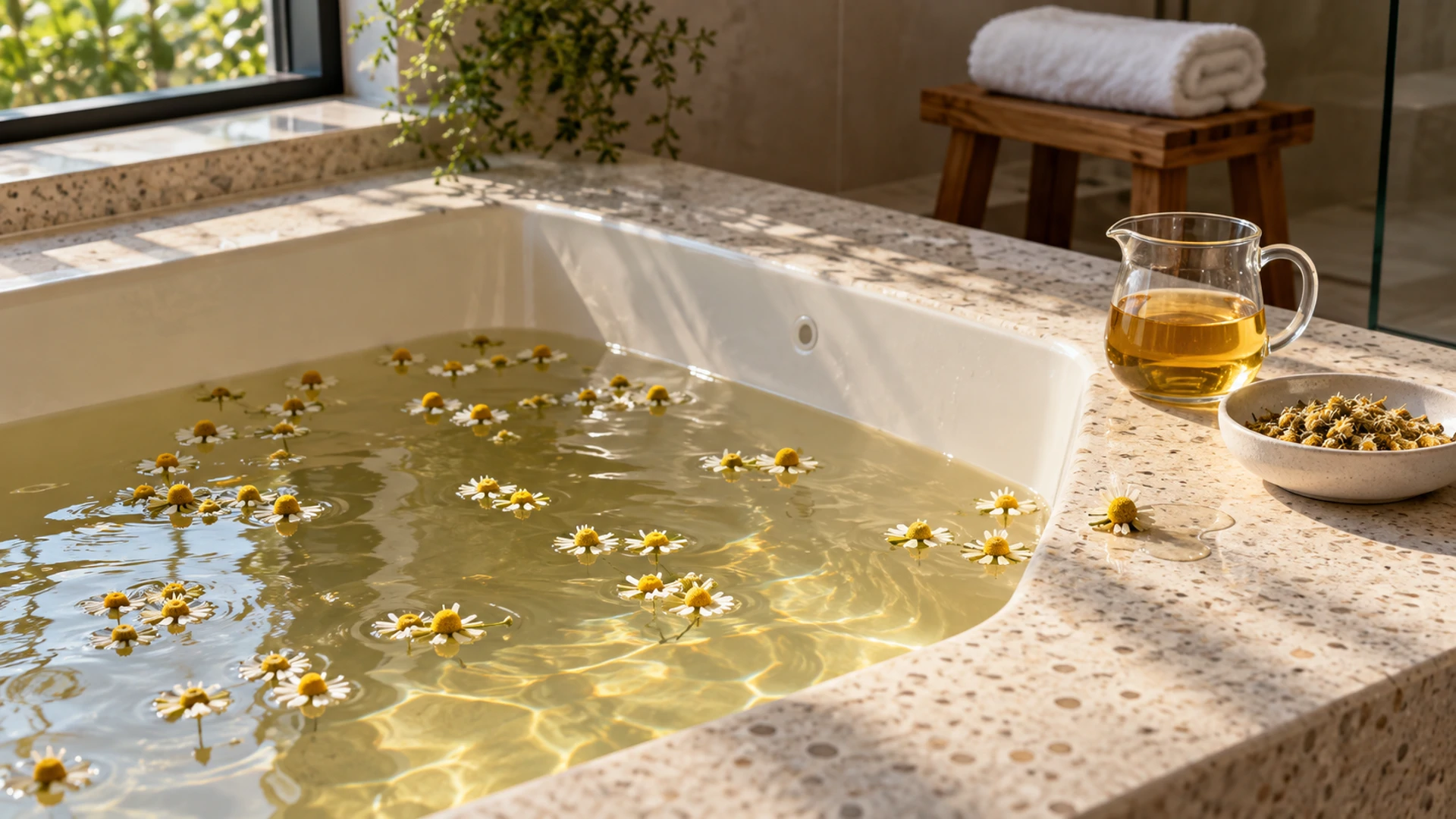
In floor washes and cleansing baths: Making a strong chamomile infusion and adding it to your bath water or using it as a floor wash is a traditional folk magic technique with real staying power. A chamomile bath before important meetings, interviews, or any situation where you want to project calm confidence and attract favorable outcomes is a simple but effective working. For a floor wash, brew a large pot of chamomile tea, allow it to cool, and wash your floors from back to front — moving toward the door — to clear out stagnant or negative energy from your space. This is one of the most low-effort, high-return practices you can build into a regular routine.
In oils and tinctures: Chamomile essential oil and chamomile-infused carrier oil both have magical applications. Use chamomile oil to anoint candles, tools, crystals, doorframes, or yourself. Applying a small amount to your wrists or temples before ritual or meditation works as a physical anchor for the intention you carry into that session. Chamomile oil blends well with frankincense for protection and purification, with rose for love and emotional healing, and with bergamot for luck and upliftment. If you're making your own infused oil, pack dried chamomile flowers into a clean jar, cover with a light carrier oil like jojoba or sweet almond, and allow to infuse for four to six weeks in a warm, sunny spot — the solar correspondence makes sun-infused chamomile oil particularly resonant.
Chamomile in Magic Across Cultures
Chamomile has one of the longest documented relationships with human magical and spiritual practice of any herb in the Western tradition. Its use reaches back thousands of years and spans multiple distinct cultural contexts, each emphasizing different aspects of the plant's character.
Ancient Egypt: Chamomile held a specific sacred status in ancient Egypt, where it was associated with the sun god Ra and used as an offering in solar rituals. Its golden flowers and the way they track sunlight made it a natural symbol of the sun's power. Chamomile oil was one of the ingredients used in the embalming process, linking it to purification, preservation, and the spiritual transition of the dead — a significant magical application that reflects its cleansing properties in a very literal ancient context. The Egyptians also prized it as a medicinal herb of the highest order, and in Egyptian magical thinking, healing and spiritual power were not separate categories.
Germanic and Norse folk practice: Chamomile was one of the nine sacred herbs referenced in the Anglo-Saxon Nine Herbs Charm, one of the oldest surviving texts of Germanic folk magic. Known as maythen in Old English, it was used in protective workings, healing formulas, and charms against poison and infection. In broader Germanic folk magic, chamomile was burned or strewn to purify spaces and protect households. Its association with luck and prosperity also appears in European agricultural folk practice, where chamomile was thought to strengthen crops growing near it — an echo of that physician-of-plants reputation that translates directly into its energy-strengthening magical applications.
American folk magic and Hoodoo: In Hoodoo and American Southern folk magic traditions, chamomile is a well-established luck and money herb. It appears frequently in formulas designed to attract gambling luck, financial improvement, and favorable outcomes in legal or business matters. Washing your hands with a chamomile infusion before gambling or a high-stakes negotiation is a practice that shows up repeatedly in Hoodoo tradition. Chamomile is also used in uncrossing work — that is, removing hexes, jinxes, and crossed conditions — which aligns with its purification and hex-breaking magical properties recognized across other traditions as well.
Safety and Practical Cautions
Chamomile is one of the gentler herbs in magical practice, and for most people it presents minimal risk. That said, there are a few real cautions worth knowing before you work with it regularly, especially if you're planning to use it internally or on your skin.
Ragweed and daisy family allergies: Chamomile belongs to the Asteraceae family — the same family as ragweed, daisies, marigolds, and chrysanthemums. If you have a known allergy to any plant in this family, there is a meaningful risk that chamomile will trigger a reaction as well. This applies to chamomile tea, chamomile essential oil, and direct skin contact with the plant. Reactions can range from mild skin irritation to more serious allergic responses. If you're unsure whether this applies to you, start with a small patch test on your inner arm before using chamomile topically, and consult with a healthcare provider before drinking chamomile tea regularly.
Essential oil safety: Chamomile essential oil — particularly German chamomile, Matricaria chamomilla — is potent and should always be diluted before skin application. Use a carrier oil such as jojoba, sweet almond, or coconut oil at a standard dilution of about 2% (roughly 12 drops of essential oil per ounce of carrier). Applying undiluted essential oils directly to skin can cause irritation or sensitization. Avoid using chamomile essential oil during pregnancy without medical guidance, as it has mild uterine-stimulating properties in concentrated form.
Drug interactions: If you're taking blood-thinning medications like warfarin, be cautious with chamomile tea consumed in large amounts. Chamomile contains compounds with mild anticoagulant properties, and significant intake could theoretically interact with blood-thinning drugs. This is most relevant to people drinking multiple cups daily rather than occasional use. When in doubt, check with your doctor — this is straightforward practical care, not cause for alarm in ordinary magical practice.
Burning chamomile indoors: When burning dried chamomile as incense, make sure your space is well ventilated. Any smoke in an enclosed space carries respiratory considerations, especially for people with asthma or other respiratory sensitivities. This applies to all herbal incense, not just chamomile — it's just good practice. Open a window, use a quality charcoal disc, and burn modest amounts rather than large quantities at once.
Continue Building Your Herbal Practice
Every herb you work with belongs to a broader category — cleansing, protection, attraction, or banishment — and knowing where a plant sits in that framework is what turns a shelf of dried botanicals into a real practice. If you're ready to see how Chamomile fits alongside the other foundational herbs, read Herbs in Magic: A Beginner's Guide to Magical Herbalism. It maps out the four core categories of herbal magic and walks you through the key plants in each one.
Start where you are, follow what calls to you, and trust that your practice will deepen with every plant you come to know.