Garlic: The Kitchen Protector at the Crossroads
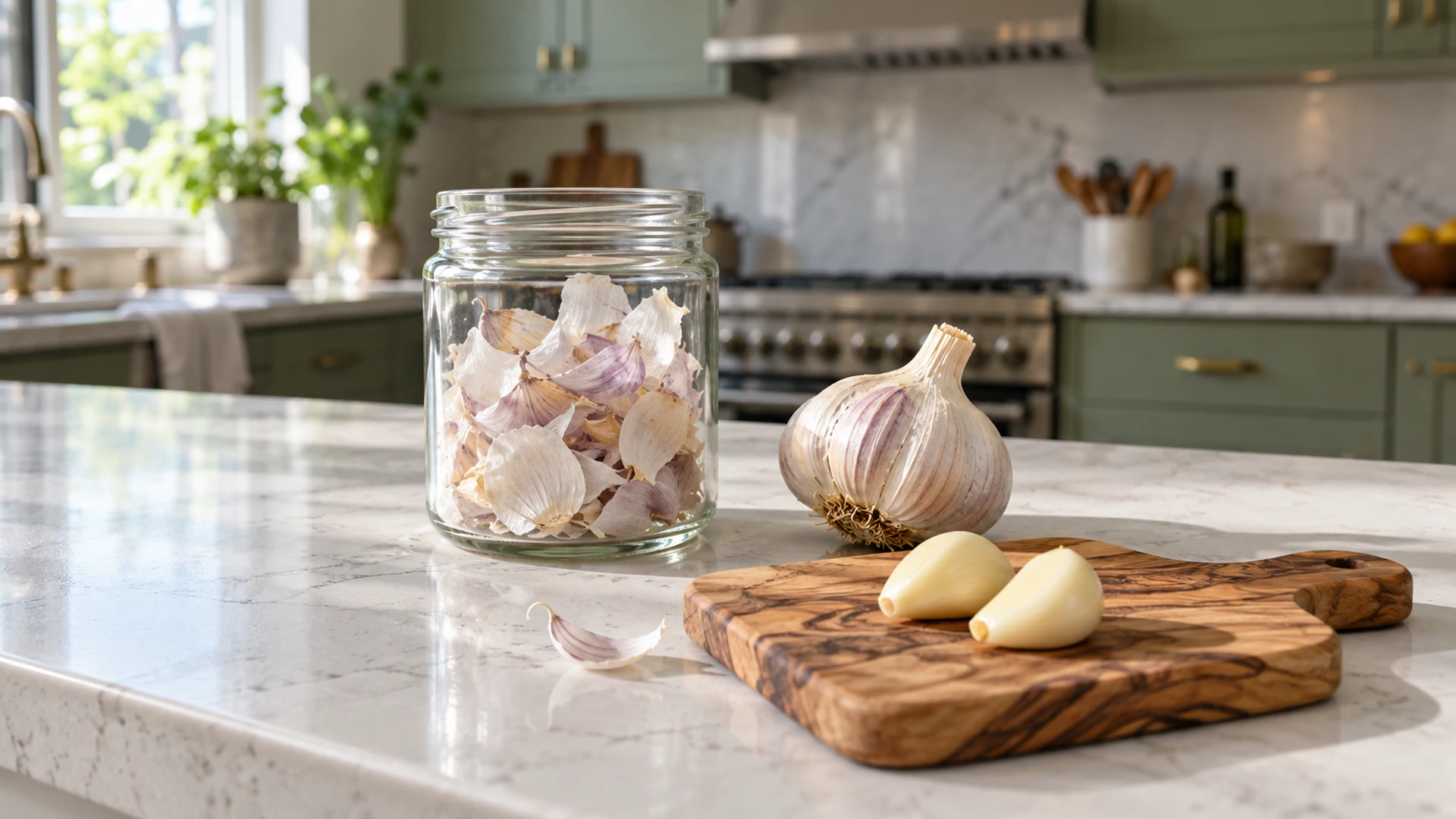
Garlic is the kitchen's most famous protective plant — hung at doors against the evil eye and evil spirits, and left at crossroads as an offering for Hecate in ancient Greece. Its magical role is active repelling: it drives off what approaches the threshold rather than quietly holding the line.
Driving Off What Approaches: Garlic's Place in Protection
Garlic belongs to the amaryllis family (Amaryllidaceae), the same family as onion, leek, and chive. Botanically, it is Allium sativum, and every part of the plant — bulb, skin, clove, even the papery outer layers — carries its pungent signature. That pungency is not incidental to its magical reputation. The same quality that makes garlic unavoidable in a kitchen makes it difficult to ignore at a threshold: it announces itself, and that announcement is the working.
Its correspondences place it firmly in the active, heat-driven current of the tradition. Both Culpeper and Cunningham assign it to Mars, the planet of decisive force, and its element is fire. Its day is Tuesday. This is not the quiet, held protection of a warding herb that simply marks a boundary — it is the energy of confrontation and expulsion. Garlic does not wait for something to test the line. It pushes outward at whatever draws near. Compare this to rue's evil-eye deflection, the other classic protective plant of the Mediterranean, which turns back envy and the evil eye but does so by redirecting it rather than driving it off. Or compare it to rowan's red-thread ward, twigs bound with red thread and hung at doors and byres against witchcraft, guarding house and livestock — a hanging ward rather than an active repelling force. Garlic belongs to a different register entirely.
Its secondary category is Banishing and Hex-Breaking, which makes sense as soon as you understand that the same repelling force that works at the threshold can be turned inward when something unwelcome is already present. The distinction matters in practice: threshold work is preventive, placing garlic where things might enter; banishing work is corrective, placing it inside a space where something has already settled. Hecate, the goddess of crossroads and liminal places, is the deity most closely associated with garlic in ancient practice.
Hecate's Suppers and the Strigoi at the Door
The ancient Greek evidence for garlic's ritual role is specific enough to date. Theophrastus, writing in the 4th century BCE, included in his Characters a portrait of the superstitious man who must ritually purify himself after seeing someone eat garlic at the crossroads. The casual reference is telling — Theophrastus does not need to explain it. His readers already knew that garlic formed part of the food offerings left for Hecate at crossroads, the goddess who governed thresholds, entrances, and the movement between worlds. Those offerings, called Hecate's suppers, were left at crossroads on the night of the new moon, and garlic was among the foods placed there. The superstitious man in Theophrastus's sketch is not alarmed by something obscure; he is reacting to something ordinary that his neighbors understood entirely.
The tradition of garlic hung at doors against harmful spirits takes a different shape in later European folklore. The most documented version concerns vampire figures, specifically the strigoi of the Balkans and Romania — restless dead who were believed to return to torment the living. Garlic hung in doorways and windows, rubbed on the frames, or placed around a body before burial was a recognized protection against them. It reflects actual folk belief and practice that was recorded by travelers and local chroniclers over several centuries. Whether you read the strigoi as a literal threat or as the folk form of a more general fear about what can enter a home, the magical logic is identical to Theophrastus's crossroads: garlic sits at the threshold and drives back what would cross it.
Bulbs, Braids, and Keeping It From the Dog
Whole bulbs and braids are the working form. You buy them fresh, preferably with the full papery skin intact, and the skins themselves are worth keeping. When you peel garlic in the kitchen, those thin papery layers carry the same protective virtue as the clove inside them — save them in a small container by the door rather than dropping them in the compost. The braid is the traditional hanging form, a long plait of whole bulbs that stays on the wall or inside the door as a standing ward. You do not need to make one yourself from scratch; a fresh garlic braid from a market works perfectly well. The intention you bring when you hang it is the working.
A few practical safety notes belong in any honest account of this herb. Garlic is toxic to dogs and cats — even small amounts can damage their red blood cells — so any cloves placed in room corners and braids hung by the door need to be positioned well out of reach of pets. If you have animals moving freely through your home, corners that sit high or behind furniture are safer choices than floor level. Raw garlic held directly on skin for any length of time can cause chemical burns, so handle whole cloves with that in mind during preparation. And at medicinal doses, garlic thins the blood, which is worth knowing if you ever decide to take it internally alongside any medication that does the same.
Three Garlic Workings for the Threshold
The Braid by the Door
Use this when you want a standing ward for your home — not a response to a specific incident, but an ongoing protection placed at the main entry point.
Take a fresh garlic braid — whole bulbs, not peeled — and hold it for a moment before hanging it. Breathe steadily. Picture the front of your home, everything outside it, and everything inside it that you want to keep safe. The braid goes on the inside of the front door, not the outside, so it guards the threshold from within. Hang it on a Tuesday or during a Mars planetary hour if you want to align it with garlic's ruling planet. Once it is up, you do not need to do anything else — the working runs as long as the braid stays fresh. When the bulbs begin to dry out completely, go papery and hollow, or start to sprout, take the braid down and dispose of it outside your home. Replace it with a new one, hung the same way.
A Clove in Each Corner
Use this when something unwelcome has already been felt in a specific room — a bad argument that left a residue, a period of disruption, an energy that simply does not lift.
Peel one garlic clove for each corner of the room. As you peel each one, hold it briefly and put your attention on what you want gone — not on the problem itself, but on the room as you want it to feel afterward. Place one clove in each corner, at baseboard level if pets are not a concern, or on a high shelf in each corner if they are. Leave them for three days. On the third day, collect every clove and take them outside your home to discard them — in an outdoor bin, buried in soil. Do not put them back in the kitchen. The act of removing them outside the home is part of the working: the cloves have absorbed what you wanted gone, and you are taking it with them.
The Skins Jar
Use this as a slow, accumulating protection built from the garlic you already cook with — no ritual timing needed, no separate purchase.
Keep a small, clean jar near the stove or on the kitchen shelf by the door. Every time you peel garlic while cooking, instead of discarding the thin papery outer skins, add them to the jar. Give the jar a brief moment of attention as you do — nothing elaborate, just a clear sense that what you are collecting carries the herb's protective quality. Over weeks and months, the jar fills. It sits in the kitchen as a quiet, cumulative guard, built from ordinary meals rather than a single ritual act. When the jar is full, empty it outside, give the jar a wash, and begin again.
The Ward Every Kitchen Already Has
Garlic's specific angle — active repelling, driving off what approaches rather than simply marking a border — makes it one of the most direct protective herbs available. It does not ask for elaborate preparation or rare materials. A braid costs what any fresh garlic costs. The skins come free with every meal. That accessibility is part of why garlic's protective reputation has survived so many centuries and crossed so many cultural lines: it is already in the kitchen, and the kitchen is already the heart of the home.
If you want to see how garlic sits alongside the other thirteen protection herbs — and how the Protection category fits into the six other paths of plant magic — the Witch's Herbarium guide is the place to go next.