Rose Tea Ceremony for Love: Where Venus and Water Meet in the Heart
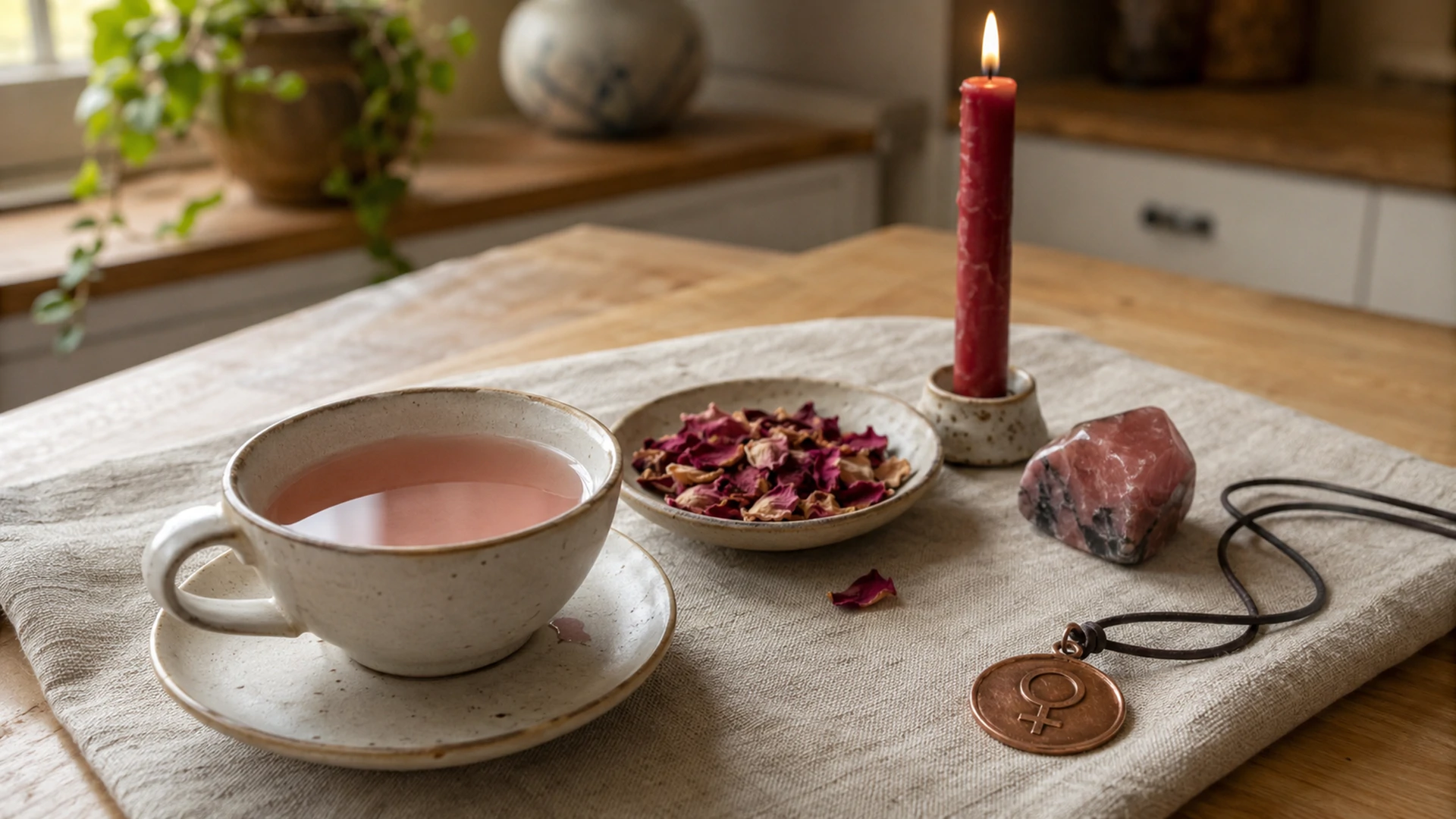
There is a reason rose has been the symbol of love across cultures for thousands of years. It is not arbitrary or decorative — it is rooted in a specific set of correspondences that make rose one of the most precisely matched herbs for love magic that exists. A spiritual tea ceremony for love built around rose is one of the clearest, most elegant workings you can do with this plant. You are not just drinking something pleasant. You are taking the energetic signature of Venus and Water — love's two governing forces — directly into your body and using your will to direct what they do there. This guide walks you through the whole ceremony: why rose, how to prepare, how to brew with intention, and how to close the working with care.
Why Rose Is Suited to a Love Tea Ceremony
Rose's love correspondence is not based on cultural association alone. It is grounded in a specific planetary and elemental framework that magical practitioners have used consistently across centuries. Rose is ruled by Venus — the planet governing love, beauty, desire, attraction, and emotional bonds — and it belongs to the element of Water, which governs feeling, intuition, the heart, and emotional depth. Together, these two rulers make rose one of the few herbs that addresses love at both the magnetic, outward-drawing level (Venus) and the deep interior emotional level (Water). That double correspondence is why rose has appeared in love workings across European folk magic, Middle Eastern perfumery traditions, Ayurvedic practice, and Victorian flower language all at once. Different cultures arrived at the same conclusion through different frameworks.
Historically, rose petals were used in Greek and Roman love rituals, strewn at wedding feasts, and offered to Aphrodite and Venus directly. In medieval European herb lore, rose was a primary ingredient in love sachets, love waters, and baths intended to draw romantic attention. In Persian Sufi poetry, the rose became the symbol of divine love itself — the beloved that the soul yearns toward. This is not a herb that picked up a love association through one tradition. It earned it through consistent use across wildly different cultural contexts, which is about as strong a signal as magical herbalism offers.
The aroma of rose also does real work here. Rose scent contains compounds including geraniol, citronellol, and phenyl ethyl alcohol — the last of which is chemically related to phenylethylamine, the compound the brain releases during attraction and early romantic feeling. Whether you approach that connection as physiology or as a signature of Venus's influence doesn't particularly matter; the effect on your nervous system and your emotional state is the same. The scent of rose, during a love ceremony, is not just pleasant. It is functionally activating the emotional register you need to be in for this working to land.
Drinking rose as tea makes this a distinctly embodied working. When you burn rose petals, carry them in a sachet, or use them in a bath, the herb works on you externally — through scent, through symbolic presence, through contact with your skin and aura. Drinking it moves that relationship inward. You are internalizing the herb's Venus-Water signature, bringing it into your body and making it physically part of you for the duration of the ceremony and beyond. In magical terms, this is an act of full integration — drinking rose tea does not just put you in contact with the energy of love, it makes you a more receptive vessel for it. That is a meaningfully different kind of working, and it is why the tea ceremony format suits rose and love so well.
Preparing for Your Rose Tea Ceremony
Choosing Your Space
Preparation is where the magic actually starts. Everything you do before you ever pour the water is part of the working. Start with your space. You want somewhere quiet where you will not be interrupted — not because the ceremony is fragile, but because your attention is the engine of this practice. Interruptions break concentration, and concentration is how you direct intention. Clear the space physically first: tidy whatever you can, open a window briefly if the weather allows, and remove anything that feels emotionally cluttered or associated with stress. You are creating a container for a very specific emotional and magical state, and the physical environment shapes that.
Timing
Timing matters for love work. The most favorable timing aligns with Venus's day and hour — Friday is Venus's day, and you can find Venus's hour for your exact location and date using our Venus's hour finder. That window is just as strong on any day of the week. For moon phase, a waxing moon supports drawing love toward you, while a full moon amplifies emotional intensity and commitment. If you are working on self-love or healing a love wound rather than drawing new love, the waning moon or even a dark moon can be appropriate — love magic is not always about attraction. Spring is the traditional season for love workings in the Northern Hemisphere, but rose is available year-round and the ceremony is effective in any season when your intention is clear.
Auxiliary Tools
Two auxiliary tools are worth including in your setup because they reinforce the intent through additional sensory and energetic channels.
- A red candle: Red candle magic works directly through the current of passionate love, desire, and the vital force that draws two people toward each other — it brings heat and urgency to a working where rose provides the emotional depth and tenderness. Lit beside your brewing space, a red candle keeps the energy of the ceremony active and outward-moving, preventing it from becoming too inward or contemplative when your intent is to call love in.
- Rhodonite: Rhodonite is a stone that holds both the warmth of love and the steadiness needed to receive it without self-sabotage — it works particularly well with rose because it addresses the place where love gets blocked, not just the place where it flows freely. Holding it in your non-dominant hand while you drink pulls your attention toward your own emotional availability, which is exactly what this ceremony is asking you to examine.
You do not need to do elaborate candle preparation for this ceremony — a lit red candle placed safely near your brewing space is enough. The rhodonite can sit beside your cup or be held in your non-dominant hand while you drink.
Safety Note
One safety note before you brew: dried rose petals and rosehips from culinary or herbal suppliers are generally very well tolerated. However, if you are pregnant, rose hips in larger amounts have historically been used to stimulate uterine contractions, so exercise caution and consult a midwife or herbalist. Rose can also interact with certain blood thinners at high doses. If you are on medication or have any relevant health concerns, check with a healthcare provider before consuming rose as a regular herbal tea. For a single ceremonial cup of mild rose petal tea, adverse effects are extremely uncommon — keep that context in mind as you read these cautions.
Brewing Rose With Intention
The brewing itself is not separate from the ritual — it is the ritual. Every step from the moment you fill your kettle is intentional action.
Setting Your Intention as You Boil
Begin by filling your kettle with fresh, cold water. As you do, hold your intent clearly in mind. Not a vague wish, but a specific and felt sense of what love means to you right now: what you are opening to, what you are healing, what you are calling in. This does not need words. It needs genuine feeling — the kind that you can sense in your chest when you let yourself focus on what you actually want.
Heating the Water
Heat your water to approximately 80°C to 85°C (175°F to 185°F). Rose petals are delicate, and boiling water can scorch them, making the tea bitter and flattening the floral notes that are part of the ceremonial experience. If you do not have a temperature-controlled kettle, bring the water to a full boil and then let it rest for two to three minutes before pouring. While the water heats, prepare your cup or teapot. Rinse it with a little warm water first — this is a small act of cleansing and readiness, the way you might clear a workspace before beginning something important.
Measuring the Petals
For the tea itself, use one to two teaspoons of dried rose petals per eight ounces of water. Culinary-grade dried rose petals are ideal — make sure they are food-safe and free of pesticides, as you will be drinking this. Loose petals in a strainer or infuser work well; you can also use a muslin bag. As you measure out the petals, take a moment to look at them. Rose petals are, even dried, extraordinarily beautiful — layered, softly curved, ranging in color from blush to deep crimson. Let that beauty register. Let it remind you that love, at its core, is not a struggle or a transaction. It is something that opens.
Pouring and Speaking Your Intention
Pour the heated water slowly over the petals. As you pour, speak your intention aloud — or if you prefer silence, hold it clearly in your mind and direct it into the cup. You might say something as simple as: "I open myself to love. I call love toward me. I am ready to receive and to give." Or make it personal — name what you want with specificity. Specificity is power in magical work. Vague intentions produce vague results. The water carrying your spoken word into the petals is an ancient act; water is receptive by nature, and Voice directed with will is one of the oldest magical tools there is.
Steeping
Steep for five to seven minutes. Do not wander off during this time. Stay with the tea. Watch the water shift from clear to golden to a pale rose. This is your window for focused visualization. See the love you are working toward as clearly as you can — not as a fantasy, but as a felt reality. Imagine yourself in it: how you feel, how you move through your days, what has changed. Let the emotion be genuine and present, not performative. The steeping period is, in magical terms, the working itself — your will and the herb's correspondence combining in the vessel you have prepared.
Drinking and Closing the Ceremony
When the steep is complete, remove the petals or strainer. Hold the cup in both hands for a moment before you drink. Feel the warmth of it. Take one slow, deliberate breath — in through the nose, catching the scent of the rose, out through the mouth with a soft release. That breath is a threshold. You are crossing from preparation into reception.
Drink slowly. This is a cup that asks you to stay present — to receive each sip the way Water receives: openly, without resistance. Take small sips and let each one be intentional. With each sip, consciously affirm that you are drawing love inward — not just hoping for it, not just asking for it, but actively receiving it as a thing that is already in motion. This is a key distinction in magic: you are not begging the universe for something. You are directing your will, which is the source of the working, to make something so. The tea is the medium; your will is the instrument.
As you drink, you may notice the taste of rose — mild, floral, slightly sweet with a delicate tannin finish. Let the taste itself be part of the working. In folk magic traditions across cultures, eating or drinking something associated with a magical intent was understood as a form of embodied commitment — you were saying, with your body, that you accepted this working into yourself. You are doing exactly that. Stay present with the warmth as it moves down into your chest. The heart center, in both magical and yogic traditions, sits in the chest. Let the warmth of this cup settle there.
When you have finished, set the cup down gently. If you have been holding your rhodonite, hold it a moment longer — then set it down as well. Take three slow breaths to begin grounding yourself back into ordinary awareness. You can gently press your palms flat on the table or your thighs, which physically signals to your nervous system that the heightened state of the ritual is complete. This step matters. Grounding closes the working cleanly and helps your energy settle so the intention can integrate rather than dissipate.
Spend five to ten minutes journaling immediately after if you can. Write whatever came up during the ceremony — images, feelings, specific thoughts, any emotional shifts. Journaling after magical work is not optional busywork; it is how you track what the working is doing over time and how you deepen your relationship with the practice. Note the date, the moon phase, any tools you used, and how the tea tasted and felt. You are building a personal record of your practice.
For disposal: if you have leftover petals from the strainer, return them to the earth if possible — bury them in a garden or at the base of a plant, or scatter them outdoors. This is a traditional way of returning the herb to its source with gratitude after it has served its purpose. Do not simply toss them in the trash immediately after a ceremony; give the gesture a moment. If you have no outdoor access, wrapping them in a tissue and disposing of them with a brief thanks is perfectly fine. The physical act of closing matters less than the intention with which you do it.
Rose, Venus, and the Love You Carry Forward
You now understand why rose is not just a romantic symbol but a precisely calibrated tool for love work — governed by Venus, belonging to Water, carrying a scent that activates the emotional register love requires, and bringing thousands of years of intentional use behind it. That is a real correspondence you can return to again and again.
This ceremony is designed to be repeatable. Love is not a one-time working. It is a state you cultivate, return to, and deepen over time. Some practitioners hold a rose tea ceremony weekly — on Fridays, Venus's day — as a standing practice of keeping their heart open and their intention clear. Others return to it when they feel love closing off in them, when grief or fear or disappointment has made them less available to connection. The ceremony meets you wherever you are.
The more you practice it, the faster your mind and body learn to drop into the right state. The scent of rose steeping becomes a reliable anchor — your nervous system associates it with the open, receptive, intentional state you have practiced, and it begins to arrive more easily each time. This is how magical practice actually builds: not through dramatic one-time rituals, but through repetition that deepens the grooves of will and attention until they become second nature.
Rose is not the only herb that brings this kind of precision to love work. If you want to explore other tea ceremonies built around the same intent, the Jasmine Tea Ceremony for Love works through a softer, more spiritually expansive frequency — jasmine opens the heart at the level of grace and divine connection rather than earthly desire. The Damiana Tea Ceremony for Love takes a more fiery approach, working through desire, confidence, and magnetic attraction. Each herb brings a different angle on love, and working with more than one over time gives you a fuller, more versatile practice.
If you want to explore how rose tea fits into a broader framework of herbal ceremony across different intents, Spiritual Tea Ceremonies: A Complete Guide by Intent maps the full landscape — from love to protection to clarity to release — so you can build a tea ceremony practice that covers every dimension of your magical life. Rose is the beginning. There is a great deal more to explore.