Jasmine Tea Ceremony for Love: Softening the Heart Open to Receive
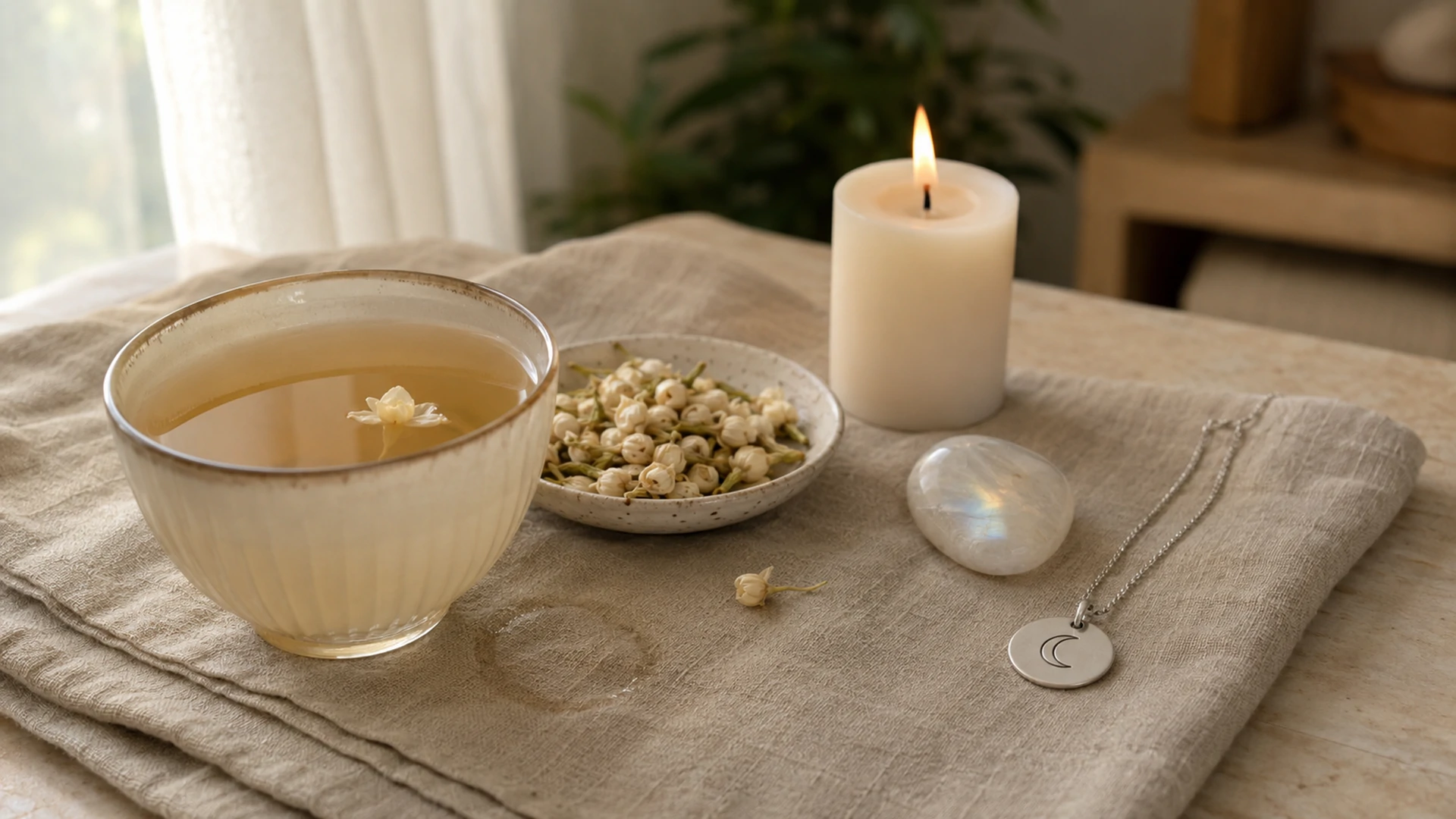
Jasmine tea for love is not a new idea. Across cultures and centuries, jasmine has been woven into wedding rites, courtship offerings, and love-drawing practices precisely because its correspondence with the heart is not arbitrary — it is rooted in the plant's planetary rulership, its scent's documented effect on human emotion, and a long cross-cultural history of associating its blooms with desire, devotion, and romantic openings. A spiritual tea ceremony built around jasmine is one of the most embodied and intentional ways to work with this plant's energy, bringing it fully inside you rather than burning it at a distance. If you're ready to direct your will toward love — whether you're calling it in, deepening it, or reopening your heart to receive it — this ceremony gives you a clear and powerful structure to do that.
Why Jasmine Is Suited to a Love Tea Ceremony
Jasmine's love correspondence isn't vague floral symbolism. In traditional Western herbalism and planetary magic, jasmine is ruled by the Moon and by Venus — the two celestial bodies most associated with emotion, romantic feeling, receptivity, and the opening of the heart. Venus governs love, beauty, and magnetic attraction. The Moon governs the inner emotional world, cycles of feeling, and the subconscious patterns that shape how we give and receive affection. Jasmine sits at the intersection of both, which is why you find it doing double duty in traditions that treat it as simultaneously emotionally softening and magnetically attractive.
In practice across South and Southeast Asia, jasmine garlands have been used in wedding ceremonies for thousands of years, adorning brides and altars as offerings to invite auspicious romantic union. In Ayurvedic and Indian folk tradition, the scent of jasmine was understood to open the heart and calm nervous agitation — two things that tend to block love from flowing freely. In the Middle East and North Africa, jasmine-scented oils were used in preparations for romantic encounters, and jasmine water was a common ingredient in beauty and attraction preparations. You can explore the full range of jasmine's magical uses and correspondences in the dedicated jasmine magic correspondences guide, but the core thread is consistent: this plant has been asked to help humans open their hearts and draw love toward them across radically different cultures, and the effect is real — jasmine's linalool-rich aromatic compounds have measurable effects on the nervous system, reducing cortisol and anxiety while increasing emotional warmth and receptivity.
Drinking jasmine as a tea rather than burning it as incense, carrying it as a sachet, or wearing it as oil is a meaningfully different act. When you ingest an herb in a ceremonial context, you are not asking it to influence the space around you — you are inviting it into your body, into your bloodstream, into your literal physical center. The boundary between you and the working dissolves. The jasmine is no longer an external symbol of love; it becomes part of you for the duration of the ceremony and the hours after. This is why tea ceremonies occupy a unique position in herbal magic: the herb's energy, its scent, its warmth, its chemistry — all of it enters you, and your intention then moves through that charged interior state outward into the world. It is one of the most intimate forms of magical working available, and jasmine's long history as a heart-opener makes it exceptionally well-suited to it.
Preparing for Your Jasmine Tea Ceremony
Preparation is not decoration. The choices you make before you ever touch the kettle are setting the container for your will — and the stronger and more deliberate that container is, the more effectively your intention moves through the ceremony.
Space
Choose a space where you will not be interrupted for at least thirty minutes. This doesn't need to be an elaborate altar room — a quiet kitchen table, a bedroom floor, a window seat with good light will all do. What matters is that the space feels intentionally chosen rather than incidental. Clear the surface you'll be working at. Remove clutter. If you like, wipe it down with a clean cloth to mark the transition from ordinary to ceremonial. The physical act of preparing your space is the first act of will in the working.
Timing
Fridays carry Venus's rulership and are the traditional day for love workings — performing your ceremony on a Friday amplifies the correspondence directly. You can find Venus's hour for your location and date using our Venus's hour finder for an even more precise window. If you want to layer in lunar timing, a waxing moon supports drawing love toward you, and a full moon supports love at its height — deepening bonds, celebrating connection, maximizing magnetic pull. New moons are useful if you're setting a long intention for love to build gradually over time. Morning ceremonies work well for jasmine because the plant's association with the Moon means it harmonizes with the transitional, liminal quality of early light — the day is still opening, just as you are. If you want to lean into jasmine's lunar side specifically, you can check the Moon's hour using the same hour finder and time your ceremony to that window instead.
Auxiliary Tools
Two tools that reinforce the intent are worth placing on your surface before you begin:
- A white candle: White candle magic works with lunar energy directly — it carries the full-spectrum, reflective quality of moonlight, which mirrors jasmine's own lunar character back into the space you're working in. Light it before you begin and let it hold that luminous, open quality throughout the ceremony. Where other candle colors narrow the focus to a specific emotional register, white keeps the field wide and receptive, which is exactly what you want when the working is about drawing love in rather than pushing feeling out.
- Moonstone: Moonstone has a specific quality that makes it useful here beyond its general love associations — it works with emotional cycles, softening the places where feeling has calcified or gone rigid. If you've been closed off, guarded, or carrying old hurt that blocks new connection, holding moonstone while you drink gives that process somewhere to land. Place it in your non-dominant hand as you sip, and let any tightness in your chest have room to shift.
A Safety Note
Jasmine tea made from culinary jasmine-scented green tea or dried Jasminum officinale flowers is generally considered safe for most adults. However, if you are pregnant, breastfeeding, managing a hormone-sensitive condition, or taking medications that affect mood or hormone levels, check with your doctor or a qualified herbalist before consuming jasmine as a tea. Some jasmine species are toxic and not suitable for ingestion — ensure you are sourcing tea-grade jasmine or culinary jasmine flowers from a reputable supplier, not ornamental garden varieties.
Brewing Jasmine With Intention
This is where the ceremony fully begins. From the moment you bring your attention to the water, you are in the working. The physical and the intentional are happening simultaneously — and that is the point.
Setting Your Intention
Start by setting your intention clearly before anything touches heat. Hold your jasmine tea — whether that's loose jasmine green tea, dried jasmine flowers, or a jasmine blossom blend — in both hands. Close your eyes. Bring to mind exactly what you are working toward. Be specific in the privacy of your own mind: not just “love” as a vague warmth, but the feeling you want to carry in your body, the quality of connection you are drawing toward yourself, the state of your own heart that you want to open or heal or strengthen. Love workings are most powerful when they begin from a place of clarity and self-knowing rather than urgency or desperation. You are not begging the universe. You are stating, with quiet authority, what you are calling in.
Heating the Water
Heat your water to around 80°C to 85°C (175°F to 185°F) — jasmine green tea scorches at a full boil and turns bitter, which is both practically unpleasant and symbolically misaligned with the tender, receptive energy you're cultivating. If you don't have a temperature-controlled kettle, bring water to a boil and let it rest for two to three minutes before pouring. As the water heats, don't walk away. Stay present with it. Watch the steam begin to rise. This is an old ceremonial instinct — the moment between cold water and hot is a threshold, and thresholds are where magic happens. Let the rising heat mirror something in you: the warmth building in your chest, the opening of your heart's center, intention gathering like pressure before release.
Measuring and Pouring
Use one heaped teaspoon of loose jasmine tea or one tablespoon of dried jasmine flowers per cup. If you're using a tea ball or strainer, load it slowly and deliberately — this is not meal prep, it's an act of will dressed in ordinary clothing. Place your vessel — your cup, your pot, your strainer over the cup — and pour the water gently and steadily. As you pour, speak your intention aloud if you feel comfortable doing so, or hold it silently and precisely in your mind. A simple, direct statement works better than elaborate poetry: something like “I open myself to love. I draw love toward me. Love moves through me freely.” Say it once, clearly, and mean it.
Steeping
Steep for two to three minutes. No longer than four — again, bitterness is not the flavor profile you want and over-steeping loses the delicate floral aromatic compounds that carry so much of jasmine's sensory and energetic character. While the tea steeps, sit with your hands wrapped loosely around the vessel if you can bear the warmth. Feel the heat against your palms. This is the charging moment — your body heat, your focused intention, your moonstone nearby, your white candle burning. Everything in the space is pointed in the same direction. You don't need to perform anything elaborate. Simply stay present, keep your intention clear, and let the working build quietly beneath the surface of the ordinary act.
Drinking and Closing the Ceremony
The tea is brewed. The intention is loaded. Now you bring it inside.
Lift the cup with both hands before you take the first sip. Look at it for a moment — the color, the steam, the scent rising toward you. Jasmine's fragrance is doing something physiological right now: it is triggering your nervous system toward relaxation and emotional openness. Let it. Breathe it in deliberately before you drink. This breath is part of the ceremony. The scent of jasmine has been opening hearts in ritual contexts for thousands of years, and you are doing the same thing now, in your own time and space, with your own will directing the working.
Drink slowly. The whole point of this ceremony is reception — your nervous system is already softening, your chest already warming — so let each sip land before you reach for the next. Feel the heat travel down your throat and settle at your center. Between sips, return your attention to your intention. You can hold the moonstone in your non-dominant hand as you drink, letting the stone's quality amplify the receptive, drawing quality you're cultivating. Some practitioners find it useful to visualize the warmth of the tea spreading outward from the chest like light — filling the body, softening any tight or closed places, dissolving the places where love gets stuck. Let that image work if it comes naturally. If it doesn't, just stay with the intention in words. Both approaches are valid.
When the cup is empty — or nearly so, if you've left a small amount with the spent leaves — sit for a moment in the feeling the ceremony has built. Don't immediately stand up and move on. The closing of a ritual is its own distinct movement, and rushing it dissipates the energy you've just gathered. Take three slow, deliberate breaths. On each exhale, imagine the intention you've been holding releasing from your grip — not disappearing, but launching outward, freed from the private space of your mind to move through the world on your behalf. This is the difference between holding a working tightly and letting it work: you've done your part, now you release it.
Extinguish or let the white candle burn down if it's small enough to do so safely. If you used loose jasmine flowers, return the spent leaves to the earth — scatter them outdoors, bury them in a small pot of soil, or place them at the base of a living plant. Returning herbs to the earth after a love working is a traditional closing gesture that completes the cycle: the plant gave something to you, and you return it to the source. If that's not practical, disposing of them in a natural way — wrapped in paper rather than plastic — is fine. Rinse your cup thoughtfully rather than mechanically. Write a few lines in your journal: what you intended, what you felt, what you noticed. This record matters over time, especially if you return to this ceremony more than once.
Jasmine and the Long Work of Keeping Your Heart Open
What you've learned in this ceremony goes deeper than a single ritual. You've worked with jasmine's Venus-Moon correspondence deliberately and specifically — not as a pleasant fragrance but as a genuine vehicle for the kind of love magic that softens emotional armor, builds magnetic receptivity, and aligns your inner state with the frequency of what you're calling in. That pairing — the meeting of Venus's attractive pull and the Moon's emotional depth — is what makes jasmine one of the most reliable and historically consistent herbs in love work, and it doesn't stop being true after one ceremony.
This ceremony is designed to be repeatable. Return to it on Fridays. Return to it on full moons. Return to it any time you feel your heart contracting, your walls going up, or your faith in love dimming. The practice accumulates — each time you hold the cup, set the intention, and drink the tea with focused will, you are reinforcing a neural and energetic pathway in yourself. You are training your own system to associate this act with openness, with worthiness, with the active, confident claiming of love as something you deserve and are capable of receiving.
Jasmine is a powerful entry point into love-focused tea ceremony work, but it isn't the only door. If you want to work with herbs that bring a different energetic quality to the same intention, two are worth knowing well. Damiana's tea ceremony for love works from a more fiery, passionate angle — it's ruled by Venus, with a Fire element that brings heat and urgency, and its ceremony is especially suited to desire, magnetic attraction, and reigniting heat in an existing connection. Rose's tea ceremony for love works from a place of deep heart-opening and self-love first — a grounding complement to jasmine's outward, receptive pull. Each herb has its own frequency, and learning to choose between them based on what you actually need is one of the marks of a maturing practice.
If you want to explore how jasmine fits into the wider world of tea ceremony magic — other herbs, other intents, the full ceremonial framework — the Spiritual Tea Ceremonies: A Complete Guide by Intent covers the full landscape of this practice and will give you a strong foundation to keep building from.
You have everything you need to do this well. The jasmine is ready. The question is whether you are — and if you've read this far, I think you already know the answer.