St. John's Wort: Midsummer's Devil-Flight
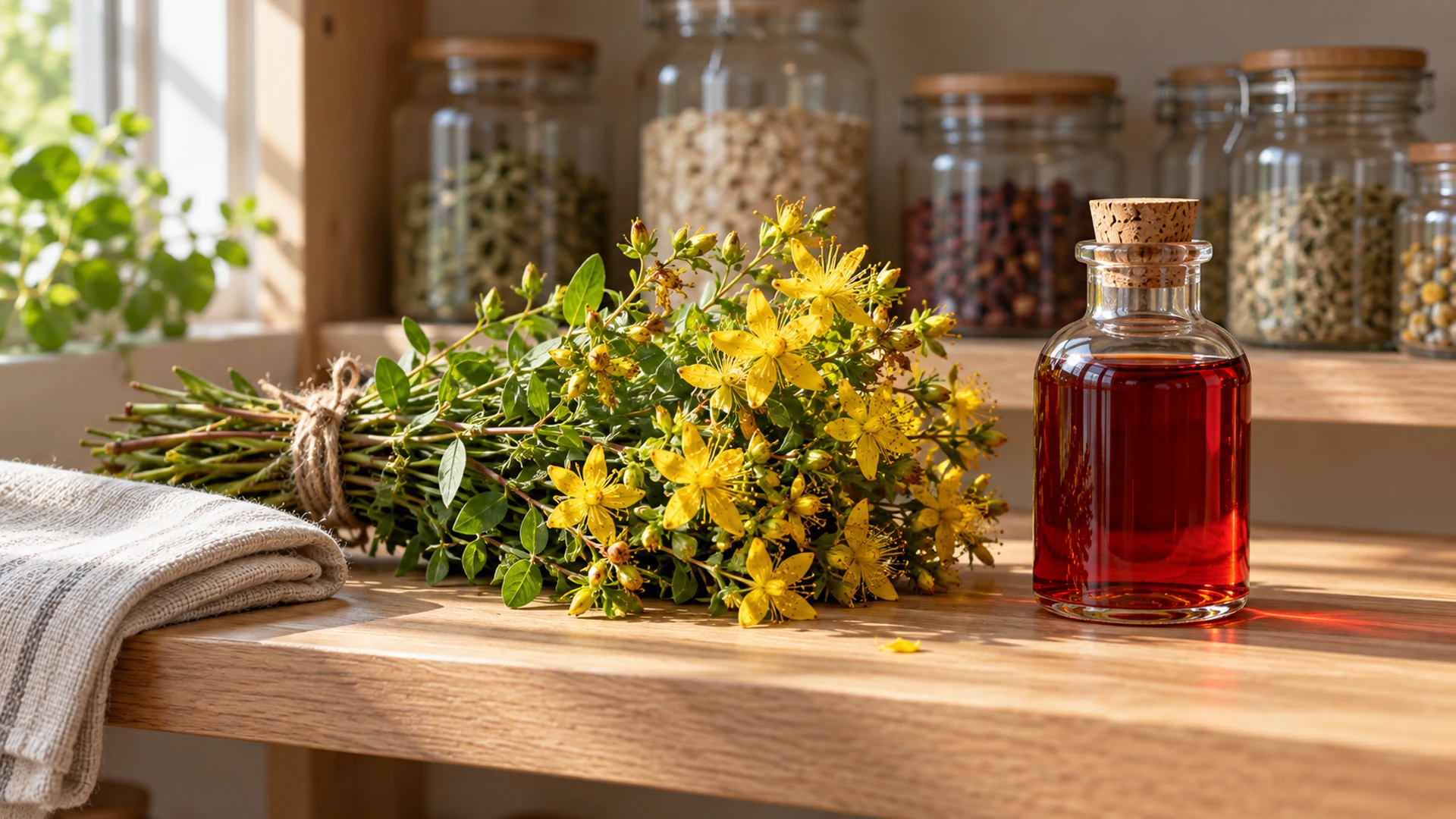
St. John's wort is a golden-flowered Midsummer herb gathered on St. John's Eve and hung over doors and windows against evil spirits and lightning, its medieval name — fuga daemonum, devil's flight — telling you exactly what tradition believed it could do.
The Sun at Its Height: St. John's Wort in Protection
Every protective herb has its own angle, its own specific way of doing the work. St. John's wort is the Midsummer ward. You gather it at the peak of the sun's power, when the light is longest and the year tips from waxing to waning, and you hang it at your door or window to hold that brightness through everything that follows. The logic is elemental: capture the year's highest point of solar energy at the moment it crests, fix it in plant matter, and let it keep working long after the days start shortening again. This is protection drawn down from the sky at the right moment, not assembled from earthy or Saturnine materials.
The correspondences follow naturally. Culpeper places St. John's wort under the Sun in Leo, which locates it precisely at high summer — the Sun in its own sign of strength and heat. Cunningham gives it the Sun and fire. Its day is Sunday. Both sources agree on the solar attribution, and the herb earns it: its flowers are a clear, strong yellow, it blooms at Midsummer, and its protective reputation is built entirely on that solar moment. Protection against evil spirits and lightning — bolts from the sky — makes more sense under a solar attribution than almost any other.
Among the protection herbs it helps to know exactly where St. John's wort sits. Compare it to mullein, which is Saturnine long-term protection — a steady, lasting guard that carries light through darkness, worked as torch, taper, and leaf. Mullein is the slow, enduring, night-appropriate ward; St. John's wort is its solar opposite, gathered in full daylight at the height of summer and hung bright overhead. Then there is fennel, the Midsummer threshold herb, the Nine Herbs Charm plant hung over doors at the same festival. Both fennel and St. John's wort went up at Midsummer, but they carry different characters: fennel guards the way in, and St. John's wort holds Midsummer's light over it. Its secondary spiritual register is Healing and Peace, not as a medicinal claim but as a quality of the plant's energy — something about Midsummer light, sustained through a bundle hung over a threshold, that carries warmth as well as warding.
Fuga Daemonum: St. John's Eve and the Red Oil
St. John's Eve falls on the night of 23-24 June, the vigil of the feast of St. John the Baptist, which the church placed at the midpoint of the year opposite Christmas. The timing stuck partly because Midsummer was already a charged date — the solstice's edge, the point where the sun begins its retreat — and partly because St. John's wort itself blooms then, its yellow flowers opening at exactly the right moment to be gathered. You pick the flowering tops on or around that night. The leaves, held against the light, show translucent dots — the "perforations" the species name perforatum is named for, and which tradition read as tiny punctures made by the devil, furious that the plant could drive him off. The name fuga daemonum, devil's flight, was in use through the medieval period, and the practice of hanging dried bundles over doors and windows against evil spirits and lightning was documented widely across Europe.
The infused oil is what makes St. John's wort visually striking. When the flowering tops are packed into oil and left to infuse in sunlight, the liquid turns deep red over several weeks. That red comes from hypericin, a compound concentrated in the dark glands on the flowers and leaves, but before anyone called it hypericin it was called the blood of St. John, a relic of the saint who was beheaded. The red oil anointed thresholds and sacred objects. At Midsummer, mugwort garlands were also gathered — mugwort was woven for St. John's Eve bonfires across medieval Europe — so the two herbs share the festival, though they work in very different directions: mugwort opens the dreaming mind and sharpens vision, while St. John's wort holds the door against what comes from outside.
The Herb With the Serious Interactions
St. John's wort carries the most significant drug interactions of any herb in this collection, and they need to be stated plainly. Taken internally, it weakens hormonal contraceptives and many prescription drugs, including some heart medications, transplant medications, and HIV medications. It can cause dangerous reactions with antidepressants. It also increases photosensitivity, meaning skin exposed to sunlight after internal use can react more strongly than usual. Internal use of St. John's wort should only be undertaken with medical advice. Every practice in this article is external: bundles, dried sachets, and infused oil applied to wood, not skin.
For practical gathering: the flowering tops are harvested at Midsummer, when the buds are just beginning to open alongside fully open flowers. Dry them in loose bundles in a warm, airy spot away from direct light. For the red oil, pack fresh flowering tops into a clean jar, cover with a light oil such as olive or sunflower, and set the sealed jar in a sunny window or outdoors in direct sun for four to six weeks. The oil will shift from yellow-green to a rich, burgundy red. Once it reaches that color and the plant matter has been strained out, the oil is ready for threshold anointing work. Store it away from heat and light between uses.
Three Midsummer Workings
The St. John's Eve Bundle
This is the foundational practice of St. John's wort, the one carried through centuries of European folk magic and still the most direct way to use the herb.
On or around 23-24 June, gather the flowering tops of St. John's wort while the flowers are fresh and the day is bright. Bind them into a bundle with natural twine — not too tight, so air can move through as they dry. Hold the bundle in both hands before you hang it, and state what you are asking it to hold: your home, your household, the threshold against anything that should not cross it. Hang the bundle over your front door or a main window. It stays there for the full year, holding Midsummer's light through autumn, through winter, through spring. At the following Midsummer, take the old bundle down. Burn it or compost it with intention, releasing what it held, and replace it with a fresh one gathered the same day.
Red Oil on the Threshold
This working uses the infused oil to renew Midsummer's protection at any point in the year when you feel the boundary of your home needs reinforcing.
Pour a small amount of the red-infused oil onto a clean cloth. Work on a Sunday, or time your work to a Sun hour if you want to align the working more precisely with the solar current the herb already carries. Begin at the top of the door frame and draw the oil down the left side, across the threshold at the base, and up the right side, making one continuous line. This is the wood you are anointing — the frame itself, not your skin. As you move, hold the intention clearly: this threshold is protected, this boundary holds. You are not asking for something vague. You are reinstating the light that was gathered at Midsummer and declaring it present at this door, right now. Finish with a firm, settled feeling rather than a question. The oil soaks into the wood; the working stays.
A Sachet of Summer Light for the Dark Half of the Year
This practice is for the months after the autumn equinox, when the dark presses in and Midsummer feels like a long time ago.
Pack a small cloth sachet with dried St. John's wort flowering tops gathered at the previous Midsummer. Hold the sachet for a moment before sealing it and picture the specific quality of light you want it to carry: not vague brightness, but the particular fullness of a June afternoon, the sun overhead, the year at its crest. Tie it closed and keep it by your bed or carry it with you through the winter months. This is not a claim about mood or health — it is a spiritual practice, a way of keeping Midsummer's protective current present in your body's daily orbit through the cold half of the year. The light was gathered at its height; you are simply carrying it forward. Renew the sachet at each Midsummer with fresh plant material.
Gathered at the Height of the Sun
What makes St. John's wort distinctive within the broader Protection and Warding category is the specificity of its moment. Its power is not drawn from the year at large. It is a plant whose power is tied to a precise point in the solar calendar — the peak — and the practice built around it is about capturing that peak and carrying it forward. Every other warding herb in the category has its own equally specific angle, its own logic of how protection is built and held. Seeing them side by side is what sharpens your practice.
If you want to see St. John's wort among all thirteen other protection herbs, alongside the six other categories of plant magic, the witch's herbarium guide is where to go next.