Tiger's Eye: Clarity Under Pressure
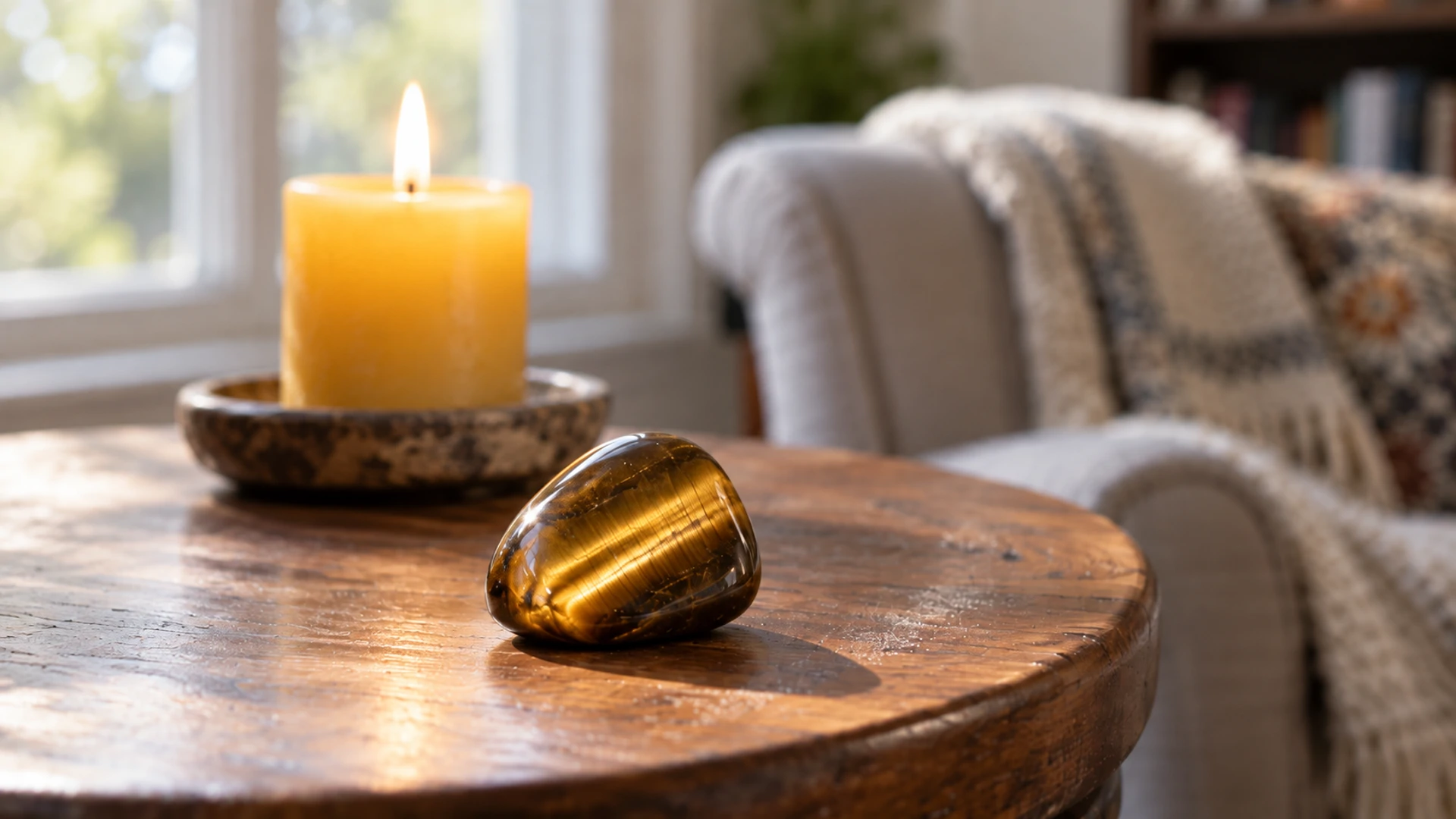
Tiger's Eye is the empowerment stone for people who need to think, not just act. Its mechanism is strategic focus under pressure — clear judgment and resistance to manipulation, rooted in the body rather than borrowed from willpower alone.
Clarity Under Pressure: Why Tiger's Eye Belongs in Empowerment
Most empowerment stones make sense through their color or their element — the red-orange fire of carnelian, the solar blaze of citrine, the grounded heat of red jasper. Tiger's Eye earns its place through geology. It forms as a pseudomorph, which means it began as crocidolite — a fibrous, blue-grey mineral belonging to the asbestos family — and was then gradually replaced, fiber by fiber, with silica. The original structure isn't destroyed. It's infiltrated and transformed. The fibrous arrangement that remains is now quartz, and it's that retained structure, oriented in parallel strands, that creates chatoyance: the moving band of light that gives the stone its name.
That formation story is also the clearest argument for what this stone does. This isn't a stone that blasts through obstacles with heat and urgency. It's a stone whose power came from a slow, complete transformation — one material becoming something harder and more stable without losing its form. The metaphysical mechanism follows. Tiger's Eye is oriented toward grounded discernment: the ability to read a complex situation clearly, hold your position without being pressured off it, and make decisions that account for all the variables rather than just the loudest one. It's a strategic stone, not a reactive one.
Its correspondences reflect that dual quality. The solar plexus and sacral chakras are both active here — the solar plexus governing personal will, confidence, and the sense of self that doesn't collapse under scrutiny, and the sacral governing instinct, desire, and the bodily intelligence that knows something is wrong before the mind catches up. Both Sun and Mars appear as planetary rulers, a pairing that surfaces in stones called to blend focused personal authority with direct, active force. Leo, Gemini, and Capricorn all carry aspects of this stone: Leo's confidence, Gemini's ability to hold multiple perspectives simultaneously, Capricorn's disciplined patience. Fire and Earth are both cited as elements, and that tension is the point — fire provides the perceptive heat, earth keeps it from burning past the useful moment.
Within the Empowerment category, Tiger's Eye occupies a specific position. Where carnelian is about immediate activation — overcoming procrastination and hesitation to spark bold decisive action right now — Tiger's Eye asks what you're acting toward and whether the move is actually the right one. They're not interchangeable. One clears the starting line, the other sharpens the route.
Chatoyance and Safety: Choosing Tiger's Eye
Given that Tiger's Eye originates from crocidolite, a mineral in the asbestos family, the safety question comes up — and the answer is genuinely clear. Finished, polished Tiger's Eye is considered safe to handle and wear. The original asbestiform crocidolite has been fully replaced by silica during the pseudomorphic formation process. What remains is a silicate mineral. The fibrous structure is still there visually, which is what creates the chatoyant shimmer, but the material those fibers are made of is quartz. It no longer carries the hazardous properties of asbestos fiber.
The only reasonable precaution applies to raw, unpolished material being cut or ground — which generates fine mineral dust of any kind, and where basic respiratory care is simply good workshop practice regardless of the stone involved. For the purposes of everyday handling, carrying, wearing, and working with tumbled or polished Tiger's Eye, there's no cause for concern.
When it comes to choosing a piece, it's worth knowing that the warm golden-brown tone most people associate with Tiger's Eye isn't always the stone's natural resting state. The base material, before the pseudomorphic replacement completes, is often closer to the blue-grey mineral known as hawk's eye — which is the same stone family but without the iron oxidation that produces the golden color. Some reddish-brown Tiger's Eye on the market is heat-treated from naturally blue-grey hawk's eye material to deepen the warm tones. This is a disclosed and accepted trade practice, not a counterfeit situation. It's simply useful to know so you're not assuming all golden-brown material is untreated. If provenance and natural coloration matter to you, ask your source.
For care: Tiger's Eye sits at Mohs 6.5 to 7, which makes it genuinely durable for daily wear. It's water-safe for normal handling — rinsing and brief soaking are fine — and holds up well alongside other stones in a collection. Store it away from materials significantly harder than itself (corundum, topaz, diamond) to avoid surface scratches over time, but in practical terms this is a low-maintenance stone. Its durability is part of its character.
Three Practices for Steady Judgment
The Clear Read
Use this practice before making a significant decision in a situation that feels murky, layered, or loaded with competing pressures — when you need to assess clearly before you act, rather than reacting to the most urgent-feeling piece of information in front of you.
Hold your Tiger's Eye in your dominant hand and sit somewhere quiet. If you have a yellow candle available, light it nearby. Spend two or three minutes saying nothing — just let the weight of the stone settle into your palm and bring your attention fully into your body rather than the circling thoughts. Then, out loud or in writing, name the situation in a single sentence. Not the backstory, not the context — just the actual decision in front of you. From that narrow starting point, let yourself identify each element separately: what you know for certain, what you're assuming, what you're afraid of, and what you actually want. Tiger's Eye's mechanism is discernment through stillness, not analysis through effort. This isn't a planning session. It's a sorting exercise. Work with the Sun hour for clarity on outcomes, or the Mars hour if the decision requires active confrontation.
The Unmoved Mind
Use this practice when you're heading into a conversation or situation where someone is likely to pressure you, argue you down, or use social tactics to shift your judgment — not because they have better information, but because they want a different outcome.
The night before or the morning of the encounter, hold your Tiger's Eye and state your actual position aloud. Not the softened version, not the version that accounts for their objections — your position as it currently stands. Then set the stone down somewhere visible while you sleep or go about your morning. Carry it with you into the encounter. Its specific role in this practice isn't to make you aggressive or immovable for its own sake. It's to keep the thread of your own thinking intact under pressure. The solar plexus engagement here is literal: if you feel that familiar collapse in the gut when someone pushes hard, press your thumb against the stone in your pocket. That physical anchor is the practice. You don't need to be right, and you don't need to win — you need to leave the room still knowing what you actually think. A piece of black pepper carried alongside it reinforces the boundary-holding current.
The Long Watch
Use this practice for sustained, strategic focus during tasks that demand patience over a stretch of days or weeks — not a single concentrated effort, but the kind of steady, methodical attention that complex projects require when there's no single dramatic push that resolves them.
Place your Tiger's Eye at the edge of your workspace — not in front of you, but within peripheral vision. The placement matters. You're not staring into it for inspiration; you're letting it anchor the space without demanding your direct attention. At the start of each working session, pick it up briefly, name one specific thing you intend to accomplish in this session, then set it back down. At the end of the session, pick it up again and state — out loud if possible — what you actually completed. This closing acknowledgment is as important as the opening one: Tiger's Eye works in part through the accumulation of kept commitments. The ritual is building a record, not just setting an intention. Work during a Saturn hour if the project requires sustained discipline, or pair the stone with rosemary at the workspace to sharpen focus across long sessions.
A Stone Formed by Becoming Something Else
Roman soldiers wore Tiger's Eye into battle. The value they placed on it wasn't the same quality they sought from stones like carnelian or garnet — the hot activation of a warrior throwing himself forward. What Tiger's Eye was meant to provide was steadiness. Composure. The ability to assess what was in front of you rather than react to it. In the context of actual combat, that distinction matters enormously: a soldier who panics makes worse decisions than one who can read the situation quickly and hold their nerve. The belief was that Tiger's Eye granted that quality — not fearlessness, but clear-headed presence under threat.
That belief maps precisely onto what the stone's own formation demonstrates. A material doesn't become a pseudomorph by overpowering what came before. It becomes one through a gradual, complete replacement that preserves the form while changing the substance. The original crocidolite doesn't disappear — it becomes something harder, more stable, and more durable through a process that works with the existing structure rather than against it. The Roman soldiers wearing this stone were drawing on exactly that quality: not the ability to destroy what's in front of you, but the ability to be transformed by pressure into something that holds.
Empowerment That Thinks Clearly
Tiger's Eye makes the argument that empowerment isn't always about more energy or bolder action. Sometimes it's about a steadier, clearer read — knowing what's actually happening, knowing what you actually think, and holding both of those things intact when something or someone is pushing hard against them. That's a specific kind of strength, and it's the one this stone is built for.
If you want to see where Tiger's Eye sits alongside the other Empowerment stones — and how the Empowerment category itself relates to the other six paths of stone magic — The Crystal Compendium: Seven Paths to Stone Magic is the place to start.