Sweet Orange: Blossom, Peel, and the Bridal Wreath
Sweet orange is worked as peel, blossom water, and oil for cheerful love, friendship, and a warm household, with prosperity as its second face.
Bridal Brightness: Sweet Orange's Place in Love & Attraction
Among the love herbs, sweet orange holds the angle called bridal brightness: the cheerful love of weddings, friendship, and a warm household. This is not the love that smolders or aches. It is the love that fills a kitchen on a Sunday morning, the love that shows up in flower arrangements and shared meals and a front door that smells like something good is happening inside. It is sociable, generous, and outward-facing, more interested in welcome than in longing.
That quality sets it clearly apart from its neighbors in the Love & Attraction category. Vanilla brings comfort — warmth that draws people near and eases them once they arrive — which is a softer, more interior energy than sweet orange's brightness. Ylang ylang is the sensual intimacy of the wedding bed: confidence and ease in physical closeness. Sweet orange is what happens before any of that, in the hallway and the garden, when guests arrive and the celebration begins. Its secondary category is Prosperity & Success, and that pairing makes sense when you look at it: a warm household is also a thriving one. The same cheerfulness that draws friends draws fortune.
In the rue family (Rutaceae), sweet orange stands alongside lemon, which cleanses and cuts, and bergamot, which draws money. Each citrus in this family pulls in a different direction, and sweet orange's direction is consistently toward abundance and welcome rather than removal or acquisition. Its planetary ruler is the Sun, which Cunningham pairs with fire — an active, radiating energy, not a passive one. That placement lands on Sunday, the Sun's day, making it one of the few love herbs ruled by neither Venus nor the Moon. Where Venus rules the quiet devotion of violet or the central romantic love of rose, the Sun rules sweet orange's louder, more celebratory warmth.
Queen Victoria's Wreath and the Tree That Fruits in Flower
The moment that fixed orange blossom as the bridal flower of the 19th century was a specific one: Queen Victoria wore a wreath of orange blossom at her wedding in 1840. That choice was widely copied, and within a generation orange blossom had become the expected bridal ornament across Britain and much of Europe and North America. But the wedding association did not begin with Victoria — it grew from something the tree does that almost no other cultivated tree does: it carries blossom and ripe fruit at the same time. On the same branch you can find flowers in full bloom and oranges already heavy and golden. That simultaneity made it a natural fertility emblem long before any queen chose to wear it. A tree that is already producing while it is still flowering is a sign of abundance that doesn't wait.
At Chinese New Year, oranges and mandarins are given as gifts to wish prosperity, and the custom is still alive in households across East and Southeast Asia. The mandarin is a related species, close enough in appearance and scent that the same symbolic logic applies: round, bright, fragrant, and golden, the fruit carries everything the Sun correspondence would predict. The giving of citrus at a new year is an act of wishing abundance forward, which maps cleanly onto sweet orange's second category. Across two very different cultural traditions — a 19th-century royal wedding in London and the Lunar New Year — the same fruit is doing the same work: marking a threshold moment with warmth and the promise of good things ahead.
Sweet or Bitter, Peel or Oil
Sweet orange is Citrus x sinensis, a member of the rue family. It is not bitter orange, which is Citrus x aurantium, and that distinction matters practically. Neroli — the intensely floral oil distilled from orange blossoms — comes almost entirely from bitter orange. Most commercial orange-blossom water is also made from bitter orange rather than sweet. So if you pick up a bottle labeled orange-blossom water, what you are almost certainly holding is bitter orange, not Citrus x sinensis. For magical purposes this is worth knowing but not cause for alarm: the bridal and love associations of orange blossom belong to both, and practitioners have used them interchangeably for generations. The distinction becomes more pressing with oils. Cold-pressed sweet orange oil is not significantly phototoxic, which puts it in a different category from lemon oil, bitter orange oil, and bergamot, all of which can cause severe burns on sun-exposed skin. Sweet orange peel oil is one of the gentler citrus oils to work with on that front, though oxidized oil — oil that has gone off from age or heat — can sensitize skin regardless of the original source. And concentrated sweet orange oil, like all citrus oils, is harmful to cats. If you have a cat in the house and you are using orange oil on candles or in a diffuser, keep the space ventilated and give the animal a way out of the room.
Three Sweet Orange Workings for a Brighter Home
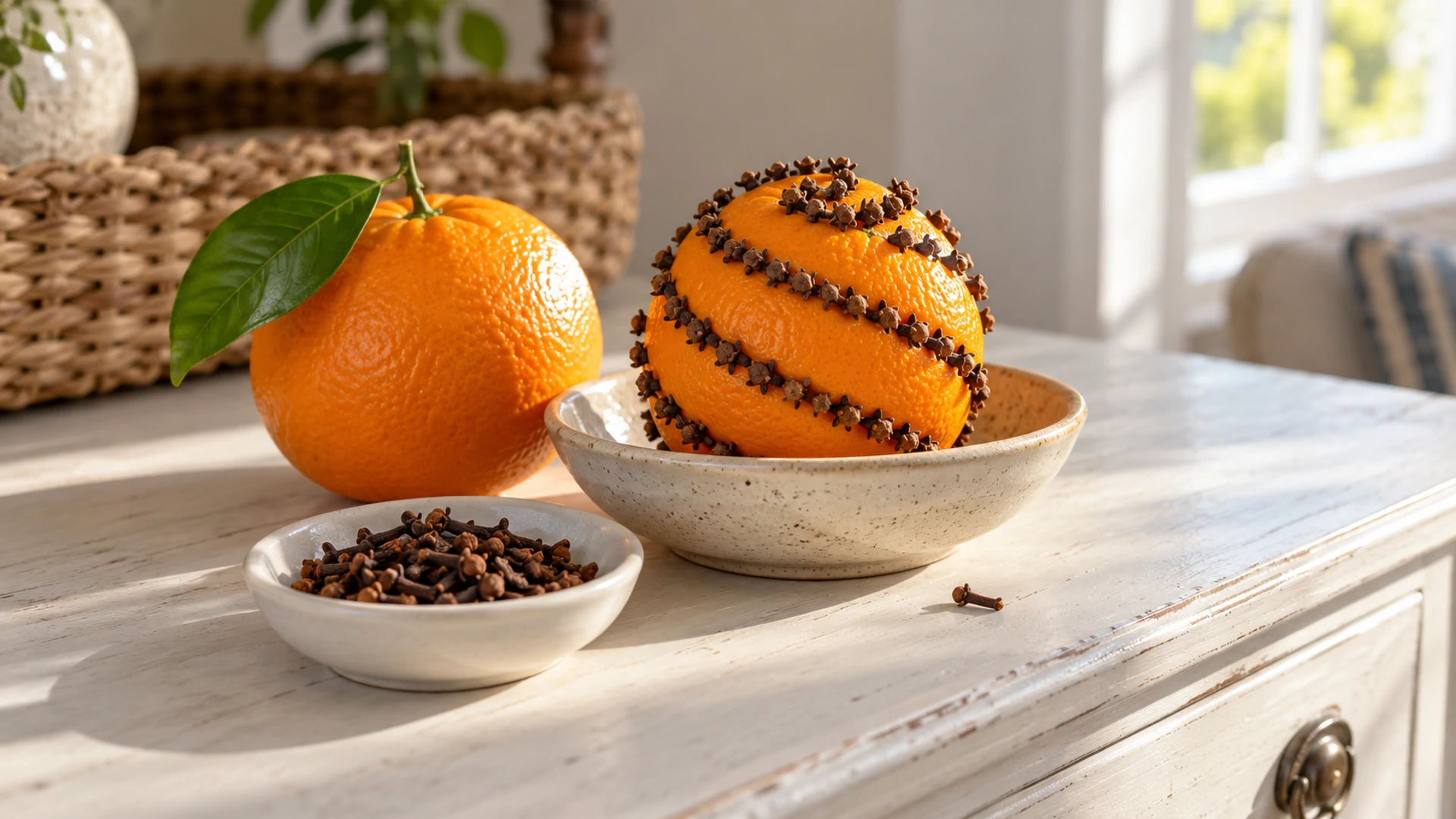
The Clove-Studded Pomander
Use a pomander when a space needs to smell and feel like welcome: before guests arrive for the season, at the start of winter, or whenever a room has gone flat and a little cold in atmosphere.
Take a firm, fresh sweet orange and press whole cloves into the peel in whatever pattern feels intentional to you — a spiral, a grid, a loose scatter, your initials, a symbol for the home. As you work each clove in, hold in mind what you are building: a house that is warm, that smells like abundance, that people want to come back to. Clove pairs with sweet orange's brightness and welcome; it intensifies whatever it is paired with, and here it pairs with sweet orange's brightness and welcome. When the orange is studded to your satisfaction, set it in a bowl somewhere central — a kitchen table, a mantel, an entryway — or hang it in a mesh bag. It will dry slowly over weeks, shrinking and hardening and deepening in scent, and for all that time it is doing its work. Replace it when the scent has faded entirely.
An Orange-Peel Bath for Friendship
This bath is for before a gathering: a dinner party, a reunion, a celebration where you want to arrive easy and open rather than tired or guarded.
Dry the peel of two or three sweet oranges — spread it on a sheet of parchment and leave it somewhere warm for a day or two until it curls and lightens. On a Sunday, or during a Sun hour, add the dried peel to your bathwater. If you have a muslin bag or a tied piece of cloth, put the peel inside so it doesn't clog anything; if not, steep it in a bowl of just-boiled water for ten minutes and pour that into the bath. Step in and let the warmth and scent do what they do. The intention is simple: you are washing yourself into your most cheerful self, the self that is genuinely glad to see people, that makes a room feel warmer. Sit with that for as long as you need. Rinse clean, dry off, and go to your people.
Orange-Blossom Water Before a Celebration
Use this before a wedding, engagement party, anniversary, or any celebration that marks a love beginning or deepening.
Take a bottle of orange-blossom water — which will almost certainly be made from bitter orange rather than sweet, and that is fine — and spritz it lightly on your wrists, your collarbone, or the hem of what you are wearing. You are not applying perfume; you are placing yourself inside the tradition Victoria's wreath made famous and that stretches back further into the fertility symbolism of the flowering-fruiting tree. Hold the occasion in mind as you do it: what it represents, who it celebrates, what is beginning or continuing. That is the whole of this working. It is brief because it does not need to be complicated. The water carries the meaning; your intention directs it.
Love That Lights the Room
Sweet orange's bridal brightness is its defining quality in the Love & Attraction category: not the deepest love, not the most complex, but one of the warmest. It is the love that makes a room feel good to be in, that draws friends back and keeps a household feeling alive. If your practice is looking for something to open a space rather than pull someone toward you, to celebrate rather than long, to welcome rather than wait — this is the citrus for that work.
To see sweet orange alongside the other nine love herbs and within the six other magical categories, the full overview is in the Witch's Herbarium: seven paths through plant magic.