Violet: The Flower of Quiet Devotion
Sweet violet (Viola odorata) is a small, spring-blooming flower worked in sachets, baths, and violet water for faithful, lasting affection and for mending trust between people who already share something worth keeping.
Quiet Devotion: Violet's Place in Love & Attraction
Violet's angle in love magic is not fire or urgency. It is the kind of love that waits, stays, and means what it says — modest, faithful, lasting affection. That puts it in clear contrast with rose, whose territory is central romantic love — love at its center, reaching outward into self-love and the healing of the heart — and with jasmine, the lunar, night-scented love of sensuality and dreaming. Violet doesn't compete with either of those. It sits beside them, doing something quieter: tending what's already there.
Its correspondences are Venus for planet, water for element, and Friday for day of working — all three shared with rose, with vanilla (warmth that draws people near and eases them once they arrive), and with cardamom (drawing people close through welcome, shared food, and desire). That Venus rulership appears in both Culpeper and Cunningham. What the violet adds to that shared planetary current is specifically its quality of constancy. It doesn't amplify longing or accelerate attraction — it strengthens fidelity, trust, and the kind of tenderness that doesn't need to announce itself.
Violet carries a secondary category in Healing & Peace, and that secondary is relevant to how you use it. The healing here isn't physical — it's relational. Violet is useful when a relationship has frayed, when trust has taken a small knock, when two people need to come back to each other after a disagreement without drama. That makes it distinct from most of the other Venus herbs. Roses mend heartbreak; violet mends a conversation. It works on connection that already exists and needs gentle attention rather than reconstruction from the ground up.
Violet-Crowned Athens and Corporal Violet
Ancient Athens was praised as violet-crowned — a description that appears in the writings of Pindar and was famous enough to be referenced and mocked by later writers, including Aristophanes, who knew it had become a cliché. The violet here wasn't metaphor; it was a literal feature of the Attic landscape in spring, and the city wore it like a garland. That association between violet and civic pride, between a small, modest flower and something that defines a place, says something true about how this flower was understood. It was never flashy. It was always there, and people noticed.
A very different kind of political devotion attached itself to violet much later. When Napoleon was exiled to Elba in 1814, his followers called him Corporal Violet and promised that he would return with the violets in spring. The violet became a Bonapartist emblem — worn as a token, used as a signal, a small flower carrying the weight of a loyalty that could not yet speak openly. When Napoleon did return in 1815, his supporters greeted him with violets. The Victorians took the flower in a softer direction: in the language of flowers that developed through the nineteenth century, violet stood for modesty and quiet devotion, the precise meaning it carries into magical practice today. Three very different contexts — a classical city, a political underground, a sentimental floral code — and all three landing on the same quality: something small, constant, and sincere.
Sweet Violet, Not African Violet
Sweet violet is Viola odorata, a member of the violet family (Violaceae). African violet, which fills windowsills and sits in grocery store garden sections, is Saintpaulia — a completely different plant with no botanical relationship to Viola and no overlap in magical use. It's worth being clear on this because the two share a name and a purple color and not much else. When violet appears in herbal magical recipes, it always means sweet violet: the spring-blooming, low-growing, genuinely fragrant European species, not the fuzzy-leaved houseplant. The parts used are the flowers and the leaves, both edible in moderation and both safe for the preparations given here. The root and seeds are a different matter — they cause vomiting and are not used in any of the workings below. For a full ritual framework that puts violet's Healing & Peace secondary into practice as a shared tea, the violet tea ceremony for harmony gives you the complete working.
Three Violet Workings for Faithful Love
Crystallized Violets Shared
This working is for a relationship that is steady and good — a partnership or long friendship where you want to quietly mark and reinforce the constancy between you, without ceremony or explanation.
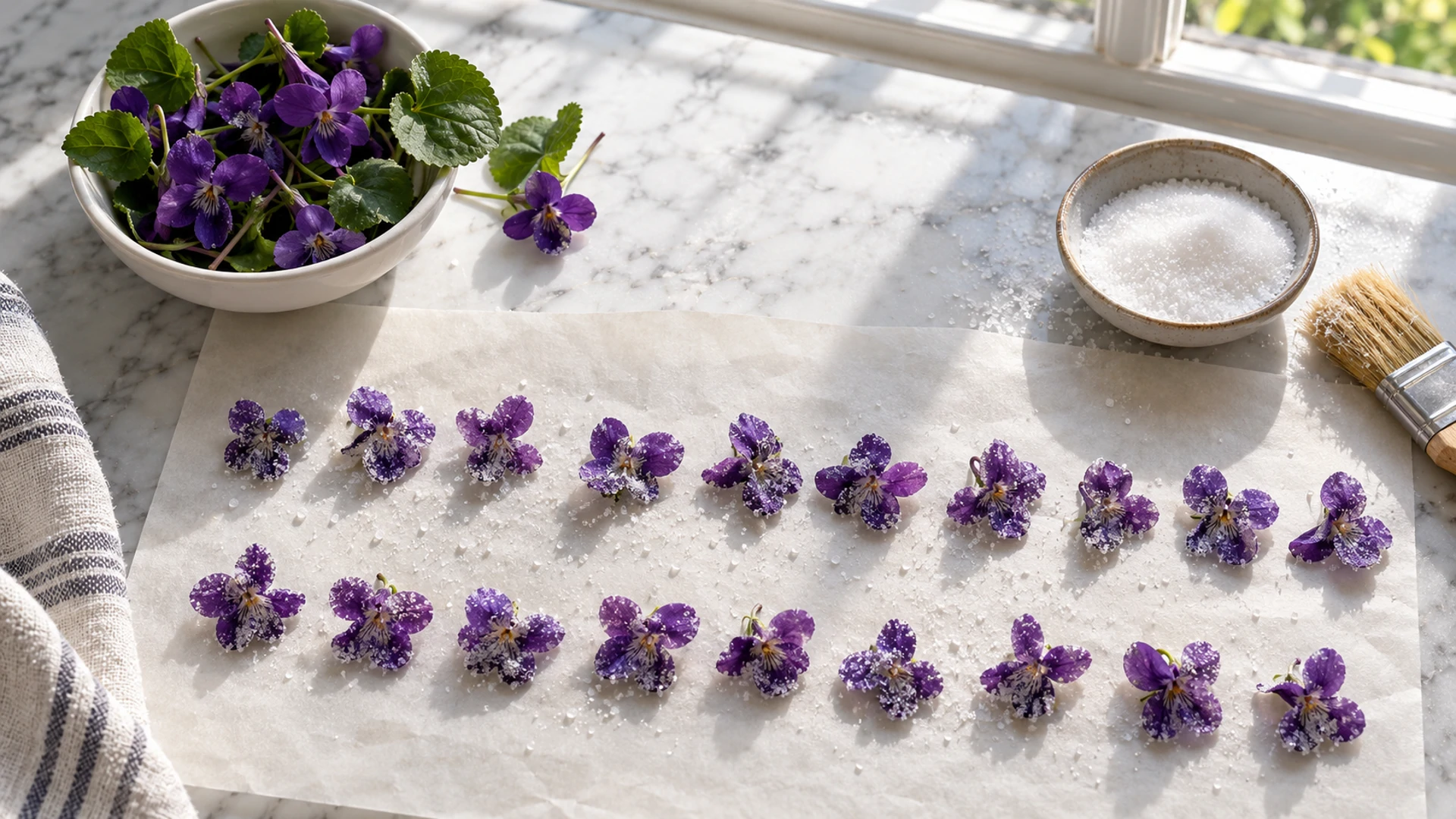
Candy fresh violet flowers by brushing them lightly with beaten egg white, dusting them with fine sugar, and leaving them to dry on parchment. Do this on a Friday or during a Venus hour, holding in mind not what you wish the relationship to become but what you value in it now. When the violets are dry, share them with the other person — no explanation needed, just the small, sweet fact of the gesture. The ritual is in the making and the sharing, not in any declaration. Constancy doesn't need speeches. It just shows up, like the flower does every spring.
A Violet-Leaf Bath for Mending Trust
Use this before a conversation you've been putting off — one where something small has gone wrong between you and someone you care about, and you want to come to that conversation soft rather than defended.
Steep a large handful of fresh or dried violet leaves in just-boiled water for fifteen minutes, strain well, and add the infusion to a warm bath. As you soak, don't rehearse what you'll say or replay what went wrong. Instead, let your attention settle on the specific quality in the other person that made you want to repair this in the first place. Violet's Healing & Peace secondary is active here — not the passionate pull of attraction, but the quieter willingness to stay. Bathe for as long as feels right, drain the water with intention, and go to the conversation before you've had time to build the armor back up.
Violets in a Love Sachet
This is for love that is already present and needs no amplification — just a steady, warm reminder that it's there.
Fill a small cotton or linen pouch with dried violet flowers and tie it closed on a Friday. Keep it beside your bed or carry it with you during the day. The intention here is not to attract someone new or to intensify feeling — it is to hold a quality: the quality of love that is faithful and undemonstrative and real. Violet doesn't push. It just stays. Let the sachet do the same.
Small Flowers, Lasting Love
Violet's particular value in a love practice is that it covers ground the more dramatic herbs don't. When you need the heat of attraction, you reach for Mars and fire. When you need the ache of longing answered, rose is closer to the mark. Violet is for after all that — for the long part, the staying part, the version of love that shows up on an ordinary Tuesday. Quiet devotion is its own kind of strength, and it tends to outlast the kinds of love that arrive with more noise.
If you want to see where violet sits alongside the other nine love herbs — and how the love category as a whole fits within six other paths through plant magic — the Witch's Herbarium: seven paths is the place to start.