Vanilla: The Orchid Born of a Love Story
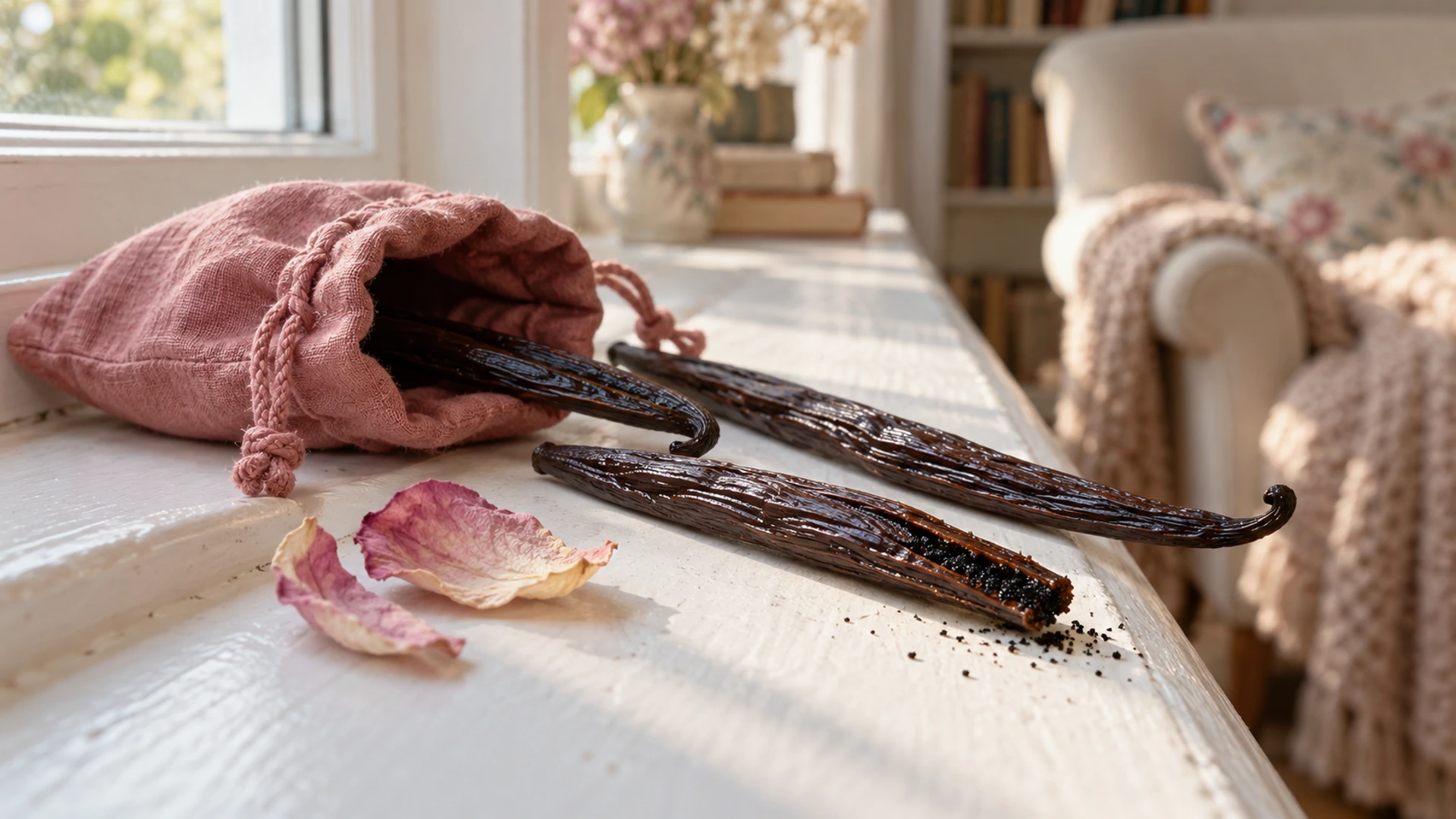
Vanilla planifolia is a sweet cured orchid pod worked in sachets, anointing oil, and candle dressing for warm, comforting love — warmth that draws people near and eases them once they arrive.
Comfort: Vanilla's Place in Love & Attraction
Every love herb has an angle. Rose works at the center of romantic love, reaching outward into self-love and the healing of the heart. Damiana brings heated desire, physical attraction, and rekindled passion. Vanilla does neither of those things. Its angle is comfort — the warmth that makes people want to be near you, and the ease that keeps them there once they are. It is the love herb for softening a room, for making yourself feel approachable, for deepening the quiet affection already present in a relationship rather than igniting something new. That distinction matters in practice. If what you need is fire, vanilla is not your herb. If what you need is warmth that stays, it is exactly right.
In scent it pairs naturally with sweet orange, cinnamon, and ylang ylang — a warm, intimate blend that reads as welcoming rather than seductive. That combination is worth noting because it suggests where vanilla sits in the emotional register of love work: closer to a hearth than a bedroom, closer to a long relationship than a first meeting. Its secondary category is Healing & Peace, specifically through comfort, and that secondary isn't just a footnote. When vanilla shows up in a working aimed at emotional recovery or a household that's been running cold, it earns its place just as much as it does in a love sachet.
Vanilla planifolia belongs to the orchid family, Orchidaceae — notably, the only orchid grown as a major food crop. Its correspondences, as given by Cunningham, are Venus, water, and Friday. Venus rules love, beauty, and the bonds between people; water carries emotion, receptivity, and depth. Friday is the day those currents run strongest, which makes it the natural timing for any vanilla working aimed at love or comfort. These aren't arbitrary assignments. The warm, sweet, yielding quality of vanilla as a scent maps directly onto what Venus and water actually mean in magical practice: openness, welcome, and the willingness to receive and be received.
Totonac Lovers and a Twelve-Year-Old's Discovery
Vanilla is native to Mexico's Gulf Coast, and its origin story begins there. A Totonac legend from Papantla tells of a princess — a daughter of a fertility goddess — and her mortal lover. Their love was forbidden. When they were caught and killed for it, their blood soaked into the earth, and from that ground the vanilla orchid grew. The story is legend, not history, but it holds the herb's character well. Vanilla didn't begin as a commodity. It began as something precious, something wanted badly enough to die for, something that bloomed from loss and sweetness in equal measure. The Aztecs later took vanilla as tribute from the Totonac people and used it to flavor chocolate — xocolatl — which they consumed as a ceremonial drink. By the time Spanish colonizers arrived and carried vanilla back to Europe, it had already been cultivated and prized for centuries.
For a long time, vanilla could only be grown where its native pollinators existed. Outside Mexico, every attempt to cultivate the plant failed to produce fruit. That changed in 1841, when Edmond Albius, an enslaved twelve-year-old working on the island of Réunion, devised the hand-pollination method that made vanilla farming possible anywhere in the world. Using a thin stick, he learned to transfer pollen from the male to the female part of the flower manually — a technique that remains the basis of vanilla cultivation today. Every vanilla pod grown outside Mexico, from Madagascar to Indonesia to Tahiti, exists because of what he figured out as a child. He died poor, and credit for his discovery was long disputed. His name is worth knowing.
Real Beans, Real Extract
Most "vanilla" fragrance and flavoring sold today is synthetic vanillin, a compound derived from wood pulp or petroleum rather than from the orchid. It smells like vanilla, but it carries none of the plant's history, complexity, or virtue — the full aromatic profile of a real cured pod includes hundreds of compounds that synthetic vanillin doesn't replicate. For magical use, whole cured vanilla pods and genuine extract are the forms that matter. The pods are safe to use however you like — in sachets, in oils, as candle dressing. Real vanilla extract is culinary-grade and safe to handle and use on skin in small amounts. If you're sourcing pods for a working, look for plump, dark, oily beans rather than dried-out ones; the more aromatic the pod, the more present the plant's character will be in the work. The vanilla tea ceremony uses the herb for luck — a different intent from the love and comfort work here, but worth knowing if you want to explore the full range of what vanilla can do.
Three Vanilla Workings for Warmth That Stays
A Bean in the Sachet
Use this working when you want to be easier and warmer to be around — more approachable in company, more comfortable to be close to, softer in the impression you leave.
Take a whole cured vanilla pod and hold it in both hands. Think about what it feels like when someone puts you completely at ease — not because they charmed you or pursued you, but because their presence was simply warm and safe. That quality is what you're building into the sachet. Set the pod into a small cloth bag in a color that speaks to you for love work — soft pink, cream, or dusty rose are all fitting. You can add a dried rose petal or two if you have them, though vanilla alone is sufficient. Close the bag and carry it with you, in a pocket or a bag, especially when you'll be in company. Recharge it by holding it and repeating your intention whenever the scent begins to fade.
A Dab of Extract Before Company
Use this working before social occasions — a date, a gathering at your home, a visit from someone you want to be closer to — when you want the warmth you carry to be felt before you've said a word.
Real vanilla extract is the working form here — not fragrance oil, not synthetic vanilla. Put a small amount on your wrists, the way you'd apply a perfume. As you do it, hold a clear intention: you're not trying to manipulate how anyone feels. You're setting the tone of your own energy — open, warm, easy to be near. The kitchen has always known that vanilla makes a room feel welcoming; this is that same knowledge turned into a small deliberate act. Let the scent settle before you go. You don't need to announce what you've done or make it ceremonial. The simplicity is the point — a moment of intention before you walk into the room.
A Comfort Candle Dressed With Vanilla
Use this working when a household needs comfort — when the emotional temperature of your home has been cold, tense, or heavy, and you want to bring warmth back into the space.
Take a candle in a color suited to Venus — pink or soft white work well — and dress it lightly with a vanilla-based oil, working from the base toward the wick. Light it on a Friday or during a Venus hour and let it burn in a common space in your home. This working leans into vanilla's Healing & Peace secondary as much as its love primary. The intention isn't romantic; it's restorative. You're warming the room, not casting for a person.
The Warmth That Keeps Them
Comfort might sound like a modest offering in a category full of desire and devotion. But it's the quality that sustains a relationship long after the initial pull fades. Vanilla's place in Love & Attraction is specific precisely because it works on that longer arc — the warmth that makes someone want to stay, the ease that makes them glad they did. Not every working needs to burn. Some just need to hold.
If you want to see where vanilla sits among the other love herbs — rose, jasmine, damiana, cardamom, hibiscus, violet, sweet orange, ylang ylang, and rose geranium — and how all seven magical categories connect, the place to go is the Witch's Herbarium guide. It's the full map of plant magic this article is one piece of.