Violet Tea Ceremony for Harmony: A Peace That Returns, Like Its Own Fading Scent
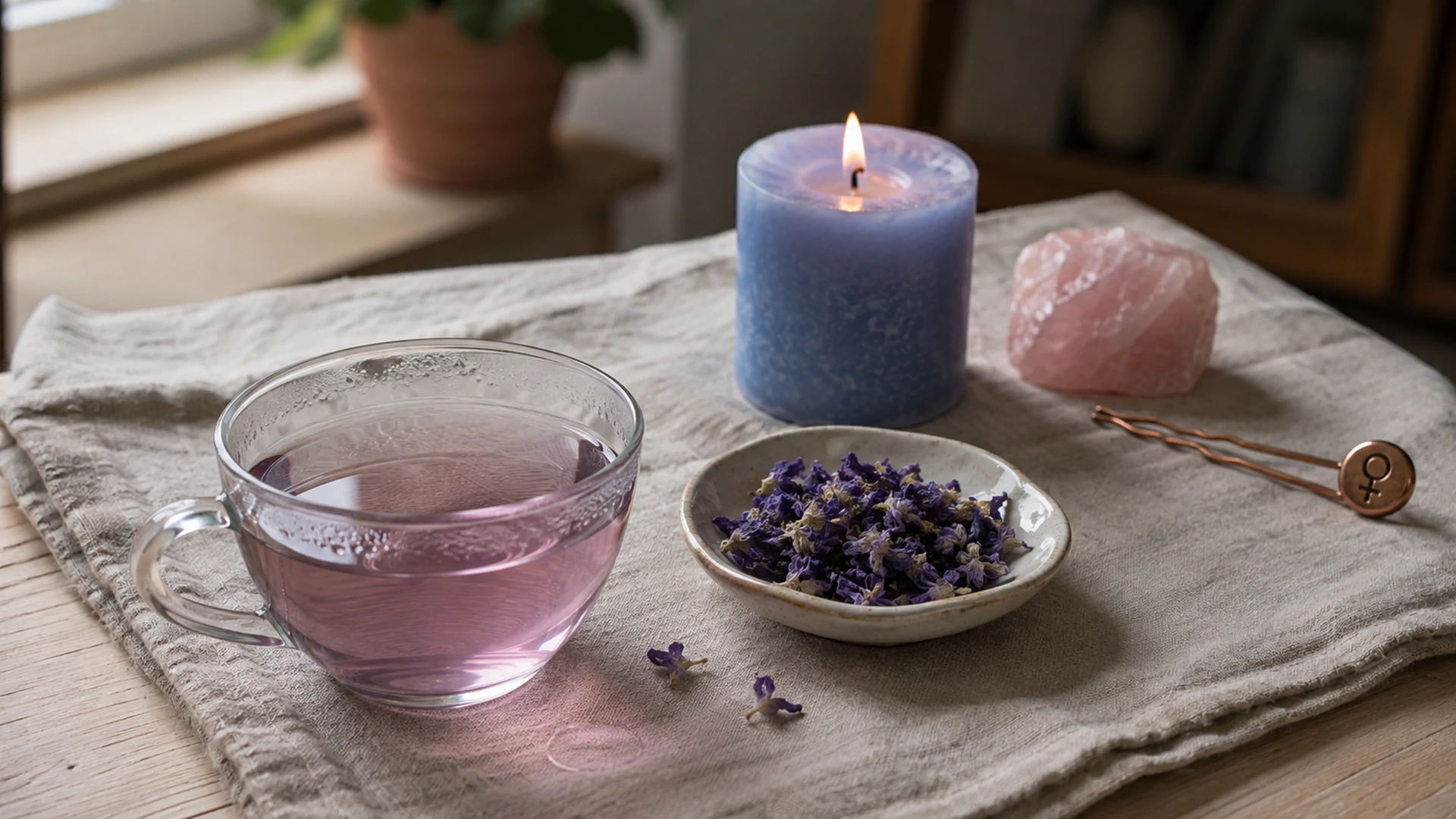
When you're working with the magical tea ceremony for harmony, few herbs sit as naturally in that intention as violet (Viola odorata). Violet isn't just gentle — it carries a specific set of historical, planetary, and sensory correspondences that make it particularly well suited to this kind of work. This guide covers everything you need: why violet earns this role, how to prepare your space and tools, how to brew with full intention, how to drink and close the ceremony, and how to make this a lasting personal practice you return to whenever your life needs rebalancing.
Why Violet Is Suited to a Harmony Tea Ceremony
Violet's harmony correspondence isn't a vague energetic claim — it has a specific planetary basis. Violet is traditionally ruled by Venus, the planet governing love, accord, beauty, and the binding of relationships into peaceful coexistence. In Agrippa's Three Books of Occult Philosophy, Venusian herbs are those that calm strife, draw affection, and create conditions of goodwill between people. Violet fits that description in both its classical planetary placement and its historical use. Medieval herbalists recommended violet garlands and violet-infused preparations specifically to soothe anger and restore goodwill — not just to heal the body, but to settle disputes and soften the emotional climate of a household.
Violet is also traditionally associated with the element of Water, which reinforces the harmony angle in a precise way. Water governs emotion, empathy, and the flow of feeling between people. When emotion is blocked or turbulent, conflict follows. Working with a Water-ruled herb means you're addressing that emotional current directly — not suppressing it, but bringing it back into smooth movement. Harmony, in this magical framework, isn't the absence of feeling; it's the restoration of flow between people who have gotten stuck in friction.
There's also a sensory dimension worth naming. Violet's scent is famously soft and fleeting — it activates the olfactory receptor so fully that it briefly goes quiet, making the perfume seem to disappear and then return. That quality has long been associated symbolically with patience and the cyclical nature of peace: harmony is not a permanent state you lock in, but something that returns, fades, and must be renewed. Brewing violet as a tea engages that scent intimately, and the faint floral sweetness on the tongue reinforces a quality of gentleness that other violet preparations — tinctures, sachets, incense — don't deliver in the same way.
Drinking an herb is one of the most embodied forms of magical work there is. When you carry violet in a sachet or burn it as incense, it works symbolically and atmospherically — the intention circles around you. When you drink it, you bring the herb inside your body. The intention moves inward. For harmony work, that matters enormously, because the friction you're trying to resolve almost always has an internal dimension too. You're not just trying to change the atmosphere between you and someone else; you're working on your own emotional state, your own willingness to soften, your own capacity to hold space for accord. Drinking violet makes you a participant in the working, not just its architect.
Preparing for Your Violet Tea Ceremony
Timing
Timing your violet harmony ceremony thoughtfully amplifies the work. The most favorable window is a Friday — Venus's day — ideally during a waxing or full moon. A waxing moon supports growth and attraction, pulling harmony toward you. A full moon gives any Venus-ruled working its maximum charge. If you're working to mend a specific relationship, choose a Friday close to the full moon. If you're trying to cultivate a more general atmosphere of ease and goodwill in your life, any Friday will serve. You can find Venus's hour for your location and date using our Venus's hour finder to time your ceremony with even more precision.
Space
For the space itself, you want somewhere genuinely quiet. Harmony work requires a certain receptivity, and you can't access that if your environment is loud or cluttered with unfinished tasks competing for your attention. Clear the surface where you'll sit. If you have a small altar space, use it. If not, a clean table or even a dedicated corner of a floor works fine. The key is that the space should feel like it belongs to this moment and nothing else while you're in it.
Auxiliary Tools
Two supporting tools will anchor the working's intent:
- A blue candle: Blue candle magic brings a quality of calm and emotional depth that pairs directly with violet's Water-ruled nature. Where a red candle drives and a pink one warms, a blue one stills — it settles the emotional atmosphere and encourages the kind of open, receptive state that genuine reconciliation requires. Lighting it as you begin the ceremony signals a shift away from reactivity and toward the quieter, more deliberate emotional register where harmony can actually take root.
- Rose quartz: Rose quartz has been used in love and reconciliation work for centuries precisely because it addresses the layer beneath conflict — the place where hurt feelings harden into walls. Placing it beside your cup while the tea steeps keeps your attention on the emotional opening you're trying to create, rather than on the grievance itself. It's a quiet but steady reminder that the goal isn't to win an argument; it's to soften back into connection.
Safety Note
A brief safety note: violet flowers and leaves (Viola odorata) used in culinary and herbal preparations are generally considered safe for most adults in moderate amounts. However, if you are pregnant, breastfeeding, on blood-thinning medications, or have known plant allergies — particularly to other members of the Violaceae family — consult a qualified herbalist or your doctor before drinking violet tea. This guide does not provide medical or dosage advice.
Brewing Violet With Intention
Gathering the Violet
Begin by gathering your violet. You can use dried violet flowers, dried violet leaves, or a combination of both — the flowers carry more of the scent and the delicate sweetness, while the leaves add a mild earthiness that grounds the blend slightly. About one teaspoon of dried violet flowers per cup is a workable amount. If you're using leaves as well, a half teaspoon of each is a good ratio. Place the herb in a small bowl or directly into your infuser before you do anything else, so your hands are on the plant before the heat is involved.
As you measure and hold the dried violet, take a moment with it. Notice the color — even dried, violet flowers often retain traces of that distinctive soft purple, which is itself a Venusian hue. Hold the herb gently and state your intention clearly, either aloud or in your mind. Be specific about what harmony means to you right now. Is it harmony within a relationship that has been strained? Is it harmony in a household that has felt tense? Is it an internal harmony — a quieting of the conflict between what you feel and what you're able to express? The more precise your intention, the more the working has to grip.
Heating the Water
Heat your water to just below a full boil — around 88°C (190°F) is ideal for violet. Boiling water can damage the delicate floral compounds that give violet its distinctive fragrance and subtle sweetness. As the water heats, light your blue candle. Let this be a deliberate act, not a reflex. Say something as you light it — something simple and true, like naming the harmony you are calling in. Watch the flame settle for a moment before you move on.
Pouring and Steeping
Pour the hot water over your violet and allow it to steep for five to seven minutes. This is where the ceremony truly opens up, because these minutes are for you, not for the herb. Place your rose quartz near the cup as it steeps. Sit with your hands close to the warmth of the cup if you like — not holding it yet, just near it. Watch the water take on the pale rose-violet tint that violet flowers release. This color shift is the herb's way of becoming present in the water; let it focus your mind on the intention you've set.
While the tea steeps, visualize the harmony you are working toward. Don't manufacture a feeling you don't have — just picture the scene, the relationship, the moment you're aiming for. See it clearly. See the people in it (including yourself) moving with ease rather than friction. Violet's Water-ruled nature means this working moves through the emotional body first, so the quality of your visualization matters. When the steep time is complete, remove your infuser or strain the tea. The tea should smell faintly floral and sweet. If you're using dried leaves as well, there'll be a mild green note beneath the flowers.
Before You Drink
Before the first sip, hold the cup in both hands. Feel the warmth. This is the moment the working becomes fully yours — the intention you've been building through preparation and brewing is now about to enter your body. Take a slow breath in through the scent of the tea. Violet's fragrance is soft and will be most present in the steam rising from the cup. Let that scent be its own moment of arrival.
Drinking and Closing the Ceremony
Drink slowly and without distraction. No phone, no background noise if you can help it. The pace of your drinking should match the quality of the intention: steady, unhurried, and open. With each sip, let your attention rest on the specific harmony you named during brewing. You're not forcing a feeling — you're simply holding the intention present in your body as the tea moves through it. If your mind wanders to the conflict or tension you're trying to resolve, don't chase it. Let the thought surface, acknowledge it, and return your attention to the warmth of what you're drinking.
When the cup is empty, sit with it for a moment. Don't immediately stand and move on. Let there be a transition. The candle is still burning; let it burn down fully if it's a small candle like a chime or tealight, or snuff it mindfully if it needs to be put out before it's done. Do not blow the candle out — snuffing preserves the intention rather than scattering it. If you're working with a chime candle, letting it burn to completion in a single sitting is ideal for a harmony ceremony, since the full burn signals the working's completion.
For the used violet leaves and flowers, the most harmonically consistent disposal is to return them to the earth. Take them outside and scatter them at the base of a living plant or tree, or bury them shallowly in a garden or a pot of soil. This isn't a rigid rule — it's an alignment of action with intent. Harmony is a relational quality; returning the spent herb to the living world completes a small but real gesture of reciprocity.
Close by grounding yourself. Press your feet flat on the floor. Take three slow breaths. If you journal, write down the specific intention you held, any images or feelings that arose while you drank, and the date. Over time, tracking these details lets you see how your harmony workings develop — what shifts in the days that follow, what you notice differently in yourself or in your relationships. Grounding is not a formality here; it's how you re-enter your ordinary life with the working intact rather than dispersed.
Violet, Venus, and the Practice of Returning to Peace
What you've done in this ceremony is more than brew a pleasant cup of tea. You've worked with a Venus-ruled, Water-element herb that carries centuries of documented folk use for exactly this purpose — softening conflict, restoring goodwill, and creating the internal conditions from which genuine accord can grow. The working is real and specific: violet's planetary correspondence links it to the same current that governs all Venusian harmony workings, and drinking it rather than carrying or burning it means the herb works from inside your emotional body outward.
This ceremony is worth repeating. Harmony isn't a state you achieve once and lock in permanently. Like violet's fleeting scent, it returns in cycles and requires renewal. Return to this practice on Fridays when relationships feel strained, when household energy has gone tense, or simply when you want to reinforce a period of peace that is already present but fragile. The more you work this ceremony, the more quickly your mind and body will recognize the ritual as a signal — and the stronger your intention will land each time.
Violet isn't the only herb that earns a place in harmony work. If you want to explore different energetic approaches within the same ceremonial tea format, lavender brings a Venus-ruled clarity to peace work — steadying the mind rather than softening the heart — while the passionflower harmony ceremony works specifically on releasing the grip of anxiety and resentment that keeps people stuck in conflict. Each herb opens the same intention through a different door.
If you want to explore other herbs, other intents, and other ways to work the ceremonial tea format, the full resource is available here: Spiritual Tea Ceremonies: A Complete Guide by Intent. Violet for harmony is one thread in a much larger practice, and every ceremony you build deepens your relationship with intentional living through magic.