Wintergreen: Green Under Snow
Wintergreen (Gaultheria procumbens) is a small evergreen ground-cover of northeastern North America whose dried leaves are carried for protection and luck, working from its central quality: endurance through winter, staying green when everything else has gone dormant.
Protection That Lasts the Winter: Wintergreen's Place in Protection
Wintergreen's angle in protection magic is evergreen endurance. Not a fierce warding smoke, not an aggressive repellent — its quality is persistence. It stays green under snow, and that physical fact is the root of why practitioners carry it through difficult stretches, keeping a steady protective presence in place for an entire season rather than a single working. Protection magic covers a wide range of approaches, and wintergreen sits at the quiet, durable end of that range: it doesn't announce itself, it just doesn't leave.
That angle sets it apart from two other long-duration protectors. Mullein offers Saturnine long-term protection — a steady, lasting guard that carries light through darkness, worked as torch, taper, and leaf. Cedar protects through preservation — dignified permanence, keeping what it holds safe. Wintergreen's quality is different from either: it's not a burning light, and it's not a vault. It's the ground cover that simply doesn't yield to the cold. That evergreen endurance is what makes it a natural fit for long seasons of difficulty, uncertain transitions, or stretches where protection needs to hold without active renewal.
Wintergreen's secondary category is Prosperity and Success, specifically through luck. Some Hoodoo-influenced suppliers include it in luck and gambling blends. That use is a modern supplier and folk practice, not a deep documented tradition. Cunningham lists protection, healing, and hex-breaking; the documented history of the plant itself is medicinal and culinary. What it does have is a clear, coherent magical logic grounded in the plant's actual behavior, and correspondences that fit it well: the Moon, water, and Monday, per Cunningham.
Teaberry, Checkerberry, Boxberry
Wintergreen goes by several names depending on where you are — teaberry, checkerberry, boxberry, eastern teaberry, American wintergreen. All of them point to the same small plant: Gaultheria procumbens, native to northeastern North America, growing low through the forests of the eastern US and Canada. Several Native American nations used the leaves as tea and as medicine, preparing them in ways long established within their own traditions. The plant was also a source of wintergreen flavor before synthesis made the compound cheap to produce, which is why Pennsylvania teaberry ice cream and teaberry gum both carry that specific cooling-sweet taste — they're named after the plant directly.
One thing worth knowing before you source or forage: the name "wintergreen" is used loosely for several unrelated plants. Pyrola, pipsissewa, and a handful of others all get called wintergreen in different regions. Commercial wintergreen oil is often distilled from Asian wintergreen or sweet birch, or produced synthetically, rather than from Gaultheria procumbens itself. The plant belongs to the heath family (Ericaceae) — the same family as heather, blueberry, and cranberry — and has nothing botanically to do with mint, despite sharing that cooling menthol-adjacent scent. The similarity is a convergence of aroma compounds, not a family relationship.
The Oil That Must Never Be Swallowed
Wintergreen oil carries a safety profile serious enough that it deserves its own section before any practice that mentions it. The oil is approximately 98% methyl salicylate and a single teaspoon contains roughly the salicylate equivalent of twenty adult aspirin tablets. That concentration has killed young children. The oil must never be swallowed under any circumstances, must be kept well out of reach of children and pets, and should be avoided entirely by anyone with an aspirin allergy or who takes blood thinners. It also absorbs through the skin, which means even topical contact carries risk. Wintergreen oil is used only on candles, applied with gloves or a tool, and never used as a body oil or an anointing medium directly on skin.
The dried leaves and the berries are a different matter. In food amounts they have been traditionally eaten and used in teas by Native American communities, and the dried leaves are the everyday working material for most practices in this article. Carrying dried leaves in a sachet, tucking them into a charm bag, keeping them in a drawer — none of that raises the safety concerns of the oil. The distinction is sharp: dried leaf for carrying and sachets, oil only for candles and only with proper handling. Work from that line.
Three Wintergreen Workings for the Long Season
An Evergreen Sachet for a Hard Winter
This working is for a stretch of time when you need protection that holds without constant renewal — a difficult season, an uncertain period, a situation that won't resolve quickly.
Take a small piece of cloth in a color that reads protection to you — white, black, or a deep blue all work — and add a small handful of dried wintergreen leaves. As you close it, hold your intention on the quality of endurance: not force, not dramatic clearing, just presence through difficulty. Set the intention specifically on duration — name the season or the stretch of time in your mind. Make this sachet on a Moon hour or on a Monday, both of which align with wintergreen's correspondences. Keep it on your body, by your front door, or in whatever space needs the steady hold. Refresh the leaves at each new moon if you're working a long protection, or simply carry it through the season without interruption.
A Few Leaves in a Luck Charm
This practice draws on wintergreen's secondary placement in luck and Prosperity work, a use credited to Hoodoo-influenced suppliers who include it in luck and gambling blends.
Add a small number of dried wintergreen leaves — three to five is enough — to an existing luck charm, mojo bag, or prosperity sachet. Wintergreen's contribution here is persistence: the idea that luck, like the plant, stays available through the cold stretches when other things have closed off. It layers well with other luck herbs or roots already in your practice without dominating the blend. Set your intention on luck that holds through a difficult period, not a single windfall, because that sustained quality is what wintergreen actually speaks to. If you're building the charm from scratch, a green cloth bag on a Thursday, in a Jupiter hour, gives the prosperity current more weight.
Wintergreen Oil on a Candle, Never on Skin
This working is for protection through an extended period — a working that needs to be set and left to burn rather than actively tended.
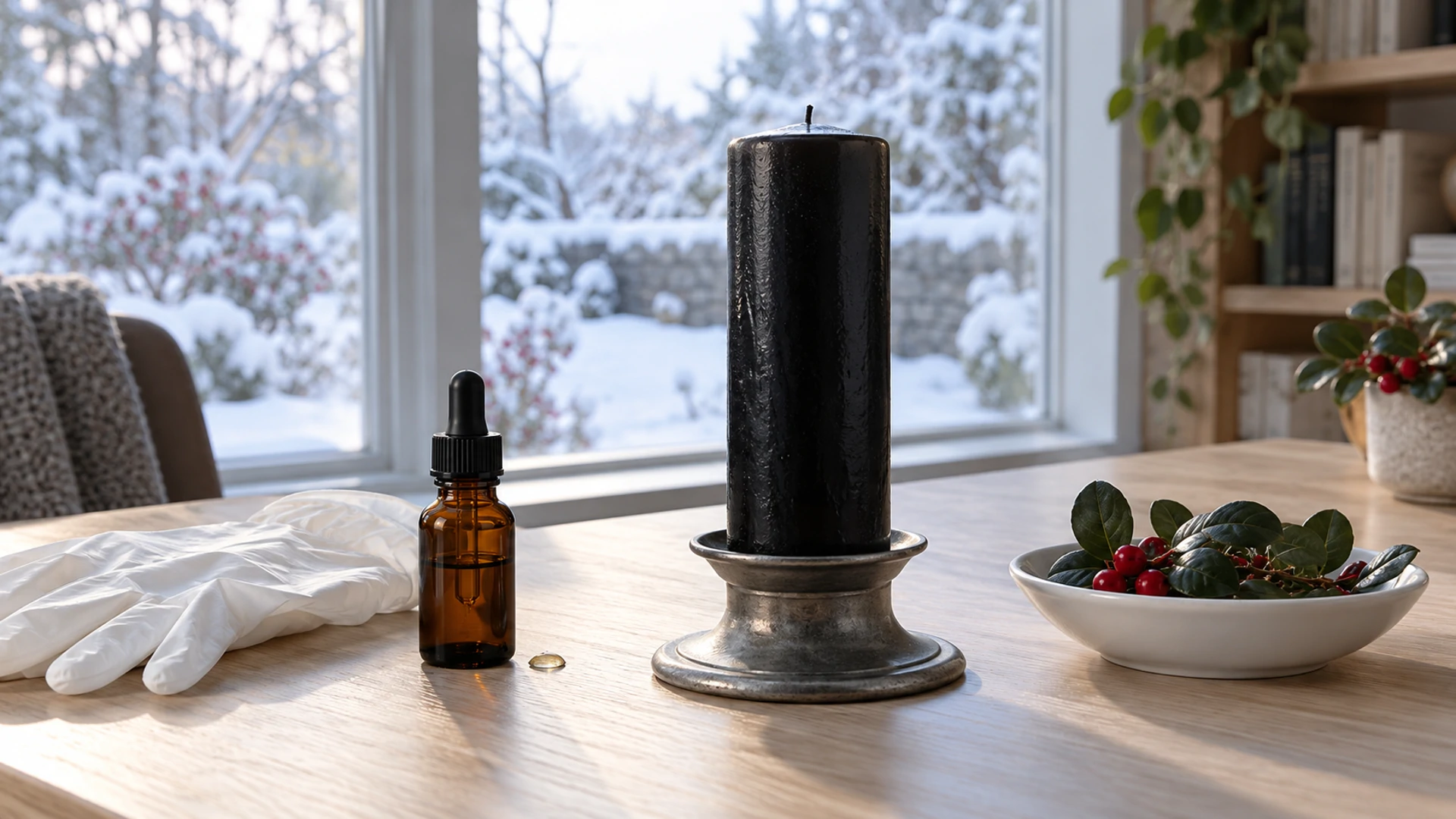
Put on gloves before opening the oil. Using a dropper or a small tool, apply a few drops of wintergreen oil to a black candle or a white candle, dressing it away from you to send difficulty outward. Keep the drops minimal — the oil is highly concentrated and a little is more than enough. Do not touch the dressed area of the candle with bare skin. Set the candle in a holder, state your intention on endurance and lasting protection, and let it burn in a safe, supervised space. The oil on a candle is a legitimate and effective way to work with wintergreen's protective virtue without any of the risks associated with skin contact. Cap the bottle, wash your hands with soap and water after handling, and store the oil where no child or pet can reach it.
Still Green in the Snow
Wintergreen earns its place in protection magic not through dramatic history or a long ceremonial lineage, but through the straightforward logic of the plant itself. It keeps its color when nothing else does. That quality — quiet, persistent, seasonally tested — is real, and a working built on it is built on something true. Protection that is asked to hold through a difficult stretch needs a different quality than protection called up for a single moment, and wintergreen is one of the few herbs whose correspondence maps directly onto that sustained need.
If you want to see wintergreen alongside the full range of protection herbs — all fourteen of them, from the aggressive threshold guards to the long-duration keepers — as well as the six other paths through plant magic, the witch's herbarium of plant magic is the place to go next.