Blackthorn: The Witch's Wood, Turned to Severing Ties
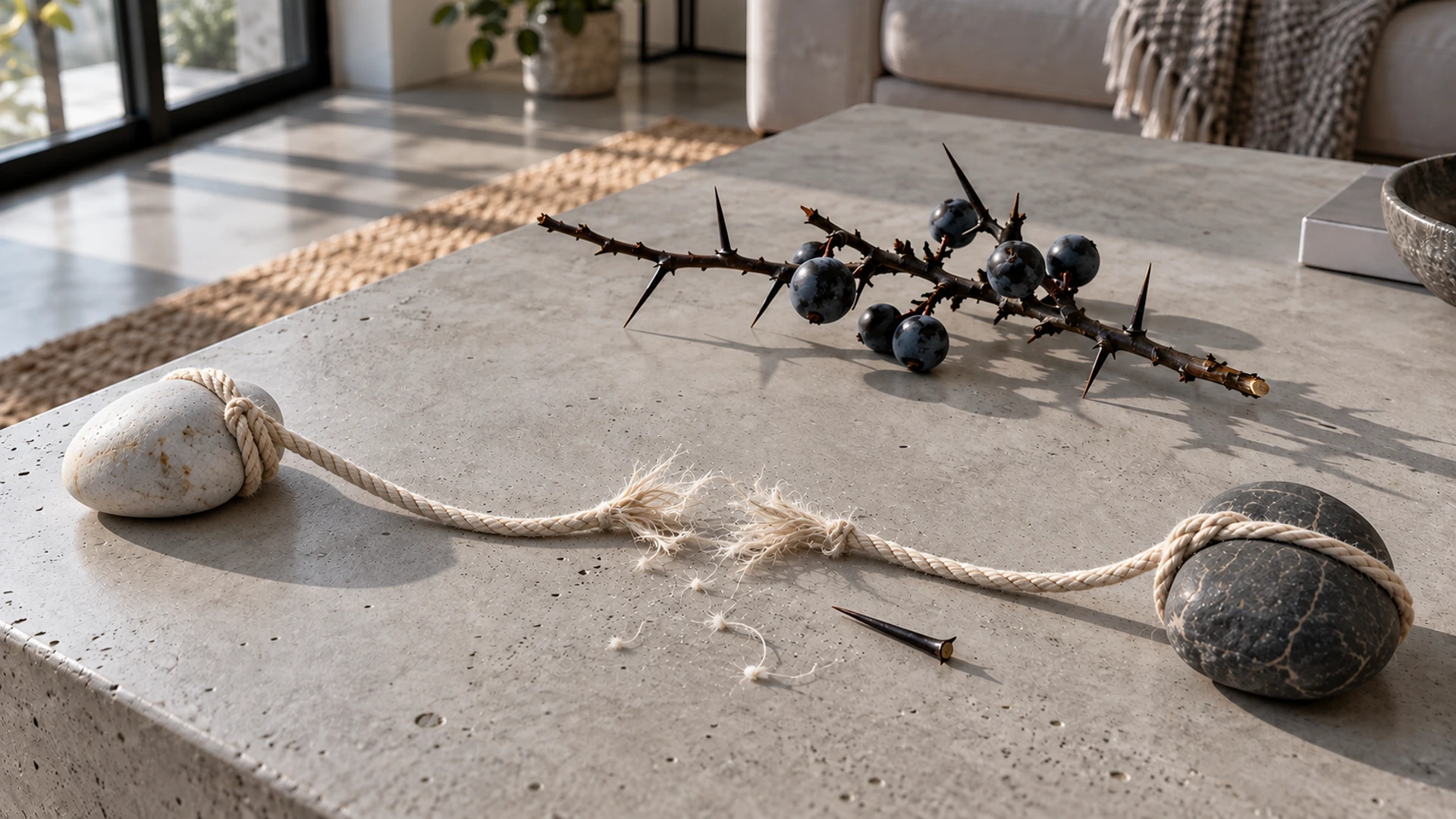
Blackthorn is a thorny hedgerow tree once reputed to be the witch's own cursing wood, now used in modern practice to sever ties and cut cords that need to end.
Severance: Blackthorn's Place in Banishing
Every banishing herb has an angle, a specific kind of removal it is built for. Blackthorn's is severance. It does not reverse, it does not repel, it does not break a curse and send it home. It cuts. Where nettle breaks what should not hold and agrimony returns a harmful working to where it came from, blackthorn ends the connection itself. If you are trying to cut a cord, close a door on a relationship that keeps reopening, or put a hard stop on a pattern you have tried to break gently without success, blackthorn is built for that work. Its thorns are the physical expression of what the plant does in magic: they are sharp, they catch, they hold, and when you finally pull free, you feel it.
That severance angle sits inside a broader category of Banishing and Hex-Breaking, with a secondary use in Protection and Warding. Blackthorn in the hedgerow is a living barrier: dense, armed, nearly impenetrable. That protective character carries into practice as a boundary enforcer, something that keeps cut ties from re-forming and holds the line once you have drawn it. Rowan wards against witchcraft; blackthorn was reputed the witch's own cursing wood, and is now worked to sever the very connections rowan might help protect. They grow in the same hedgerow and occupy opposite roles in British plant lore, which is worth knowing when you are building a working that has both a defensive and a cutting component.
For correspondences: Scott Cunningham gives blackthorn no planetary ruler. Modern tree-lore writers most often reach for Saturn, for blackthorn's association with winter and hard boundaries, and Mars, for its thorns and the forceful nature of its work. These are modern attributions, not classical ones, and you will see them vary by source. Botanically, Prunus spinosa belongs to the rose family (Rosaceae), which puts it in the same family as rowan, rose, and agrimony — a family that turns up across a surprising range of magical uses.
Blasting Rods, Blackthorn Winters, and the Cailleach's Staff
Blackthorn's dark reputation is old and specific. British folklore named it the wood of the blasting rod, a staff used to direct a curse or bring harm from a distance. In 1670, the Edinburgh occultist Major Thomas Weir was burned at the stake, and his thorn staff was burned with him. The staff was part of the accusation against him. That detail is useful to hold onto, because it tells you how seriously this particular association was once taken. The cursing history belongs to recorded folklore, not to practice you would replicate, but knowing where a plant has been tells you something real about the energy attributed to it.
The Cailleach, the old woman of Scottish winter lore, carries a staff of blackthorn. She strikes the ground with it to freeze the earth and hold back spring. A cold snap that arrives when blackthorn is in flower is still called a blackthorn winter, a piece of weather lore that survives because it is also just true: blackthorn blooms early, often in late February or March, and a cold snap at that time is common enough to have earned the name. The meeting of bare white flowers on bare black thorns, before any leaves appear, is the plant's most visually striking moment, and the timing of its bloom in the bleakest weeks of the year probably has a lot to do with why it attracted winter mythology in the first place.
Beyond the cursing lore, blackthorn also has more everyday histories. It is the traditional wood of the Irish shillelagh, the walking stick that doubled as a fighting stick, valued for its density and hardness. And its small, deeply astringent fruits, the sloes, are what go into sloe gin, left to steep in spirit with sugar through autumn and winter until the bitterness softens into something drinkable.
Thorns, Sloes, and Gloves
The most important practical fact about blackthorn is this: its thorns cause wounds that become infected with unusual reliability. This is not ordinary scratch territory. The thorns carry bacteria that can cause localized infections that are disproportionately serious for such a small puncture, and deep punctures near joints have, in documented cases, required medical treatment. Gather thorns with thick gloves, handle with care, and keep them in a sealed container. That caution is not superstition — it is just sensible. Beyond thorns, the parts used in practice include the wood for staffs and wands, the bark, the flowers, and the sloes. Sloe pits contain amygdalin, a compound that breaks down to release small amounts of hydrogen cyanide, and should never be crushed or chewed. Raw sloes are also extremely astringent — enough to make your mouth pucker sharply — so they are not eaten fresh. Sloe gin is made by whole-berry maceration, leaving the pit intact, which is how it should stay in any charm.
Three Blackthorn Workings for Cutting Free
Cutting the Cord With a Thorn
This working is for a tie that has been named and recognized but keeps holding: a connection you have already decided to end but that has not yet released.
Take a length of cord or thread and tie it loosely between two small objects — one representing you, one representing the tie that needs to end. A Saturday or a Saturn hour suits this kind of boundary work. Hold the cord steady and use a blackthorn thorn to work it apart: pressing, fraying, or severing the thread with slow, deliberate pressure rather than a single clean cut. The effort in the action is part of the working — it is a statement that some things do not come apart easily, and you are doing it anyway. When the cord separates, hold both ends for a moment, then bury or burn the piece connected to the tie. Keep the piece connected to yourself, or burn both if a clean release is what you are after.
A Thorn Through the Paper
This working is for a habit, pattern, or situation — not a person — that you want to formally declare ended.
Write the thing clearly on a small piece of paper: the pattern, the situation, the recurring dynamic you are cutting free from. Name it plainly, in your own words. Hold the paper flat and press a blackthorn thorn through it, once, deliberately, as a statement that this is ended. Say whatever you need to say out loud — there is no formula required, just clarity. Then burn the paper if you have a safe way to do that, or bury it in the ground away from your home. The thorn stays with it, not carried forward. The act of naming the thing, piercing it, and then getting it out of your space is a complete working on its own.
Sloes in a Charm by the Door
This is a simple protective working that draws on blackthorn's secondary category of Protection and Warding.
Dry a small handful of whole sloes, pits uncrushed and intact. Place them in a small cloth pouch or a sealed jar and hang it near your door — inside or outside. The hard-seeded fruit of a thorned tree holds the protective quality of the plant without requiring thorn handling. Replace the sloes when they lose their scent or begin to break down. This is meant as a quiet threshold ward, nothing more elaborate than that.
Cut Clean
Blackthorn's history as the witch's cursing wood is not a reason to avoid it — it is the evidence that people have known for a long time that this plant has a particular force to it. What was once framed as harm in old folklore is now worked as severance: the clean ending of something that should not continue. That is not a softening of the plant, it is a change in direction. The force is the same. The blasting rod ends things; so does the cord-cutting thorn. The distinction is in what you are aiming it at.
If you want to see where blackthorn sits among the full range of banishing herbs — nettle, agrimony, and the rest — and how all of this fits into the broader landscape of plant magic across seven categories, the place to go is the witch's herbarium guide. Every angle, every category, laid out together.