The Second Pentacle of Saturn: The SATOR Square Against Adversity
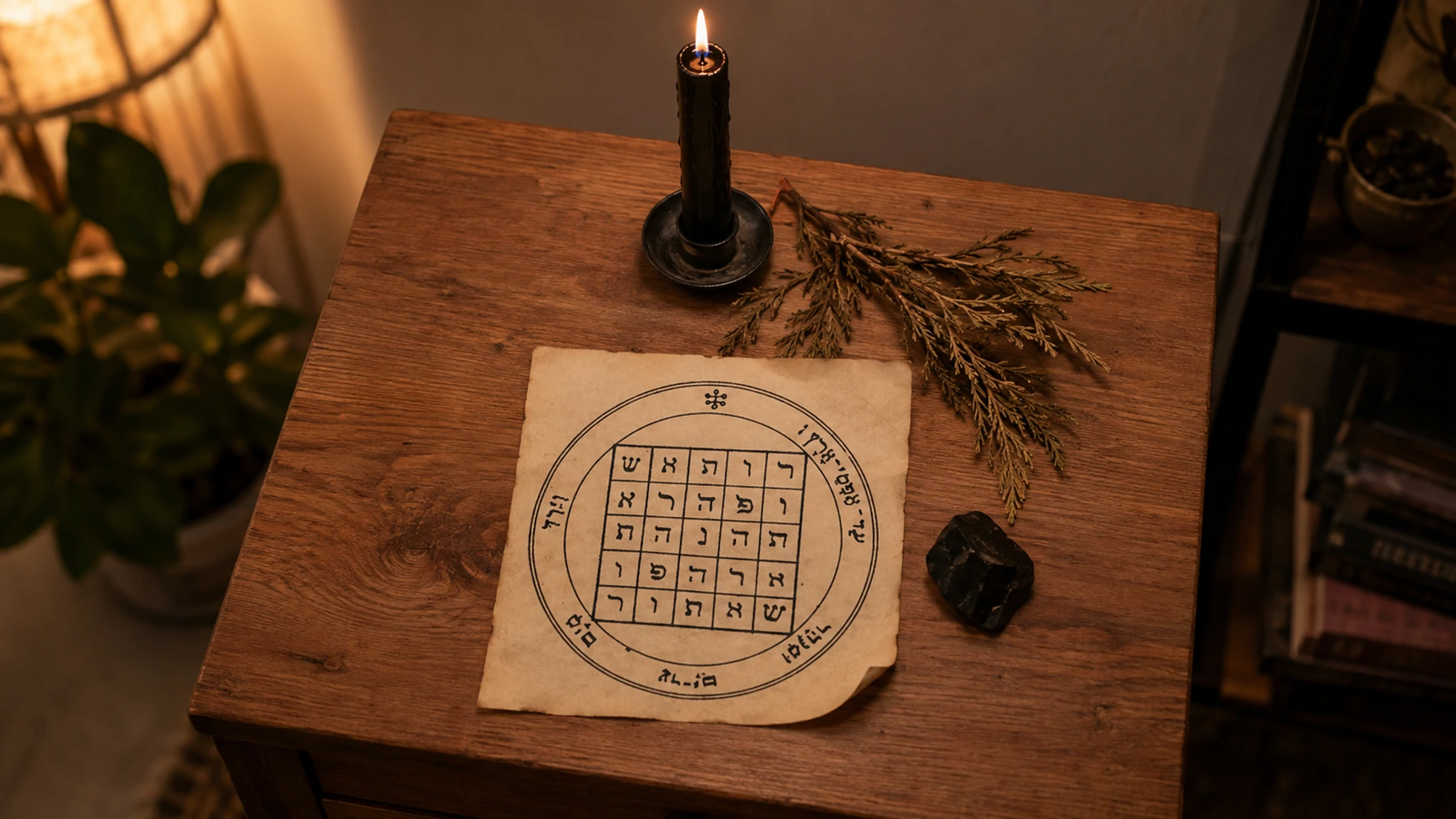
The Second Pentacle of Saturn is documented for two specific offices: it is of great value against adversities of all kinds, and it represses the pride of spirits. This Pentacle of Solomon works through Saturn's authority over boundaries and limitation, bending what resists you, wearing down what stands against you, and restoring your footing when circumstances have stacked up in the wrong direction. Saturn governs restriction, discipline, karmic weight, and hard-won authority; the full history and practice of the Pentacles of Solomon gives essential context for what these seven Saturnine workings collectively do and how they sit within the broader Solomonic tradition.
What makes this pentacle worth paying attention to is exactly what makes it easy to overlook. It isn't the most dramatic of Saturn's seven. It doesn't promise destruction or earthquakes or the binding of demons to your will. What it promises is harder to fake: the ability to hold your ground when adversity has its hands around your situation and won't let go.
If you want a full map of every pentacle across all seven planets, the complete guide to all 44 Pentacles of Solomon lays them out in full.
Construction and Symbolism of the Second Pentacle of Saturn
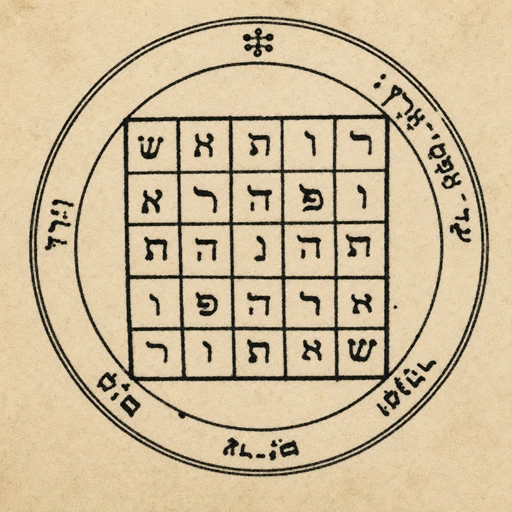
The defining feature of this pentacle's construction is the SATOR square, one of the oldest known palindromic word squares in Western history. It reads the same in every direction — left to right, right to left, top to bottom, bottom to top — and has been found inscribed on Roman walls, medieval manuscripts, early Christian artifacts, and folk amulet traditions stretching across centuries. The five words are SATOR, AREPO, TENET, OPERA, ROTAS. Their meaning has been debated for just as long as the square has circulated: the most common translation renders something close to "the sower Arepo holds the wheels with effort," though scholars disagree. What matters magically is the square's formal perfection — its total symmetry — which made it a symbol of dominion over chaos and of a force that holds in every direction simultaneously.
The square's numerology reinforces this. It is a 5x5 grid of 25 letters. Add unity — 1 — and you arrive at 26, the Hebrew numerical value of IHVH, the divine name at the heart of Solomonic practice. The Psalm 72:8 versicle surrounding the square also consists of exactly 25 letters in Hebrew, and its total numerical value, combined with the value of Elohim, equals the total numerical value of those same 25 letters in the square itself. That kind of layered numerical correspondence is not incidental in the Solomonic tradition. It is how the figure is bound together: every element confirms every other, and the whole thing locks shut.
In the Solomonic context, that symmetry is exactly the point. The Second Pentacle of Saturn is not built around named angels or individual spirit seals, the way several of its siblings are. It is built around a structure of pure written authority — a figure whose power comes from its inversion-proof, rotation-proof form. Whatever you press against it, it holds. That formal quality mirrors the pentacle's office directly: where adversity pushes, this figure pushes back equally from every angle.
The verse sealed into this pentacle is Psalm 72:8: "He shall have dominion also from sea to sea, and from the river unto the ends of the earth." This is not a verse about protection in the ordinary sense. It is a verse about total, uncontested rulership — authority that extends to every boundary, leaves no corner of the world outside its reach. In the context of this pentacle's office against adversity, that verse reframes what the working actually does. You are not asking for a shield. You are invoking the principle of dominion itself, the idea that the force governing your situation reaches further than any obstacle facing you.
Compare that to the verse on the First Pentacle of Saturn, which draws on Psalm 72:9 — spirits bow and enemies lick the dust — which is a verse of submission through terror. The Second's verse is not about terror. It is about scope. The enemy cannot outrun dominion that extends from sea to sea. That is a quieter and, in some ways, more unnerving kind of authority than raw fear.
The pentacle's metal is lead, Saturn's traditional material, and its associated color is black. In classical planetary magic, lead carries Saturn's weight — its slowness, its permanence, its heaviness against anything that would shift or corrupt it. A pentacle worked in the spirit of Saturn's lead is meant to settle and hold, not to flash and dissipate.
The Spiritual Office of the Second Pentacle of Saturn
The office here is double, and both parts matter. First: great value against adversities. Second: repression of the pride of spirits. These aren't the same thing, and the pentacle holds both at once.
Adversity in the Solomonic tradition isn't limited to personal hardship. It means any force, situation, or arrangement that presses against your will and refuses to yield. Legal blockades, long-running enmity, systemic resistance, circumstances that keep restoring themselves to their obstructed state no matter what you do. Saturn is the planet of slow grinding difficulty, and this pentacle works squarely within that current — not to eliminate Saturn's weight, but to place it behind you rather than against you.
The second office, repressing the pride of spirits, has a specific technical meaning in ceremonial practice. When spirits are invoked and they resist, posture, or refuse to submit, the practitioner needs a forcing agent. This pentacle is that agent for Saturnine spirits specifically. Shown or declared, it breaks the resistance of spirits who are presenting themselves as powerful or independent. This is exactly what the SATOR square's total symmetry communicates: there is no angle from which resistance holds.
In modern practice without formal evocation, this second office translates well to situations where you're dealing with someone or something that is relying on perceived superiority to obstruct you — an institution, an adversary who believes they hold all the power, a situation structured so that the existing hierarchy benefits from your failure. The pride being repressed doesn't have to belong to a spirit in the classical sense.
Saturn Correspondences for This Working
Saturn's element is Earth, which gives this planet's workings a particular quality: they are slow, heavy, final, and material. Saturn doesn't produce quick results. What it produces tends to stick. When you bring Saturn to bear on adversity, you are calling on a force that doesn't simply push back — it settles. The obstacle doesn't evaporate; it gets ground down over time by something heavier than itself.
Saturday is Saturn's day, and it is the natural choice for any working under this pentacle. The planetary hour of Saturn on a Saturday compounds the correspondence significantly. You can find your exact Saturn hours using the planetary hour almanac.
The colors for Saturn are black and dark grey, occasionally deep indigo. For candle work aligned to this pentacle, black is the strongest choice. It carries Saturn's resonance with endings, limitation, and the weight of authority — all of which are present in the Second's office against adversity.
Among Saturn's crystals — obsidian, onyx, jet, hematite — jet is the most fitting choice for this particular working. Unlike hematite's shielding quality or obsidian's reflective and shadow-facing nature, jet has a long history specifically as a stone carried against adversity and harm — worn by mourners, kept by those under pressure, used in talismanic practice where sustained protection from negative conditions is the goal. That maps exactly onto the Second Pentacle's documented office.
For herbs, Saturn rules cypress, mullein, and comfrey. Cypress carries the quality of Saturn's connection to endings and the boundary between living and dying — it has been planted at gravesites across Mediterranean cultures for millennia. In ritual smoke or as a dried offering, it reinforces the sense of finality this working calls on: the adversity ends here. Myrrh and patchouli serve as the traditional incenses for Saturn, with myrrh being particularly well-suited for workings involving spirits, as it has been used in ritual contexts for thousands of years as an offering that carries intentions to non-physical forces.
Who Should Work With the Second Pentacle of Saturn
This pentacle is for people who are worn down, not people who are angry. That distinction matters. If what you're dealing with is a single adversary who acted against you and you want a sharp, direct response — the Fourth Pentacle of Saturn, with its office of ruin and destruction, is a different tool with a different purpose. The Second is not that. It doesn't strike. It holds and outlasts.
The situations that actually call for this pentacle tend to share a quality: they have been ongoing. A legal dispute that won't resolve. A professional situation where you're being systematically undermined by people who believe their position protects them. Institutional obstruction where the people in power are relying on that power to simply wait you out. A long-standing pattern of circumstances that restores itself to the bad outcome regardless of what you do. These are adversities in the true Saturnine sense.
The second office, against the pride of spirits, is relevant to practitioners doing Saturnine evocation work and finding resistance. But in the language of modern practice, it also speaks to any situation where the other party's belief in their own untouchability is the main thing sustaining the problem. The pentacle's dominion principle is aimed squarely at that.
You should probably not reach for this pentacle if what you want is speed. Saturn does not move quickly. This is a working you set into motion and then maintain, trusting that the accumulated weight of the working will eventually surpass whatever is pressing against you. If you need something immediate, look elsewhere. If you need something that will not quit, this is the right pentacle.
It's also worth being clear: this pentacle isn't a substitute for action in the physical world. Saturn's energy rewards discipline and sustained effort. The working lands hardest when you are also doing the real-world things that address the adversity — it amplifies your efforts, it doesn't replace them.
A Modern Ritual for the Second Pentacle of Saturn
This ritual is built specifically around the Second Pentacle's documented office against adversity and the repression of pride. Every element here traces back to that intention.
Timing
Saturday, during a Saturn hour. For maximum resonance, work at the first Saturn hour after sunset on a Saturday. Use the planetary hour almanac to find the exact window for your location.
Materials
- Black candle — black is Saturn's color and carries the specific quality of weight, authority, and finality that this working requires; it isn't a color of harm here, it's a color of settlement.
- Jet — historically carried as protection against adversity and harm, jet anchors the working in Saturn's sustained, enduring current rather than its sharper martial edges.
- Cypress — burned as incense or placed dried near the candle; it signals to the working that the adversity you're addressing has an ending, that Saturn's dominion reaches further than the obstacle does.
- The Second Pentacle of Saturn — drawn or printed clearly; place it at the center of your working space as the focal point of the ritual. The SATOR square and its complete symmetry is the engine of this working.
Setup
Clear and settle your space. This is a Saturn working, which means you want stillness, not energy or excitement. Dim the lights. Place the pentacle flat in the center of your altar or surface. Set the black candle behind it. Place the jet on top of or directly beside the pentacle. Light the cypress incense first, letting the smoke move over the pentacle before you light the candle.
The Working
Sit with the image of the adversity clearly in your mind — not emotionally, but structurally. See it as a weight or a wall. See its shape. Hold that image steady while you light the black candle.
Place both hands flat on the surface, framing the pentacle without covering it. Look directly at the SATOR square and speak your intention aloud, once, clearly:
"By the dominion of Saturn, from sea to sea and to the ends of the earth, the pride of what stands against me is broken, and this adversity falls beneath what is greater."
You don't need to repeat it. Saturn's current doesn't require volume or urgency. Say it once, mean it fully, and then sit in silence for a few minutes with the candle burning, the incense moving, and the pentacle in your field of attention.
Closing
When you feel the working is settled — not dramatically resolved, just set — extinguish the candle deliberately. Don't blow it out; pinch or snuff it. You are not dismissing the flame, you are sealing the working. Keep the pentacle on your altar or in your space for the duration of the adversity you're addressing. The jet can be carried with you if the situation requires you to show up in spaces where the adversity is active — a workplace, a courtroom, a meeting where someone's pride has been the main obstacle.
Repeat the full working on subsequent Saturdays if the adversity is long-running. Saturn responds to sustained attention, not single dramatic gestures.
How to Work With the Second Pentacle of Saturn Today
Lead engraved during Saturn's day and hour, under the correct preparatory conditions — that is what the Solomonic tradition calls for, and it is a standard worth understanding even if your practice doesn't match it exactly. If you're working within a fully ceremonial framework where the entire system of preparations and observances is in place, that precision is genuinely meaningful. If you're not, the honest answer is that most modern practitioners work with drawn or printed versions and see results worth continuing with.
What you're actually preserving when you use this pentacle is the figure itself, the intention it focuses, and the planetary current you're aligning to. The SATOR square's power in this tradition comes from its symbolic and formal qualities — its palindromic perfection, its historical weight as a talisman against adversity, its inclusion in the specific verse from Psalm 72. All of that is present in a carefully drawn paper version. What the lead engraving adds is an additional layer of correspondence between the material and the planet. It's a real layer, and if you have access to it, use it. But it isn't the gate the working has to pass through.
Timing matters more than material, in most practitioners' experience with this pentacle. Saturday and the Saturn hour are the correspondences that are easiest to observe precisely and that seem to make the most consistent difference. If you can only choose one thing to get right, get the timing right.
The pentacle's office against adversity is not a curse or a baneful working in the traditional sense. It doesn't direct harm toward anyone. What it does is invoke Saturn's dominion over the situation, asking that the weight of limitation and karmic authority fall where it belongs rather than where the current imbalance has placed it. That's a working a lot of people would call protective. Some practitioners also see it as a gentle form of justice working, since Saturn governs karma and the right ordering of things over time. If you're looking for Saturn's heavier hand — something that names an enemy directly and calls for their undoing — the Sixth Pentacle of Saturn is the working built for that office.
The second office, repressing the pride of spirits, is more charged in a modern reading. If you're using this pentacle to address human adversaries rather than literal spirits, you're asking for their sense of untouchability — whatever is making them confident that your opposition doesn't matter — to be deflated. That's not violence. It's a removal of false protection. Whether you're comfortable with that distinction is worth sitting with before you begin.
Carry the pentacle, pin it to your working altar, tuck it into a wallet or bag during a situation where adversity is active. Its presence as a physical or drawn object is part of how it functions — the original system was talismanic, built for bearing on the body or displaying in space, not just for one-time ritual use. The SATOR square worked as an amulet for centuries before it was incorporated into Solomonic tradition. Let it do that work for you in whatever form your practice makes possible.