Hematite: Iron, Blood, and the Weight That Grounds You
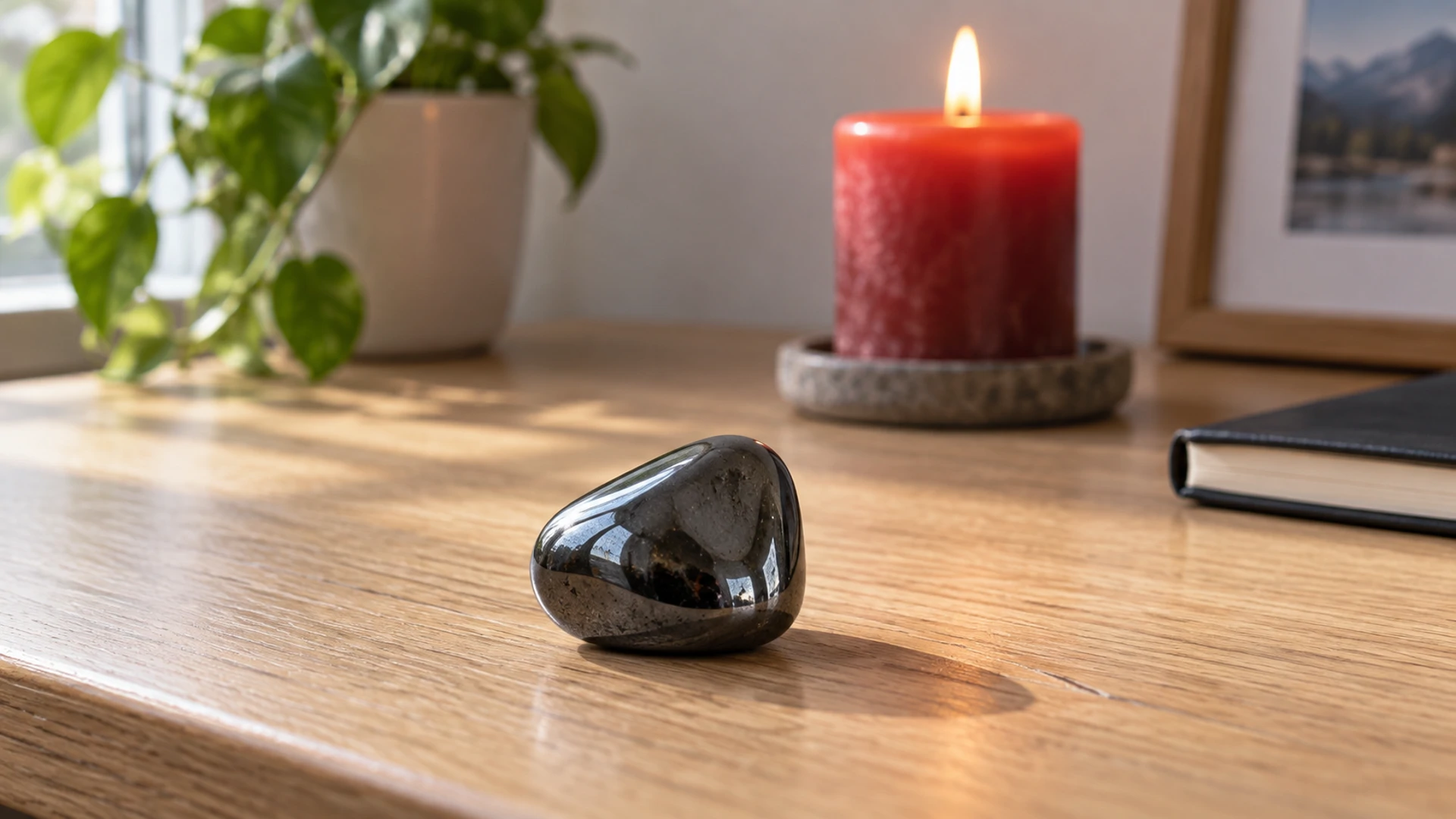
Hematite protects through sheer physical weight and density — its iron oxide composition is the direct source of its grounding power, its blood-red streak, and its long history as a warrior's stone.
Grounded in Iron: Why Hematite Belongs in Protection
When people ask what makes a stone protective, the easy answer is darkness — black stones ward things off. But hematite's protective function isn't about deflection or even about holding a boundary. It works through density. When you hold a piece of hematite, you feel it immediately: it is genuinely heavy for its size, denser than almost anything else you'd pick up in a crystal shop. That physical weight is not incidental. Hematite is iron oxide, and iron is one of the densest elements in the Earth's crust. What you feel in your hand is the same substance that gives blood its color, that ancient soldiers ground into powder and rubbed on their skin before battle. The weight is the point.
In magical terms, that density translates into a grounding force rather than a reflective or transmuting one. Compare this to how other stones in the protection category work: black tourmaline grounds first and then holds a boundary, while smoky quartz transmutes rather than blocks. Hematite does something different from both. It pulls scattered, elevated, or anxious energy back down into the body and anchors it there. The protection it offers is the protection of being fully present in your physical form — hard to destabilize, hard to manipulate, hard to sweep away.
Its chakra correspondence is the root, which fits exactly. The root chakra governs physical safety, the body, and the sense that you have solid ground beneath you. Hematite's mineral composition makes it a natural fit here, not just symbolically but literally: it connects you to iron, to blood, to earth.
The planetary correspondence for hematite is a genuine point of disagreement in the tradition, and it's worth being honest about that rather than picking one and pretending the other doesn't exist. Mars is the more historically grounded assignment. Roman soldiers used hematite ritually before battle, and the stone's pairing with Aries reflects that martial energy — courage, decisive action, forward momentum under fire. Its fire element attribution and its root-chakra heat fit the Martian register well. Saturn, however, is the more common assignment in modern crystal-healing literature. The case for Saturn rests on hematite's density, its structural solidity, and its association with discipline and endurance over time — qualities that fit Capricorn and Aquarius, both Saturn-ruled signs, more than Aries does. Both readings are coherent. Mars speaks to hematite's warrior history and its activating, courage-building use. Saturn speaks to its role as an anchor and a long-term structural support. Which one you reach for may depend on whether you're working with the stone in a moment of action or a moment of steadying.
What isn't disputed: root chakra, fire element in many Western traditions, and an association with courage and grounding that has been consistent across centuries of use. Its Mohs hardness is 5.5 to 6.5 — firm, reliable, not fragile.
Real Hematite or Hematine? Choosing and Keeping This Stone
The single most practically useful thing to know before buying hematite is this: a large proportion of what gets sold as hematite in metaphysical shops, online marketplaces, and even some crystal fairs is not natural hematite at all. It's a man-made magnetic composite usually called hematine (also spelled haematine), produced by fusing iron oxide particles under heat and pressure. It is shiny, uniformly black or dark grey, strongly magnetic, and cheap to produce. Natural hematite, by contrast, is only weakly magnetic. If a piece labeled hematite sticks firmly to a refrigerator magnet or attracts other small metal objects on its own, you're looking at hematine, not hematite. This is not a subtle difference — the magnetic pull is obvious.
Natural hematite can be metallic silver-black, reddish-black, or even reddish-brown depending on its formation. Raw or unpolished pieces often show the characteristic reddish streak when scratched across unglazed porcelain — one of the classic field identification tests for this mineral. Polished pieces are usually a bright metallic grey, but they won't attract a magnet the way hematine does. If you're buying in person, bringing a small magnet with you takes five seconds and saves you from a misidentification.
Once you have genuine hematite, the main care concern is moisture. Hematite is iron oxide, and iron and prolonged water exposure are not a good combination — over time, sustained wetness can cause surface rust. A brief rinse is generally fine and won't damage a polished piece, but you shouldn't leave hematite soaking in water, and you definitely shouldn't leave it in a damp environment for extended periods. Dry it off immediately after any contact with water. Cleansing it with smoke, sound, or moonlight avoids the moisture issue entirely and works just as well energetically.
Hematite is also denser and heavier than most stones its size, which means it can scratch softer stones if stored loose together. Keep it in a pouch or separate compartment rather than rolling around with things like celestite or selenite. When worn as jewelry — and polished hematite rings and bracelets are genuinely common — it's worth knowing that hematite's brittleness means it can chip or crack on a hard impact. Don't wear it for physical work where it might take a knock against a hard surface.
Three Practices for Working with Hematite's Weight
The Soldier's Steadying
Use this when you're heading into something that requires courage — a difficult conversation, a performance, a high-stakes meeting — and you need to feel solid rather than scattered before you walk through the door.
On a Tuesday, ideally timed to a Mars hour, light a red candle and place your hematite directly in front of it. Sit quietly with both hands around the stone for two to three minutes. Feel its weight — actually pay attention to it, the specific heaviness of it in your palms. This is not incidental. You're pulling that density into your awareness deliberately, using it to anchor your attention in your body rather than in the future scenario you're anxious about. State once, aloud or in your mind, what you intend to carry into the situation: steadiness, clarity, presence, or whatever is actually true for you. Carry the stone with you afterward — in a pocket, not a bag, where you can close your hand around it.
The Anchor Hold
Use this when your thoughts are circling and you can't locate yourself — anxious, overthinking, or feeling untethered from your own body.
Sit or lie down. Place hematite at the base of your spine if lying flat, or hold it in both palms in your lap if sitting. Close your eyes and take three slow breaths, but don't try to control the breath — just notice its weight, and then notice the stone's weight, and let those two sensations anchor you. The practice here is attention, not visualization. Hematite doesn't ask you to imagine anything. Its job is to give your nervous system something real and heavy to orient around. Stay here for five to ten minutes. If thoughts pull you up and away, bring attention back to the stone's weight in your hands or against your body. End by pressing both feet flat on the floor, feeling the same solidity in the ground beneath you that you've been holding in your hands.
The Blood Return
Use this when you're recovering from illness, burnout, or a period that has genuinely depleted your physical vitality — when rest hasn't been enough and you need to deliberately call your energy back into your body.
This practice draws on hematite's iron-and-blood connection directly. Sit comfortably and hold hematite against your sternum, over the center of your chest, with both hands pressed over it. Breathe slowly and picture the stone's density moving inward — not as a visualization exercise, but as a felt sense of weight and iron and earthedness settling into your body rather than hovering above it. Hematite's root chakra correspondence grounds scattered vital energy back into the physical. Spend ten to fifteen minutes here, once a day for as many days as feels right. Pair it with practical support — hydration, sleep, food — rather than using it as a substitute for those. On the days you work with it, a red candle lit nearby reinforces the vitality correspondence without requiring any additional ritual steps.
A Stone Named for Blood
The name hematite derives from the Greek word haima, meaning blood. That etymology is earned: when you grind hematite or drag it across an unglazed surface, it leaves a deep red streak that genuinely resembles dried blood. The mineral inside the silver-grey metallic exterior is red iron oxide — the same compound that gives blood its color. The stone looks like iron and bleeds like blood, and its name has held that double meaning for over two thousand years.
Roman soldiers knew this. Before battle, some rubbed hematite powder directly onto their skin — an act that was simultaneously practical (iron was associated with Mars, the war god) and ritual (the red powder marked them as under Mars's protection). This wasn't a metaphor. The soldiers understood that iron was the substance of weapons and the substance of blood, and they were literally wearing both. The red ochre pigment that appears in prehistoric cave art and burial sites is often hematite, which means this stone's connection to the human body — and to the threshold between life and death — is older than any documented civilization.
That lineage matters for how you work with it. When you hold hematite during the Blood Return practice above, or carry it into a situation where you need courage, you're drawing on a thread that runs from modern metaphysical practice back through Roman ritual and further back still into prehistoric pigment and burial rite. The stone hasn't changed. Its iron content, its red streak, its weight in the hand — these are the same across all of it.
The Case for Weight
Most protective stones work by deflecting, reflecting, absorbing, or transmuting. Hematite does none of these things. Its protection is simpler and more physical: it makes you heavier, in the best possible sense. It pulls your awareness into your body, your body into the ground, and your presence into the room you're actually standing in. That is the whole mechanism. You cannot be easily moved, manipulated, or destabilized when you are genuinely occupying your own body with your full weight behind you.
If you want to see how hematite sits alongside the rest of the Protection category — and how that category relates to Cleansing, Healing, Empowerment, and the others — the full breakdown is in The Crystal Compendium: Seven Paths to Stone Magic. That's the place to understand how these stones work together, and how to choose between them when more than one seems to fit what you need.