The Fifth Pentacle of Saturn: Guarding the Nighttime Invoker
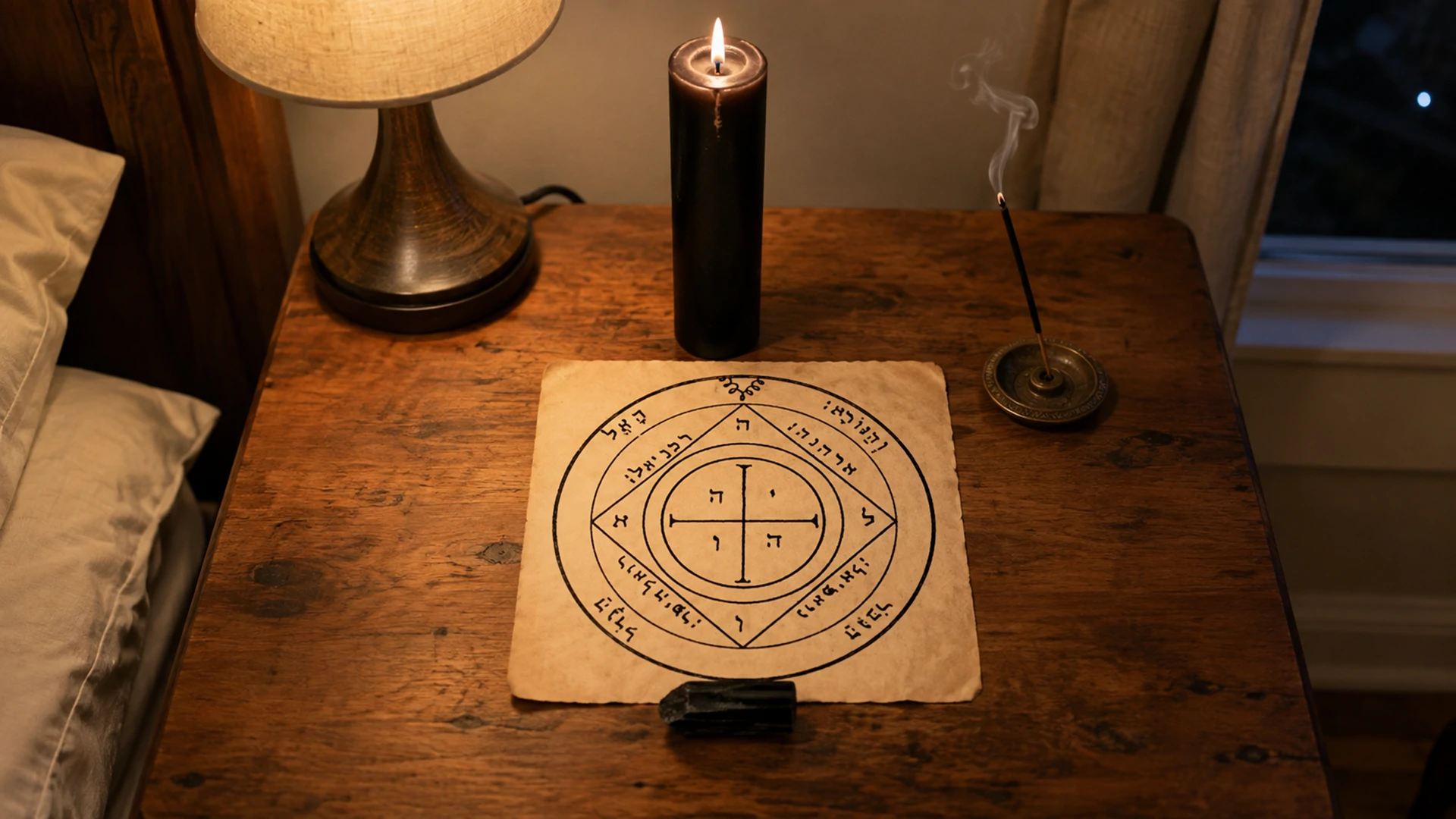
The Fifth Pentacle of Saturn is documented with two distinct offices: it defends those who invoke Saturn's spirits at night, and it chases away the spirits who stand guard over buried or hidden treasures. That combination — protective function and spirit-dispersal — makes it one of the more practically focused seals in Saturn's group. This Pentacle of Solomon commands both safety in the ritual space and the clearing of spiritual obstruction standing between the operator and what they seek.
Saturn governs limits, time, endings, binding, and the kind of deep authority that comes from confronting hard truths. If you want more context on how Saturn's current runs through all seven of its seals, the Pentacles of Solomon reference covers the planetary framework in full.
This article focuses entirely on the Fifth — its construction, what makes its office distinct from its siblings, how to work with it today, and a complete ritual you can use right now. For a broader look at all forty-four seals, the complete guide to every Pentacle of Solomon is the place to start.
Construction and Symbolism of the Fifth Pentacle of Saturn
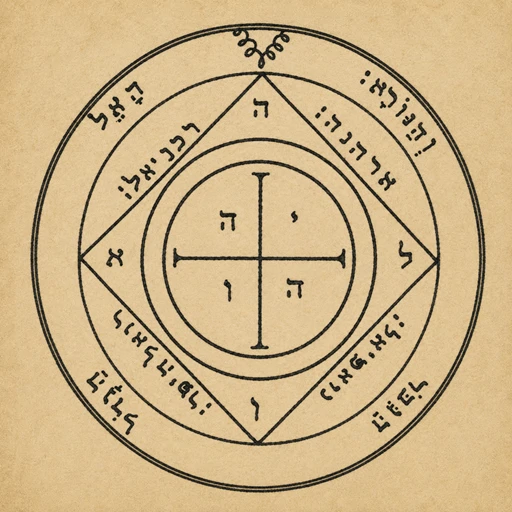
The Fifth Pentacle of Saturn is built around a specific set of names drawn from two layers of divine authority: two names of God and four named angels. Each element has a distinct role in the figure, and understanding what each contributes is the foundation for working with this seal intentionally.
The two divine names inscribed on this pentacle are IHVH — the Tetragrammaton, the four-letter name of God transliterated from Hebrew as Yod-Heh-Vav-Heh — and Eloah, a singular form of Elohim that appears frequently in the poetic books of the Hebrew Bible. IHVH is placed in the angles of a cross shape within the figure; Eloah is inscribed in the angles of a square. IHVH represents absolute divine authority, the name above all names in the Solomonic tradition. Eloah carries a different resonance: it is intimate and direct, the form used when addressing God in first person, and it appears over forty times in the Book of Job alone. Together, these two names give the pentacle its commanding character — supreme authority paired with direct divine address.
The four angels named on this pentacle — Arehanah, Rakhaniel, Roelhaiphar, and Noaphiel — are Saturn's own. Their names do not appear in other planetary groups within the Key of Solomon, which tells you something important: their office is specific to the Saturnine current. They are called specifically in the context of nighttime invocation, which means they function as guards and companions within the ritual space itself, not simply external forces directed outward. Invoking them is an act of calling protective presence into the working rather than projecting force away from it.
The verse attached to the Fifth Pentacle of Saturn is Deuteronomy 10:17 in full: "For the LORD your God is God of gods, and Lord of lords, a great God, a mighty, and a terrible, which regardeth not persons, nor taketh reward."
This verse was not chosen arbitrarily. Its content maps precisely onto the pentacle's office. A spirit guarding a treasure expects to negotiate — to be bribed, flattered, or appeased. The verse declares that the authority behind this seal does none of that. It regards no persons, takes no reward. The phrase "God of gods and Lord of lords" is also a direct assertion of hierarchy: no spirit, however powerful its office, sits outside this chain of command. For a pentacle whose job is to send guarding spirits away and protect the operator who stands in the presence of Saturnine forces at night, a verse about absolute uncompromising divine authority is exactly right.
The Fifth Pentacle of Saturn sits within a seven-seal group all governed by the planet Saturn, with lead as its traditional metal and black as its color. Unlike the Sixth Pentacle of Saturn — which is explicitly a binding and cursing seal formed entirely from Saturn's mystical characters — the Fifth is constructed around named angelic and divine forces rather than planetary characters alone. That distinction matters for practice: this seal calls named intelligences into protective relationship with the operator, which gives it a different quality from pentacles that project Saturnine force outward as a weapon.
The Spiritual Office of the Fifth Pentacle of Saturn
What makes this pentacle's office unusual within Saturn's group is that it is primarily defensive rather than coercive or destructive. Four of Saturn's seven seals direct force outward — striking terror, executing ruin, causing earthquakes, binding targets. The Fifth turns inward, toward the operator. Its job is to keep you safe while you are doing the work.
The documented office is explicit that this pentacle defends those who invoke Saturn at night. Night invocation of Saturn is considered more demanding than daytime work in this tradition — the Saturnine current is heavy, and the hours of darkness carry their own atmospheric weight. The angelic names inscribed on this pentacle are not generals you send into battle; they are sentinels you station around yourself. Working with this seal means you are not going in unguarded.
The second office — chasing away spirits guarding treasures — has a more specific historical context than it might first appear. In the ceremonial tradition behind the Key of Solomon, "treasure" refers to anything sealed under spiritual protection: buried wealth, hidden knowledge, locked resources, or access that has been deliberately warded. The spirits guarding these things resist approach, and not through force alone — they work on the operator's confidence, doubt, and fear. This pentacle disperses them by asserting the authority of the divine names it carries. You are not fighting the guarding spirit; you are presenting credentials it cannot refuse.
Saturn Correspondences for This Working
Saturn's traditional correspondences are well-established across European magical literature. The planet rules Saturday, governs the element of Earth in its densest, most structured form, and its hour — the Saturn hour — is considered appropriate for workings involving discipline, binding, limitation, endings, and serious protective operations.
Traditional Saturnine crystals include jet, black obsidian, black onyx, smoky quartz, hematite, and black tourmaline. For the Fifth Pentacle specifically, black tourmaline is the stone to reach for. Its traditional virtue is protective deflection — it does not absorb threat so much as it redirects it away from the operator. That function mirrors precisely what this pentacle does in ceremonial terms: it stands between you and what would approach uninvited.
Saturnine herbs in the traditional literature include mullein, wormwood, patchouli, Solomon's Seal, comfrey, yew, and cypress. The incense tradition for Saturn draws on several of these: myrrh, cypress, asafoetida, and patchouli all appear in Saturnine incense formulas across the grimoire literature. For this working specifically, cypress is the right choice. Cypress has been associated with Saturn, death, and the passage between worlds across Mediterranean traditions for centuries — Egyptians, Greeks, and Romans all planted it at burial sites. In the context of the Fifth Pentacle, that connection to thresholds and boundaries makes it a natural companion for a seal whose office involves standing guard at the edge of dangerous spiritual territory.
Saturn's color is black, and its metal is lead. The planetary day is Saturday. The element governed is Earth. These are not just flavor — they are the framework that helps your intention orient correctly. When you light a black candle on a Saturday night in Saturn's hour, you are aligning every layer of the working with the same current. That coherence is what gives a ritual its weight.
Who Should Work With the Fifth Pentacle of Saturn
The clearest candidate for this pentacle is someone doing active Saturnine work — invoking Saturn's spirits, working with Saturn's seals, or entering any ritual space where heavy planetary forces are in play — who wants protection built into the working itself rather than handled separately afterward.
Beyond formal ritual, the Fifth Pentacle speaks to anyone who feels spiritually blocked in a way that seems externally imposed rather than internally generated. If you have worked toward something repeatedly and met the same wall — the same failed contact, the same deflected intention, the same sense that something is standing between you and what you are seeking — this seal's office of dispersing guarding spirits applies. The key question is whether the block feels like a warded threshold rather than simply a lack of clarity or readiness on your own part. The Fifth is for the former, not the latter.
If your need is general psychic protection without a Saturnine context, the Second Pentacle of Saturn — which addresses adversity more broadly — or the Third Pentacle of Saturn — which covers nighttime invocation without the spirit-dispersal office — may be a closer match. If you are trying to guard yourself against a specific person rather than a spiritual force, that points toward binding work, which lives in the Sixth Pentacle's territory. The Fifth is most precisely suited to situations involving active ritual engagement with Saturnine forces or a specific warded threshold you need to cross.
A Modern Ritual for the Fifth Pentacle of Saturn
Timing
Work this ritual on a Saturday night, in a Saturn hour after sunset. Saturn hours at night carry the heaviest quality of the planet's current — the protective office of this pentacle was specifically documented for nighttime invocation. Use a planetary hour almanac to find the exact Saturn hour for your location on the night you plan to work. Aiming for the first or second Saturn hour of the night is ideal.
Materials
- Black candle — Saturn's planetary color anchors the working's energetic signature to the correct current; black specifically signals authority over endings, thresholds, and what stands outside the light.
- Black tourmaline — placed at the base of the pentacle, it holds the deflective function physically in the space, reinforcing the pentacle's office of keeping the operator safe while the work proceeds.
- Cypress incense — burned throughout the working to consecrate the threshold and signal to Saturn's spirits that you are approaching with awareness of the boundary between worlds.
- The Fifth Pentacle of Saturn, drawn or printed — the central object of the ritual; this is what carries the named angels and divine names that do the actual work.
Setup
Clear your space before the Saturn hour arrives. Wipe down your working surface, remove anything unrelated to this working, and sit with the space quietly for a few minutes before you begin. This is not ceremony for its own sake — it is about focusing your attention so that when the Saturn hour opens, you are already oriented.
Place the pentacle flat at the center of your altar or working surface. Set the black tourmaline directly below it. Position the black candle behind the pentacle, unlit. Light the cypress incense first and let the smoke move through the space while you settle your intention. The candle comes last.
The Working
When the Saturn hour begins, light the black candle. Hold your hands over the pentacle — not touching it — and read the four angel names aloud: Arehanah, Rakhaniel, Roelhaiphar, Noaphiel. Speak them slowly and with full attention. Then read the two divine names: IHVH, Eloah. Then speak the verse from Deuteronomy 10:17 aloud:
"For the LORD your God is God of gods, and Lord of lords, a great God, a mighty, and a terrible, which regardeth not persons, nor taketh reward."
Let that land. Then speak your intention clearly and directly:
By the names of Arehanah, Rakhaniel, Roelhaiphar, and Noaphiel, by IHVH and Eloah whose authority no spirit refuses, I call the protection of this seal upon myself and upon this work. Let all that would guard against my approach be turned aside. Let this space be defended while I stand within it. So it is.
Sit with the pentacle for a few minutes afterward. Hold the black tourmaline in one hand if you want something physical to anchor the experience. Let the candle burn down if it is a small one, or snuff it deliberately if you are using a larger taper and plan to relight it for subsequent sessions.
Closing
When you feel the working is complete, thank the named angels by speaking their names once more. Extinguish the candle and the incense. Leave the pentacle and the black tourmaline on your altar until the working has resolved — if you used this for nighttime protection during a ritual series, keep them in place through the duration of that series. If you used it to clear a specific obstruction, you can put the pentacle away once you see movement on the situation.
How to Work With the Fifth Pentacle of Saturn Today
The Fifth Pentacle of Saturn is distinguished from its siblings by something precise: it names four specific angels — Arehanah, Rakhaniel, Roelhaiphar, Noaphiel — whose office is explicitly tied to nighttime Saturnine invocation. That is not a detail you swap out for convenience. Those names are why this pentacle does what it does. Whatever material form you use for the figure, the names need to be present and legible on it.
The traditional material for Saturnine pentacles is lead, engraved during a Saturn day and hour with the planet in favorable position. Most modern practitioners are not casting lead, and that is fine. The office of this pentacle travels through any carefully made version of the figure — drawn on heavy paper or card stock, printed and handwritten over, or rendered in ink on natural parchment. What matters is that you made it with attention to this specific seal's names and structure, not that it was manufactured in lead under exact astrological conditions.
If you want to get closer to the traditional approach without working in metal, drawing the pentacle yourself on black or dark paper using a silver or white pen during a Saturn hour is a reasonable middle ground. The act of drawing it by hand — tracing the divine names, writing out the angel names in sequence — is itself a form of engagement with the seal's content that printed versions skip.
Unlike the Fourth Pentacle of Saturn, whose office involves ruin and destruction and requires careful handling, the Fifth is specifically protective in character. You can carry it with you — wrapped in black cloth, kept in a small pouch, or placed in a wallet or bag — without concern that its energetic content will misfire. Its job is to guard you and clear your path, and it does that continuously when kept close.
The spirit-dispersal office of this pentacle is coercive in a specific sense: it does not ask guarding spirits to leave. It presents them with names and authority they cannot refuse, and they go. That is not a gentle or collaborative working. If your practice is built on consent-based spirit relationships, it is worth sitting with that honestly before using this seal in a treasure-hunting or threshold-clearing context. The protective office — defending yourself during Saturn invocation — is less ethically complicated, since you are not directing the coercion outward at a named target but establishing a defended perimeter around your own working space.
Either way, the Fifth Pentacle of Saturn is a powerful and specific tool. It rewards clarity about what you actually need it to do. Work it with intention and full attention, and it delivers exactly what the tradition documented it for.