The Sixth Pentacle of Saturn: The Binding Seal of Demonic Obsession
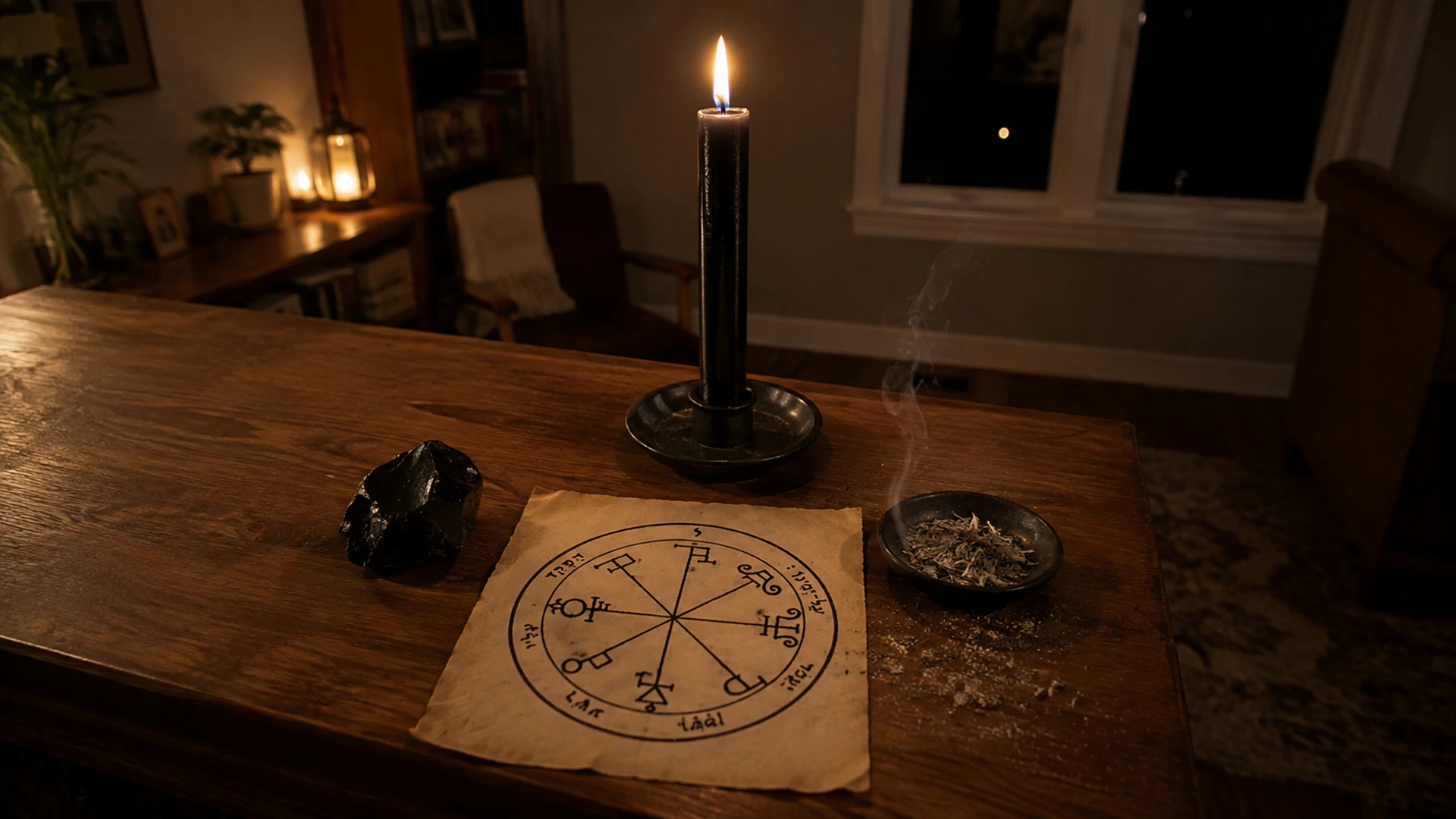
The Sixth Pentacle of Saturn carries one of the most direct and unambiguous offices in the entire Solomonic corpus: the named target shall be obsessed by demons. That is its documented function, stated plainly in the source material, with no protective qualifier softening the clause. As a Pentacle of Solomon, this seal belongs to the baneful current — it is not a defensive tool repurposed for offense, and it is not a protection working that happens to harm enemies. It is a cursing and binding instrument, designed with that intent from the ground up.
Saturn governs endings, restriction, time, karmic consequence, and the slow grinding weight of necessity. Those currents run through all seven of Saturn's pentacles, but they manifest very differently across them — from invocation support to treasure-guarding to outright destruction. The Sixth sits at the extreme end of that range.
What follows is a close reading of this pentacle's construction, its office, the Saturn correspondences that support it, and a complete modern ritual built around its specific function. If you're newer to Solomonic work and want the full map before going deep on a single seal, start with the complete guide to all 44 pentacles.
Construction and Symbolism of the Sixth Pentacle of Saturn
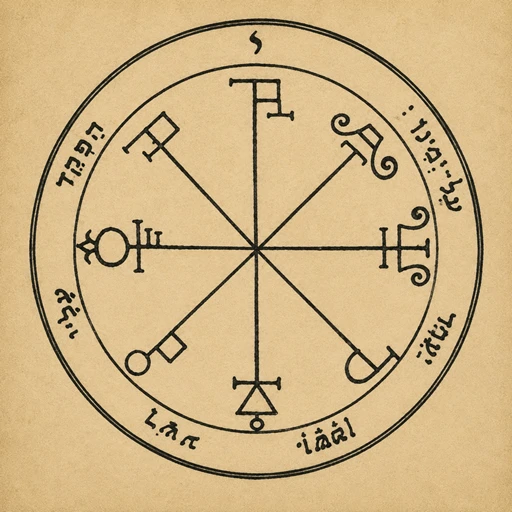
The Sixth Pentacle of Saturn is built entirely from the mystical characters of Saturn. This is the first thing that sets it apart from most of its siblings in the Saturn set. The first pentacle carries four divine names — IHVH, Adonai, Yiai, Eheieh — arranged inside a square. The second is anchored by the famous SATOR AREPO TENET OPERA ROTAS acrostic. The fourth centers on the mystic letter Yod with a supporting Psalm verse. The fifth names four angels and two divine names explicitly. The Sixth has none of that. No divine names are listed. No angels are invoked. And while the figure does carry a Hebrew line inscribed around it, it is not a formal psalm versicle in the way its siblings use one — it is a single wrathful clause drawn from Psalm 109:6: "Set thou a wicked man over him: and let Satan stand at his right hand."
That absence of the usual authorizing layers is significant. In Solomonic practice, divine names function as authorization — they tie the working to heavenly authority and provide the operator a layer of spiritual protection. Angels named on a pentacle are presences you can call upon and reason with. A full psalm versicle anchors the pentacle's office to sacred language, lending it a theological frame. The Sixth Pentacle of Saturn has stripped most of that away. What remains at its core is the characters of Saturn itself: raw planetary force, undiluted, with no mediating angelic presence and no divine name to temper or direct the current beyond the operator's own intention. The Hebrew inscription that does appear is not protective language — it is an invocation of Satan as adversary, pointing him directly at the named target.
The mystical characters of Saturn are a set of traditional sigil-forms associated with the planet in the grimoire tradition — not letters from any standard alphabet, but symbolic marks derived from planetary magic squares and angelic script systems that evolved through medieval and Renaissance ceremonial practice. They encode the planetary virtue directly into the figure's geometry. In a pentacle built primarily from these characters, the figure itself becomes the primary carrier of the working, with the inscribed Hebrew line sharpening its aim rather than softening it.
This construction choice is consistent with the pentacle's office. A tool designed to set demons upon a named person is not a tool that requires you to call on protective angelic intermediaries — it operates at a level where the planetary force acts directly, without the softening presence of named spiritual allies. The figure reads as intentionally stark, and that starkness is doing real magical work. Compare this to the Fourth Pentacle of Saturn, which executes ruin and destruction but carries the mystic letter Yod alongside a Psalm verse that grounds its office in the same wrathful Psalm 109. The Sixth takes a single clause from that same psalm — not as context, but as a targeting instruction — and surrounds it with planetary characters alone.
The Spiritual Office of the Sixth Pentacle of Saturn
The office is a binding and cursing working: the person whose name is written upon or spoken in connection with this pentacle shall be obsessed by demons. In the language of the grimoire tradition, obsession refers to demonic influence exerted from without — a relentless spiritual pressure rather than full possession. The target does not become inhabited; they become hounded. Their thoughts are disturbed, their will is undermined, their capacity for peace is eaten away. It is a sustained, compounding working rather than a single strike.
In modern practice, most people who work with this pentacle frame its office in terms of justice, consequence, or reversal rather than literal demonology. The underlying magical act — directing sustained Saturn current toward a specific person with the intent to destabilize, diminish, or compel — translates into contemporary baneful work without requiring a literal belief in demons. What matters is the precision of the target and the weight of Saturn's force. This is a working that commits. You are not sending a warning; you are setting something in motion that will not stop on its own.
That sustained quality is worth taking seriously before you work with this pentacle. Most protection and binding workings, including several others in the Saturn cluster, are designed to stop harm or contain a threat. The Sixth is not containment. It is pursuit. If what you actually need is to stop someone from reaching you or to wall off an enemy's influence, the Fifth Pentacle of Saturn — which defends invokers and chases away malevolent presences — is likely the better fit. The Sixth is for situations where stopping the threat is not sufficient and you intend to take the working directly to the source.
Saturn Correspondences for This Working
Saturn's traditional correspondences form the foundation of any working under its influence. The planet's metal is lead, its color is black, and its day is Saturday. Its element is Earth. The Saturn hour on a Saturday — especially the first hour after sunrise or the first hour after sunset — carries the densest saturnine current of the week, and that timing is traditional for heavy binding and cursing work.
Crystals traditionally associated with Saturn include black obsidian, jet, black onyx, smoky quartz, hematite, and black tourmaline. Herbs and incenses in Saturn's domain include mullein, wormwood, patchouli, cypress, myrrh, comfrey, Solomon's seal, and yew.
For the Sixth Pentacle specifically, black obsidian is the correspondence to emphasize. Obsidian is Saturn's most aggressive crystal — it cuts, it reveals, and it does not soften what it uncovers. Unlike jet, which carries more of Saturn's protective and grief-absorbing qualities, obsidian carries the planet's capacity for force and penetration. For a working whose entire office is to send something relentlessly toward a target, obsidian's energy is a direct match rather than an approximate one.
On the herbal side, wormwood is the right choice here over mullein. Mullein tends toward Saturn's quieter, more contemplative current — it is used for invocation, for working in liminal spaces, for opening communication with chthonic spirits. Wormwood is confrontational. It has a long history in cursing and banishing traditions precisely because it carries Saturn's bitter, stripping quality: it removes what should not remain. As an incense, wormwood smoke is acrid and unmistakable. Burning it during this working marks the working's nature plainly and feeds the saturnine current surrounding the pentacle.
Who Should Work With the Sixth Pentacle of Saturn
This pentacle is for situations involving a specific person who has caused serious, ongoing harm and where conventional approaches — cutting contact, protection workings, boundary-setting magic — have not resolved the situation. Think about someone who continues to harass after being cut off, who is actively working to damage your livelihood or relationships, or who has caused harm that you believe warrants a direct magical response rather than containment.
It is not the right tool if what you need is to stop the influence from reaching you. That is a job for warding, shielding, or the Fifth Pentacle of Saturn's protective office. It is also not what you want if your goal is justice in the sense of consequence catching up to someone through natural or karmic means — the Second Pentacle of Saturn, built on the SATOR square and aimed at repressing pride and adversity, is better suited to that kind of regulatory working. The Sixth is specifically for situations where you have decided to act directly against a person and intend the working to follow them.
If you are newer to baneful work, be honest with yourself about where you are. The Sixth does not hedge. It does not contain a self-limiting clause or a built-in timer. Once you set this working in motion, it runs until you close it or until the saturnine current has exhausted itself — and Saturn's current is slow and patient. That is not a reason to avoid it, but it is a reason to be clear before you begin. Ask yourself whether the situation genuinely warrants this response, and whether you are prepared to carry a working of this weight. If the answer to both is yes, you are in the right place.
A Modern Ritual for the Sixth Pentacle of Saturn
Timing
Work on a Saturday during a Saturn hour, ideally the first Saturn hour after sunset. Saturday evening during a waning or dark moon is ideal — the waning phase strips and diminishes, which aligns directly with the pentacle's office of sustained pressure on a target. You can find your exact Saturn hour using a planetary hour almanac calculated for your location.
Materials
- Black candle — black is Saturn's color, and for a working of this office it carries the weight of the planet's most compressive, binding current rather than any neutralizing or purifying quality.
- Black obsidian — chosen specifically for obsidian's capacity to penetrate and pursue rather than absorb or contain, which mirrors the pentacle's sustained pursuit of the target.
- Wormwood — burned as incense throughout the working for its bitter, stripping Saturnine quality, feeding the force being directed outward toward the named target.
- The Sixth Pentacle of Saturn, drawn or printed — the figure should be reproduced accurately, with the mystical characters of Saturn rendered clearly; write the target's name on the back in black ink before the ritual begins.
Setup
Clear and darken your space. Place the black candle at the center of your working surface. Set the pentacle face-up directly in front of the candle, with the target's name facing down against the surface. Place the obsidian on top of the pentacle, resting on it, pressing the name between the figure and the stone. Set your wormwood in a fireproof dish to one side. Light the wormwood first, letting the smoke rise and fill the space before you do anything else. Let the acrid scent mark the working's character. Then charge your black candle by holding it between both palms and pushing your intention into it — the specific name, the specific intent, the sustained pressure you are setting in motion.
The Working
Light the candle. Sit with the pentacle, the obsidian, and the smoke for a moment. Let yourself settle fully into Saturn's current — the slow, grinding, inevitable weight of it. When you feel that weight in your body, pick up the pentacle and hold it so the name presses against your palm.
Speak your intention aloud. Do not rush it. Slowness is Saturn's nature, and this working does not need to be shouted. Say it plainly:
By the mystical characters of Saturn inscribed upon this seal, I name [target's full name] and I send the weight of Saturn's force to follow them. Let their peace be stripped away. Let the pressure of what they have done return to them without rest. This working stands until I close it or until Saturn's justice is complete.
Set the pentacle back down with the name still face-down. Return the obsidian to its place on top of the figure. Sit with the candle burning and the wormwood smoking, holding the target's name in your mind without softening it. You are not sending anger — you are directing force. Stay with it for as long as the current feels active, then allow the candle to burn down completely or snuff it and return the following night to burn it further.
Closing
When the candle has burned down, allow the wormwood to go out on its own if possible. Leave the pentacle and obsidian in place for as long as you intend the working to run. If you choose to close the working at some point, remove the target's name from the back of the pentacle, burn it, and thank the Saturn current for its work. Store the pentacle separately, cleansed with salt or black obsidian, before using it again for anything else.
How to Work With the Sixth Pentacle of Saturn Today
The figure is built primarily from the mystical characters of Saturn — no divine names, no angels, and no formal psalm versicle, though it carries that one wrathful line from Psalm 109:6. That means the accuracy of those characters matters more here than it does for a pentacle that carries multiple layers of symbolic content. With a figure like the Second Pentacle of Saturn, the SATOR acrostic square is immediately legible and verifiable. With the Sixth, what you are reproducing is a specific set of traditional planetary sigil-forms, and rendering them carefully is the foundation of the work. Start with a reliable source for the figure — S. L. MacGregor Mathers' 1888 edition of the Key of Solomon remains the most accessible English-language reference — and reproduce the characters with attention.
Traditional practice called for engraving this figure on lead, Saturn's metal, during the day and hour of Saturn. Lead engraving is not impossible to source today — some practitioners commission hand-engraved lead discs from metalworkers — but for most people working with this pentacle in a modern context, drawing the figure on heavy black paper or card in silver or white ink, or printing a high-quality reproduction and consecrating it, is entirely workable. What traditional lead engraving accomplished was material alignment between the figure's planetary nature and the substance carrying it. You can approximate that alignment through intention and timing even without the metal itself.
What is worth preserving regardless of how you render the figure is the timing. Working this pentacle during Saturn's day and hour is not an arbitrary formality — it is how you put the planetary current behind the working rather than working in spite of it. A waning moon phase stacks additional stripping energy on top of that. If you can get all three conditions aligned — Saturday, Saturn hour, waning moon — the working is operating with the full support of the sky behind it.
The coercive nature of this pentacle's office is worth addressing directly. This is a seal that sends demonic obsession toward a named person. In a modern context, that reads as a serious cursing working, and it should be treated as one. That does not make it illegitimate — baneful magic is a genuine part of the tradition and has been practiced across cultures for as long as people have been practicing magic at all. But it does mean you should enter the working with your eyes open rather than framing it to yourself as something softer than it is. The Sixth Pentacle of Saturn is a weapon. Use it as one, with the deliberateness and clarity that kind of working requires.