Emerald: Love That Keeps Its Word
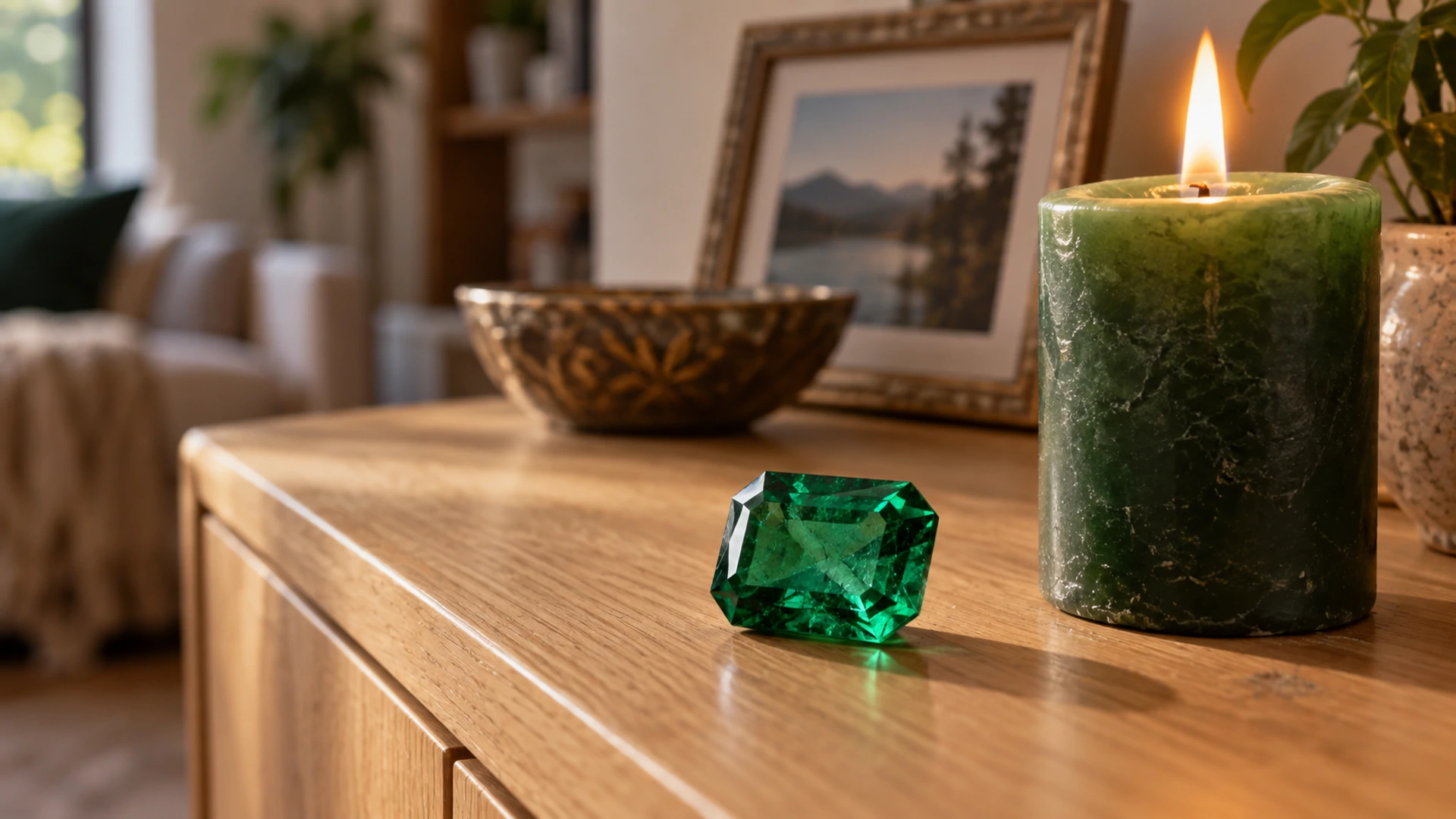
Emerald is the Stone of Successful Love — not the love that starts with a rush, but the love that holds its shape across years. Its magic lives in fidelity, loyalty, and the willingness to stay.
Love That Keeps Its Word: Why Emerald Belongs in Love & Relationships
Emerald is beryl — the same mineral family as aquamarine — distinguished from its blue cousin by trace amounts of chromium or vanadium, which pull its color into that vivid, saturated green. The color can range from pale spring-leaf to deep forest, depending on the concentration of those trace elements and the specific mine it came from. What almost every natural emerald shares, regardless of origin, is its interior: a dense web of inclusions, fractures, and growth patterns that the gem trade has long described with the French word jardin, meaning garden. It's a fitting term. That inner landscape isn't a flaw — it's the stone's signature. A perfectly clean emerald under magnification is so rare it triggers suspicion rather than admiration in the trade, and a stone showing no jardin at all is usually a synthetic or a simulant.
In magical practice, emerald belongs to the Love & Relationships category, but not in the same register as every other stone in that group. Rose quartz works with universal, unconditional love — the foundational stone for every form of love, from self to family to friendship to romance, casting wide rather than narrow. Chrysoprase brings joyful new beginnings in love, heart-reopening and optimism specifically after heartbreak. Ruby carries passionate, vital, embodied love — fire, sensuality, and courage in romance, distinct from tenderness or commitment. Emerald does something different from all three. Its mechanism is fidelity and loyalty in committed partnership — what used to be called, in older lapidary tradition, the Stone of Successful Love. That phrasing matters. Successful love, in the sense it's meant here, isn't the most dramatic love or the most intense love. It's the love that succeeds at remaining love over time. The partnership that endures, the household that stays stable, the vow that doesn't drift.
This makes emerald a stone oriented toward marriage and domestic harmony rather than courtship. It isn't the stone you reach for when you want to attract a partner or rekindle a fading flame — that's the territory of ruby or the warm invitation of rose quartz. Emerald's energy is already inside a commitment, tending to it. Venus rules this stone — the planet that governs love, beauty, and the agreements we make through relationship — and Taurus is one of its most commonly cited zodiac associations. Taurus is a fixed earth sign: loyal, slow-moving, resistant to upheaval, oriented toward what lasts. The connection makes sense. Emerald's correspondences converge around the same idea: Venus's relational gravity and Taurus's staying power, both anchored in the heart chakra, where those qualities translate into the willingness to tend a relationship rather than simply enjoy it.
The Garden Inside the Stone: Choosing Emerald
The single most important fact to know before buying emerald is that nearly all natural emerald on the market is oiled. This isn't a secret, and it isn't a defect — it's a trade standard, disclosed by reputable sellers and accepted as a normal part of working with this stone. The inclusions that make up emerald's jardin frequently reach the surface, creating tiny fractures where the stone meets air. A colorless oil or resin is introduced to fill those surface-reaching fractures, improving apparent clarity and reducing the visual impact of the internal garden. The treatment is stable under normal conditions, but it isn't permanent, and it has real implications for how you care for the stone.
Ultrasonic cleaners, steam, and harsh chemical solvents are the three things emerald should never encounter. All of them can draw the oil back out of the fractures, making those inclusions suddenly much more visible than they were when you bought the stone. For cleaning, a soft cloth and, at most, lukewarm water with mild soap are all you need. This is worth building into any ritual practice that involves regular handling of the stone — don't submerge it for long periods, don't run it under hot water, and keep it away from anything chemically aggressive.
On sourcing: Colombia's Muzo mines are the benchmark. Fine Colombian emerald — particularly material from Muzo — is considered the standard against which other origins are compared, valued for a particular warmth in its green that tends to come through even in included material. Zambia and Brazil produce significant quantities of natural emerald as well, often at more accessible price points. When choosing a specimen for magical practice, the inclusions visible in the stone shouldn't concern you — that jardin is genuinely characteristic of real emerald, and a heavily included natural stone will carry as much correspondence as a cleaner one.
Emerald sits at Mohs 7.5 to 8, which is genuinely hard. But its hardness rating tells only part of the story. Because of those internal inclusions and fractures, emerald is more brittle than that number suggests, and it chips more readily on sharp impact than a sapphire or ruby at comparable hardness would. Handle it thoughtfully — it doesn't need to be treated as delicate, but it also doesn't want to be thrown into a bag with harder stones or knocked against a hard surface during ritual work.
Three Practices for a Kept Commitment
The Renewed Vow
Use this practice when you want to consciously reaffirm a commitment already made — not only at a wedding anniversary, but at any moment when a relationship needs deliberate re-grounding in its own foundation.
Hold the emerald in both hands in a quiet space. Light a green candle on the surface in front of you. Spend a few minutes bringing the full weight of your commitment to mind — not the aspirational version, but the actual relationship: its texture, its history, the things you've both chosen to stay for. Then speak aloud, with the stone still in your hands, the specific thing you are recommitting to. Not a vow to the other person — this isn't a performance — but a statement directed inward, to yourself. What are you choosing again, right now? You can do this alone. The emerald holds the intention; the charged candle anchors it in the present moment. Let the candle burn for at least fifteen minutes after you finish speaking before you extinguish it.
The Steady Home
Use this practice to strengthen domestic harmony and shared stability within an established household — particularly during periods of transition, stress, or friction that haven't yet broken into real conflict.
Place the emerald at the center of a shared table or surface in your home — a kitchen table, a coffee table, any space both people move through regularly. Surround it with a small arrangement that matters to the household: a dried sprig of rose, a few dried lavender buds, whatever is already present in your practice. The intention here isn't dramatic — it's a slow, steady broadcast into the space itself. Leave the stone in place for as long as feels right, ideally several days. Working during a Venus hour on a Friday deepens the correspondence, but the stone does its work simply by sitting at the center of a shared space with a clear intention behind its placement.
The Loyal Ground
Use this practice during a period of external temptation or internal doubt — when the commitment itself is intact but something outside is pulling attention away from it, or when uncertainty is making loyalty feel like effort rather than choice.
Carry the emerald on your person throughout this period — in a pocket, held in the hand during any moment of quiet. Each time you become aware of it, let the weight of it serve as a physical reminder of what you have already chosen and why. This isn't a practice that resolves doubt by suppressing it — it's a practice that keeps you present to your own commitment while the doubt runs its course. In the evenings, hold the stone at the heart and breathe slowly for a few minutes, letting yourself feel the full reality of what you've built in the relationship, not the idealized version of it. This grounding in the actual — the real, specific, imperfect thing you've committed to — is where emerald's loyalty correspondence does its clearest work.
Mined Near the Red Sea, Prized by an Empire
The oldest well-documented source of emerald in the ancient world is Egypt — a cluster of mines in the Eastern Desert, between the Nile and the Red Sea, worked in antiquity and later associated so strongly with Cleopatra that they're still sometimes called Cleopatra's Mines in gemological writing today. Exactly how far back their use goes is a matter of ongoing historical debate, so it's worth holding the precise dating loosely — what's well established is that Egypt's emerald was known and valued in the ancient world long before Roman accounts describe it.
The Roman naturalist Pliny the Elder wrote admiringly about emerald in his encyclopedic survey of the natural world. His account described the stone's intense green as uniquely restful to the eye — a quality he regarded as unmatched by any other gem — and noted the way even cutting and polishing emerald left a green tint on the hands of the craftsmen working it, a detail that suggests just how deeply saturated the finest stones could be. Pliny's writing on emerald is admiring rather than clinical, and that quality of admiration — the sense that the stone's green is not merely decorative but genuinely restorative — runs through centuries of writing about it after him.
The Love That Stays
Emerald's specific work is the hardest kind: not the beginning of love, but its continuation. Fidelity and loyalty in committed partnership — the willingness to keep showing up for what you have already chosen — sit at the center of its correspondence, and that's what makes it distinct within the Love & Relationships category. It doesn't light anything on fire. It tends the fire that's already burning.
If you want to see how emerald sits alongside the other stones in its category, and how the Love & Relationships category relates to the six others — protection, cleansing, healing, empowerment, abundance, and intuition — The Crystal Compendium: Seven Paths to Stone Magic maps all of it in one place.