Amethyst, the February Birthstone: Clarity for a Mind Ready to Open
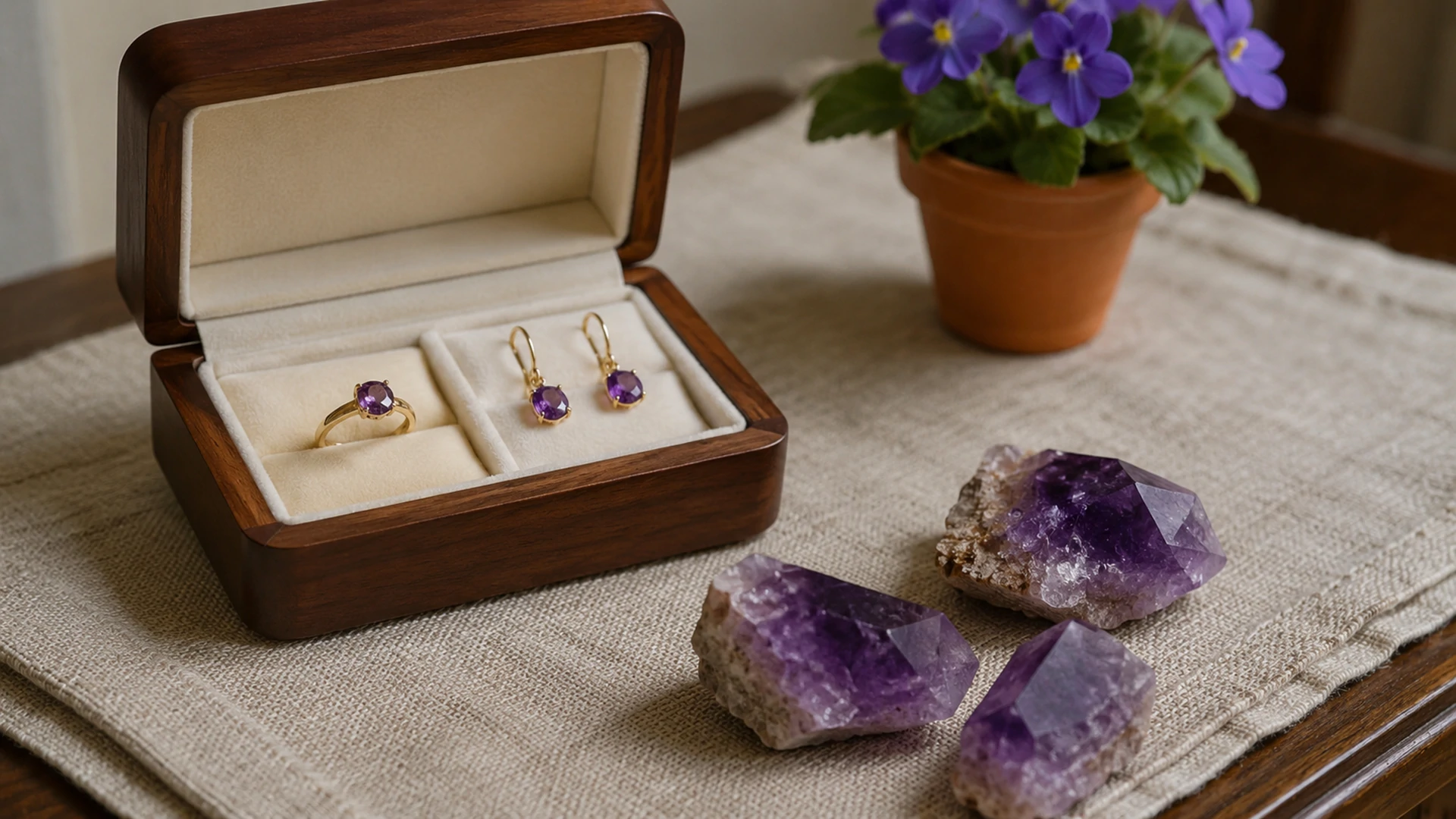
Amethyst is one of the most widely recognized stones in magical practice, but there's something different about working with it as your February birthstone rather than just another crystal on the shelf. When Amethyst belongs to your birth month, the relationship shifts. You're not borrowing its energy — you're activating a correspondence that runs through your own energetic signature. This article is specifically about that relationship: the meaning of Amethyst as a February birthstone, how to use it in ritual, how to carry it in daily life, and how to pair it for maximum effect.
What Amethyst Means as the February Birthstone
February sits at a peculiar threshold in the year. Winter hasn't broken, but the light is visibly returning. The world is still quiet, still inward-facing — and yet something underneath is stirring. This liminal quality, caught between dormancy and emergence, is baked into the energetic character of the month. Amethyst, with its deep violet hue and its longstanding association with clarity of mind, spiritual perception, and the dissolving of illusion, fits February not as a coincidence but as a correspondence. The stone mirrors the month's essential tension: the gap between what you know and what you're about to become.
The historical record places Amethyst firmly in the February slot going back to at least the 1st century CE, when the Roman-Jewish historian Josephus is traditionally credited with connecting the twelve stones of the High Priest's breastplate to the twelve months. That early assignment was later reinforced through medieval gem lore and formally standardized by the National Association of Jewelers, which met in Kansas City and formally adopted the modern list in 1912 — the organization is known today as Jewelers of America. Across those centuries, the stone's assigned qualities remained consistent: sobriety, wisdom, clear perception, and protection against self-deception. Those aren't generic virtues — they're specifically relevant to the astrological energies that dominate February. If you were born in February and feel more drawn to earthy, grounding energy than to Amethyst's high-vibration clarity, it's worth knowing that Jasper is recognized as February's modern alternative birthstone with a very different energetic character.
February spans two zodiac signs. Aquarius runs through most of the month (approximately January 20 to February 18), and Pisces takes over for the final stretch (February 19 onward). Aquarius is an air sign ruled by both Saturn and Uranus — brilliant, visionary, and prone to living so far inside its own ideas that it loses contact with emotional reality. Pisces is a water sign ruled by Neptune and Jupiter — deeply intuitive, spiritually open, and vulnerable to confusion between inspiration and illusion. Both signs, in their own way, struggle with the same core tension: the gap between inner perception and outer reality. Amethyst's full magical correspondences reflect exactly this territory — it's a stone of spiritual clarity, psychic protection, and the sharpening of inner vision. As a February birthstone, it addresses the specific energetic challenge the month actually poses.
There's a distinction worth making here between using Amethyst as a general magical tool and working with it as your birthstone. When you pick up Amethyst because it fits a working, you're drawing on its inherent Jupiter and Neptune qualities from the outside. When you work with it as your birthstone, something different is happening. The traditional understanding holds that a birthstone carries a frequency already compatible with the person born in that period — not just useful to them, but resonant with what's already present in their energetic makeup. For February-born people who carry Jupiter and Neptune influences in their natal chart by virtue of their sun sign, Amethyst doesn't need to be introduced as a foreign quality. It amplifies what's already latent. Charging it to your birth month and carrying it consistently deepens that resonance over time in a way that one-off workings simply don't.
Amethyst's planetary ruler is traditionally Jupiter — the planet of wisdom, expansion, and spiritual authority — with some modern traditions also assigning Neptune, ruler of Pisces, as a secondary influence. Both rulerships reinforce the stone's role as a clarity amplifier. Jupiter pushes toward higher understanding; Neptune governs mystical perception and the dissolution of ego-constructed barriers. Together they describe a stone that doesn't just clear your thinking — it opens you to a wider frame of reality than you were previously operating from. For February-born people, who carry these planetary influences in their natal charts by virtue of their sun sign, Amethyst acts as a resonant amplifier of those natal qualities rather than an external supplement.
Amethyst's Hardness, Care & Origins
Amethyst sits at 7 on the Mohs hardness scale, which puts it squarely in the range of everyday wear. It's harder than most metals used in jewelry settings and won't scratch from normal handling. That said, hardness doesn't tell the whole story with this stone. Amethyst is genuinely light-sensitive in a way that many other crystals in the same hardness range are not. Prolonged exposure to direct sunlight or heat can fade its color noticeably, sometimes shifting it toward yellow or citrine-like tones. This isn't a metaphysical concern — it's a straightforward photochemical reaction in the iron impurities that give amethyst its violet color. Keep display clusters away from sunny windowsills, and be thoughtful about how long you leave pieces in direct outdoor light. This matters practically for this article's own recommendations: the Imbolc ritual suggests windowsill placement to catch returning light, and the dream work practice places it bedside — ambient indoor light in both cases is fine. It's sustained direct sun exposure you're avoiding.
The stone's origins have shifted considerably over the centuries. For most of European history, the finest amethyst came from Siberian deposits — "Siberian amethyst" became a quality designation in gem trade, describing deep violet stones with a reddish flash. Then large Brazilian deposits were found in the 19th century, which dramatically increased supply and brought the stone from relative rarity to wide availability. Today the major sources are Brazil's Rio Grande do Sul state, Uruguay's Artigas region (known for especially deep violet material that still commands a premium), and Zambia's Kariba mine, which produces a rich royal purple distinct in character from South American material. One genuinely striking fact about amethyst: it's the source of the world's largest gem geodes. The so-called "cathedral" geodes — hollow basalt formations lined with amethyst crystals — can reach over 20 feet tall, and the most impressive examples have found homes in museum collections and high-end magical working spaces as focal anchors for group ritual. No other stone in the February correspondence produces anything quite like them at that scale.
How to Use Amethyst as Your Birthstone in Magic Rituals
The Birthstone Charging and Carrying Practice
This is the foundational practice for working with any birthstone, and it's where you should start if Amethyst is new to your ritual work. Begin by cleansing your stone — pass it through incense smoke, set it in moonlight overnight, or rest it on a bed of selenite for a few hours. Once it's clear, hold it between both palms and breathe slowly until you feel your attention settle. State your name, your birth month, and a single clear intention — something specific to where you are in your life right now, not a vague wish. The intention doesn't need to be spoken aloud, but it should be fully formed in your mind before it reaches the stone. Then carry the stone on your body for a full lunar cycle, ideally starting at a new moon. Check in with it daily by holding it briefly and noticing what surfaces — not analyzing, just observing. After the cycle, journal what shifted. Repeat with a new intention at the next new moon.
Purple Candle and Amethyst Clarity Ritual
This candle magic pairing draws on the shared correspondences of Amethyst and purple candle energy — both are aligned with Jupiter, with spiritual clarity, and with the expansion of higher perception. Use this ritual when you're facing a decision that feels unclear, when you're second-guessing yourself, or when you need to cut through mental noise and access your actual knowing. Dress a purple pillar or taper candle with a small amount of lavender or frankincense oil, working from the center outward to draw clarity toward you. If you practice candle inscription, carve a word representing what you want to perceive clearly — a person's name, a situation, a single word like "truth" or "direction." Place your Amethyst directly in front of the candle so the light falls across the stone. Light the candle, hold the stone, and let your mind go quiet. Don't force insight — create the conditions for it. Sit with it for as long as the candle burns comfortably, then snuff (don't blow) the flame and keep the Amethyst on your altar until the decision becomes clear. Repeat across multiple nights if needed.
Imbolc Threshold Ritual
Imbolc falls on February 1st or 2nd and marks the energetic midpoint between the winter solstice and the spring equinox. It's one of the most potent threshold moments in the seasonal year — a natural alignment point for intention work that involves transition, new beginnings that haven't yet manifested, and the kind of quiet, internal readiness that precedes visible change. For February-born people, Imbolc falls within or near their solar return period, making it an especially resonant time to work with their birthstone. On Imbolc eve, sit at a threshold in your home — a doorway works perfectly. Hold your Amethyst in your dominant hand. Reflect on what you are leaving behind in the darkness of the previous season and what you are calling into the growing light. Speak both aloud: what ends, what begins. Then cross through the threshold from one side to the other, stone in hand, stepping deliberately into the space that represents the new. Place the Amethyst on your altar or windowsill where it will catch the returning light for the remainder of February.
Third Eye Activation Practice
Amethyst has a genuine and historically grounded correspondence with the third eye chakra — the energy center associated with intuition, clairvoyance, and inner perception, located at the center of the forehead just above the brow line. This isn't a forced correspondence; it runs through the stone's planetary rulership (Jupiter and Neptune both govern expanded perception), its violet color (associated in chakra systems with the higher mind), and its longstanding use in protective and psychic-enhancement workings across multiple traditions. Lie flat on your back in a quiet space. Place your Amethyst on your forehead, resting it gently at the brow point. Close your eyes and breathe slowly and deliberately, drawing attention away from the body and toward the space behind your closed eyes. Hold this position for ten to fifteen minutes, staying receptive rather than seeking. Many practitioners use this before meditation, before journaling, or before any working where they need access to intuitive rather than analytical intelligence. If your mind runs to problem-solving, redirect your attention back to the stone's weight on your forehead — the physical sensation is the anchor.
Amethyst Dream Work Practice
Dream work is among the oldest documented uses of Amethyst. The stone's association with Neptune and with the liminal space between consciousness and sleep makes it a natural tool for anyone wanting to work with dreams intentionally — whether that's improving dream recall, seeding a specific question for dream processing, or gaining access to symbolic material the waking mind is too defended to receive. Place your Amethyst under your pillow or on your nightstand directly beside your head before sleep. In the few minutes before you close your eyes, hold the stone and think clearly about what you want to understand. Don't ask for a specific answer — ask for clarity, or for your deeper mind to show you something useful. Keep a notebook and pen within reach. The moment you wake, write before you do anything else — even before you check your phone. Don't interpret while you write; just record. Patterns emerge over time, not in a single night. Run this practice for at least two weeks before drawing conclusions.
February New Moon Protection Working
Amethyst's protective function is deeply connected to its clarity correspondence — it protects not by building walls but by making you perceptive enough to see threats before they become problems. This new moon ritual is specifically about psychic and energetic protection for the month ahead. On the February new moon, create a small circle using four pieces of Amethyst placed at the cardinal directions. Sit in the center with a fifth piece — your traditional birthstone — in your hands. Speak aloud (or inwardly, but firmly) a declaration of what you are closing your field against: manipulation, confusion, energy drain, psychic static. Name things specifically rather than speaking in vague abstractions — your intention is the active force here, and specificity sharpens it. After you've spoken your declaration, sit quietly for a few minutes and feel the boundary you've created as a real thing, not a metaphor. Close the ritual by picking up the four directional stones and placing them at the four corners of your bedroom or home to hold the working through the month.
Wearing & Carrying Amethyst for Daily Protection
Jewelry
The most immediate way to keep Amethyst's clarity and protective energy in your daily field is direct skin contact. A ring, pendant, or bracelet works well — the stone doesn't need to be large to be effective. What matters is consistency. Wearing Amethyst daily, particularly for February-born people whose energy already resonates with the stone, creates a sustained and cumulative effect rather than a single-session spike. Over time, the stone functions as a kind of steady baseline: keeping your perception sharp, your nervous system a little more settled, and your energetic boundaries a little more defined.
There's also a genuinely Amethyst-specific reason to wear it in settings where you're teaching, leading, or speaking with any kind of spiritual authority. The stone has a long ecclesiastical history as the bishop's stone — set into rings and worn by clergy as a symbol of piety, sober judgment, and spiritual standing. That tradition maps directly onto any contemporary work where you need to hold a clear, authoritative presence without losing your grounded center. If public-facing spiritual or leadership work is part of your life, wearing Amethyst in those contexts isn't decorative. It's drawing on a correspondence that's been used that way for centuries.
If you prefer not to wear jewelry, a tumbled stone in your pocket achieves the same proximity. Keep it in the pocket closest to your dominant hand — the hand you reach out with, sign things with, interact with the world through. The stone works through proximity and intention, not through elaborate ceremony, so this is legitimately effective daily practice even without any ritual framing.
In the Home
Amethyst placed in common areas where thinking and decision-making happen — a home office, a kitchen table where you read or plan — supports the clarity correspondence established through its planetary rulership. It won't do the thinking for you, but it supports an environment where your own thinking is less cluttered. For home display, avoid sustained direct sunlight as noted in the care section — ambient indoor light is fine, and a north-facing shelf or desk is ideal for pieces you want to keep at their deepest color.
Large amethyst geode clusters are worth naming here as something distinct from pocket stones or jewelry. A cathedral cluster or even a modest tabletop geode functions as a focal anchor for group meditation or shared ritual space in a way most other stones simply can't replicate at the same scale. The combined crystal surface area generates a consistent and diffuse field rather than a single point of concentration, which makes it particularly well-suited to spaces where multiple people are working toward the same intention.
In the Bedroom
Amethyst near the sleeping space draws on the dream-work correspondence covered in the ritual section — but even without active dream work intention, it tends to support deeper, quieter sleep for people who are sensitive to energetic static. This is consistent with its Neptune association and its historical reputation as a stone that quiets overstimulated minds. The ancient Greek word for amethyst — amethystos, meaning "not intoxicated" — speaks to exactly this quality. The Greeks wore the stone and drank from amethyst-set vessels believing it warded off drunkenness and the kind of clouded, unguarded thinking that comes with it. That's the same correspondence applied at night: a mind that's clear rather than flooded, receptive rather than overwhelmed. Bedside placement keeps that quality active through sleep without requiring any active ritual work on your part.
Amethyst and Jasper: February's Two Birthstones
Amethyst is February's traditional birthstone, the one that has held the month since the early history of birthstone assignments and carries the deeper ancient pedigree. Jasper doesn't share that historical claim — its recognition as a February stone comes from the modern alternative birthstone tradition, which acknowledges that the original assignments don't suit everyone's energetic needs equally well. The two stones are genuinely different in almost every respect, and knowing which one fits your practice better is more useful than treating one as superior to the other.
Where Amethyst is translucent violet and oriented toward upper-chakra work — spiritual clarity, psychic perception, third eye activation — Jasper is opaque, earthy, and physically grounding. Its color comes from mineral patterning in the stone itself rather than from light-sensitive iron saturation, which makes it significantly more fade-resistant — a practical difference if care is a concern. Jasper is also generally more affordable per carat, which matters if you want multiple pieces for home placement or gridding. The deeper consideration is energetic fit. If February's astrological challenge for you feels more like disconnection from your body and physical reality than confusion about inner vision, Jasper addresses that directly in a way Amethyst doesn't. If you're drawn to the clarity and psychic-opening work this article covers, Amethyst is your stone. If you want roots instead of windows, Jasper is worth exploring.
Amethyst Crystal Combinations: What Pairs Well
Amethyst and Clear Quartz — Clear Quartz is an amplifier without a fixed intention of its own, which makes it the most direct way to intensify Amethyst's clarity and protective functions without shifting their character. The two stones share a high-vibration, spiritually oriented energy profile, and Clear Quartz magnifies whatever Amethyst is already doing. Use this pairing when you need Amethyst's qualities at full intensity — during major decisions, during spiritually significant periods like your solar return, or when the clarity work you're doing requires exceptional precision.
Amethyst and Black Tourmaline — These two stones operate on the same protection function but through entirely different mechanisms. Amethyst protects through perception — it makes you clear-sighted enough to see what's coming. Black Tourmaline protects through deflection and grounding — it forms a hard energetic boundary and keeps intrusive energy from landing. Paired together, they create layered protection: the outer shield of Black Tourmaline and the inner clarity of Amethyst. This combination is particularly well-suited for empaths, for practitioners who do a lot of energetically draining work, or for February-born Pisceans who are especially prone to absorbing the emotional static of others.
Amethyst and Labradorite — Both stones operate in the space of psychic perception and mystical awareness, but they approach it differently. Amethyst clarifies — it sharpens and focuses intuitive signal. Labradorite opens — it expands access to liminal perception, spiritual insight, and the kind of awareness that operates below conscious thought. Together they create a potent combination for deep intuitive work, spirit communication, or any practice where you need both wide-open perception and the clarity to interpret what you're receiving accurately. This is an excellent pairing for Aquarian practitioners who want to balance their native rational sharpness with genuine psychic openness.
Amethyst and Lepidolite — Lepidolite contains lithium in its mineral structure and carries a pronounced calming, stabilizing energy that addresses anxiety and mental overactivity. Amethyst brings clarity. Together, they specifically address one of February's most common energetic challenges: the Aquarian tendency toward mental overdrive and the Piscean tendency toward emotional overwhelm. Where Amethyst alone might sharpen perception without necessarily quieting the nervous system that's receiving it, Lepidolite fills that gap. This is one of the best pairings for February-born people who feel mentally congested, anxious, or overstimulated.
Amethyst and Rose Quartz — These two stones share a long history of being used together, and the mechanism is sound: Amethyst provides clarity and spiritual grounding while Rose Quartz provides emotional warmth, self-compassion, and heart-centered energy. The pairing is particularly useful for shadow work — the practice of examining the parts of yourself you've suppressed or denied. Amethyst provides the clear-eyed perception to see what's there; Rose Quartz provides the self-love that makes it possible to look without collapsing. For Pisceans especially, who feel deeply and can be hard on themselves, this combination creates a container for emotionally difficult work that is both honest and gentle.
Amethyst and Fluorite — Fluorite is one of the strongest mental clarity and focus stones in the crystal lexicon. It organizes chaotic thought, supports concentration, and helps establish mental boundaries against confusion. Amethyst operates on a similar frequency but from a more spiritually elevated angle — where Fluorite organizes the mind, Amethyst clears the energetic static that's generating the disorganization in the first place. Used together, they address both the symptom (scattered or confused thinking) and the deeper cause (energetic interference or psychic noise). This is an excellent desk combination for anyone doing focused intellectual or creative work.
You Were Born Into This Stone — Now Let It Work for You
What you've worked through in this article isn't just information about a pretty purple stone. It's the framework for a genuine ongoing relationship with a birthstone that was assigned to your month for specific, grounded reasons — reasons that trace back through the zodiac signatures of February, the planetary rulerships of Aquarius and Pisces, and the ancient tradition of matching stones to the energetic character of the time you were born into.
Amethyst is February's traditional birthstone because it addresses the specific tension February actually poses: the gap between inner knowing and outer clarity, the pull between visionary perception and confusion, the challenge of sharpening intuition without losing your grounding in reality. Those aren't generic problems. They're the particular challenges Aquarius and Pisces energy creates — and Amethyst's Jupiter and Neptune rulership, its third eye correspondence, and its centuries-long reputation as a stone of sober wisdom make it the right answer to that specific question.
The rituals, pairings, and daily practices in this article all build on that central correspondence. They're not arbitrary — they're applications of the same quality, showing up differently depending on what you need in a given season of your life. Start with the charging and carrying practice if you're new to birthstone work. Add the new moon protection working if you're feeling energetically scattered. Reach for the dream work practice when your waking mind can't access what you already know somewhere deeper.
Your birthstone isn't a passive object. It's a tool that resonates at your frequency — and the more intentionally you use it, the more clearly you'll feel that resonance building over time. If you want to see how every month's stone fits into the larger tradition, the complete guide to every month's birthstone is the place to go next.