Lepidolite: The Mineral Behind the Calm
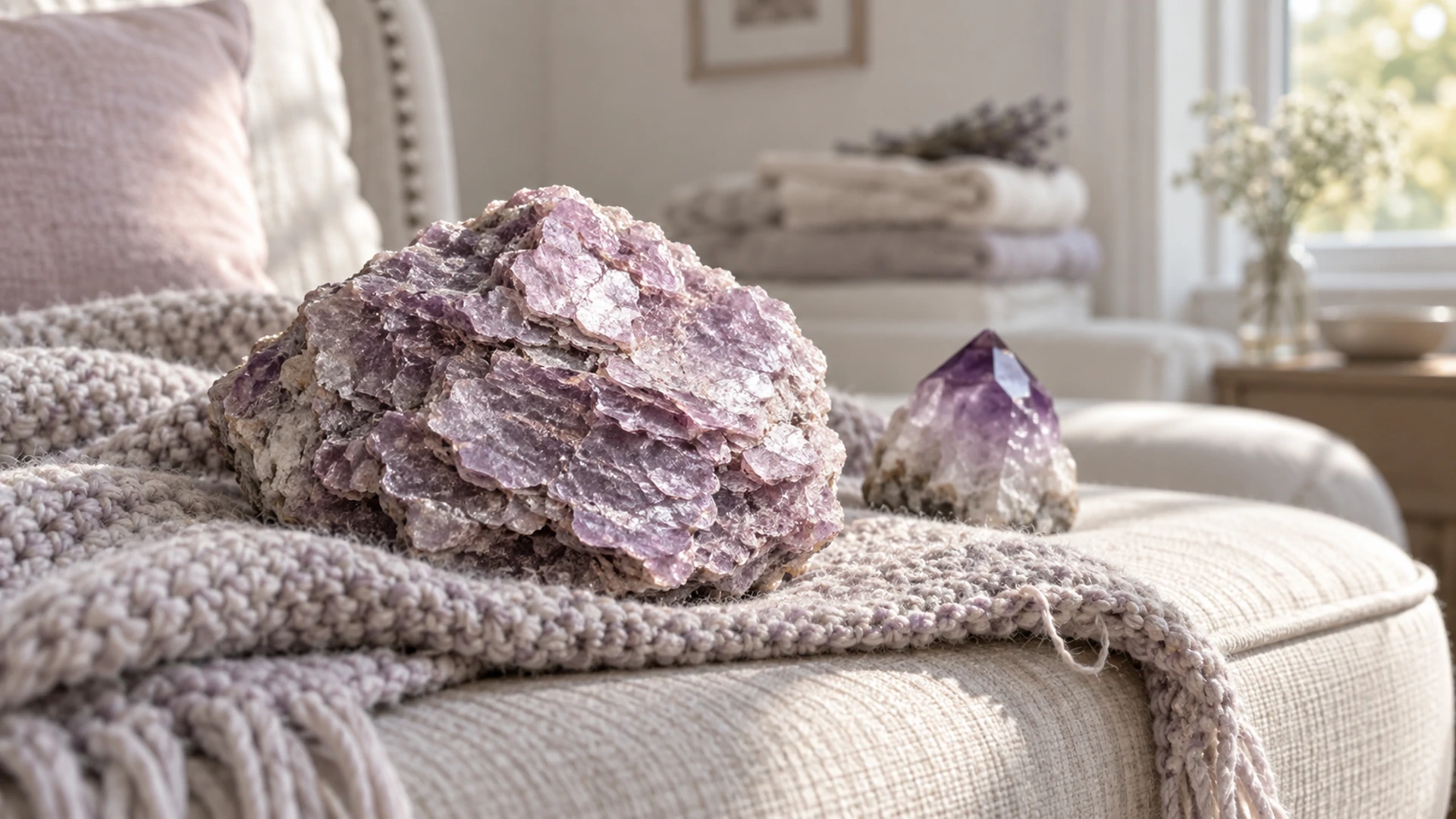
Lepidolite is a lithium-bearing mica whose calming reputation traces directly to what it's made of. That specificity sets it apart from nearly every other stone in the Healing category.
The Mineral Behind the Calm: Why Lepidolite Belongs in Healing
Most healing stones work at the level of emotional content — surfacing what's buried, softening what's rigid, or slowly integrating what's been stored too long. Lepidolite does something different. Its primary correspondence is nervous system stabilization: easing anxiety and racing thoughts not through emotional processing, but through a kind of physiological settling. The distinction matters, and it's rooted in chemistry.
Lepidolite is a lithium-bearing mica. Lithium, the element, has a long and well-documented history in the treatment of mood disorders — it's one of the oldest pharmaceutical mood stabilizers still in clinical use. That's not a metaphysical claim. It's a material fact about what lepidolite contains. In crystal healing, the correspondence is symbolic and energetic, not medicinal. The stone itself does not deliver therapeutic doses of lithium, and it should never be treated as a substitute for medication, therapy, or professional mental health care. But the correspondence is not invented. It's an extension of a real chemical relationship between this mineral and the element that defines it — and that's precisely what distinguishes lepidolite from every other stone in the Healing category. Where Malachite surfaces buried trauma so it can be processed, sometimes uncomfortably, or Chrysocolla heals within relationship patterns specifically — codependency, caretaking burnout, how you've allowed yourself to be treated — lepidolite stabilizes first, before any of that deeper work begins.
Its chakra correspondences reflect that dual action clearly. Lepidolite sits at the heart chakra and the third eye simultaneously — not because it's vaguely "spiritual," but because anxiety operates on both of those channels at once. The chest tightens. Thought loops. The heart races and the mind follows. Lepidolite's energy, in practice, is described again and again as quieting both layers at the same time, which makes it unusually well-suited to the moments when emotion and thought have lost track of which one is driving.
Its elemental correspondence is water, which fits: water in magical practice governs the emotional and intuitive body, the inner tidal rhythms that anxiety disrupts. Its planetary ruler is Neptune — the planet associated with the dissolution of ego-boundaries, dreams, compassion, and the threshold between the conscious and unconscious mind. Lepidolite works right at that edge. Its zodiac sign is Libra, ruled by Venus, which places it in the register of balance and equilibrium — not the fiery action of Mars or the driving expansion of Jupiter, but the careful, deliberate restoration of something that has been pulled out of alignment. All of this maps onto the same central action: the stone settles what has become destabilized, quietly and without drama.
Flaky by Nature: Choosing and Keeping Lepidolite
Lepidolite is a mica, which means it forms in thin, layered sheets that can be separated along their planes — a property called cleavage in mineralogy, and visible to the eye in raw specimens. When you hold a piece of raw lepidolite, you're often holding something that wants to flake. That's not a defect. It's what this mineral is. The lilac and pink-purple color comes from its lithium content, and that soft, almost powdery appearance is an extension of its physical nature: fine-grained, flaky, light-catching, genuinely soft at Mohs 2.5 to 4.
Raw lepidolite rarely occurs as large, pure masses of a single mineral. In practice, it usually appears intergrown with quartz or other minerals from the pegmatite formations where it crystallizes — Brazil, Madagascar, the USA, and Zimbabwe are among the major sources. That intergrowth is part of what makes some raw specimens feel more solid than you'd expect from a soft mica. The quartz component provides structural support that the mica alone wouldn't have. This is worth knowing because it helps explain something you'll encounter when shopping: specimens that are marketed as lepidolite range from fully natural pieces with visible mica layering, to tumbled material where the stone has been polished down into something much more uniform, to reconstituted lepidolite — crushed material that has been pressed or bonded back into a solid form.
Reconstituted lepidolite is not fraudulent, but it is a different product. The mineral content is real, but the structural integrity of the original mica formation has been disrupted. If the particular quality of a natural mica — its layered structure, its physical expression of the stone's soft and tiered nature — is important to you in practice, it's worth asking a seller directly which you're looking at. For palm stones and tumbled pieces used in meditation, reconstituted material works perfectly well. For a raw specimen kept on a shelf or altar, natural material with visible layering carries a different physical presence.
On care: the mica layers can genuinely delaminate with water exposure. Water works its way between the planes and separates them — this is not hypothetical, it happens. Keep lepidolite dry. Do not soak it, do not run it under water to cleanse it. Instead, use smoke, sound, or moonlight, all of which work beautifully on this stone and carry appropriate symbolic resonance given its Neptune and water-element correspondences. Beyond that practical concern, lepidolite should never be used to make elixirs or infused water. Its lithium content is the reason — not a metaphysical precaution, but a genuine safety note. Internally consuming an elixir made with a lithium-bearing mineral is not a practice to take lightly, and the risk is not worth it for any purpose. Store lepidolite away from harder stones that could scratch it, and if you're keeping raw material, handle the thinner, more flaky edges with care.
Three Practices for Quieting a Racing Mind
The Slow Breath
Use this practice when anxiety has already arrived — the thoughts are looping, the chest is tight, and you need to interrupt the pattern rather than process its source.
Sit comfortably and hold a piece of lepidolite in both hands, cupped loosely so it rests against the center of your palms. Close your eyes. Breathe in for a count of four, hold for four, and exhale for a count of eight — the extended exhale activates the parasympathetic nervous system, which is the same system lepidolite's energetic correspondence is said to support. Keep your attention on the stone's weight and temperature as you breathe, returning to the physical sensation every time thought tries to pull you back into the loop. Ten cycles is enough. You don't need a candle or additional tools for this practice, though a blue candle lit nearby can deepen the calm if you have one available. The point is simple: the breath is the mechanism, and the stone keeps the hands and awareness anchored while it works.
The Bedside Companion
Use this practice when sleep is elusive — not because the day was hard, but because the mind refuses to stop moving once the lights go out.
Place a piece of lepidolite on your nightstand, within arm's reach but not held during sleep. If you have a smaller tumbled piece, you can tuck it under the edge of your pillow. Before you turn off the light, hold the stone for a few moments and set a clear, simple intention aloud or silently: that the racing mind is allowed to slow, that you are ready to rest. Then put it down. The practice here is intentional proximity rather than active engagement — you're creating a consistent association between that stone and the transition into sleep, and over time that association itself becomes part of what makes the boundary between waking and rest easier to cross. Amethyst is often paired with lepidolite for dreamwork if you want to add a second stone, placed on the opposite side of the nightstand to give both stones room to do their distinct work.
The Burnout Pause
Use this practice during periods of sustained depletion — when you've been running on empty long enough that "anxious" doesn't quite describe it anymore, and what you actually need is not immediate calm but genuine rest for the nervous system.
Set aside fifteen to twenty minutes in the middle of the day, not at the end of it when you're already spent. Lie flat on your back and place a piece of lepidolite on your chest, over the heart chakra. Do nothing else — no breathwork, no visualization, no intention-setting beyond the decision to stop. The practice is the stopping. You might want to pair this with a few drops of lavender nearby, or time it to a Moon hour if you have the flexibility — but neither is required. What is required is that you don't compress this into a shorter window or multitask through it. Burnout isn't acute anxiety; it doesn't respond to rapid intervention. The practice asks you to give the nervous system an actual pause, not a shorter version of one. Fifteen minutes of genuinely lying still with this stone is more useful than an hour of half-rest.
Mined for Lithium Long Before It Was Mined for Meaning
Before lepidolite was a healing stone, it was an ore. Historically, lepidolite was one of the primary mineral sources from which lithium was extracted industrially. Lithium, once isolated, became significant in a wide range of industrial and eventually pharmaceutical applications — its use as a mood stabilizer in psychiatric medicine represents one of the more well-documented examples of an element with a clear, measurable effect on human neurological function. That pharmaceutical history belongs to the element itself, not the stone, but the stone was where the element came from.
This mining history pre-dates lepidolite's adoption in crystal healing by a considerable distance. The stone's modern reputation for calm — for easing anxiety, quieting a looping mind, softening the edge of emotional overwhelm — arrived much later, largely through the crystal-healing literature of the late 20th century. But the reputation isn't baseless. It's a symbolic extension of a real chemical fact: this mineral contains lithium, and lithium has a documented, centuries-long relationship with mood and neurological stability. That's a more grounded foundation than most stones can claim. The leap from "lithium ore" to "calming stone" is not arbitrary. It follows the logic of correspondence that underlies all crystal practice: the energetic property mirrors the material one, scaled into the symbolic register.
Its name comes from the Greek word for scales — "lepidos" — which refers to its characteristic flaky, scale-like cleavage rather than to any metaphysical association. The mineral was named for what it looks like physically, not for what it does. That's an unusual case of a stone's name being purely geological rather than symbolic, and it's worth knowing if you work with etymology as part of your practice. The "scales" connection does map, somewhat incidentally, onto Libra — the zodiac sign of balance, also symbolized by scales — which gives the correspondence an additional thread of internal coherence that the naming probably didn't intend.
A Calm You Can Trace to Its Chemistry
Lepidolite's place in the Healing category isn't a matter of softness or prettiness — it's a matter of mechanism. It stabilizes the nervous system through a symbolic and energetic correspondence to its lithium-bearing composition, which makes it one of the most clearly grounded healing stones in practice. That's the claim, made precisely: energetic, not medicinal, but rooted in something real rather than in invented lore.
If you want to see how lepidolite fits alongside the other Healing stones — Mangano Calcite for unconditional tenderness without confrontation, Unakite for slow layered return to the same wound, Blue Lace Agate for relearning to speak after being silenced — and how those Healing stones sit alongside the six other stone paths, the full picture is in The Crystal Compendium: Seven Paths to Stone Magic.