Bloodstone, the March Birthstone: Life Pressing Through Resistance
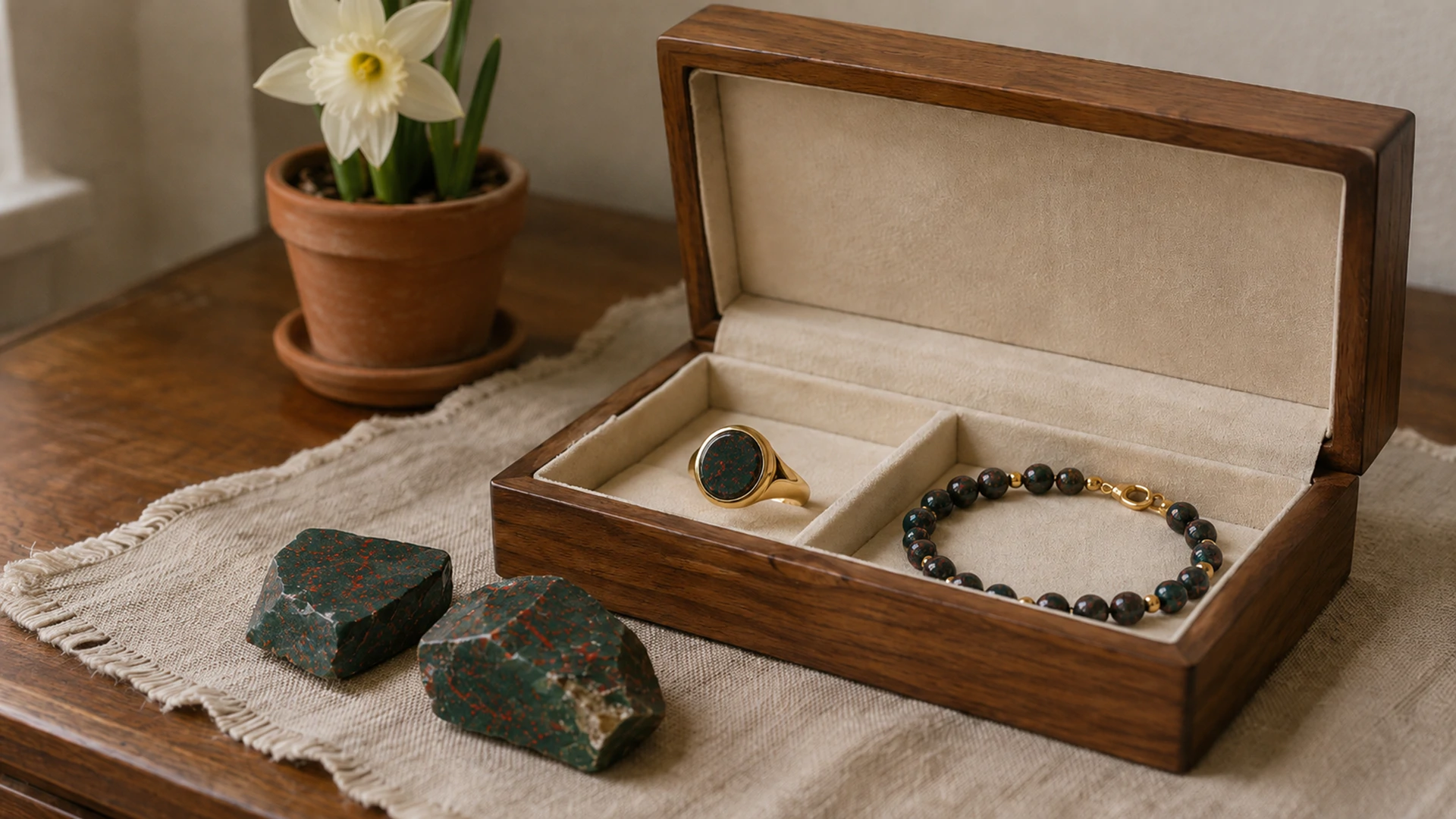
Bloodstone is one of the oldest recorded birthstones in history, and as the traditional March birthstone, it carries a depth of meaning that goes well beyond its striking appearance. While Aquamarine holds the modern primary position for March, Bloodstone is the stone that ancient gem-lore assigned to this month long before standardized birthstone lists existed. If you were born in March, working with Bloodstone isn't just aesthetically meaningful. It's a direct line into an energetic framework that has been built around your birth season for thousands of years. This article covers what that framework actually means, how to use it in ritual, and how to bring the stone into your everyday life as a March-born practitioner.
What Bloodstone Means as the March Birthstone
Bloodstone — a dark green chalcedony flecked with red iron oxide spots — was listed as the stone for March in the Breastplate of Aaron as interpreted through the Septuagint, and appears in medieval gem-lore texts as the primary stone for the month. The American National Retail Jewelers Association's 1912 standardized list preserved it as March's traditional birthstone alongside Aquamarine, which was added to the list at around that time. Its assignment to March is not arbitrary. The red spots on a green stone are a natural symbol of life-force emerging from dormancy — exactly what March represents in the Northern Hemisphere, where the ground is thawing, sap is moving, and living things are pressing forward after the stillness of winter.
March contains two zodiac signs: Pisces (February 19 – March 20) and Aries (March 21 – April 19). Pisces is emotionally perceptive, spiritually attuned, and deeply feeling — but it can struggle with boundaries, with knowing when to act versus when to yield, and with grounding its rich inner world into concrete reality. Aries is direct, energized, and courageous — but it burns fast and can run ahead of its own foundation. Bloodstone addresses both tensions with precision. For Pisces, it provides grounding and physical vitality, anchoring spiritual sensitivity in the body where it can become useful. For Aries, it supplies endurance and focus — the ability to sustain the burst of initial energy and see something through to completion. The stone's core qualities of courage, stamina, and protective force serve both signs without contradiction.
If you want to go deeper into Bloodstone's general correspondences — its planetary rulerships, elemental associations, and broader magical uses — that material is covered in a dedicated correspondences article on Bloodstone in magic. What this article focuses on is the birthstone relationship specifically: the way the stone functions when it is yours by birth, not just borrowed for a working.
That distinction carries real weight when you consider what Bloodstone actually is: a stone whose two colors tell a single story. The green is earth, dormancy, contained potential. The red is blood, action, life breaking through. Working with Bloodstone as your birthstone isn't about drawing on an external reserve of courage or vitality — it's about recognizing that the same tension encoded in the stone's appearance is already encoded in you. You were born in the month when the year makes that exact push. The stone doesn't supply what you're missing. It reflects back what's already present in your will and gives it a clear direction to move.
Bloodstone's Hardness, Care & Origins
Bloodstone sits at 6.5–7 on the Mohs hardness scale, which makes it durable enough for daily wear and historically well-suited to carving — something artisans took full advantage of for centuries. It's softer than Aquamarine, so it won't compete with harder stones in terms of scratch resistance, but for rings, pendants, and tumbled carry pieces, it holds up well under normal use.
Care is straightforward. Clean it with mild soap and lukewarm water, rinse well, and dry it thoroughly. Skip ultrasonic cleaners and harsh chemical solutions — both can damage the stone's surface over time. Because Bloodstone is dense and opaque, it doesn't need the light-exposure precautions that some translucent stones require, but keeping it away from extreme heat is still good practice.
India — particularly the Gujarat region — produces the finest specimens and is the primary modern source. You'll also find it in Brazil, Australia, Madagascar, and parts of the United States, including Oregon and California. The stone has two names used interchangeably: Bloodstone and heliotrope. That second name comes from the Greek words helios (sun) and trepein (to turn). Pliny the Elder recorded the ancient belief that when Bloodstone was submerged in water, it could turn sunlight blood-red — a detail that tells you how deeply the stone's dramatic appearance captured the ancient imagination, and why it ended up embedded in so many traditions of power and protection.
How to Use Bloodstone as Your Birthstone in Magic Rituals
The six rituals below draw from different practice types so you have real options depending on what your practice looks like right now. Each one is built on Bloodstone's established correspondences: courage, endurance, vital force, protection, grounding, and the transition from potential into action.
The Birthstone Charge-and-Carry Practice
This is the foundational birthstone practice and it is where most people should start. Hold your Bloodstone in both hands and bring your full attention to it — not a vague awareness, but deliberate focus. Breathe slowly and feel the weight of the stone. Speak aloud, in your own words, what you are asking it to carry with you: protection, sustained energy, courage, or whatever quality is most alive in your intentions right now. The spoken word matters here because it externalizes your will, making the intention explicit rather than ambient. Once you have spoken, hold the stone against your sternum — not your heart in an emotional sense, but the physical center of your chest, where breath lives. Hold it there for a full minute. After that, carry the stone on your body for the day. This is not a one-time ceremony. It works best as a daily practice, done each morning so the charge stays fresh and the relationship between you and the stone deepens over time through repetition.
Red and Green Candle Pairing Ritual for Vital Force
Bloodstone's red and green dual nature makes it a natural pairing for a two-candle working that addresses both the vitality-and-life-force side of the stone and its grounding, endurance qualities. Set a red candle and a green candle side by side with your Bloodstone placed between them. Before lighting either candle, hold the stone and state your intention clearly: you are not asking for external energy to fill you — you are calling forward the vital force that already exists in you and asking the stone to help you access it consistently. Light the red candle first, naming it as the spark of action and physical energy. Light the green candle second, naming it as the sustained growth that action needs to become real. Place the Bloodstone between the two flames and let both candles burn down in a single sitting while you remain present, either in silence or in spoken repetition of your intention. Dressing your candles beforehand with a grounding or protective oil — cedar, black pepper, or frankincense all work well with Bloodstone's correspondences — will deepen the working considerably.
Spring Threshold Ritual for Intention-Setting
March sits at one of the most energetically significant thresholds in the year: the spring equinox, which typically falls between March 19 and 21. This moment — when day and night are equal and the year pivots toward light — is a powerful time to plant an intention, and Bloodstone is exceptionally suited to it because its whole symbolic structure is about life pressing through resistance. On the evening before the equinox, place your Bloodstone on a windowsill or outside where it will catch the night air. Write down one clear intention — not a wish, but a commitment to action — on a piece of paper. Fold the paper and place the stone on top of it. In the morning, retrieve the stone at or just after sunrise. Read your intention aloud, then carry the stone with you throughout the equinox day as a physical anchor to that commitment. The seasonal timing matters because your will and the season's movement are pointed in the same direction, which amplifies the clarity and momentum of the working.
Root Chakra Grounding Practice
Bloodstone has a genuine correspondence with the root chakra — the energy center at the base of the spine associated with physical safety, groundedness, and the sense of being present and stable in the body. This makes root chakra work one of the most natural applications of the stone. Lie down on your back in a quiet space. Place your Bloodstone at the base of your spine or, if that is uncomfortable, held in both hands resting on your lower abdomen. Close your eyes and breathe deeply into your belly rather than your chest — this alone begins to activate root-level awareness. With each exhale, consciously release tension from your legs, your hips, and the base of your torso. Visualize the stone's deep green as a color moving up through the ground beneath you, stabilizing and filling the lower body. Hold this for ten to fifteen minutes. This practice is particularly useful for Pisces-born March individuals who spend a great deal of energy in emotional or spiritual space and need regular anchoring back into the physical body.
Shadow Work Dream Practice
Bloodstone has a historical association with courage in the face of what is hidden or feared — ancient warriors carried it not just for physical protection but for psychological fortitude. This maps well onto shadow work, the practice of consciously engaging with the parts of yourself you typically avoid or suppress. Place your Bloodstone under your pillow or on your nightstand before sleep on a night when you intend to engage with a difficult aspect of yourself — a fear you have been circling, a pattern you have not wanted to examine, or an emotion you have been suppressing. Before sleep, speak a direct instruction to yourself: name what you are willing to look at tonight. The stone's presence is not meant to make the process easier in the sense of comfortable — it is meant to give you the courage to stay with what arises rather than pulling back. Keep a journal beside your bed and write immediately upon waking, before the material from sleep fades. Over several nights of this practice, patterns will emerge that would not surface in ordinary waking reflection.
Protective Altar Placement
On a working altar, Bloodstone functions best when placed at the front edge — the boundary between the sacred space and the room around it. This positioning is deliberate: the stone's protective correspondence is strongest when it stands at a threshold rather than the center, because its energy is outward-facing, guarding what is within rather than fueling what is above. Pair it with a small dish of salt at either side if your altar work involves protection magic specifically. You do not need to perform a formal ritual to activate this placement — the act of intentionally positioning the stone at the altar's edge, with a clear mental statement of what it is guarding, is sufficient. Refresh the placement monthly, particularly at the new moon in March or at the new moon closest to your birthday, by holding the stone, grounding yourself, and reaffirming the intention.
Wearing & Carrying Bloodstone for Daily Protection
Jewelry
Bloodstone's grounding and protective qualities make it genuinely useful outside of formal ritual, and the best way to access that usefulness is consistent skin contact. Wearing Bloodstone as a bracelet on your left wrist — the receiving side in many Western magical traditions — keeps the stone in contact with your pulse point throughout the day, which many practitioners find creates a more continuous sense of calm alertness compared to carrying the stone loose in a pocket. A pendant worn at the chest works equally well and has the added benefit of keeping the stone near the sternum, which aligns with the breath-centered charging practice described above.
There's also a historically grounded case for wearing Bloodstone as a ring. Babylonian nobility used carved bloodstone seal rings to stamp official documents — the stone's deep color and fine-grained surface made it ideal for signet work, and its association with authority and commitment made it the natural choice for marks that carried legal and ceremonial weight. Wearing a Bloodstone ring today taps into that same current: it's not just ornamental, it's a statement of intention and personal authority that you carry into every interaction.
In the Home
Bloodstone placed near the front door or main entry point of your living space draws on its traditional role as a protective stone for thresholds. This is not about ritual — it is simply placement with purpose. The stone sits at the boundary between your private space and the outside world, where its outward-facing protective energy is most naturally directed.
If you are working with Bloodstone specifically for vitality or health recovery, its dual color symbolism gives you a concrete placement practice to work with. Keep a piece of Bloodstone on your bedside table or nightstand — the spot where your body begins and ends each day. Before sleep, hold the stone briefly and state what you are asking it to support: sustained energy, physical resilience, the kind of slow regeneration that happens overnight. The green in the stone corresponds to the contained, building phase of recovery; the red to the active return of strength. Both happen while you sleep. The stone sits with that intention while you do.
In the Workspace
If your work involves high-pressure decision-making or situations where sustained focus and composure are regularly tested, Bloodstone belongs on your desk. A piece on the left side of your work surface — consistent with the receiving-and-grounding orientation of the left side — supports steady energy and mental endurance through long sessions.
Ancient warriors carried Bloodstone into battle specifically for physical protection and the psychological fortitude to keep moving under pressure. That's not a metaphor you have to stretch very far to apply to a difficult workday, a high-stakes presentation, or any situation where you need to stay grounded and clear-headed when everything around you is moving fast. Keep it visible. Touch it when you feel yourself starting to scatter. You are not doing anything ceremonial — you are simply redirecting your attention back into your body and your intention, which is the whole point.
Bloodstone Crystal Combinations: What Pairs Well
Bloodstone and Hematite — Both stones are iron-bearing and strongly grounding, but they work at different layers. Bloodstone's grounding operates through vitality and courage — it keeps you present by energizing you. Hematite's grounding is more absorptive — it stabilizes by drawing excess energy downward and neutralizing it. Together they create a grounding matrix that handles both the energetic and the psychological dimensions of being present under pressure, making this pairing excellent for high-stress periods or for Aries-born March individuals who tend to burn hot and need both fuel management and structural anchoring.
Bloodstone and Black Tourmaline — Where Bloodstone protects through active force — courage, vital energy, the willingness to stand your ground — Black Tourmaline protects through deflection and absorption of hostile or disruptive energies. The two stones layer protection differently: Bloodstone strengthens your interior resilience while Black Tourmaline manages what comes at you from outside. This pairing is particularly effective for protection-focused work and for people who work in environments where they are regularly exposed to others' negative emotional states.
Bloodstone and Carnelian — Carnelian supplies creative fire, confidence, and the willingness to begin. Bloodstone supplies the endurance and grounded follow-through to see that beginning through to completion. This is a natural pairing for any working centered on sustained creative output, career momentum, or seeing a long-term project through a difficult phase. Carnelian initiates; Bloodstone persists. They are energetically complementary without overlapping in a way that creates redundancy.
Bloodstone and Moss Agate — Moss Agate shares Bloodstone's green earth energy and strong connection to the natural world and seasonal cycles. Where Bloodstone emphasizes force and courage in the face of resistance, Moss Agate emphasizes patience, organic growth, and the long view. Together they address the full arc of sustained intention: the courage to begin and push through resistance (Bloodstone), and the patience to allow growth to unfold at its own pace without forcing it (Moss Agate). This pairing works beautifully for spring equinox intention-setting work.
Bloodstone and Labradorite — Labradorite is a stone of intuition, inner knowing, and psychic protection — it strengthens your ability to perceive what is true beneath surface appearances. Bloodstone is a stone of physical courage and grounding. Paired together, they address the Pisces tension directly: the deeply intuitive, spiritually perceptive side of Pisces (Labradorite) is given a grounded, embodied anchor (Bloodstone), creating a combination that keeps spiritual awareness from floating away from practical reality. This is one of the most useful pairings for Pisces-born March practitioners specifically.
Bloodstone and Red Jasper — Red Jasper is sometimes described as Bloodstone's close cousin, and the overlap is real: both are iron-bearing stones with strong connections to physical vitality, endurance, and the root chakra. The difference is that Red Jasper works more slowly and steadily — it is a stone of quiet persistence and gentle stamina — while Bloodstone tends to carry more urgency and active protective force. Together they create a layered vitality support that covers both the sustained, slow-burn endurance Red Jasper provides and the active courage-under-pressure that Bloodstone supplies. This pairing is useful for long-term health or energy recovery work.
Aquamarine: March's Modern Birthstone
If Bloodstone is the traditional March stone, Aquamarine is the one that now occupies the official modern position. It's the stone you'll find on standard birthstone lists, the one typically set in March birthstone jewelry, and for good reason. At 7.5–8 on the Mohs scale, Aquamarine is harder than Bloodstone and more resistant to daily wear, which makes it better suited to fine jewelry settings and long-term use in rings or bracelets that take regular knocks.
Energetically, the two stones point in different directions. Aquamarine's correspondences are built around clarity, communication, emotional flow, and the calming of mental noise — water energy in the clearest sense. If you are drawn to work on how you express yourself, how you process emotion, or how you move through anxiety and overwhelm, Aquamarine is the more targeted tool. Bloodstone's territory is vitality, courage, physical endurance, and protective force — earth and blood rather than water and voice. You don't have to choose one and leave the other aside. Many March-born practitioners work with both, using each stone for the kind of work it does best.
Bloodstone Is Already Part of You — Here Is How to Work With That
Bloodstone became the traditional March birthstone because its entire symbolic architecture — life-force pressing through resistance, courage sustaining action, vital energy grounding into endurance — mirrors exactly what March asks of the people born in it. Whether you are a Pisces navigating the tension between deep feeling and real-world effectiveness, or an Aries learning to sustain initial fire into lasting results, Bloodstone was assigned to your month because it speaks directly to those specific challenges. That's the working premise behind how birthstone assignment developed historically: matching the stone's energetic signature to the energetic demands of the season.
What makes birthstone work different from general crystal work is that the stone's qualities are not just useful to you — they are already resonant with you. You are not borrowing courage from an external source. You are recognizing a frequency that belongs to your birth season and using the stone to amplify what is already present in your will. The charge-and-carry practice, the equinox threshold ritual, the root chakra grounding, the shadow work — all of these function as mirrors and amplifiers, not substitutes for your own strength. The stone does nothing without your intention directing it. But with your intention behind it, it becomes one of the most powerful personal tools in your practice.
If you want to understand how birthstone magic fits into a broader framework — how stones are assigned to months, why the practice works, and how to use yours most effectively regardless of which month you were born in — the complete guide to every month's birthstone covers all of that in depth. Start there if you are new to birthstone work, or return to it after working with Bloodstone for a few weeks — you will read it differently once the stone is already part of your practice.