Chrysoprase: Ready to Love Again
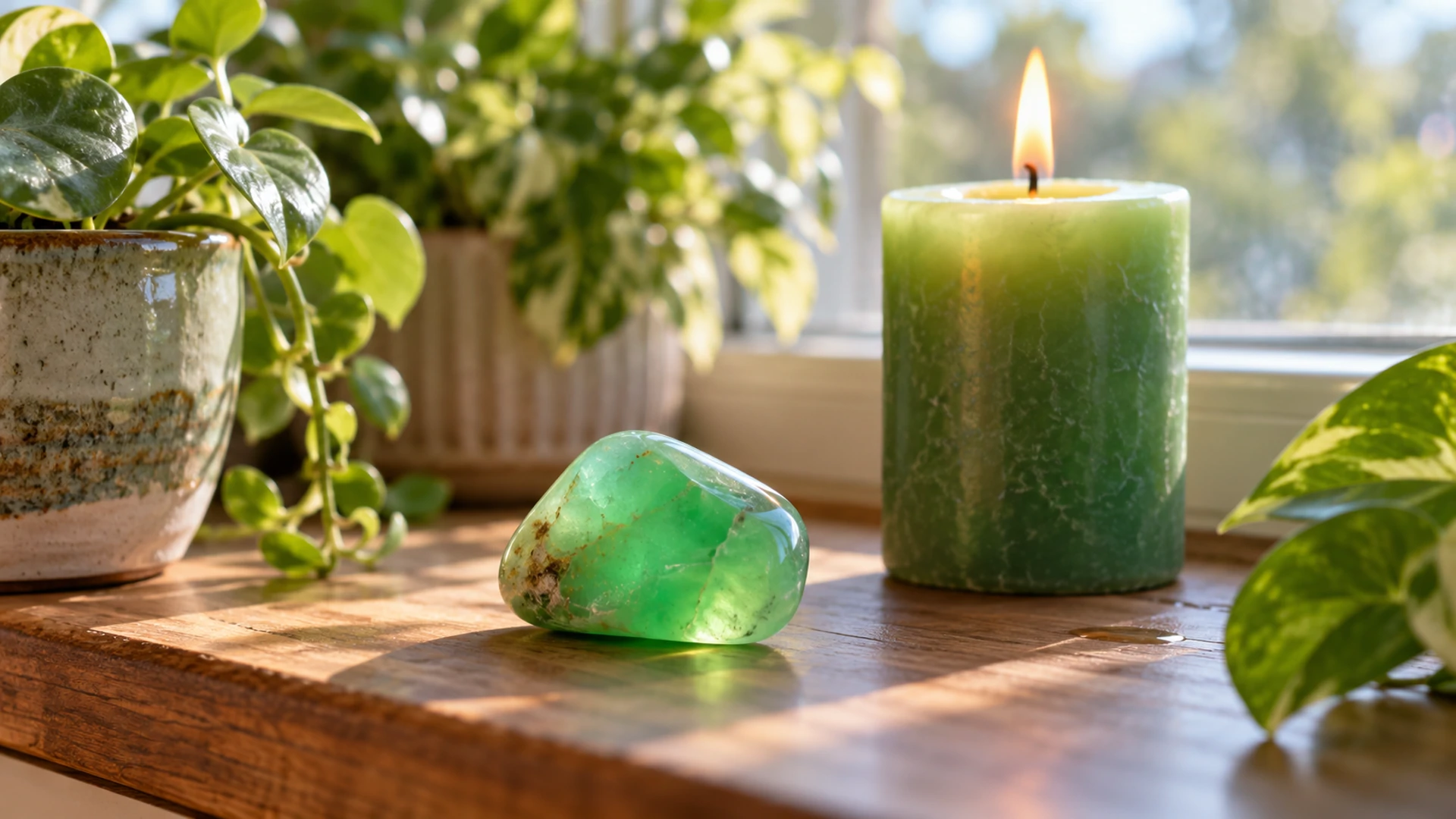
Chrysoprase is the stone for when you've done the work and you're genuinely ready to open up again. It doesn't repair what's broken — it picks up exactly where that repair leaves off, bringing optimism and joy back into the heart.
Ready to Love Again: Why Chrysoprase Belongs in Love & Relationships
Chrysoprase is a chalcedony — a microcrystalline variety of quartz — colored by trace amounts of nickel. That nickel content produces its signature apple-green color, a fresh, bright shade distinct from the deeper, richer greens you see in beryl-family stones. It sits at Mohs 6.5 to 7, making it a reasonably durable stone for everyday wear. Sources include Australia as the major modern supplier, alongside Kazakhstan, Poland, Tanzania, and the United States. Its ancient pedigree goes back to Greece and Egypt, where it was carved, traded, and worn as jewelry long before mineralogists had the tools to understand exactly what made it green.
In the Love & Relationships category, every stone does something specific. Rose quartz holds universal, unconditional love — it's foundational, working across every register of love from family to self to romance without being targeted at any one of them. Emerald anchors fidelity and loyalty in committed partnership, the steady long-haul of domestic harmony. Rhodonite does the healing-and-forgiveness work after relational wounds — it repairs what's broken. Chrysoprase does not do that work. It doesn't sit with the grief or process the betrayal. Its specific mechanism is what becomes possible after rhodonite has finished: joyful new beginnings in love, optimism and heart-reopening specifically after heartbreak, for new relationships and fresh starts.
That distinction matters for practice. If you're still in the middle of grieving a relationship, still untangling resentment or confusion, chrysoprase is the wrong tool. It isn't a stone for sitting with pain. But if you find yourself at the edge of something new — genuinely curious, genuinely willing, but maybe not quite believing yet that it's safe to be open — that's exactly the state chrysoprase is calibrated for. It meets optimism where optimism is just beginning to stir, and gives it somewhere to grow.
Its correspondences root this clearly. Chrysoprase aligns with the heart chakra, the energy center that governs love, connection, and the ability to both give and receive. Venus is its commonly cited ruling planet — the planet of love, beauty, and relational ease. If you're working within a planetary timing framework, a Venus hour makes straightforward sense for any chrysoprase working aimed at opening the heart to new connection. The stone's earth element grounding adds steadiness to that openness — not a giddy, unanchored optimism, but one with roots.
Nickel Green, Not Chromium Green: Choosing Chrysoprase
The identification point that matters most when choosing chrysoprase is understanding exactly what produces its color. Chrysoprase is green because of nickel. Emerald is green because of chromium, or in some specimens vanadium. These are mineralogically distinct mechanisms, but the resulting colors can look similar enough on a jewelry counter that historical confusion between the two is well documented — jewelers working from visual assessment alone, before compositional testing was standard, sometimes conflated them. Knowing this history makes you a sharper buyer.
Genuine chrysoprase is typically more affordable than emerald and, importantly, shows far fewer inclusions. Emerald's internal fracturing is so common that the trade has its own term for it — the "jardin," or garden — and nearly all commercial emerald is oil- or resin-treated to improve clarity. Chrysoprase, by contrast, is generally clean to the eye. If you're looking at a piece marketed as chrysoprase that shows significant visible fracturing or cloudiness, that's worth questioning. Good chrysoprase should have a translucent, even quality to it — that fresh apple-green coming through cleanly without much internal disruption.
Color saturation matters too. The most prized chrysoprase has a vivid, almost glowing apple-green. As quality decreases, the color becomes paler or more muted. Paler pieces aren't necessarily poor quality for magical use — the intention and care you bring to the working matters more than saturation — but they are worth less on the gem market, and a seller pricing pale material at top-quality prices should prompt a second look. The finest specimens still come from Australia, particularly from the Marlborough Creek district in Queensland.
For care: chrysoprase can fade with prolonged exposure to heat or direct sunlight. This is a real, documented concern rather than just a general disclaimer — nickel-colored chalcedony is known to lose vibrancy when left in a permanently sunny display spot or stored somewhere warm. Keep it away from windowsills that get strong afternoon sun. For cleansing, brief water contact is fine — the stone is water-safe and presents no toxicity concerns. Just avoid extended soaking, and keep it out of very hot water. A soft cloth wipe after handling is enough for regular maintenance. Store it away from harder stones that could scratch its surface.
Three Practices for Opening to Something New
The Green Light
Use this when you want to mark a specific, conscious moment of readiness — a deliberate declaration to yourself that the healing chapter is closed and the new one is open.
Sit with your chrysoprase in your left hand (the receiving hand) and a lit green candle in front of you. Breathe slowly until you feel settled. Then say aloud — it matters that you say it aloud — something like: "I am ready. The door is open." Keep it simple, in your own words. You're not performing for anyone. You're making a declaration to yourself, marking a real internal shift. Sit with the candle until it burns down or until you feel the statement land fully. Place the chrysoprase on your bedside table that night, and keep it there for the next week as a quiet reminder of the intention you set.
The Joyful Ask
Use this before reaching out to someone new, or before a first date, when you want to come from genuine curiosity rather than anxious hoping.
Hold your chrysoprase between both palms and spend two or three minutes thinking about something that genuinely delights you — not about the person or the outcome, but about any source of real joy in your life. Let that feeling settle in your chest before you do anything else. The point is to anchor yourself in actual positive feeling rather than projected hope. When you go into the interaction, carry the stone in your pocket. It isn't magic in the sense that it makes the outcome go a certain way — it's a physical anchor to the state of openness and genuine interest you cultivated beforehand. If you want to reinforce this with a corresponding herb, rose or cardamom both carry Venus correspondences and pair well with a stone of this nature — tuck a small amount into your pocket alongside the stone if that adds meaning to the practice for you.
The Fresh Page
Use this at the beginning of a new relationship — not because there's anything wrong yet, but because you want to enter it on its own terms rather than through the lens of old wounds.
Write on a clean page in a journal the name of the old pattern you most want to leave behind — not the name of the person who was associated with it, just the pattern itself. Something like "expecting to be abandoned" or "going quiet when I'm hurt." Read it once. Then place your chrysoprase on top of the page and leave it overnight. In the morning, tear out the page, fold it away somewhere out of sight (or burn it safely if that feels right), and keep the chrysoprase on your person through the first weeks of the new connection. The practice works because you're doing two things at once: naming what you're leaving behind with enough precision that it doesn't sneak along unacknowledged, and carrying a physical object that holds your intention to be genuinely present to something new. During a moon hour on a Friday — Venus's day — gives this additional resonance if you're working within a planetary timing practice.
A Foundation Stone of the New Jerusalem
Chrysoprase has a specific, verifiable place in the biblical text of the Book of Revelation, where it is named as the tenth of the twelve foundation stones of the New Jerusalem. The passage describes the foundations of the holy city as decorated with twelve different precious stones, each corresponding to one of the twelve apostles. Chrysoprase holds the tenth position — a detail precise enough to trace in any translation of the text. That's a meaningful historical anchor: this stone was named and individually distinguished from its neighbors in the list, which tells you it was recognizable and valued as a distinct gemstone in the ancient world rather than being a vague green stone lumped with others.
Separately, there is a long-standing legend that Alexander the Great wore chrysoprase for luck and courage in battle, reportedly tucking a piece into his belt on campaign. This is worth mentioning because it turns up repeatedly in historical writing about the stone — but it should be held as legend rather than documented fact. There's no contemporary primary source that confirms it with specificity. What it does suggest, if the legend has any grounding at all, is that chrysoprase had enough reputation for potency in the ancient world that such a story seemed plausible enough to circulate. The stone's documented ancient use across Greek, Roman, and Egyptian jewelry contexts supports the general idea of it being prized and intentionally chosen, even if the Alexander story specifically can't be verified.
The Heart Open Again
Chrysoprase's work is the joyful part — the part that comes after the hard part is already done. In the landscape of love magic, it fills a very specific gap: the space between repair and renewal, between being healed enough and being genuinely open. That's a transition that doesn't always get named, but it's real, and it's worth marking with intention.
If you want to see how chrysoprase sits alongside the other stones in this category — and how the Love & Relationships category itself fits within the wider map of crystal work — The Crystal Compendium: Seven Paths to Stone Magic lays it all out in one place.