Diamond: Whatever You Bring, Made Louder
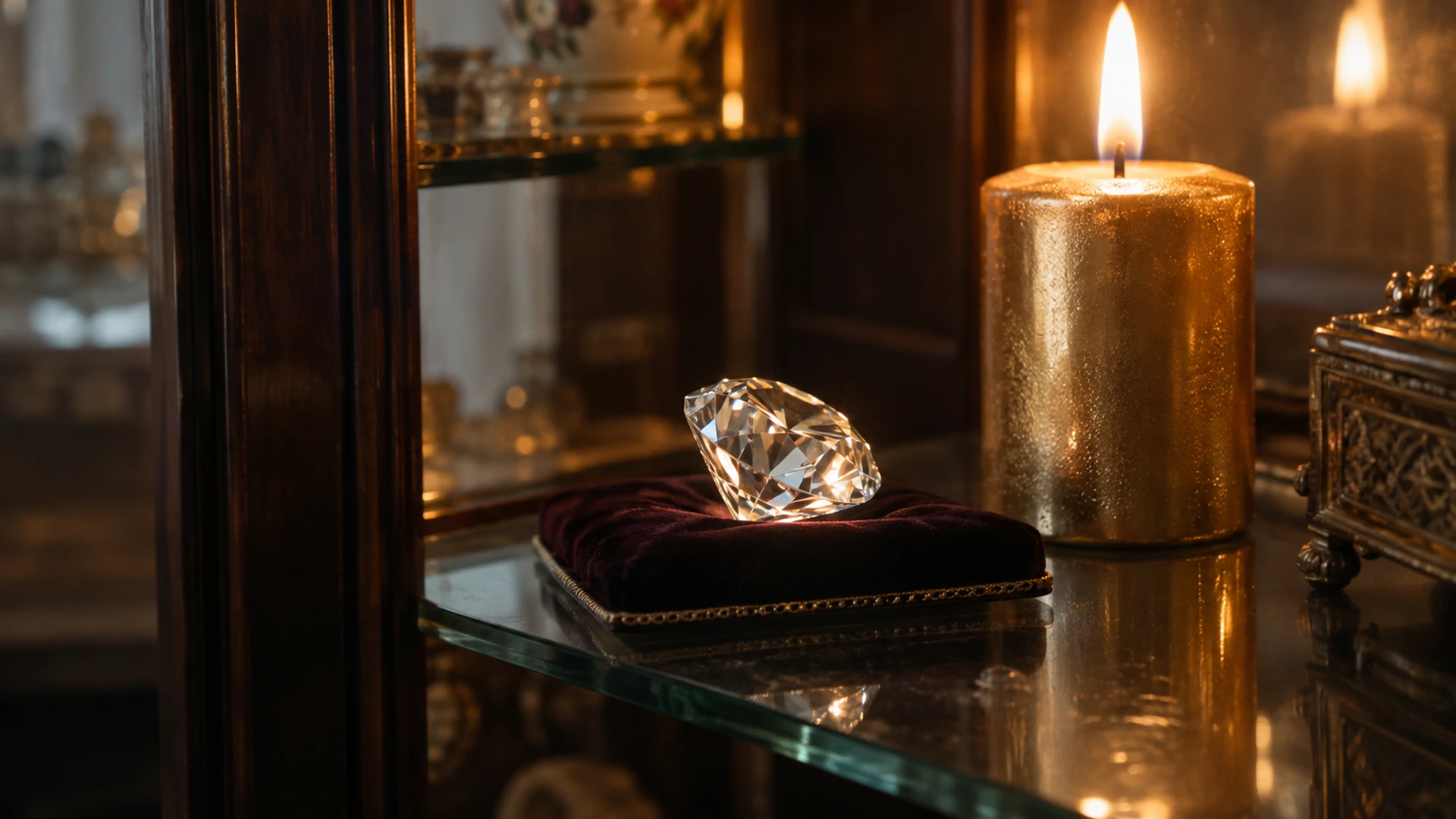
Diamond is the amplifier stone. It doesn't carry a fixed direction the way most empowerment stones do — it takes whatever intention or state of will you bring and makes it louder, clearer, and more insistent. That's its specific gift, and its specific demand.
Whatever You Bring, Made Louder: Why Diamond Belongs in Empowerment
Most stones in the empowerment category work by lending you a specific quality. Carnelian's mechanism is immediate activation — overcoming procrastination and hesitation, sparking bold decisive action right now. Garnet's mechanism is rebuilding motivation after a setback — restoring drive specifically following failure or defeat. Both stones generate a direction. Diamond does something different. It doesn't supply a quality; it takes what's already present in you and amplifies it. Point it at a clearly held intention and that intention becomes sharper, more present, harder to ignore. Point it at distraction or anxiety, and you get more of that instead. This is what makes Diamond unusual in this category and worth understanding before you work with it.
The amplifying property traces directly to what Diamond is at the material level. It is pure crystallized carbon — the same element as graphite, coal, and the carbon in every living cell, but arranged under extreme pressure and heat into a cubic lattice so geometrically stable that nothing on Earth scratches it. At Mohs 10, Diamond is the hardest naturally occurring substance known. That density and structural perfection are part of why so many traditions describe its energetic quality as total amplification rather than a specific directional influence. There's nothing in its composition to bias it toward one kind of intention over another — it's simply that stable, that complete.
Correspondences in most Western traditions assign Diamond primarily to the crown chakra, which governs clarity, higher consciousness, and connection to a source of purpose beyond the personal. But the amplifying nature of the stone makes that single assignment feel like an understatement to many practitioners. Because Diamond takes in whatever it's given and reflects it back at a higher intensity, many traditions describe it as touching all the chakras simultaneously rather than anchoring at one center. Its planetary association falls most consistently with the Sun and with Venus — the Sun for personal authority, vitality, and sovereign will; Venus for beauty, refinement, and the capacity for love. Its astrological connections tend toward Aries, Leo, and Taurus, signs that share a relationship with personal force and with what we choose to build and claim. None of these correspondences change its fundamental nature: they describe where Diamond's amplification tends to resonate most naturally, not what it generates on its own.
Grown or Mined, the Amplifier Still Works: Choosing Diamond
The most important thing to understand when choosing a Diamond for magical work is that lab-grown Diamond is chemically and physically identical to mined Diamond. Same carbon atoms, same cubic crystal structure, same Mohs 10 hardness. The difference between them is origin and price, not composition. Lab-grown Diamond is not a simulation or an imitation — it is Diamond, made in a controlled environment rather than extracted from the earth. From a practical standpoint, this matters because lab-grown stones are dramatically more affordable and more ethically transparent in their sourcing, and they carry the same amplifying capacity as mined material. If you're drawn to a lab-grown stone, you don't need to treat it as second-tier. It isn't.
On size and form: Diamond for magical use doesn't require a large faceted gem. A small rough crystal, a chip, a tiny set stone in a ring you already wear — all of these work. What matters is that you're working with actual Diamond, not cubic zirconia (a man-made simulant that shares part of the name but is an entirely different material, zirconium oxide) or moissanite (another simulant, silicon carbide). If you're buying specifically for practice, ask for disclosure of origin. Reputable sellers of both mined and lab-grown stones will provide it.
Care for Diamond is genuinely simple. At Mohs 10, no other stone in your collection will scratch it — Diamond is at the top of the hardness scale and can only be scratched by another Diamond. It is completely water-safe. You can rinse it, hold it under running water, and cleanse it without any concern about structural damage to the stone itself. The only thing to protect is the setting if your Diamond is mounted — certain harsh chemical cleaners can corrode metal prongs or affect softer stones set nearby. The stone itself is essentially indestructible under normal handling conditions.
Three Practices for Naming What Gets Amplified
The Named Intention
Use this before wearing or carrying Diamond in any working where you want amplification, not scatter — which is most workings.
Hold the Diamond in your dominant hand and speak your intention aloud in a single sentence. Not a paragraph, not a list of related hopes — one sentence, stated once, clearly. The specificity forces you to actually decide what you want before Diamond starts doing its work. Something like "I am building financial stability through the work I'm doing this month" is a named intention. "I want things to be better" is not — it gives Diamond nothing to aim. After stating the intention, hold the stone for a moment in silence, then put it on or place it where it will be with you. You don't need a candle or additional tools for this practice, though a gold candle lit beside you during the naming can sharpen the solar current if you want to strengthen the will-and-authority layer of what you're setting. The practice is in the naming itself.
The Paired Working
Use this when you want to strengthen the output of a specific empowerment stone by bringing Diamond into direct contact with it.
Choose one stone whose mechanism matches what you actually need right now — Tiger's Eye for strategic focus under pressure, clear decision-making and resistance to manipulation, for instance, or Sunstone for reclaiming personal sovereignty when you've been self-sacrificing or over-giving. Place the chosen stone in your left hand and the Diamond in your right, or place both stones side by side on your sternum. Sit quietly for five to ten minutes and hold your named intention in mind. Diamond doesn't redirect the other stone — it amplifies what the other stone is already doing. This means the pairing only works as well as your selection of the primary stone. If your actual need is renewed drive after a defeat, pair with Garnet, not Sunstone. Getting that selection right is the real work of this practice. A Sun hour on a Sunday morning is a natural fit for this working if you want to time it deliberately.
The Cleared Field
Use this whenever you're uncertain about your own state before a working — particularly on days when you're anxious, unfocused, or carrying something unresolved that you haven't named yet.
Before picking up Diamond for any intentional work, take five minutes to do a simple inventory. Sit down, breathe, and ask yourself honestly: what's louder right now — the intention I want to amplify, or something else? If the answer is "something else," either handle that first or postpone the Diamond working for the day. This isn't about achieving a perfect meditative state — it's about being honest with yourself about what's running in the background, since Diamond will amplify background noise exactly as readily as clear foreground intention. If you want to use a stone to help with this settling before you pick up Diamond, Smoky Quartz or Black Tourmaline in hand for a few minutes beforehand will do the grounding work without competing with what you're planning to set afterward. A small amount of frankincense burned in the room while you do this check also tends to clear mental static and settle the field before you move into the main working.
The Ring That Started a Tradition
In 1477, Archduke Maximilian of Austria commissioned a diamond ring for Mary of Burgundy as a betrothal gift — the first documented use of a diamond ring as an engagement token. The choice was deliberate: diamond's permanence and hardness made it a legible symbol of commitment that was not going to crack or wear away. The gesture carried political weight as much as romantic weight, since the union of Maximilian and Mary was a dynastic match of significant consequence. But the form of the symbol — a diamond ring exchanged as a pledge — was new, at least as a documented practice.
The tradition remained largely a practice of European nobility for several centuries after that. Its spread into mainstream Western culture is a much more recent story. The De Beers company launched its famous "A Diamond Is Forever" advertising campaign in 1947, and within a generation the diamond engagement ring had become the default in Western markets. The line was coined by a copywriter at an ad agency, not mined from centuries of romantic tradition — but the symbol it attached itself to was real and already carried deep cultural weight. That context is worth knowing, not because it diminishes the stone, but because it's honest. Diamond's amplifying power was being put to very deliberate use.
Amplifying the Will Already Present
Diamond's place in the empowerment category rests on something specific: it is the only stone in that group whose work is purely relational to what you bring. Every other stone generates something — Carnelian generates activation, Orange Calcite generates creative reactivation for stalled projects, Spinel restores vitality and resilience after illness or emotional exhaustion. Diamond generates nothing by itself. It takes what's already there and makes it bigger. That's not a limitation — it's a very specific and powerful capability when you arrive with clarity. The entire practice of working with it centers on that one question: what am I actually bringing?
If you want to see how Diamond fits alongside all seven categories of stone work — protection, cleansing, healing, empowerment, abundance, love and relationships, and intuition — the full reference lives in The Crystal Compendium: Seven Paths to Stone Magic. That's where the relationships between all the stones in this collection get mapped out in full.