Green Tourmaline: Prosperity as a Side Effect
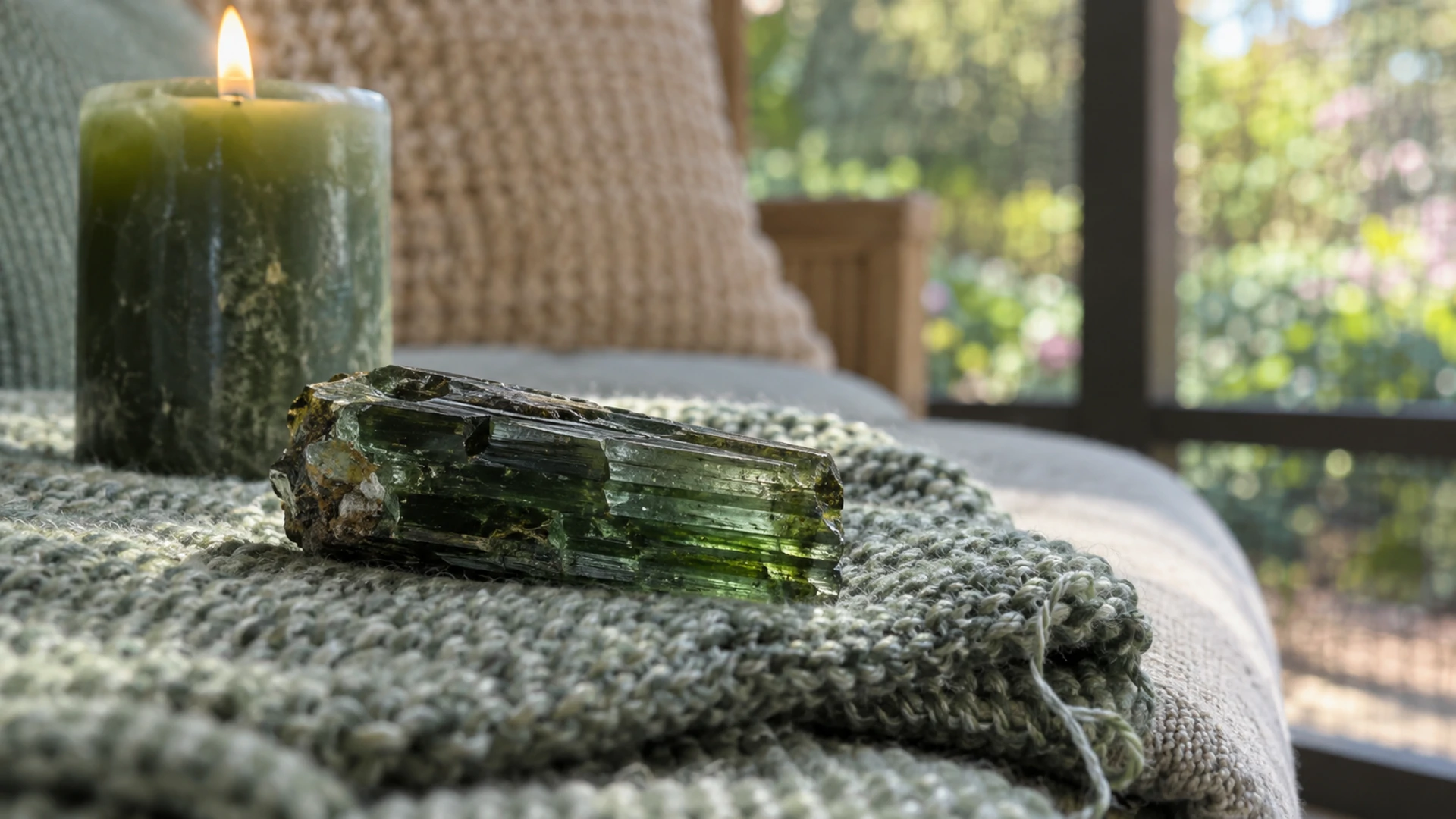
Green tourmaline creates the conditions for prosperity — opened heart, restored vitality, cleared emotional stagnation — and lets abundance follow on its own terms.
Prosperity as a Side Effect: Why Green Tourmaline Belongs in Abundance
Green tourmaline belongs in the Abundance category, but not the way most abundance stones do. Citrine works through spontaneous manifestation — active, radiant generation of new wealth and opportunity through confidence and joy. Pyrite builds through protective, disciplined wealth-building — abundance through willpower, resolve, and safeguarding what's already been established. Green tourmaline doesn't do either of those things directly. Its mechanism is abundance as a downstream effect: prosperity that flows outward from restored vitality and an open heart, not a direct target you aim at. That distinction matters, because it changes how you work with it and what you can honestly expect from it.
Known in the gem trade as verdelite, green tourmaline is the green variety of the complex borosilicate mineral tourmaline, colored by iron, chromium, or vanadium depending on the specific deposit. It forms in granite pegmatites, with notable sources in Brazil, Nigeria, Mozambique, Afghanistan, and Maine in the United States. It sits at Mohs 7 to 7.5 on the hardness scale, making it a genuinely durable gem that holds up to daily wear and handling. Its primary chakra is the heart — Anahata — which is the clearest lens through which its abundance connection makes sense. When the heart chakra is blocked or depleted, generosity contracts, motivation dims, and the capacity to recognize opportunity narrows. Green tourmaline's work is to restore that openness, and prosperity tends to move more freely through a person who is operating from a full, rather than a defended, center.
Beyond the heart, green tourmaline has a strong association with physical vitality and life-force energy — a current that runs throughout its historical and metaphysical reputation. It is connected to the Earth element, grounding its heart-opening quality in something tangible rather than abstract. Venus governs it. That combination — heart chakra, Earth, Venus — tells you what kind of abundance this stone generates: relational, embodied, and organic. Not the sudden arrival of money, but the gradual improvement of conditions that make prosperity more likely to take hold and stay. It's closer to tending soil than to striking gold.
The lowest-confidence aspect of this stone's category placement is worth naming honestly. Across independent research, many sources lean toward healing or empowerment as green tourmaline's primary register rather than abundance directly. That's not a reason to exclude it from this cluster — it's a reason to be precise about its mechanism. The wealth that flows from genuine restoration, from a heart that gives and receives freely, from a body with enough vitality to pursue what it values — that is real abundance. Green tourmaline earns its place here because of that downstream reality, not because it targets a bank balance.
Clearer Than Emerald: Choosing Green Tourmaline
The most useful thing to know when choosing a piece of green tourmaline is how it compares to emerald. The two stones are often placed side by side in the gem trade, and they can share a similar rich green color range. But green tourmaline typically shows noticeably better clarity and far fewer visible inclusions than emerald, which is famously included internally — so much so that the trade term for emerald's characteristic fractures and inclusions is a "jardin" (French for garden). A clean green tourmaline with good transparency is genuinely available at accessible price points. A clean emerald of comparable color is either heavily treated or very expensive. If you're drawn to deep, vivid green and clarity matters to you, green tourmaline is often the more honest choice.
Color in green tourmaline ranges from pale, almost mint green to deep chrome green, with the more saturated, slightly cool greens generally commanding the highest prices. Chromium-bearing material from certain African deposits (particularly Tanzania and Kenya) tends toward that deeper, more emerald-like green, and is sometimes specifically labeled "chrome tourmaline" in the trade. Brazilian material covers the full spectrum. If you're sourcing for magical use rather than gem investment, your primary guide should be which color resonates with your heart chakra work — brighter, lighter greens often feel more immediately energizing; deeper greens tend toward a slower, steadier quality.
One thing to watch for at lower price points: dyed green quartz is sometimes sold as green tourmaline. Natural tourmaline is a visibly distinct crystal — it forms in striated, elongated prisms, and has a characteristic "watermelon" quality where different zones can show different colors. Dyed quartz lacks those striations and tends to show even, flat color throughout without the subtle tonal variation tourmaline naturally carries. If a piece is suspiciously uniform and very cheap, ask for mineral verification or buy from a reputable mineral dealer rather than a general gift shop.
On care: green tourmaline is water-safe, requires no special storage conditions, and poses no toxicity concerns for regular handling. At Mohs 7 to 7.5, it's harder than most household surfaces and won't scratch easily in normal use. Store it away from harder stones like sapphire or diamond that could nick its surface, but otherwise it's a low-maintenance piece. Brief rinsing is fine if you want to cleanse it physically. For energetic cleansing, moonlight, sound, or smoke all work well.
Three Practices for a Fuller Heart
The Full Heart
Use this when you feel emotionally depleted, contractured, or shut down — and when you notice that depletion is making it harder to engage with work, relationships, or opportunity.
Lie down somewhere quiet and place a piece of green tourmaline directly over your heart. Set no prosperity intention at the start. Let the only goal be restoration. Breathe into the stone's weight on your chest and stay with any tightness or grief that surfaces without moving to fix or solve it. After ten to fifteen minutes, when you feel some softening in the chest, you can optionally close with a single clear statement of what you would do or pursue if you had enough energy to do it — a seed thought, not a demand. A green candle lit nearby supports the Venus-Earth current of this stone without pulling the focus away from restoration.
The Grounded Growth
Use this during or after a period of physical recovery, illness, or sustained burnout — when you are beginning to regain energy and want to consciously tie that returning vitality to longer-term growth.
Hold the green tourmaline in your dominant hand. With your non-dominant hand, touch something physically rooted — the floor, a houseplant, the surface of a wooden table. The point is contact with earth or something earth-connected. Breathe steadily for several minutes, letting yourself feel the returning physical energy as a resource rather than an absence. Then speak or write one concrete intention for what you will build, tend, or pursue as your strength returns — framed in terms of action over time rather than immediate arrival. You might pair this with rose or a drop of patchouli oil on the stone, both of which carry the Venus-Earth frequency. Repeat this practice at the same time each week as a check-in rather than a one-off event — the consistency is part of what makes it a grounded-growth working rather than a single wish.
The Open Conduit
Use this when you feel a scarcity-driven urgency around money or opportunity — the grasping, pressured quality that tends to narrow rather than open the channels this stone works through.
Sit quietly with the green tourmaline held loosely in both hands — not gripped, just resting in your palms. Notice any physical tension in your chest, shoulders, or jaw and let it be present without immediately trying to dissolve it. The practice is not to force relaxation but to acknowledge the tightness honestly. Then breathe slowly and, with each exhale, imagine the hands loosening very slightly. This is not a visualization of wealth arriving — it is specifically a practice of releasing the forced-target quality that works against this stone's mechanism. Working during a Venus hour suits this practice well, since the planetary current supports receptivity over striving. Close by setting the stone down deliberately rather than pocketing it immediately — the physical act of releasing it from your hands is part of the working.
Passed Through a Rainbow
Ancient Egyptian tradition held that tourmaline traveled from the center of the Earth to the surface along a rainbow — and that is why it appears in so many colors. This is legend rather than documented history, but it's a vivid one, and it captures something true about the stone: tourmaline's color range is genuinely extraordinary, spanning nearly the full visible spectrum within a single mineral species. The green variety carries its own specific lore in this story — the color of growing things, of life returning, of the heart.
In more recent history, Brazilian deposits drove tourmaline's rise through the modern gem trade. When a significant Maine specimen reached Tiffany and Co. in 1876, it marked the beginning of tourmaline's serious presence in Western jewelry — but Brazil had already established itself as the dominant global source, a position it largely holds today. Green tourmaline's current reach into metaphysical practice follows that same commercial path: it became more widely available as Brazilian mining scaled up, and its heart-chakra and vitality correspondences found a ready home in the post-1980s growth of crystal healing in the West.
Abundance That Follows, Not Leads
Green tourmaline's placement in the Abundance category is honest, but it requires precision. This stone doesn't target wealth directly. It works by restoring the heart's capacity and the body's vitality — and prosperity tends to follow those restored conditions because a person operating from fullness engages differently with opportunity than one operating from depletion. That is a real mechanism, and it is worth working with intentionally. It just requires accepting that the abundance is downstream, not immediate.
If you want to see how green tourmaline fits alongside the other stones in this category — and across the six other categories of crystal magic — the Crystal Compendium maps all seven paths and is the clearest place to understand how these stones relate, contrast, and complement each other in practice.