Golden Tiger Iron: Three Stones Built for the Long Haul
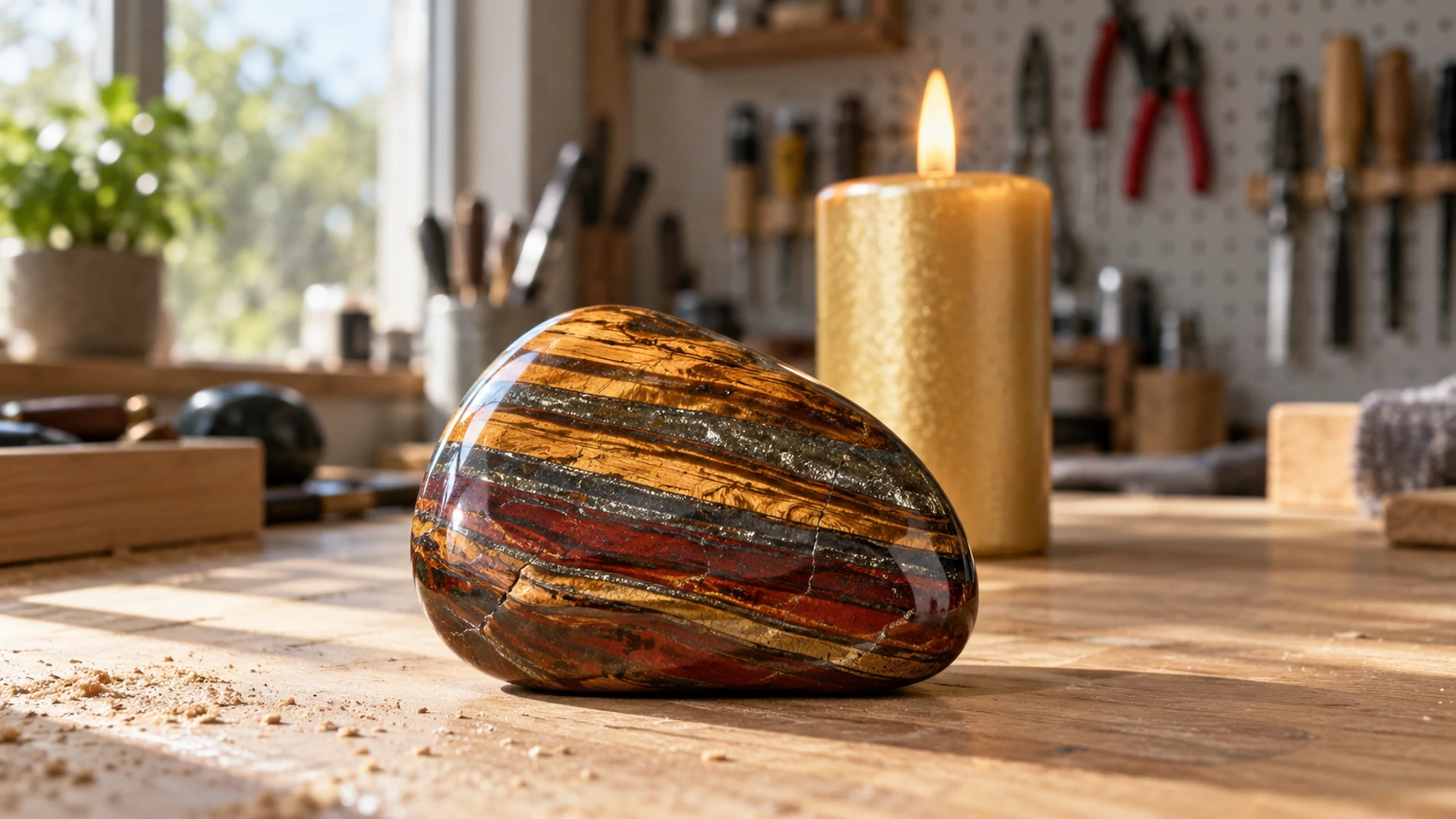
Golden Tiger Iron is an empowerment stone whose mechanism is built directly into its composition: it combines Tiger's Eye, Hematite, and Red Jasper into a single banded material, which means its strength comes from sustaining energy across time rather than delivering a single surge of it.
Three Stones Built for the Long Haul: Why Golden Tiger Iron Belongs in Empowerment
Most empowerment stones operate in a specific register. Carnelian's immediate activation overcomes procrastination and hesitation, sparking bold decisive action right now. That's a real and distinct quality — but it's a single spark. Golden Tiger Iron works in a completely different timeframe. Its mechanism is sustained endurance over the long haul: staying power across weeks or months, not a one-time ignition. The reason it can do that is structural. It isn't one mineral asked to carry all of this on its own.
The golden-brown chatoyant bands come from Tiger's Eye, which brings strategic focus under pressure — the kind of grounded discernment that lets you keep making clear decisions when a project gets complicated or exhausting. The metallic silver-black streaks are Hematite, an iron oxide mineral with deep roots in protective and grounding work, holding your energy anchored at the root level so that the demands of a long commitment don't scatter you. And threading through both is Red Jasper, whose contribution is physical vitality and stamina specifically — root-level staying power, the bodily endurance that keeps you showing up when the novelty has worn off. Together, those three qualities compound into something none of them does alone.
That's why Golden Tiger Iron belongs in Empowerment. It's not a healing stone, it's not a cleansing stone, and it's not an abundance stone — it's a stone about doing difficult things for a long time without losing yourself in the process. The category fit is a direct consequence of the material itself.
Its correspondences reflect that combination. Golden Tiger Iron works with the solar plexus and sacral chakras — the centers governing personal will, motivation, and the sustained drive to act — as well as the root chakra, anchored there by the Hematite component. Elementally, it draws on both fire and earth: fire for the forward-moving, goal-oriented quality, earth for the grounded, slow-burning endurance. The planetary correspondence is the Sun, which governs vitality, creative output, and the long arc of personal achievement. Astrologically, it carries the heat of Leo and the disciplined earth-energy of Capricorn, a pairing that captures both the ambition and the follow-through this stone is built for.
Reading the Bands: Choosing Golden Tiger Iron
Because Golden Tiger Iron is a composite rather than a single mineral, the key thing to look for when choosing a piece is whether you can actually read all three components. You want distinct, legible banding — clear separation between the golden-brown sheen of the Tiger's Eye, the metallic silver-black weight of the Hematite, and the deep brick-red of the Jasper. When a piece has that kind of clear definition, it's doing what it's supposed to do visually and structurally. When the three components blur together into a muddy brownish mass without distinguishable layers, the material is lower quality — not just less attractive, but genuinely harder to work with intentionally, since part of how this stone operates is through the distinct properties each layer contributes.
That said, no two pieces will look the same. The ratio of the three minerals varies naturally depending on where and how the layers formed, so some pieces lean heavily golden with thin red streaks, and others are nearly half Hematite with only thin bands of the others. Neither is more correct — but it's worth sitting with a piece before committing to it and noticing which component draws your attention most. If you're drawn to a piece where the Hematite dominates, you're probably sensing a need for grounding more than activation. A piece that's almost entirely Tiger's Eye banding will emphasize the focus-and-discernment end of the stone's range. A good all-purpose working piece will show a visible and roughly balanced presence of all three.
On durability, Golden Tiger Iron benefits from its two hardest components. Tiger's Eye and Red Jasper are both chalcedony-family stones with a Mohs hardness around 6.5 to 7, and that durability carries through to the composite. This stone is water-safe for brief rinsing and poses no toxicity concerns for normal handling or wear. The one caution worth noting comes from Hematite: prolonged soaking in water can eventually cause surface oxidation on iron-rich material. A quick rinse to clear dust is fine, but leaving it submerged for extended periods isn't ideal. Otherwise, it handles everyday carry well — it's a robust stone, which is fitting for what it's meant to be used through.
Three Practices for Staying the Course
The Long Commitment
Use this practice when you're formally beginning something that will take months — a new creative project, a business venture, a training program, anything that requires you to recommit repeatedly rather than complete in a single session.
Hold the Golden Tiger Iron in both hands and name the project aloud, as specifically as you can: not "I want to get healthier" but the actual target, the actual timeline, the actual work involved. Speak it into the stone the way you'd describe it to someone who's going to hold you accountable. Then set it somewhere visible in your workspace — not in a drawer, not on an altar shelf you rarely approach, but somewhere you'll see it on ordinary working days. The intention here is less about charging the stone in a ritual sense and more about giving yourself a visible anchor you'll encounter repeatedly. A gold candle lit for the duration of this initial sitting reinforces the solar correspondence — Sun energy for the long arc of a significant commitment. Let the candle burn down while you do the first concrete task related to the project, no matter how small.
The Weekly Check-In
This is a recurring practice, not a one-time ritual — its value accumulates across repetitions, and it's designed to be done on the same day each week throughout the life of a long-term commitment.
Pick a consistent time — Saturday morning works well given Saturn's correspondence with discipline and long-term structure, but any regular slot you'll actually keep is the right choice. Take the stone in your non-dominant hand and spend five minutes in silence reviewing the week just past: what moved forward, what stalled, what you avoided. Don't judge it, just account for it. Then switch the stone to your dominant hand and name one specific action for the coming week — one thing, not a list. The stone isn't doing the planning for you; it's giving the planning a physical anchor so it doesn't stay abstract. This works particularly well when paired with a brief session during the Sun planetary hour on your chosen day, leaning into its correspondence with sustained personal vitality and achievement. After several weeks, the ritual itself becomes a form of accountability — the act of picking up the stone and knowing what you're supposed to account for carries its own momentum.
The Three-Fold Draw
Use this practice when a long-term project has hit a rough patch — when you need to consciously identify which quality is most depleted and pull from the stone's composite nature intentionally rather than generally.
Hold the stone and find one of its three banding types with your thumb — run it slowly across the surface until you can feel a distinct shift in texture or see a clear change in color. Start with the Tiger's Eye band and spend two or three minutes focusing specifically on its quality: strategic focus under pressure, the ability to make one good decision rather than spinning in indecision. Then shift your thumb to a Hematite band and spend two or three minutes with its quality: rootedness, the grounded presence that keeps you functional when everything feels uncertain. Finally, move to the Red Jasper band and draw on physical vitality and stamina — the bodily endurance that underpins everything else when your energy is running low. The sequence matters because it moves from mental to physical, from the top of the problem to the foundation of it. Finish by holding the whole stone without focusing on any single band — letting all three qualities sit together the way they actually exist in the material. Rosemary burned nearby supports mental clarity and endurance, fitting for a practice aimed at a project that's become difficult to push through.
A Composite Stone, Named for What It's Made Of
The name "Golden Tiger Iron" is a modern trade designation for a naturally occurring banded combination of Tiger's Eye, Hematite, and Red Jasper — primarily sourced from Western Australia. As a named and marketed material, it doesn't carry an ancient documented tradition of its own. There's no historical record of people working with this exact composite under this specific name, and it would be inaccurate to pretend otherwise.
What it does carry is history through its parts. Tiger's Eye was worn by Roman soldiers in battle, valued for the alertness and tactical clarity associated with the cat's gaze. Hematite has one of the longest documented histories of any stone in this category — ground into red ochre pigment for cave paintings and body decoration in prehistoric cultures, and worn as a protective amulet through antiquity, its name tracing directly to the Greek word for blood, from the red powder it leaves when ground. Red Jasper, meanwhile, has been documented as a warrior's stone across a wide range of ancient cultures, used in amulets, seals, and carved talismans to support courage and physical endurance.
So while the composite itself is modern, you're working with three materials that carry genuine depth of use behind them. The combination is new; the components are not. That's actually an honest description of how most contemporary crystal practice works — materials with old histories get discovered, named, and brought into new combinations. Golden Tiger Iron is a clear case of that, and knowing it doesn't diminish what it does in practice.
Empowerment Measured in Months, Not Moments
Golden Tiger Iron's specific place in the Empowerment category is as the stone for the long middle of a commitment — not the excited start, not the final push, but the sustained weeks in between where most things succeed or fail. That's a genuinely distinct role, and it's one not many stones are built for as directly as this one.
If you want to see where Golden Tiger Iron sits alongside the full range of Empowerment stones — and how Empowerment itself relates to the six other categories of stone magic — The Crystal Compendium: Seven Paths to Stone Magic is the place to start.