Unakite: Healing in Layers, By Design
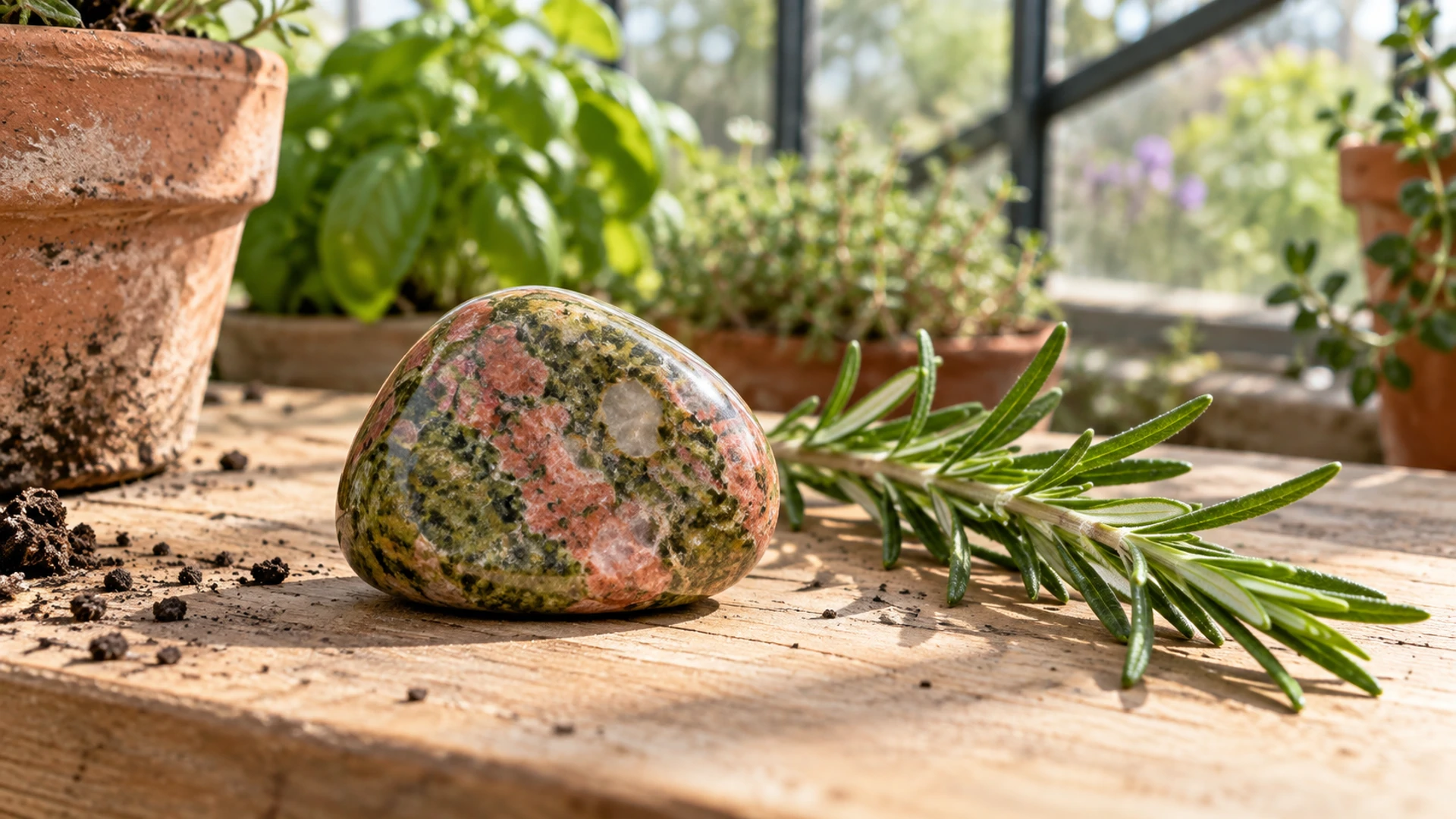
Unakite supports slow, layered emotional healing — the kind that returns to the same wound more than once, finding a deeper angle each time rather than expecting a single resolution to do all the work.
Healing in Layers, By Design: Why Unakite Belongs in Healing
Most healing stones earn their category through a felt quality — softness, calm, the impression of warmth or relief. Unakite earns it structurally. It isn't a single mineral at all. It's a rock: a fused composite of pink potassium feldspar, green epidote, and quartz, three distinct minerals grown together so tightly that they can't be separated without destroying the piece. That literal layering inside the stone is the most honest argument for how it works in practice. It doesn't produce a single cathartic moment of release. It supports healing that happens in passes — returning to the same emotional territory again and again, each time from a slightly different angle, each time going a bit deeper than the time before.
This is a genuinely different mechanism from most of the other stones in the Healing category. Malachite surfaces buried trauma so it can be processed — sometimes uncomfortably, because it won't let you avoid what needs healing. Lepidolite stabilizes the nervous system directly through its lithium-bearing composition, easing anxiety and racing thoughts — a physiological calm rather than emotional processing. Mangano calcite offers gentle, unconditional-feeling tenderness for shame, trauma, and self-worth — the softest stone in this category, no confrontation required. Unakite's mechanism is none of those things. It isn't a breakthrough stone. It's a long-haul stone. It suits people who already know what they're healing from and need support for the sustained, non-linear work that follows the initial reckoning.
Its correspondences reflect that role precisely. Unakite sits with the heart chakra — not because it's particularly tender or romantic, but because the heart chakra is where emotional patterns live, where old wounds get lodged and slowly worked through. Its element is Earth, which connects directly to the slow, patient quality of its healing mechanism. Earth energy doesn't rush. It works incrementally, through accumulation rather than event. Unakite's composite mineral structure — pink feldspar for the emotional layer, green epidote for the physical, quartz binding both together — makes the Earth correspondence feel almost literal rather than assigned.
On planetary rulership: Mars is sometimes cited across sources, partly because Mars governs Aries and unakite does share some fire-adjacent courage in its emotional endurance. But there's no strong or consistent consensus on this one. Some sources attribute it to Mars, others leave it unassigned, and it's worth being honest that the correspondence isn't settled the way it is for stones with a single, clearly dominant planetary tradition. The heart chakra and Earth element are the anchors you can rely on. The planetary ruler, if you work with planetary timing, is worth researching for your own tradition rather than treating as definitive.
Two Minerals, One Rock: Choosing and Keeping Unakite
The first thing worth knowing before buying unakite is that its proportions vary — sometimes dramatically. Some pieces are heavily pink with small islands of green epidote; others are almost entirely green with just threads of pink feldspar running through. Neither ratio is more genuine than the other. This is a composite rock, not a single mineral with a defined chemical formula, so variation in the balance of its components is completely normal and has no bearing on the quality or authenticity of the piece.
What does matter when you're identifying it is the presence of both colors together. A stone that is entirely green with no pink at all is more likely epidosite than true unakite. Epidosite is also an epidote-bearing rock, and the two are sometimes confused, but epidosite lacks the pink feldspar that gives unakite its characteristic mottled appearance. If you're sourcing from a seller who doesn't label their stock carefully, a piece that shows only solid green is worth questioning. The contrast between the warm pink and the deeper green — sometimes almost olive, sometimes cool and bright — is what you're looking for. Quartz may appear as clear or slightly translucent patches, usually smaller and harder-looking than the feldspar areas.
Because unakite is a rock rather than a single uniform mineral, its internal structure is composite by nature — which makes it slightly more prone to cleaving under sharp impact than a stone of equivalent Mohs hardness would be if it were chemically uniform. The feldspar, epidote, and quartz layers have different properties, and boundaries between them can be weak points. Treat it with reasonable care: don't drop it onto hard surfaces, and don't store it loose against significantly harder stones. Its Mohs hardness of 6 to 7 puts it in a fairly durable range for everyday handling and carrying, and it's water-safe for brief contact — rinsing, cleansing, or washing your hands while wearing it poses no concern. Avoid prolonged soaking, less because of toxicity (there's none) and more because extended water exposure over time is never ideal for composite rock structures.
Tumbled unakite is the most widely available form and often the most practical for carrying or placing in a body layout. Raw slabs and cabochons are also common and show the patterning more dramatically. Because the stone is mined in quantity in North Carolina, South Africa, and Brazil, it's consistently available and generally affordable — which makes it easy to buy a few pieces and keep them in different spaces without worrying about cost.
Three Practices for Returning to the Same Wound
The Spiral Return
Use this when you've already done real work on something — grief, resentment, an old pattern — and you can feel there's more underneath, a deeper layer that wasn't accessible the first time through.
Sit quietly with a piece of unakite held against your chest or placed flat over your heart. Before you begin, take a moment to acknowledge the work you've already done on this wound — not to rehash it, but to honor it as real. Then let yourself arrive at the same territory again, with the explicit intention of going one layer deeper than last time rather than expecting resolution. You might journal after, or simply sit with what surfaces. The practice doesn't require a defined outcome. The point is to return — not to redo, but to revisit with more capacity than you had before. Holding the stone through the session gives your hands something to anchor to while the emotional territory shifts beneath you. You can pair this with a green candle for patient, sustained growth energy, or work in silence. What matters is the deliberate act of returning rather than avoiding.
The Convalescence Hold
Use this during physical recovery from illness or injury, when the body needs to rebuild and the process feels slow or uncertain.
Place a tumbled unakite piece on or near the part of your body that is recovering — on the chest during respiratory illness, near a healing limb, or simply held in the palm closest to the area of concern. Hold it for ten to twenty minutes while resting, without an agenda. Unakite's traditional association with convalescence isn't about accelerating recovery — it's about supporting the patience recovery requires. The green epidote in the stone carries the physical-vitality correspondence; the pink feldspar works with the emotional frustration that often accompanies physical limitation. Working with both consciously — acknowledging that physical healing and emotional acceptance of that healing are happening in parallel — is where the stone's composite nature becomes most useful. You can do this daily during a recovery period, treating it as a quiet anchor to the process rather than a single intervention.
The Balance Point
Use this when you suspect you've been addressing one aspect of a healing process — emotional or physical — while neglecting the other.
Hold your unakite piece and look at it directly: identify where the pink feldspar sits and where the green epidote sits in that particular stone. These two minerals are your guide for this practice. Spend five minutes with your attention on the pink areas — what's the emotional component of what you're healing? What feelings, patterns, or relational dynamics are involved? Then shift your attention to the green areas — what's the physical dimension? Sleep, energy, tension held in the body, physical symptoms connected to the emotional weight? The quartz present throughout the stone acts as the binding thread: what would it look like to tend to both layers at once rather than sequentially? You can close the practice by holding the stone with both hands and setting a simple intention to address whichever layer you've been avoiding. Pairing this with rosemary — either as an herb on your altar or brewed as a tea — works well, since rosemary bridges the physical and the mental with equal confidence.
Frank Bradley's 1874 Discovery in the Unaka Mountains
Unakite's history is recent and well-documented, which is worth saying plainly rather than reaching for older lore that doesn't exist. The stone was formally identified and described in 1874 by the American geologist Frank Howe Bradley, who encountered it in the Unaka Mountains along the North Carolina-Tennessee border and wrote it up in the American Journal of Science. The name comes directly from those mountains. That's the origin story — not ancient Egypt, not Roman soldiers, not a mythological association — just a 19th-century geologist doing fieldwork and writing it down.
This places unakite in similar company to several other stones in the Healing category whose metaphysical reputations are genuinely modern rather than layered with centuries of cross-cultural tradition. Celestite, mangano calcite, and apophyllite all entered metaphysical practice relatively recently rather than carrying deep ancient documentation. With unakite, the honest version of its history is that its use in crystal healing began in the 20th century, building outward from its known geological properties and the visible qualities of its composite structure. That's not a weakness in the stone's case for practice — it just means its reputation is built on direct observation rather than inherited mythology, which is its own kind of integrity.
The stone is mined in the United States, South Africa, and Brazil, among other locations, and is found in quantities sufficient to make it consistently available and affordable. Its ornamental use has been documented since the 19th century — it's been used as decorative stone in architecture and jewelry making — but its incorporation into intentional crystal practice is the more recent development that most practitioners working with it today are engaging with.
Healing That Doesn't Rush
Unakite's whole argument is that some things can't be resolved in a single session. The healing it supports is the kind that happens across months and years — the same emotional territory revisited when you have more capacity, more context, more distance, and gradually more freedom from what originally hurt. That mechanism is rare in the Healing category, where most stones offer something more immediate: the confrontation of malachite, the calm of lepidolite, the tenderness of mangano calcite. Unakite is the stone for the long work, and that makes it quietly essential.
If you want to see where unakite sits in relation to the full range of Healing stones — and how the Healing category itself fits alongside Protection, Cleansing, Empowerment, Abundance, Love, and Intuition — the place to go is The Crystal Compendium: Seven Paths to Stone Magic, which maps all seven categories and the stones within each one.