Garnet: Getting Back Up
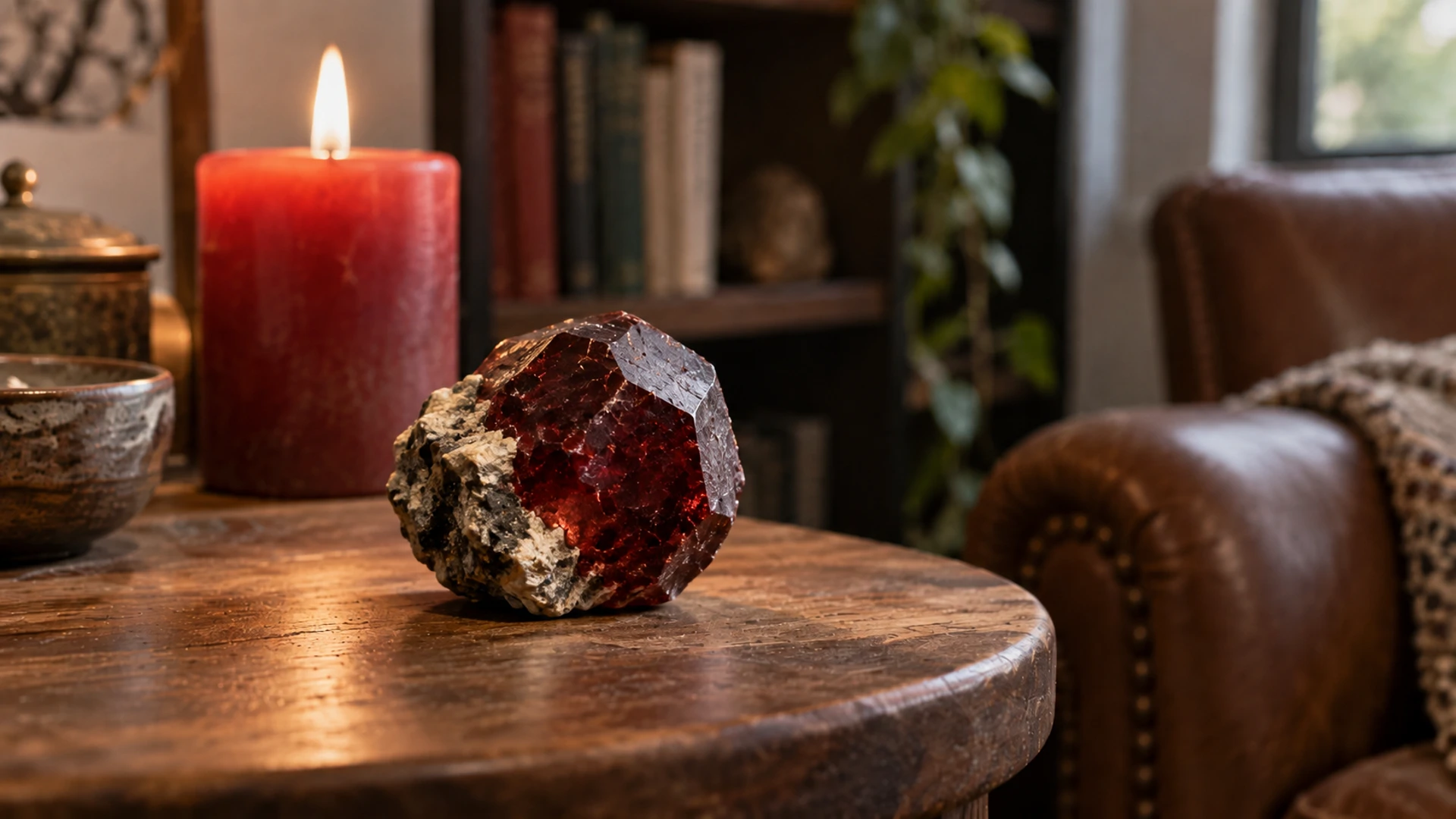
Garnet is the stone you reach for after something goes wrong. Its role in the Empowerment category isn't about igniting ambition before you start — it's about restoring the drive to continue after you've already been knocked down.
Getting Back Up: Why Garnet Belongs in Empowerment
The first thing to get clear is what kind of empowerment garnet actually provides. It isn't a stone for firing up courage before a challenge, and it isn't for sharpening focus mid-effort. Garnet's mechanism is specific: rebuilding motivation after a setback. If something failed — a project collapsed, a relationship ended badly, an opportunity was lost — garnet is the stone for the aftermath of that experience. It works on the layer of the self that has gone quiet after a defeat and needs help finding a reason to try again.
This is worth distinguishing from what the other Empowerment stones do. Carnelian's mechanism is immediate activation — it overcomes procrastination and hesitation, sparking bold decisive action right now. That's a stone for the before, not the after. Garnet addresses the aftermath: the period when something has genuinely failed and motivation hasn't yet returned on its own. The root-level drive it restores isn't excitement — it's the slower, quieter rebuilding of the will to move forward at all.
Its correspondences make the mechanism legible. Garnet sits at the root chakra, the energetic center concerned with survival, stability, and the basic will to persist. Its element is fire — specifically the kind that burns low and steadily rather than flaring up in a single brilliant moment. Its planetary ruler is Mars, which governs effort, stamina, and the capacity to keep fighting when the fight is hard. And its associated signs — Aquarius, Leo, and Virgo — bring in themes of resilience across very different emotional registers: the fixed determination of Aquarius, the pride and self-recovery of Leo, and Virgo's disciplined attention to what needs rebuilding practically, piece by piece.
Taken together, these correspondences describe a stone for sustained recovery rather than a sudden surge of confidence. If you've experienced a real defeat and are trying to find your footing again, garnet's energy meets you where you actually are — not where you'd like to be — and works from that ground up.
One Name, Many Minerals: Choosing Garnet
"Garnet" refers to a mineral group, not a single species. That distinction matters in practice, because different garnet varieties carry genuinely different physical and energetic properties — and not all of them belong in the same category of work.
The garnet most commonly used for Empowerment work, including everything described in this article, is the deep red variety — typically a pyrope-almandine blend. This is the material whose correspondences trace to Mars, fire, and the root chakra. It's the stone ancient warriors carried, the one described in medieval texts as sustaining life-force, and the one most people mean when they simply say "garnet." Pyrope-almandine forms in metamorphic rock, with significant sources in India, Sri Lanka, the USA, and the Czech Republic, among others. Its characteristic deep red comes from the iron and magnesium content of the mineral blend.
But the garnet group also includes green varieties — tsavorite (a green grossular) and demantoid (a green andradite) — which have entirely different visual profiles and somewhat different correspondences. And then there's melanite, the opaque black, titanium-bearing variety of andradite garnet that belongs to the Protection category, not Empowerment. Melanite's focus is dense, grounded shielding — a very different working than rebuilding drive after a defeat. Knowing which garnet you're actually holding matters, because applying melanite's correspondences to pyrope-almandine (or vice versa) won't serve the intention.
When sourcing red garnet for this kind of work, you're looking for the pyrope-almandine material: deep red to reddish-brown, often slightly translucent in thin sections, with a vitreous rather than metallic luster. Raw, tumbled, or faceted all work for magical use — form matters less than the material itself and the clarity of your intention when you work with it. Be cautious with very large, very cheap specimens sold as garnet without any variety disclosure, since the garnet group's range means labeling matters.
On care: garnet sits at Mohs 6.5 to 7.5, which makes it reasonably durable and able to handle the wear of daily carrying. It's water-safe for brief rinsing and raises no toxicity concerns for normal handling and wear. Store it away from harder stones that could scratch a polished surface, but otherwise garnet is a low-maintenance companion. It doesn't require complex cleansing protocols — regular exposure to sunlight, moonlight, or sound works fine for keeping it energetically clear.
Three Practices for Rebuilding Drive
The Rise Again
Use this practice when you've experienced a specific, named failure — not general low motivation, but an actual identifiable defeat — and the will to try again hasn't returned on its own.
Hold your garnet in both hands and name the failure aloud, plainly and without softening it. Say what happened. Say what it cost you. Then set the stone on a surface in front of a lit red candle — red for Mars, for effort, for the will to persist — and sit with both for ten minutes without doing anything else. You're not trying to feel better yet. You're acknowledging the defeat and asking the stone to hold the space while your drive starts to reform. When the ten minutes are done, carry the garnet with you for the next seven days. Let it be a physical reminder that the process of returning has started, even if it doesn't feel like it yet.
The Sustained Push
Use this practice when the initial drive has returned but a long recovery period still lies ahead — weeks or months of sustained effort, where the risk is losing momentum partway through rather than failing to start.
Place your garnet on your workspace or carry it daily throughout the recovery period, and at the beginning of each week, spend two or three minutes holding the stone and stating, out loud, one specific thing you're going to accomplish before the week ends. Keep the statement simple and concrete. If you want to bring in timing, the Mars planetary hour on a Tuesday sharpens the declaration — Mars rules the sustained will, and anchoring your weekly commitment in that window ties it to the planet's energy directly. The garnet becomes a running record of your kept commitments over the recovery arc, accumulating a kind of intention history that reinforces the pattern each time you return to it.
The Warrior's Light
Use this practice when motivation feels completely absent — not just low, but gone — and you need a way to orient yourself before any directed effort is possible.
This practice draws on one of garnet's oldest associations: the stone as a source of light in total darkness. Hold it at the level of your sternum in a dim or dark room, and breathe slowly for several minutes without any agenda. You're not setting an intention yet — you're simply using the stone as an orienting point when nothing else is providing one. After the breathing settles, place the garnet on a flat surface and ring it with a small circle of rosemary — one of the oldest herbs for memory, clarity, and the return of the self after loss. Sit with it until one single next step becomes clear, even a very small one. That step is enough. The practice is about finding the first direction, not the whole path.
Named for a Seed, Carried Into Darkness
The word "garnet" traces directly to the Latin granatus, meaning seed-like or grain-like. The reference is visual and immediate: the deep red crystals, especially when found in a matrix rock, closely resemble the seeds of a pomegranate. This etymology is well-documented and historically unambiguous. The name was in use in medieval Latin texts on stones and minerals, and it reflects the way medieval naturalists described what they saw rather than any mystical attribution.
Jewish religious tradition — recorded in the Talmud and Midrash — describes a glowing stone or light source that illuminated the interior of Noah's ark during the flood. This light-bearing stone has been identified with garnet by some interpreters over the centuries, though it should be understood plainly as religious legend and tradition rather than verified historical fact. The identification reflects garnet's long-standing association with light in darkness, a theme that appears independently across cultures and that the Warrior's Light practice above draws on directly. Whether or not the interpretation is literalist, the image is consistent: this is a stone for holding light when none is available from outside.
Garnet has also been carried as a protective talisman by warriors and travelers across various ancient cultures. The name derives from a seed, the shape suggests a fruit associated with life's renewal, and its color runs the spectrum from the red of blood to the dark red of embers — all imagery that speaks to persisting through difficulty rather than avoiding it. This is a stone with a long, consistent narrative: you carry it when the way is hard and the outcome is uncertain, and it holds the fire until you can.
Empowerment After a Setback
Garnet occupies a specific position in the Empowerment category because it addresses a specific moment: the aftermath of a real failure, when drive hasn't returned and the path forward isn't yet visible. That specificity is what distinguishes it from the other stones in the category. Not every empowerment working is the same, and garnet isn't trying to do what carnelian, tiger's eye, or spinel does for vitality recovery — it does what it does, and it does it well.
If you want to see how garnet fits within the full landscape of Empowerment stones, and how the Empowerment category sits alongside Protection, Cleansing, Healing, Abundance, Love, and Intuition, the Crystal Compendium maps all seven paths and is the place to start if you're building a practice across multiple intentions.