Chrysocolla: The Stone for What Happens Between People
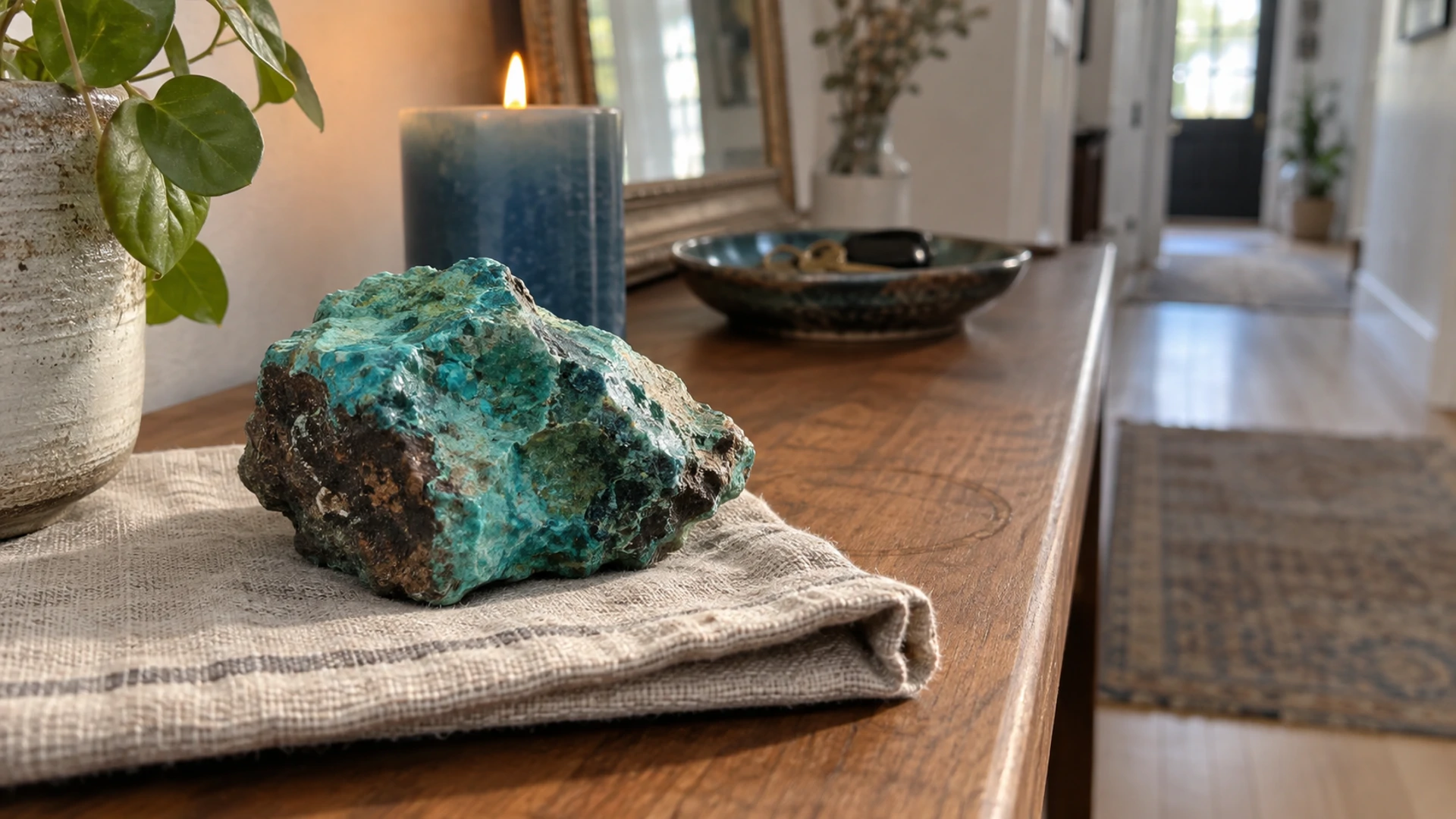
Chrysocolla is a copper-bearing healing stone whose work is specifically relational — it doesn't offer a broad emotional reset so much as a careful look at the patterns you've built with other people, and what it's cost you to maintain them.
The Stone for What Happens Between People: Why Chrysocolla Belongs in Healing
There's a meaningful distinction worth drawing before anything else. Most stones in the Healing category work on the emotional body in a general sense — they calm, restore, soften, or resurface. Chrysocolla does something more specific. Its healing work is relational in nature. It addresses the dynamics that form between you and another person: the codependent loops, the caretaking that has stretched past its limits, the subtle ways you've learned to make yourself smaller to keep a relationship intact. That's not the same as general emotional healing, and it's worth being clear about the difference.
This specificity is part of why chrysocolla bridges the heart and throat chakras rather than sitting comfortably in just one. Heart-chakra work is about how you feel in a relationship. Throat-chakra work is about what you actually say — what you're willing to name aloud, what you've been swallowing. Chrysocolla sits at the intersection of those two things: the gap between what you feel and what you've found yourself able to express. For anyone who has spent years managing someone else's emotions at the expense of their own, that gap is familiar territory.
Its correspondences anchor this theme at every level. Venus governs chrysocolla — the planet most associated with love, beauty, and how we relate to others. The water element runs through it, which is fitting for a stone concerned with the emotional currents that move between people. Earth is also sometimes cited, grounding that emotional fluency in something practical and patient. The associated signs — Taurus, Virgo, and Gemini — bring their own textures: Taurus's steadiness, Virgo's precision, and Gemini's comfort with complexity and contradiction. All three have something to offer someone trying to understand a complicated relational pattern.
Its blue-green color, caused by copper content, gives chrysocolla a visual kinship with turquoise and malachite — both also copper-bearing minerals with strong Venus associations. But chrysocolla is softer and more porous than either, and its energy tends to feel less confrontational than malachite (which surfaces buried trauma so it can be processed, sometimes uncomfortably, and won't let you avoid what needs healing). Chrysocolla is not avoidant, but it tends toward calm examination rather than upheaval. Where malachite can feel like pulling a splinter, chrysocolla feels more like having an honest conversation you've been putting off — still uncomfortable, but at a pace you can manage.
Soft and Porous: Choosing and Keeping Chrysocolla
The physical reality of chrysocolla governs almost every practical decision you'll make about it, so it's worth understanding from the start. This is a genuinely soft mineral — sitting between Mohs 2.5 and 3.5 depending on its composition — and it is porous. That means it should never be submerged, soaked, or used to make gem elixirs or infused water. The copper content makes elixir use a real safety concern, not a theoretical one. Clean it with a soft, dry cloth only.
Because it's soft and porous, chrysocolla intended for jewelry is frequently resin-stabilized, similar to the treatment used for turquoise. This isn't inherently deceptive — stabilization makes the stone more durable and wearable, and it's common enough that you should assume it unless a seller explicitly states otherwise. What it does mean is that treated chrysocolla may respond differently to certain cleansing methods than raw or untreated material. If you're using sound, moonlight, or smoke for cleansing — all of which work well here and avoid the water-related risks — this distinction matters less. But if you're choosing a piece specifically for raw, untreated energy, ask the question directly rather than assuming.
When choosing a specimen, look for pieces where the color has some depth — chrysocolla ranges from a vivid turquoise blue to a deeper blue-green, sometimes with brown or black matrix mineral running through it. Some chrysocolla appears alongside quartz inclusions, which adds some hardness and makes it more durable for everyday carry. Pieces sold as pure chrysocolla at very low cost sometimes turn out to be dyed material or a heavily matrix-mixed aggregate — not necessarily a problem, but worth knowing what you're getting. A reputable seller will tell you whether a piece has been treated, what other minerals it contains, and how it was sourced.
For placement in a space rather than on the body, chrysocolla is well-suited to resting undisturbed on a surface — a bedside table, a workspace, or an altar. It doesn't need frequent handling to stay active, and keeping it in one place avoids the knocks and scratches its softness makes it vulnerable to. Store it away from harder stones that could scratch it, and away from direct sunlight for extended periods, which can dry and further weaken porous material over time.
Three Practices for Relationship Patterns
The Untangling
Use this practice when you're struggling to separate your own feelings, needs, and responsibilities from those of someone you're in a close or enmeshed relationship with — a partner, a parent, a friend you've been carrying.
Hold a piece of chrysocolla in your non-dominant hand and sit quietly with two sheets of paper in front of you. Label one "mine" and one "theirs." Without filtering or judging, write down every feeling, responsibility, or worry currently taking up space in your mind — one item per line, however it comes. Then go through each one and place it on the page where it actually belongs. Some will be genuinely yours. Some will be things you've absorbed or adopted that were never yours to hold. A few will land somewhere in the middle, which is honest. When you're done, fold the "theirs" sheet and set it aside — physically off the surface you're working on. The exercise isn't about abandonment; it's about visibility. Do this during a Venus hour if you want the timing to support the relational focus, or simply at a quiet moment when you won't be interrupted.
The Caretaker's Rest
Use this practice when you've been in a sustained caretaking role — for a sick partner, an aging parent, a friend in crisis, a child — and your own reserves have run low enough that rest has started to feel like a failure rather than a necessity.
Place chrysocolla on your heart chakra and lie down somewhere comfortable. Set a timer for at least twenty minutes — longer if you can. This is not a meditation with a goal; it is a deliberate permission structure. Before you close your eyes, say aloud or internally: "I am allowed to stop." That's the whole of the working. The chrysocolla's role here is to hold the relational field — the emotional weight of everything you've been managing for someone else — while you step out of it temporarily. You can pair it with a piece of lepidolite held in one hand if your nervous system is running too hot to settle; lepidolite stabilizes the nervous system directly through its lithium-bearing composition, easing anxiety and racing thoughts with what feels like a physiological calm. When the timer goes off, don't rush. Take a few breaths before you move. Repeat as often as needed — this is not a one-time practice.
The Honest Boundary
Use this practice before a conversation where you need to set or re-establish a boundary with someone you're in an ongoing relationship with — not an ultimatum, not a confrontation, but a calm and honest statement of what you need.
In the day or two before the conversation, carry chrysocolla on your body — in a pocket or as jewelry if you have a stabilized piece. Each time you touch it, spend a moment articulating to yourself — silently, clearly — exactly what you want to say. Not a script, but the core of it: what is true, and what you need. On the day of the conversation, before you begin, hold the stone briefly and take three slow breaths. A blue candle lit before the conversation — whether you're meeting in person or speaking by phone — adds a throat-chakra support that reinforces calm, honest communication. The goal of the working isn't to control the outcome; it's to help you stay grounded in your own clarity while you speak. Afterward, cleanse the chrysocolla with smoke from lavender or frankincense to clear any emotional charge it absorbed during the interaction.
A Solder's Stone as Much as an Ornament
Chrysocolla's history is less romantic than some stones and more practical — which, given what the stone actually does, feels appropriate. Its copper content placed it in the hands of metalworkers long before it ended up in metaphysical practice. Ancient Egyptian craftspeople used copper-bearing minerals including chrysocolla as ornamental material, and historically related copper compounds served a genuinely functional role in metalworking as a soldering flux — lowering the melting point of metals during the joining process. This was a material valued for what it could actually do in a workshop, not only for how it looked.
Aztec craftspeople also worked with chrysocolla and related copper minerals as ornamental stones, drawn by the same vivid blue-green that made the material so visually striking. The point worth holding onto is this: chrysocolla has spent most of its documented history in the hands of people doing precise, practical work — joining things, shaping things, making them fit together. There's something honest about that lineage for a stone whose contemporary use is so focused on the work of fitting people together, and recognizing when that work has cost too much.
Healing What Happens Between You and Others
What makes chrysocolla worth keeping in a practice is the specificity of what it addresses. Plenty of stones will help you feel calmer, or soften the edges of a hard week. Chrysocolla asks a more precise question: what are the actual dynamics between you and the people in your life, and where have those dynamics pulled you away from yourself? That's relational healing in its most useful form — not a general soothing, but a careful accounting.
If you want to see how chrysocolla sits alongside the other Healing stones — and how the Healing category fits within the six others — The Crystal Compendium: Seven Paths to Stone Magic is the place to start.