Mangano Calcite: The Gentlest Stone in the Room
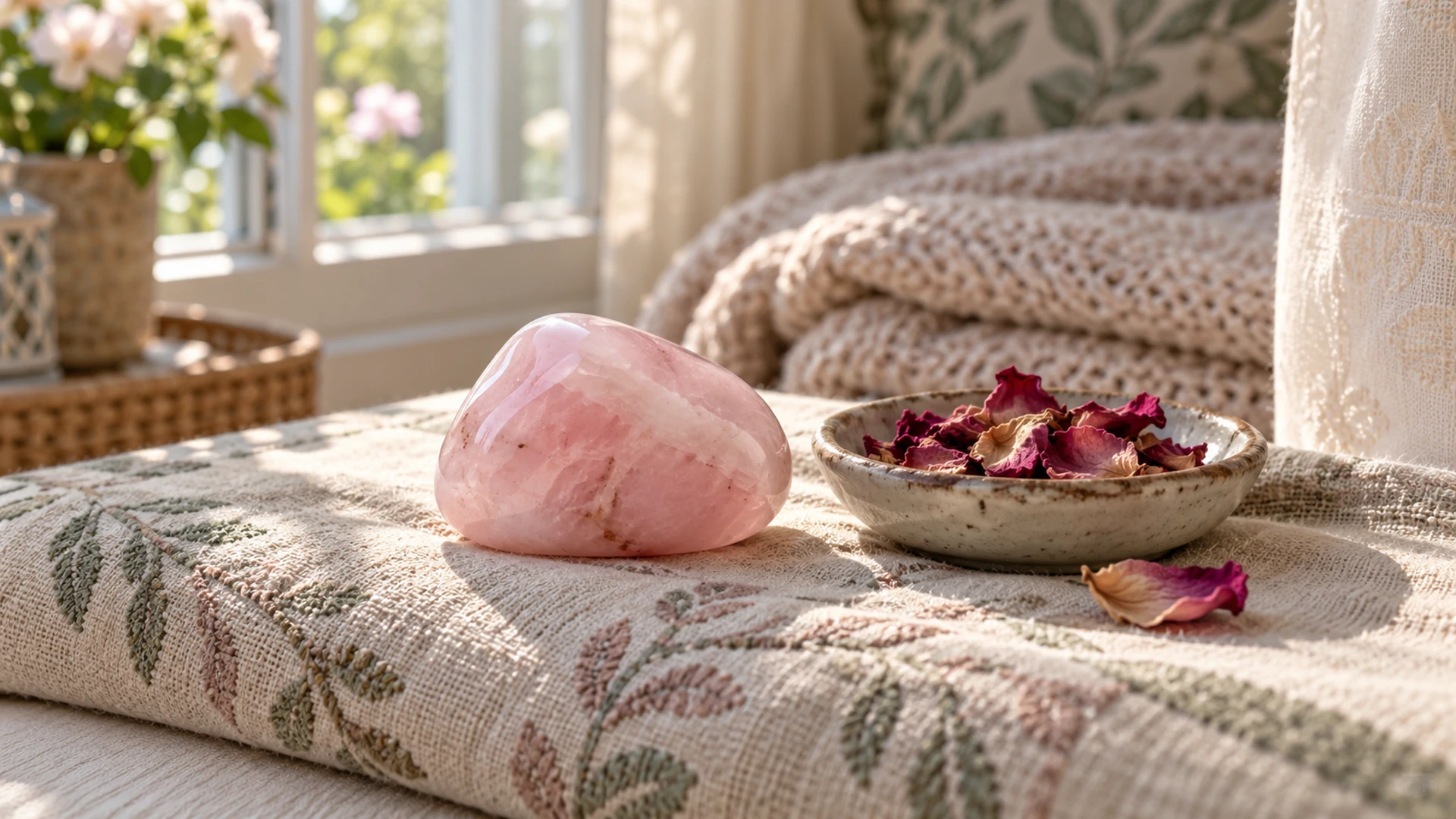
Mangano Calcite is the softest stone in the Healing category — not metaphorically, but functionally. It doesn't surface buried patterns, accelerate breakthroughs, or ask you to confront anything. It simply offers tenderness, and for certain kinds of inner work, that's exactly what's needed.
The Gentlest Stone in the Room: Why Mangano Calcite Belongs in Healing
Every stone in the Healing category works differently. Malachite surfaces buried trauma so it can be processed, sometimes uncomfortably — it won't let you avoid what needs healing. Lepidolite stabilizes the nervous system directly through its lithium-bearing composition, easing anxiety and racing thoughts — a physiological calm rather than emotional processing. Unakite supports slow, layered healing that returns to the same wound at progressively deeper levels over time, rather than a single breakthrough. Mangano Calcite doesn't do any of that. It offers something quieter: unconditional-feeling tenderness for the parts of you that are most ashamed, most depleted, or most convinced they aren't worth the effort.
That specific quality — gentleness without confrontation — is why it belongs in this category. Most healing work, at some point, requires you to look directly at something difficult. Mangano Calcite is the exception. It's suited to the moments before that's possible, when the inner ground needs softening before any deeper work can take root. It's especially well-matched to shame, long-standing self-worth wounds, and the kind of grief that has gone quiet but not away. The work it supports isn't dramatic. It's closer to being held.
Its correspondences all reinforce this quality. Mangano Calcite works with the heart chakra, the energetic center for self-love, compassion, and emotional openness. Its element is water — the element of feeling, receptivity, and flow rather than force. Its planetary ruler is Venus, which governs love, beauty, and the softer registers of value and worth. And its zodiacal association is Cancer, the sign most associated with emotional protection, nurturing instinct, and the need for a safe inner home. Everything about this stone's energetic signature points toward gentle, inward-facing care rather than outward transformation.
It's worth placing Mangano Calcite alongside a few of the other softer Healing stones so the distinction is clear. Rose Quartz shares the heart chakra and Venus rulership, but it works across a broader range — self-love, relationships, and receiving love from others. Chrysocolla heals within relationship patterns specifically — codependency, caretaking burnout, how you've allowed yourself to be treated — not general emotional healing. Mangano Calcite is narrower than both. Its focus is the self, specifically the self that's been diminished, ignored, or made to feel like a burden. That's a precise thing, and precision matters in crystal work.
Soft, Pink, and Easily Damaged: Choosing Mangano Calcite
The most practically important thing to know about Mangano Calcite before you buy a piece is that it's genuinely soft. It registers at Mohs 3 on the hardness scale, which puts it in the same fragility range as calcite generally — softer than a copper coin, considerably softer than quartz. You can scratch it with a fingernail if you try. That softness has direct implications for how you store, handle, and clean it: keep it away from harder stones in your collection, don't toss it into a bag with tourmaline or quartz points, and set it somewhere it won't be knocked over easily.
Water is a real concern. Calcite dissolves slowly in prolonged water contact, so brief rinsing is generally tolerated but extended soaking is not. More importantly, calcite reacts visibly to acidic substances — if you use any vinegar-based cleaning product near your altar or shelves, keep Mangano Calcite away from it. The same applies to anything citrus-based. A soft dry cloth is all you need for regular cleaning. Some practitioners cleanse their stones energetically with sound, moonlight, or smoke, and all three work well for Mangano Calcite without any of the risks that come with water or salt methods.
Its pale pink color comes from manganese content within the calcite matrix. The manganese produces that signature blush tone — ranging from very pale almost-white pink through to a deeper, more saturated rose depending on the concentration. When you're choosing a piece, even color saturation throughout the stone, without visible dye lines or uneven patches of artificial intensity, is a reasonable sign that the color is natural. Dyed calcite exists on the market, particularly in vibrant or neon shades that wouldn't occur naturally, so if a pink calcite piece looks almost fluorescent or has an unnaturally uniform coating on one face only, it's worth a second look. Primary sourcing for quality Mangano Calcite comes from Peru, and a reputable supplier should be able to tell you where their material originates.
Because of its softness, Mangano Calcite isn't an ideal everyday carry stone in the way that Black Tourmaline or Carnelian can be dropped in a pocket without much worry. It suits altar work, bedside placement, or held meditation better than jewelry or daily carry — and if you do want to wear it, a well-protected setting that shields it from impact is worth investing in. Tumbled pieces tend to be slightly more durable for handling than raw chunks, though the raw material has a natural appeal that makes it popular for altar display.
Three Practices for Tenderness Without Confrontation
The Inner Child Hold
Use this practice when you feel disconnected from, critical of, or impatient with a younger version of yourself — particularly after a period of inner harshness or self-blame.
Sit quietly and hold your Mangano Calcite with both hands over the center of your chest, the stone resting against your heart. Close your eyes and let your breathing slow without forcing it. When you feel settled, bring to mind an image of yourself as a child — any age that comes naturally, not necessarily the most difficult one. Don't analyze the image. Just look at it with the kind of softness you'd offer someone else's child. Let the stone stay warm in your hands. If you want to add to the practice, a pink candle lit nearby keeps the energy of the space gentle and Venus-aligned. Stay for as long as feels right — five minutes or twenty. There's no goal here other than presence.
The Worth Return
Use this practice after a period of feeling unseen, diminished, or as though your needs were consistently placed last — not as a one-time fix, but as a repeated act of returning to yourself.
Begin in the Venus hour if you can time it, since this practice draws directly on Venus's domain of worth and self-regard. Set your Mangano Calcite on your altar or in your lap. Speak aloud, or write in a journal beside the stone, three things that are genuinely true about you — not achievements or external markers, but qualities. Not "I am successful" but "I am someone who notices when others are struggling." Keep these specific and real rather than aspirational. The stone's job during this practice is to hold what you're saying as true. Over repeated sessions, the worth this practice rebuilds isn't manufactured — it's simply remembered, piece by piece, in the presence of something that asks nothing of you in return.
The Grief Cushion
Use this practice not for active grief work — not for processing the full weight of a loss — but for the quieter kind of grief that has become a background ache, when you need tenderness toward yourself rather than more movement through the loss.
Place your Mangano Calcite on a soft surface — a folded cloth, your lap, or your pillow — and rest your hand over it. Don't guide your thoughts. Let whatever is present be present without asking it to shift or resolve. If you want to support the atmosphere, rose as dried petals nearby or a few drops of rose oil diffused into the room softens the space without adding any energetic pressure. The practice is simple: you are not trying to heal the grief in this session. You are being soft with the person who is carrying it. That's Mangano Calcite's particular gift, and it's enough.
A 2003 Book and a Genuinely New Stone
Mangano Calcite doesn't carry an ancient documented tradition. Unlike Lapis Lazuli, which has been traded and revered for thousands of years, or Garnet, which shows up in warrior burials and ancient amulets across multiple civilizations, Mangano Calcite entered metaphysical practice relatively recently. Its use in crystal healing was first described in Judy Hall's widely read reference work The Crystal Bible, published in 2003 — a book that introduced many stones into mainstream practice for the first time and remains one of the most referenced works in the field.
That's not a weakness. It's just the truth of this stone's history, and it's worth being straightforward about rather than working around. Mangano Calcite is a genuinely modern addition to crystal practice. Its correspondences, ritual uses, and energetic reputation have been developed over the past two decades through the accumulated experience of practitioners who found it useful for specific kinds of work — particularly the tender, inward-facing healing it's described above as suited to. That's a shorter lineage than some stones carry, but a lineage nonetheless. The absence of ancient lore doesn't diminish what it actually does in practice; it just means we hold it with intellectual honesty about where the tradition starts.
It's also worth noting that calcite as a mineral family has been known and worked with far longer — halite and selenite, both in their own ways related to evaporite mineral traditions, have documented human use stretching back thousands of years. Calcite's physical properties, including its softness and acid reactivity, were known to ancient cultures even if Mangano Calcite as a metaphysical object was not named or worked with specifically. The pink, manganese-bearing variety simply wasn't part of any tradition that's been documented before the modern era of crystal practice.
Healing That Doesn't Push
Mangano Calcite's defining quality — offering tenderness without confrontation, holding space without demanding anything back — makes it one of the most specifically useful stones in the Healing category, not despite its gentleness but because of it. Not every moment of inner work needs intensity. Some of the most important shifts happen slowly, quietly, when the conditions are simply soft enough for something to ease.
If you want to see how Mangano Calcite sits alongside the other Healing stones, and how the Healing category as a whole fits into the broader landscape of crystal practice, The Crystal Compendium: Seven Paths to Stone Magic maps all seven categories — Protection, Cleansing, Healing, Empowerment, Abundance, Love and Relationships, and Intuition — with the stones that belong to each. It's a good place to find what you're actually looking for, rather than reaching for the nearest pink stone and hoping it fits.