Apophyllite: A Window You Can Look Through
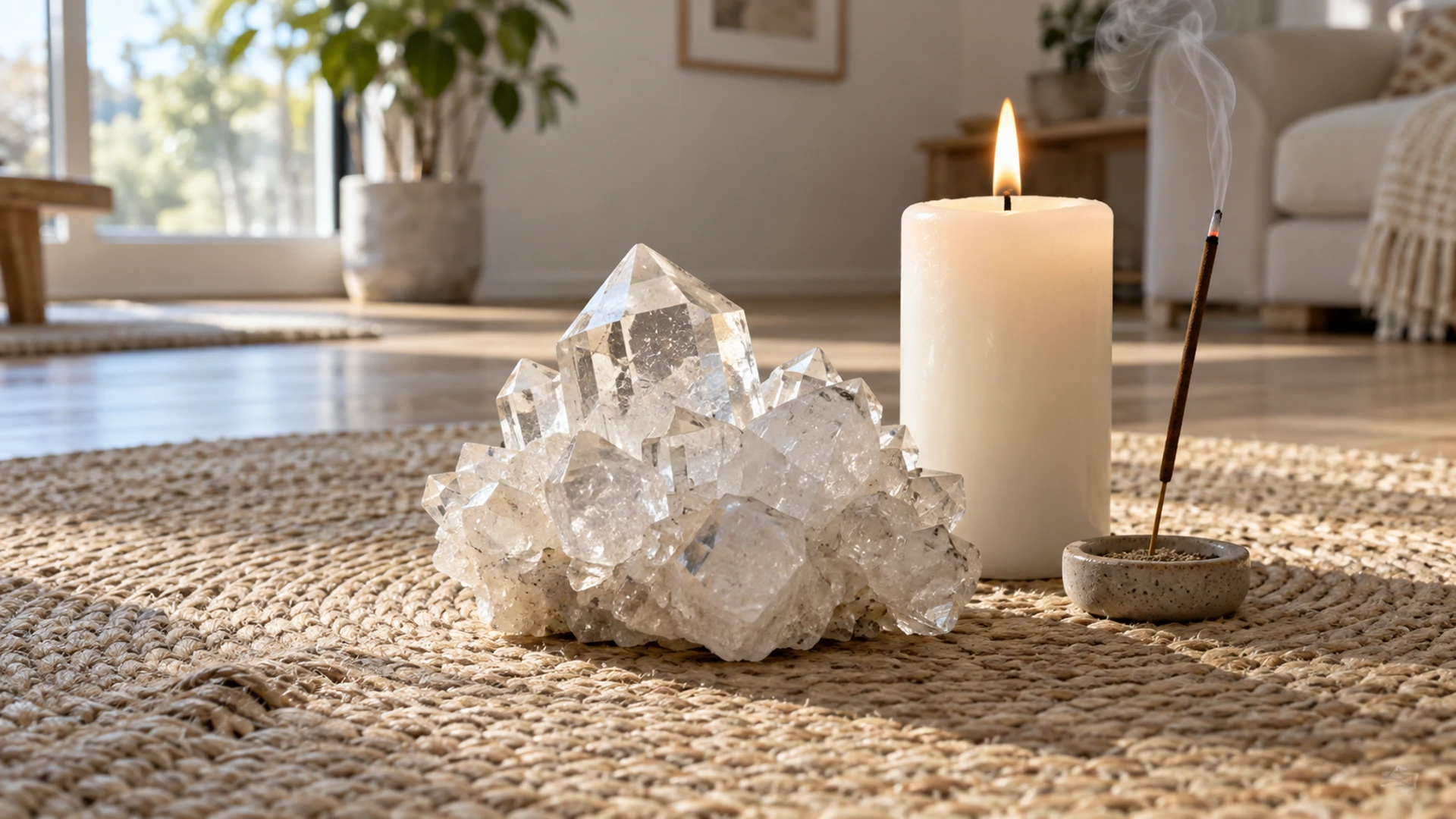
Apophyllite's role in intuition and psychic development isn't metaphorical. The stone's mechanism is its own transparency — it functions as a literal window between realms, which makes it unlike nearly every other stone in this category.
A Window You Can Look Through: Why Apophyllite Belongs in Intuition & Psychic Development
Most stones in the intuition and psychic development category work by doing something to you or around you. Labradorite awakens dormant psychic ability while shielding the aura during that opening — it's an active double operation, protection and activation running simultaneously. Celestite offers gentle, receptive contact with angelic and higher realms — the softest and most passive stone in the category, reaching upward rather than outward. Apophyllite does neither. It doesn't activate. It doesn't protect. It doesn't reach. It's simply clear enough to see through, and that transparency is the entire mechanism.
This matters because it changes how you work with it. When you sit with apophyllite, you aren't asking it to open something in you or guard you while something opens. You're placing yourself next to a substance that is, mineralogically speaking, a window — a hydrated potassium calcium silicate that forms in glassy, pyramid-shaped crystals inside the gas cavities of volcanic rock. The structure is genuinely translucent, sometimes near-perfectly transparent, and in good specimens it has a vitreous luster that makes the comparison to glass feel accurate rather than poetic. The finest material comes from India's Deccan Traps, one of the largest volcanic formations on Earth, where apophyllite grows in abundance inside basalt cavities, often clustered with zeolite minerals in formations that look like small cathedrals of light.
The chakra correspondences follow the stone's own qualities rather than a tradition. Clear apophyllite works with the third eye and crown chakra — the centers associated with perception beyond ordinary sense, and with connection to whatever you understand as the higher or universal. The third eye here isn't being activated by the stone so much as being offered a clear medium to perceive through. Green apophyllite, which is rarer and less commonly discussed, shifts to include the heart chakra. That addition isn't cosmetic. The heart chakra's quality of openness and nurturing warmth genuinely changes the register of the work, bringing empathy and care into what might otherwise be a purely perceptual practice. These are two meaningfully different tools even though they share a mineralogy, and treating them as interchangeable flattens something worth knowing.
The element correspondences most often cited are water and air, which together reflect both the stone's literal water content and its association with perception and communication. There's no strong single planetary consensus in the literature, though the stone's transparent, connective quality aligns it loosely with Mercury. Its metaphysical recognition as a distinct tool is comparatively recent, and the traditions around it haven't calcified the way they have around amethyst or lapis lazuli — which means correspondences are somewhat more fluid and practitioner-shaped than for older stones. That's worth knowing upfront rather than presenting a false precision.
Clear or Green: Choosing Apophyllite
The name itself tells you something true about the chemistry. Apophyllite comes from the Greek for "off" and "leaf" — a direct description of what happens when you heat the stone. Because apophyllite contains water within its own crystal structure, that water expands under heat, causing the stone to exfoliate in thin, leaf-like layers. This isn't a vague caution about sensitivity. It's a real mineralogical behavior built into the stone's composition, and it's the same property that makes moisture a genuine concern for care.
On choosing: clear apophyllite carries a more purely transcendent quality. It's the version most strongly associated with the third eye and crown, with a focus on perception, spiritual contact, and the kind of clarity you're looking for when you want to see beyond ordinary understanding. The pyramid-shaped crystal clusters are the most iconic form, and when a specimen is well-formed, the faces catch light in a way that makes the window metaphor feel earned. Green apophyllite adds the heart chakra's register — warmth, compassion, and a grounding of the spiritual work in emotional openness. It's genuinely rarer than the clear variety, which makes it less available and often more expensive. Choosing between them is a question of what quality you want to bring into a practice, not a judgment about which is better or more powerful. Both are the same mineral; the color changes what the work feels like, not what the stone fundamentally is.
Apophyllite sits at Mohs 4.5 to 5, which is soft for a stone used in active practice. That softness, combined with the water content, means a few things for care. Don't soak it. Brief contact with water for rinsing won't cause immediate damage, but prolonged soaking or storage in humid conditions can affect the stone's surface and structure over time. Keep it away from heat — not just flame, but also prolonged direct sunlight in warm climates, which can stress the crystal. For cleansing, sound and moonlight are both good options that carry no risk of physical damage. The pyramid points on clustered specimens chip easily, so store them with care, away from harder stones that might knock against the faces. Apophyllite is beautiful to display, but it's not a stone you want rattling around in a bag with obsidian.
Three Practices for Looking Through the Pyramid
The Looking Through
Use this practice when you want to work with apophyllite's transparency directly rather than simply placing it on an altar and hoping for access — it turns the stone's own structure into the meditation.
Find a pyramidal apophyllite specimen with a reasonably flat base and some translucency. Sit facing a soft, natural light source — a candle flame works especially well, as does a window in indirect daylight. Hold the stone at eye level, base toward you, and look through it toward the light rather than at it. Let your eyes soften and your focus loosen. You're not looking for a vision or an image. You're practicing the state of perception the stone represents: seeing clearly without straining, receiving without grasping. Spend five to ten minutes this way. When thoughts come, let them pass through the same way light passes through the crystal. The practice ends when you set the stone down. Notice what feels different in the minutes after.
The Space Cleared
Use this before any spiritual work that requires a clean energetic environment — divination, meditation, ritual, or any practice where ambient psychic clutter would interfere with clear reception.
Place an apophyllite cluster at the center of the room you're working in, or at the highest point in the space if a central placement isn't possible. Light a stick of frankincense or a white candle — both associated with purification and spiritual clarity — and let the smoke or light move through the room while the apophyllite sits as a focal point. Walk the perimeter of the room slowly, moving clockwise, while holding the intention that the space is being clarified rather than forcibly cleared. Apophyllite's mechanism here is its passive transparency: it isn't banishing anything so much as raising the room's receptivity to clear, undistorted energy. Leave it in place throughout your session. When you're finished, you can leave the cluster where it sits or return it to a dedicated space on your altar.
The Dissolving Illusion
Use this when you're preparing to act on a desire or intention and you genuinely aren't sure whether it comes from a place of ego, fear, or attachment — or from something more aligned with what you actually need.
Sit quietly with a clear apophyllite specimen in both hands, held loosely. State the intention or desire aloud in one plain sentence — not a prayer or an affirmation, just the thing you want. Then sit with the stone for at least ten minutes without elaborating, justifying, or arguing for it internally. Let the stone's transparency do the diagnostic work. Apophyllite's quality here is that it doesn't add anything — it doesn't amplify, comfort, or validate. It simply offers clarity. If the intention is ego-driven or fear-based, that quality often becomes easier to feel in the stone's neutral, non-reactive presence. Working a purple candle into this practice is an option for those who want a stronger spiritual-clarity anchor, lit before the session and allowed to burn while you sit. When the time is up, speak the intention again and notice whether it feels the same or different. What changed — if anything — is the useful information.
Named for How It Flakes, Not for a Tradition
Apophyllite's name comes directly from two Greek roots: "apo," meaning off, and "phyllon," meaning leaf. That etymology describes a real, observable mineral behavior — the tendency to exfoliate in thin layers when exposed to heat — rather than a deity, a legend, or a mythological lineage. The name was applied when the mineral was formally described and identified as a distinct species, which happened comparatively recently in mineralogical history. It's a name born from chemistry, not from ceremony.
That's worth being honest about because the stone genuinely doesn't carry a documented ancient spiritual tradition the way some of its neighbors in the intuition and psychic development category do. Lapis lazuli has six thousand years of documented use tied to a single source in Afghanistan. Amethyst's protective and sobering reputation was codified in classical antiquity. Apophyllite doesn't have that. Some sources vaguely attribute ancient or multicultural spiritual use to it, but without any verifiable specifics — and repeating vague claims as though they're historical fact does the stone a disservice. What's real and verifiable is that its primary source for fine specimens today remains India's Deccan Traps, where the volcanic geology produces clusters of exceptional clarity and size. The stone's entry into spiritual practice is a modern one, shaped by contemporary crystal work rather than by inherited tradition, and there's nothing wrong with that.
This also means that the lore around apophyllite is more alive and less fixed than it is for older stones. Practitioners working with it now are in some sense building its tradition in real time. That's a different kind of relationship than working with a stone whose meaning was handed down across centuries — it asks more of the practitioner, and offers more room to discover what the stone actually does rather than what it's supposed to do.
Clarity That Doesn't Need Activating
What makes apophyllite distinct in the intuition and psychic development category isn't a quality it adds but an obstacle it removes. It's a literal window between realms — transparency as the mechanism, structural clarity as the path. That's a different proposition than activation, shielding, alignment, or transmission, and it's why this stone sits in a category full of powerful company without being redundant.
If you want to see where apophyllite fits alongside the full range of intuition stones — and alongside the six other categories this site maps across crystal magic — The Crystal Compendium: Seven Paths to Stone Magic is the place to start.