Yellow Topaz: The Everyday Gold
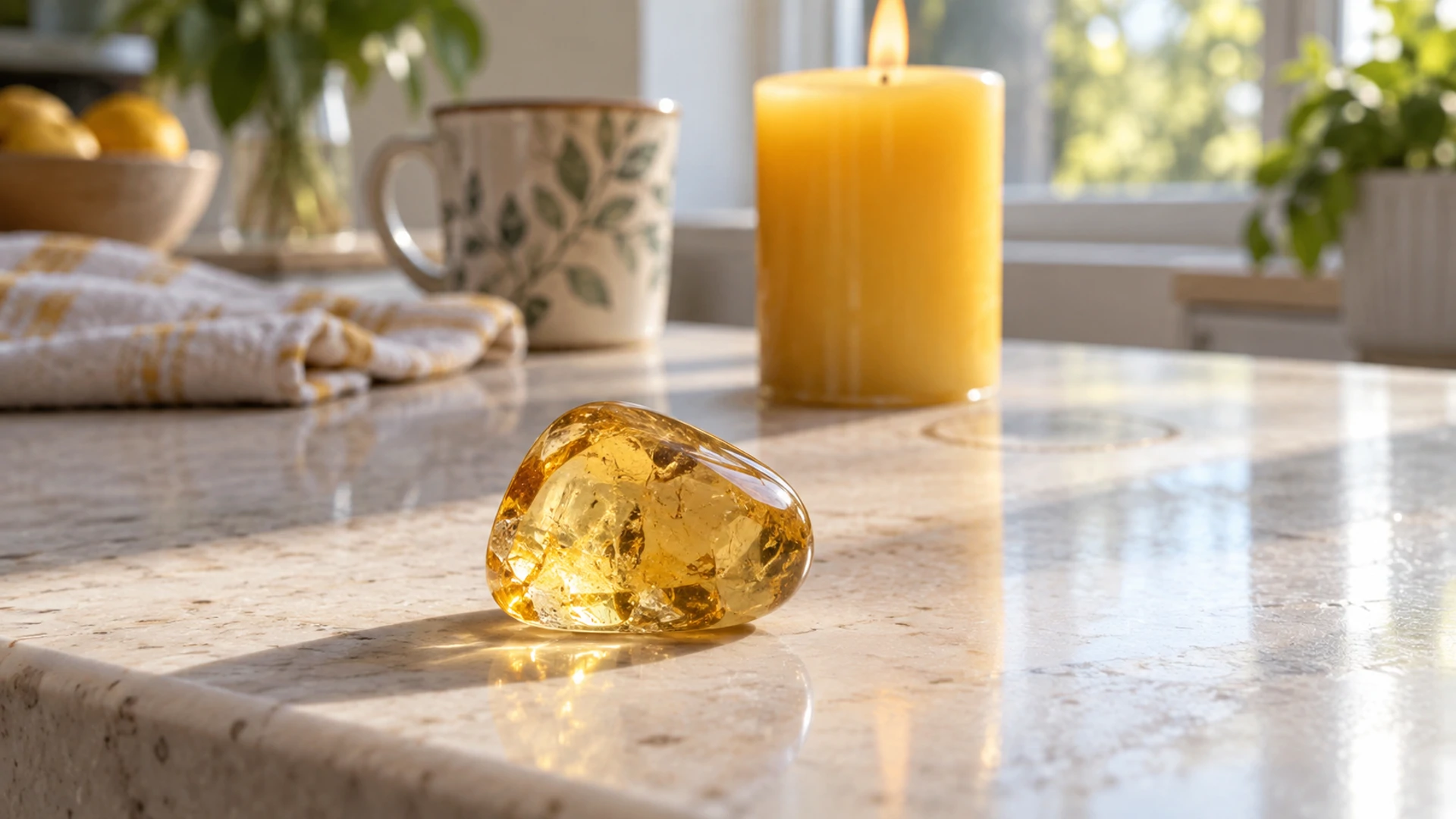
Yellow topaz is the abundance stone of ordinary life — not a dramatic windfall, not a prestige leap, but the steady, confident current of daily good fortune that makes everything else easier to build on.
The Everyday Gold: Why Yellow Topaz Belongs in Abundance
Yellow topaz sits squarely in the Abundance category, but the reason why matters more than the label. Its mechanism is everyday, accessible abundance — joy, confidence, and the common daily flow of good fortune. This is not a stone for grand, single-moment leaps. It works in ordinary time: the morning you wake up feeling capable, the conversation that goes better than expected, the pattern of small good things that compounds into something real. That quality is what makes it useful, and it's also what sets it apart from the two stones it gets most confused with.
Imperial Topaz is its rarer sibling in the same mineral family, and the distinction is real. Imperial Topaz's mechanism is rare, elevated wealth-consolidation — stepping into higher status and value, a prestige register rather than everyday flow. It's the stone for a significant threshold moment, a major professional ascent, or a consolidation of hard-won status. Yellow Topaz is not that. It operates at a more accessible register, which is precisely its value — you don't need to be at a turning point to use it. Day-to-day confidence and ordinary financial ease are worth having even when nothing dramatic is happening.
The other stone it's frequently confused with is citrine, and the confusion runs deeper than color. Both are golden yellow, both are associated with the solar plexus, and both appear on the same November birthstone lists. But citrine is a variety of quartz — silicon dioxide — while yellow topaz is an aluminum fluorosilicate, an entirely different mineral with different hardness, density, and crystal structure. Their magical mechanisms are also genuinely different. Citrine's is spontaneous manifestation: active, radiant generation of new wealth and opportunity through confidence and joy, not slow accumulation. Yellow Topaz works in a quieter register — not that sudden solar spark, but a sustained warmth that keeps the channel open day after day. The distinction isn't just mineralogical. It reflects a real difference in what each stone is best suited for.
Its correspondences are straightforward and internally consistent. The solar plexus chakra is its primary energy center — the seat of personal will, confidence, and the sense of one's own capacity to act in the world. The Sun is its ruling body, which connects it to vitality, visibility, and forward motion. Ancient Egyptian tradition associated the golden color of yellow topaz with Ra, the sun god, and is said to have used topaz-family stones in protective amulets — this is presented in the tradition as a solar-devotional connection, not a documented historical certainty. Roman tradition separately associated the stone with Jupiter, the planet of expansion and abundance, which layers a different quality onto the same golden hue: not just solar warmth but also Jovian increase. Yellow topaz is a traditional November birthstone, a designation it shares with citrine, and one of the oldest gemological classifications attached to it. These correspondences reinforce each other: Sun, solar plexus, November, Jupiter — all pointing toward the same register of confident, everyday generativity.
Where Yellow Ends and Imperial Begins: Choosing Yellow Topaz
Yellow topaz spans a wide color range, from pale lemon at one end to a deep, warm gold at the other. That matters practically because the deeper end of the yellow topaz range begins to overlap visually with Imperial Topaz's territory — and because the two are sometimes sold interchangeably at the high end of the market. The distinction isn't purely cosmetic. Imperial Topaz carries its own specific color designation (golden-orange to pinkish-orange, sometimes described as a champagne or sunset color) and commands significantly higher prices for fine natural material. If you're purchasing a deeply golden stone marketed simply as "yellow topaz," it's worth asking whether it might qualify as Imperial — not because one is magically superior, but because you want to know what you're actually working with.
The more common source of confusion is citrine. Because citrine is abundant, inexpensive, and shares a similar warm yellow palette, it's sometimes sold under misleading names — or buyers simply assume they're getting one when they receive the other. They are not the same stone. Topaz is denser and heavier than quartz. It has a different crystal habit, forming in orthorhombic rather than hexagonal crystals. And its hardness is genuinely higher — Mohs 8 versus quartz's Mohs 7. If you place a piece of yellow topaz and a piece of citrine side by side, the topaz will feel noticeably heavier for its size. That weight difference, combined with its different luster, is one of the fastest physical checks you can do without equipment.
It's also worth knowing that some yellow topaz on the market is irradiated or otherwise treated colorless topaz. This is a disclosed trade practice — legitimate sellers should identify treated material — but it's common enough to be worth asking about, especially at lower price points. Treated yellow topaz is not a fraud as long as it's disclosed; the treatment produces a stable, permanent color. Whether the treatment changes the stone's energetic quality is a matter of practice and personal experience. For work where provenance and natural formation feel important, asking for untreated material is reasonable.
Care is straightforward but requires one specific attention point. Yellow topaz is Mohs 8, which makes it genuinely hard — harder than most crystals you'll handle, and durable enough for daily wear as jewelry. However, it has perfect cleavage in one direction. This means that despite its surface hardness, a direct blow at the right angle can cause it to split cleanly along that cleavage plane. It won't scratch easily, but it can chip or fracture if struck sharply, particularly on a corner or edge. Store it separately from other hard stones to avoid contact abrasion, and be cautious with rings or bracelets on the dominant hand where impact risk is higher. Brief water contact is safe. Avoid extreme heat, which can alter its color, and keep it out of prolonged direct sunlight for the same reason.
Three Practices for the Ordinary Flow of Fortune
The Daily Draw
Use this when you want to keep ordinary financial flow steady over time — not for a single event, but as a consistent background practice.
Each morning, before you reach for your phone or begin the day's tasks, hold your yellow topaz in your dominant hand for two to three minutes. You're not asking for anything specific. You're simply orienting your attention toward abundance as the baseline condition of the day — open, receptive, confident. Set it somewhere visible on your desk or near your work space for the rest of the day. If you work with a yellow candle on your altar, lighting it during this moment reinforces the solar current. The practice builds its effect through repetition rather than intensity — consistency is the whole point.
The Sunlit Confidence
Use this before an everyday moment that requires confident financial action — a routine negotiation, a modest ask, a pricing conversation, any situation where you need your confidence to show up cleanly.
In the hour before the moment, hold yellow topaz against your solar plexus for five minutes. Breathe steadily and let your attention rest on the stone's warmth rather than the outcome you want. The solar plexus is the seat of personal authority, and this is not a working about a specific result — it's about your capacity to act from that seat without apology or hesitation. If you can time this during a Sun planetary hour, the alignment sharpens the practice. Carry the stone in your pocket through the moment itself, and return it to a prominent place afterward as a reminder that the action was taken.
The Warm Ledger
Use this as a weekly or daily closing practice for noticing and reinforcing the abundance already present — not what you want more of, but what is already flowing.
At the end of the day or week, sit with your yellow topaz in your non-dominant hand and a journal open in front of you. Write down three to five specific instances of ordinary good fortune from the period — a bill that was smaller than expected, a connection that came through, a task that went smoothly, a meal that felt like enough. These don't need to be significant. The practice trains your attention to track what is already arriving, which is the foundation of any genuine abundance orientation. Cinnamon, a solar herb with its own abundance correspondences, can be burned or kept nearby during this practice to deepen the sensory anchor. Close by holding the stone briefly at the solar plexus before setting it down — a small physical acknowledgment that closes the working.
A Name Shared With an Island, Maybe Two Ways
The word "topaz" has a genuinely disputed origin, and that uncertainty is worth sitting with rather than papering over. One account traces it to Topazios, the ancient Greek name for an island in the Red Sea — now called St. John's Island, or Zabargad — where a greenish stone was mined in antiquity. The stone mined there was most likely peridot, not what we now call topaz, which makes the etymological thread a little loose at its historical end. The other account traces the name to the Sanskrit word "tapas," meaning heat or fire — a reading that connects naturally to the stone's warm golden color and its long solar associations. Both accounts are plausible. Neither is settled. The honest answer is that the name carries two possible origins and the truth is probably somewhere in that uncertainty.
What does carry across time, in tradition if not in documented historical record, is the solar connection. Ancient Egyptian practice is said to have associated golden stones with Ra, tying yellow topaz-family material to solar protection and divine favor. Roman tradition placed it under Jupiter — a separate lineage with its own quality of expansion and worldly increase. These aren't competing accounts so much as two different cultural lenses landing on the same stone. The color is the constant: warm, golden, lit from within — the color of the sun at the hour before it sets, when everything it touches looks like it's already arrived.
Abundance You Don't Have to Wait to Afford
Yellow topaz is one of the more accessible stones in the Abundance cluster, both in price and in how it works. Its mechanism — everyday, accessible abundance through joy and daily confident action — doesn't require a dramatic life event to activate. You can pick it up on an ordinary Tuesday and begin working with it on an ordinary Wednesday. That accessibility is part of what it is, not a lesser version of what Imperial Topaz does. They are different stones for different moments, even though they share a name and a mineral family.
If you want to see how yellow topaz fits alongside the other stones in its category — and across the six other categories of stone magic — The Crystal Compendium: Seven Paths to Stone Magic is the place to go. The full map is there.