Amazonite: Courage That Sounds Like Honesty
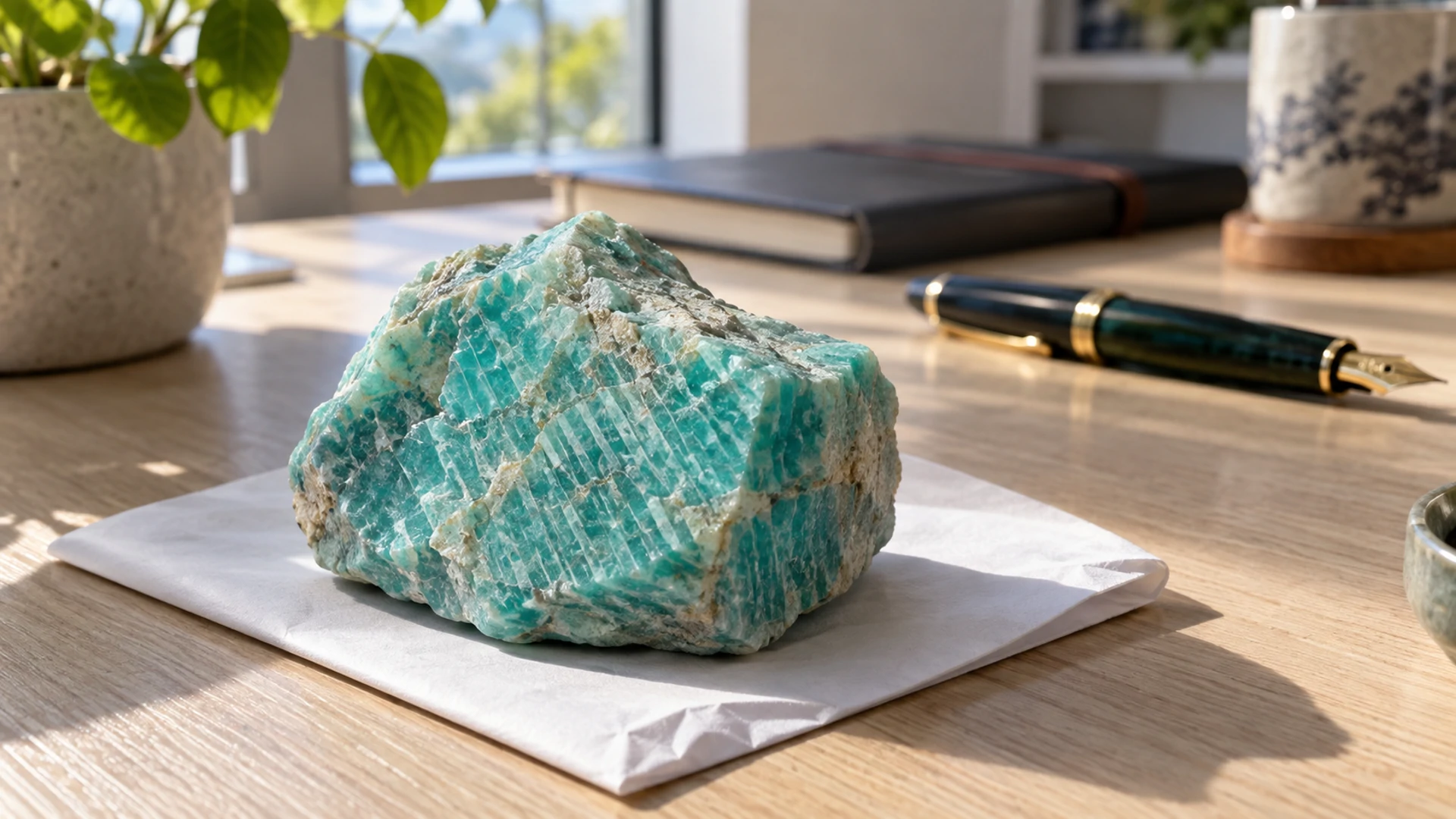
Amazonite is a turquoise-green microcline feldspar whose core quality is verbal courage: the willingness to say true things plainly, hold a boundary when it's tested, and stay honest under social pressure to soften.
It sits in a category of stones typically associated with fire, physical stamina, and bold decisive action — and it earns its place there through a completely different mechanism. Most empowerment stones want to move you through the world more forcefully. Amazonite wants to make sure you say what you actually mean when you get there. That distinction matters, and it's worth tracing through everything the stone does before you pick it up and assume it works the same way as the other stones on that shelf.
Courage That Sounds Like Honesty: Why Amazonite Belongs in Empowerment
The empowerment category in crystal work is dominated by fire-element stones — red, orange, and gold minerals associated with Mars, the Sun, physical vitality, and bold action. Carnelian drives immediate activation, sparking decisive action through the sacral chakra. Tiger's Eye builds strategic focus under pressure, grounding discernment rather than raw courage. These are warrior stones in the most literal sense of that framing.
Amazonite is not a warrior stone. Its color is turquoise-green, its dominant elements are water and earth, and it activates the heart and throat chakras rather than the root or sacral. Its courage is communicative, not kinetic. What it builds is the capacity to state something honestly when dishonesty would be easier, to say "no" when a relationship or a workplace has trained you to say "yes," and to stand by what you said when someone pushes back hard enough that backing down starts to feel like the reasonable option. That is a real form of empowerment. It's just a rarer one in this category.
The throat chakra association is the spine of how this stone is understood to work. Throat-chakra work in crystal practice concerns authentic expression, particularly in situations where something true is being suppressed or softened to keep the peace. The heart chakra connection sits just below that: the reason people suppress honest communication is often relational — fear of rejection, fear of conflict, fear of the emotional cost of being fully honest. Amazonite addresses both. It doesn't just loosen the throat; it gives the heart enough steadiness to let the throat speak.
Its planetary ruler is a genuinely disputed point across sources. Uranus, Mercury, and Venus all appear with real frequency depending on which tradition you're drawing from, and none of them has an overwhelming consensus behind it. Mercury governs communication and makes a clean thematic fit. Venus governs relationships and the heart, which maps to the stone's relational honesty work. Uranus governs disruption and originality, which resonates with the kind of truth-telling that breaks an established but dishonest pattern. Rather than choosing one and presenting it as settled fact, it's more useful to know that the planetary correspondence here is genuinely unsettled — and that any of the three gives you a workable framing depending on what you're working toward.
There's a secondary quality to Amazonite that's worth naming plainly: it carries a real thread of Abundance energy alongside its primary empowerment function. This isn't a stretch or a marketing claim. The confidence to state your worth clearly, to negotiate without apology, and to ask directly for what you're owed is precisely the same quality that amazonite builds for emotional boundaries — it's just applied to material or professional stakes instead. Ancient Egyptian carvers included it among tomb treasures. More practically, it appears in the "gambler's stone" description that follows this mineral across several traditions. The Abundance thread is secondary, but it's genuinely supported, and the two qualities reinforce each other rather than competing.
Lead Content and Care: Choosing Amazonite
The first thing to know about amazonite before you work with it is that its color comes partly from lead within its crystal structure. This is a real, material fact — not an abundance-of-caution disclaimer — and it means amazonite should never be used to make gem elixirs or infused water, regardless of whether the stone is polished or raw. Unlike some stones where the elixir caution is precautionary, here it's chemical. Lead leaches into water. Do not make infused water with this stone, full stop.
For external handling, amazonite is safe to work with normally. Its Mohs hardness sits at 6 to 6.5, which puts it in the durable-but-not-tough range. It can handle brief contact with water without damage, so rinsing it for cleansing purposes is fine as long as you're not submerging it or leaving it in prolonged contact with liquid. Keep it away from harsh chemical cleaners, which can dull its surface. Store it away from stones significantly harder than itself — anything in the 7-plus range on the Mohs scale can scratch its surface if they knock together in a drawer or bag.
When choosing a specimen, genuine amazonite has a turquoise to blue-green color that often shows fine white streaking from its intergrown albite feldspar. That white veining is not a flaw; it's characteristic of the material and one of the things that distinguishes it from look-alikes. The stone has a slightly waxy, characteristic feldspar luster — not glassy like quartz and not matte like dyed porous stones. Dyed howlite and magnesite are sometimes sold as amazonite, particularly at the lower price end of the market. These fakes tend to look more uniformly colored and have a more chalky or absorptive surface. If you hold a piece and the color looks completely even with no albite threading and the surface feels slightly porous, that's worth questioning.
The most common form available is tumbled, which is practical for carrying. Raw or rough specimens typically show the blade-like cleavage surfaces characteristic of feldspar — they can chip or split along those planes with impact, so they're better suited to altar display than to pockets or bags. Carved pieces and cabochons in jewelry settings are widely available and give you ongoing contact with the stone through the day, which suits the stone's function: the work it's associated with is verbal and relational, and those situations happen continuously rather than in a dedicated ritual window.
Three Practices for Speaking Without Flinching
The Unflinching Word
Use this practice when you have something honest to say that you've been softening, delaying, or avoiding saying in full.
Hold your amazonite at the throat. Take a slow breath in through the nose and exhale through the mouth. State what you actually mean out loud, in the quietest possible setting, to no one — just to hear yourself say the full truth without softening it. Say it again. The point is not to rehearse a speech; it's to feel the sentence leave your body without you pulling it back. You can light a blue candle to anchor the throat-chakra work, or burn a small amount of lavender for clarity without sedation. When the sentence comes out clean — without a softening clause, without "I mean, it's probably fine, but..." — the practice is complete. Carry the stone with you when you have the actual conversation.
The Boundary Spoken
Use this practice when a boundary has already been set but is being ignored, tested, or walked back by someone else — or when you need to state one clearly for the first time.
Place your amazonite on a flat surface in front of you. Write the boundary down on paper in one sentence. Not a paragraph — one sentence, plain language. Read it out loud three times without changing the wording between readings. The repetition matters: a boundary that shifts every time it's restated isn't a boundary yet. If you work during a Mercury hour, the timing aligns with the stone's communicative thread and can give the working additional structure. After the third reading, fold the paper and place the stone on top of it overnight. In the morning, carry the stone. The paper can be kept or burned — what matters is that the sentence is now inside your body as well as on the page.
The Held Ground
Use this practice when you've stated a position clearly and are now facing sustained social pressure — from one person or from a group — to back down, soften, or agree with something you don't actually agree with.
Before entering the situation where you expect that pressure, hold your amazonite in your non-dominant hand. Feel its weight. Press it firmly enough that you're aware of the contact without gripping. Take three slow breaths and say internally, once: "What I said is what I meant." Put the stone in your pocket and enter the room. The stone's function here is not to make you right — it's to keep your nervous system steady enough that you can remain honest rather than appeasing. You're not reaching for carnelian's spark of bold action here; you're not trying to escalate. You're staying still and staying honest. That's a different kind of strength, and it often requires more sustained effort than a single bold move.
Named for a River It Never Touched
In 1847, the German mineralogist August Breithaupt named this stone "amazonite" under the belief that it had been sourced near the Amazon River. The problem: no amazonite deposit has ever actually been confirmed in that region. The name is one of the more clearly documented errors in mineralogical naming history — the stone had almost certainly come from deposits in Russia or elsewhere, and the Amazon connection was simply wrong. The name stuck anyway, the way incorrect names often do once they enter the literature and the trade. Breithaupt was a significant figure in 19th-century mineralogy, which meant the name carried enough authority that it wasn't quietly corrected. Amazonite is a microcline feldspar that has never had a confirmed Amazon River source, named for a place it apparently never was.
The stone's actual documented history runs much further back than that naming error. When Howard Carter excavated Tutankhamun's tomb in 1922, amazonite was among the materials found in the burial treasures — including a scarab ring carved from the stone. This places amazonite in active use in ancient Egypt well over three thousand years ago, long before any 19th-century European naturalist was thinking about it. Egyptian funerary use of semiprecious stones was deliberate, not decorative: each material included in a royal burial carried specific significance. Amazonite's presence in Tutankhamun's tomb suggests a meaningful valuation of the stone in that cultural context, though the specifics of what it signified to the craftspeople who carved it aren't fully documented.
What those two facts together give you is a stone with a genuine ancient history and an invented modern name, which is a more honest account of amazonite's biography than the "ancient stone of the Amazon warriors" framing that sometimes gets attached to it. The Amazonian warrior narrative makes a certain mythological sense given the name, but it has no archaeological basis. The Egyptian scarab ring does. Work with what's actually there.
Empowerment Through the Truth You Speak
Amazonite's particular kind of empowerment — verbal courage, honest communication, the willingness to hold ground when pressure builds to back down — sits at a different angle from most of the stones in its category. It doesn't ask you to act more boldly or move more decisively. It asks you to say what you actually mean and then not immediately unsay it. For many people in many situations, that takes more sustained effort than a decisive move. The courage to stay honest through a difficult conversation, to restate a boundary clearly when someone ignores it, to let a true sentence land without softening it into something more comfortable — that's real, and it's a form of empowerment that matters.
If you want to see how amazonite sits alongside the other empowerment stones, and how the empowerment category relates to the other six paths in crystal work — protection, cleansing, healing, abundance, love, and intuition — The Crystal Compendium: Seven Paths to Stone Magic is the place to start.